
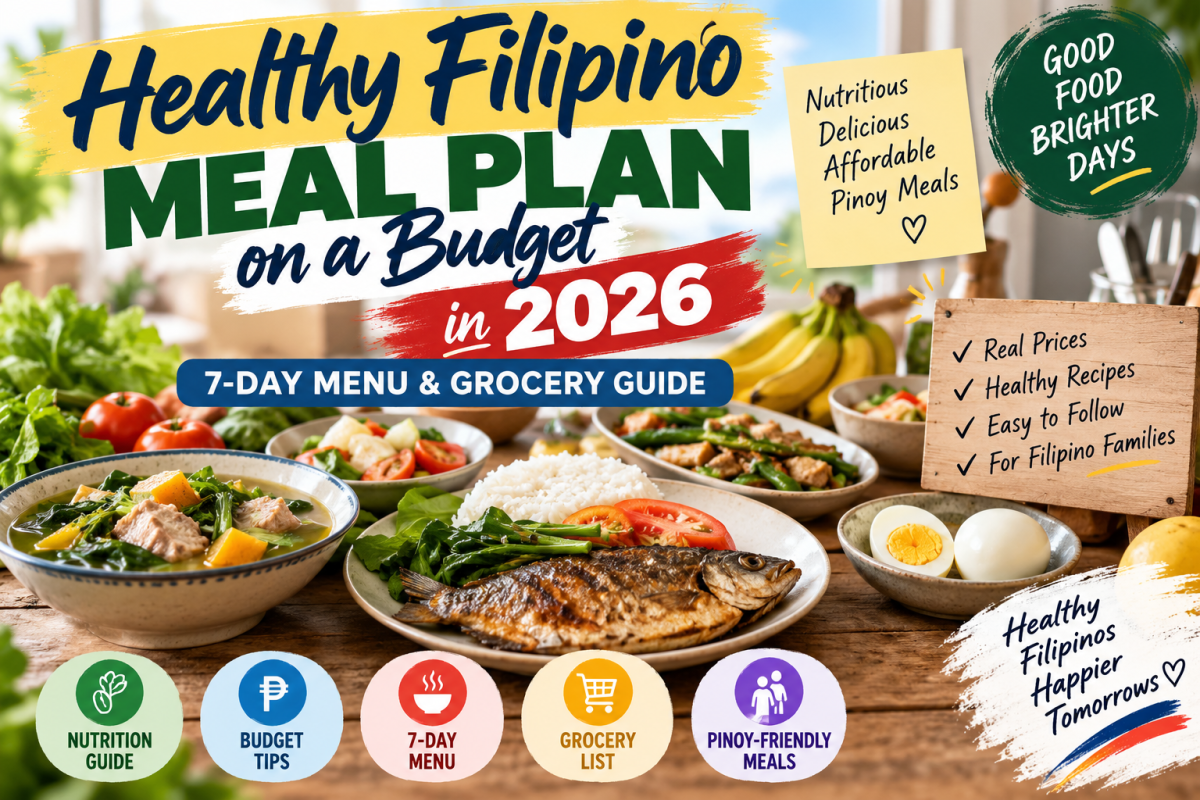
Filipino meal plan on a budget can make healthy home cooking more practical without relying on expensive ingredients or complicated diet products. By combining familiar staples such as rice, eggs, monggo, tofu, local fish, chicken, vegetables and seasonal fruit, Filipino households can create balanced meals while keeping grocery spending under control. This 2026 guide provides a practical 7-day menu, grocery list, cost-planning method and nutrition framework based on Philippine nutrition guidance and current government price references.
Eating healthy in the Philippines does not have to mean spending a large portion of your income on imported health foods, expensive supplements, premium meat or complicated diet products.
A practical Filipino meal plan can be built around familiar foods such as rice, eggs, monggo, tofu, chicken, local fish, vegetables and seasonal fruit. The bigger challenge is creating a system that balances nutrition, affordability, convenience and food waste.
This guide presents a practical seven-day meal plan for a generally healthy adult who prepares most meals at home. It also explains how the estimated costs were calculated, how to create a weekly grocery list, how to substitute ingredients when prices change, and how to distinguish the amount of food consumed from the amount actually paid at the checkout.
The nutritional framework is based on Philippine nutrition guidance, particularly Pinggang Pinoy and the Nutritional Guidelines for Filipinos. The National Nutrition Council describes Pinggang Pinoy as a practical plate guide emphasizing vegetables and fruits, rice and other carbohydrate-rich foods, and protein-rich “Grow” foods. (National Nutrition Council)
The budget component uses official Philippine Statistics Authority price information where applicable. Because food prices differ between regions, markets, stores and dates, the figures in this article should be treated as reference calculations rather than guaranteed grocery prices.
For a Davao Region reference, the Philippine Statistics Authority’s second-phase August 2026 price situationer reported average retail prices of ₱54.22 per kilogram for regular-milled rice, ₱223.75/kg for bangus, ₱94.33/kg for tomatoes, ₱66/kg for Lakatan bananas and ₱192.88/liter for cooking oil. (Philippine Statistics Authority – Davao Region)
Nationally, the PSA reported food inflation of 4.6% in August 2026, demonstrating why a meal plan published in one year should not simply rely on old grocery-price articles. (Philippine Statistics Authority)
Who This Meal Plan Is Designed For
This guide is intended primarily for:
- Generally healthy adults
- Filipinos cooking most meals at home
- Individuals trying to control grocery spending
- Households looking for simple Filipino meal ideas
- Readers who want a flexible seven-day menu rather than a strict diet
It is not an individualized medical diet.
People with diabetes, kidney disease, food allergies, eating disorders, hypertension requiring dietary management, pregnancy-related nutritional needs or other medical conditions may need different portions, nutrient targets or food restrictions.
Children and older adults may also have different nutritional requirements.
For those situations, a physician or registered nutritionist-dietitian can provide individualized advice.
Why a Filipino Meal Plan Can Be Healthy and Affordable
Healthy eating does not require abandoning traditional Filipino foods.
In fact, many familiar Filipino ingredients can form the foundation of balanced meals.
Examples include:
- Rice
- Eggs
- Monggo
- Tofu
- Bangus
- Galunggong
- Tilapia
- Chicken
- Pechay
- Kangkong
- Malunggay
- Sayote
- Squash
- Eggplant
- Cabbage
- Banana
- Papaya
- Kamote
The key is how these foods are combined.
For example:
Rice + grilled fish + pechay + banana
provides a carbohydrate source, protein-rich food, vegetables and fruit.
Another practical combination is:
Rice + monggo + malunggay + egg
which uses inexpensive ingredients that can be prepared in batches.
A healthy meal plan is therefore less about finding one “superfood” and more about consistently creating meals with variety and reasonable portions.
The Philippine Nutrition Framework Behind This Guide
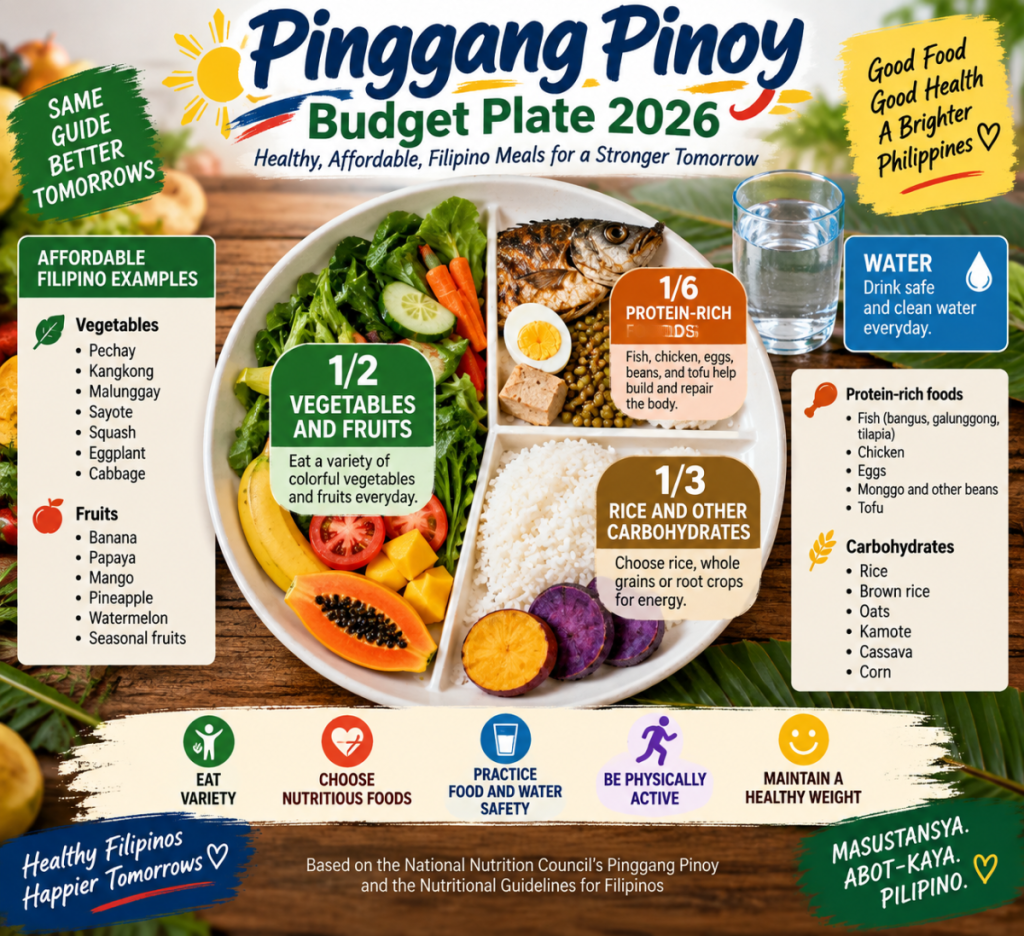
The National Nutrition Council’s Pinggang Pinoy provides a visual approach to building Filipino meals.
The general plate concept emphasizes:
- Vegetables and fruits occupying about half of the plate
- Rice and other carbohydrate-rich foods occupying about one-third
- Protein-rich foods occupying about one-sixth
This is a practical visual guide rather than a prescription requiring every person to eat identical quantities. Individual energy and nutrient requirements vary. (National Nutrition Council)
The NNC’s 10 Kumainments also emphasizes dietary variety, eating vegetables and fruits regularly, including protein-rich foods, observing food and water safety, limiting excessive sugar, salt and fat, maintaining an appropriate body weight and staying physically active. (National Nutrition Council)
This is why the meal plan in this article does not focus only on calories.
It also considers:
- Food variety
- Protein sources
- Vegetables
- Fruit
- Portion awareness
- Food safety
- Affordability
- Practical preparation
- Food waste
How BuzzPH Built This Meal Plan
This meal plan was developed using a combination of Philippine nutrition guidance, current government price references and editorial calculations.
The process was:
1. Establish the nutrition framework.
Pinggang Pinoy and Philippine nutrition guidance were used as the foundation for meal composition.
2. Select commonly available Filipino foods.
The menu prioritizes ingredients that can commonly be found in supermarkets, public markets and neighborhood stores.
3. Check official price references.
PSA data were used where directly comparable commodity prices were available.
4. Convert reference prices into usable quantities.
For example, a kilogram price can be converted into the estimated cost of 100 or 150 grams.
5. Build meals using reusable ingredients.
The same ingredients are intentionally used across multiple meals to reduce waste.
6. Add substitutions.
Readers can replace an expensive ingredient with another affordable food that serves a similar role in the meal.
7. Separate consumption cost from purchase cost.
The amount of food consumed during a week is not necessarily the same as the amount paid at checkout.
This methodology makes the article a planning framework rather than a copied meal schedule.
Why Food Prices Matter in 2026
A meal plan based on outdated prices can quickly become misleading.
The PSA reported national food inflation of 4.6% in August 2026. (Philippine Statistics Authority)
Regional prices can also differ considerably.
For example, the PSA’s Davao Region second-phase August 2026 data reported:
| Selected food or ingredient | Davao Region reference price |
|---|---|
| Regular-milled rice | ₱54.22/kg |
| Bangus | ₱223.75/kg |
| Tomato | ₱94.33/kg |
| Lakatan banana | ₱66.00/kg |
| Cooking oil | ₱192.88/liter |
These are regional average retail prices for the specified reporting period, not guaranteed prices at every market. (Philippine Statistics Authority – Davao Region)
The same PSA report also demonstrates why consumers should remain flexible. Commodity prices can change even within relatively short periods.
How to Calculate the Cost of a Meal
The basic formula is:
Quantity used × price per unit = ingredient cost
For example, if regular-milled rice is ₱54.22/kg:
100 grams = 0.1 kg
Therefore:
0.1 × ₱54.22 = ₱5.42
For bangus at ₱223.75/kg:
150 grams = 0.15 kg
Therefore:
0.15 × ₱223.75 = ₱33.56
For tomatoes at ₱94.33/kg:
50 grams = 0.05 kg
Therefore:
0.05 × ₱94.33 = ₱4.72
For Lakatan banana at ₱66/kg:
150 grams = 0.15 kg
Therefore:
0.15 × ₱66 = ₱9.90
The four ingredients would therefore have a reference subtotal of:
₱5.42 + ₱33.56 + ₱4.72 + ₱9.90 = ₱53.60
This example is not a promise that the meal will cost exactly ₱53.60. Actual edible portions, trimming, cooking losses, package sizes and local prices can change the result.
The purpose is to demonstrate a reproducible calculation method.
Purchase Cost Versus Consumption Cost
This distinction is important when creating a weekly grocery budget.
Suppose your meal plan uses approximately 250 ml of cooking oil.
The Davao Region reference price is ₱192.88 per liter.
The theoretical consumption cost would be:
0.25 × ₱192.88 = ₱48.22
But the store may sell the oil in a 500 ml or 1-liter bottle.
You may therefore pay considerably more at checkout than the amount attributed to the week’s meals.
The same principle applies to:
- Rice
- Oats
- Monggo
- Cooking oil
- Soy sauce
- Vinegar
- Garlic
- Onions
- Seasonings
A useful household budget should therefore track two numbers:
Food consumed during the week
and
Cash actually spent on groceries.
Seven-Day Healthy Filipino Meal Plan
The following menu is a practical template rather than an individualized prescription.
The rice portions are reference portions for planning. People with different energy requirements may need more or less food.
Water is the default beverage throughout the week.
Day 1 — Chicken Tinola and Bangus
Breakfast
- 2 eggs
- 1 cup cooked rice
- Tomato
- 1 small banana
Lunch
- Chicken tinola
- Sayote
- Leafy vegetables
- 1 cup cooked rice
- Papaya
Dinner
- Grilled bangus
- Ginisang pechay
- 1 cup cooked rice
Planning cost: approximately ₱250–₱300
The amount depends heavily on the portion of chicken and fish purchased.
Day 2 — Monggo and Local Fish
Breakfast
- Oatmeal
- Banana
- 1 boiled egg
Lunch
- Monggo with malunggay
- Local fish
- 1 cup cooked rice
Dinner
- Grilled fish
- Cabbage and carrots
- 1 cup cooked rice
- Seasonal fruit
Planning cost: approximately ₱220–₱290
Cooking monggo in a larger batch can reduce the effective cost per serving.
Day 3 — Chicken and Tofu
Breakfast
- Two-egg tomato-and-onion omelet
- 1 cup cooked rice
- Banana
Lunch
- Chicken adobo
- Sautéed vegetables
- 1 cup cooked rice
Dinner
- Tofu and mixed vegetables
- 1 cup cooked rice
- Seasonal fruit
Planning cost: approximately ₱220–₱290
Tofu provides an additional protein option without requiring meat at every meal.
Day 4 — Fish and Pinakbet-Style Vegetables
Breakfast
- 2 boiled eggs
- Kamote
- Banana
Lunch
- Grilled local fish
- Pinakbet-style vegetables
- 1 cup cooked rice
Dinner
- Sardines with tomato, onion and vegetables
- 1 cup cooked rice
- Papaya
Planning cost: approximately ₱220–₱285
Choose the fish variety based on what is reasonably priced and available in your area.
Day 5 — Chicken and Monggo
Breakfast
- Oatmeal
- Banana
- 1 boiled egg
Lunch
- Chicken with vegetables
- 1 cup cooked rice
- Seasonal fruit
Dinner
- Monggo with malunggay
- Tofu
- 1 cup cooked rice
- Tomato and cucumber
Planning cost: approximately ₱220–₱290
This day demonstrates how legumes and tofu can reduce dependence on meat while maintaining meal variety.
Day 6 — Market-Based Menu
Breakfast
- Vegetable omelet
- 1 cup cooked rice
- Banana
Lunch
- Locally available grilled fish
- Ginisang sayote
- 1 cup cooked rice
- Seasonal fruit
Dinner
- Chicken vegetable soup
- 1 cup cooked rice
- Papaya
Planning cost: approximately ₱230–₱300
The flexible design allows the shopper to choose the vegetables and fish that offer better value that week.
Day 7 — Leftover and Meal-Prep Day
Breakfast
- Oatmeal
- Banana
- 1 boiled egg
Lunch
- Leftover chicken or fish
- Mixed vegetables
- 1 cup cooked rice
Dinner
- Tofu and vegetable stir-fry
- 1 cup cooked rice
- Seasonal fruit
Planning cost: approximately ₱190–₱260
The final day deliberately uses leftovers so the household does not need to purchase another completely separate set of ingredients.
Seven-Day Meal Cost Worksheet
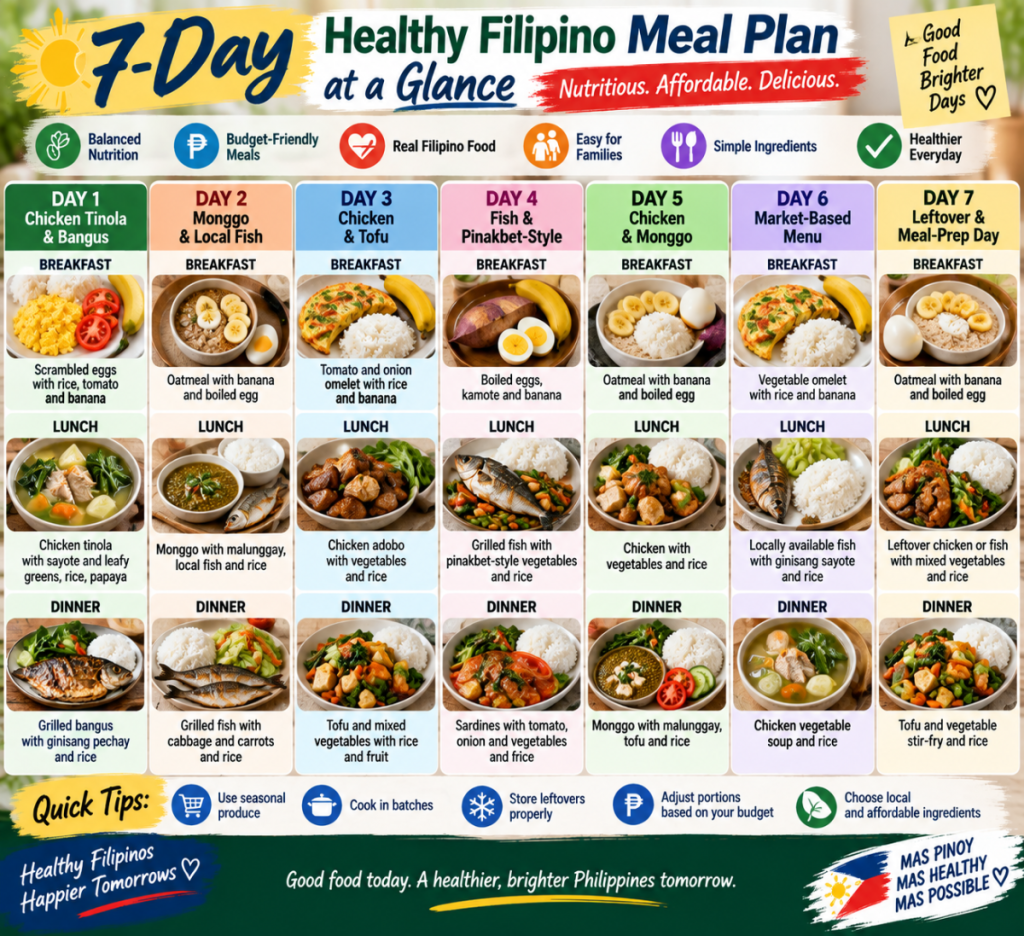
The ranges above are planning estimates. A more useful approach is to calculate the individual meals using your own market prices.
A household can use a worksheet like this:
| Day | Breakfast | Lunch | Dinner | Daily target |
|---|---|---|---|---|
| 1 | ₱XX | ₱XX | ₱XX | ₱250–₱300 |
| 2 | ₱XX | ₱XX | ₱XX | ₱220–₱290 |
| 3 | ₱XX | ₱XX | ₱XX | ₱220–₱290 |
| 4 | ₱XX | ₱XX | ₱XX | ₱220–₱285 |
| 5 | ₱XX | ₱XX | ₱XX | ₱220–₱290 |
| 6 | ₱XX | ₱XX | ₱XX | ₱230–₱300 |
| 7 | ₱XX | ₱XX | ₱XX | ₱190–₱260 |
The reason for retaining a range rather than manufacturing an exact peso amount is that not every ingredient has a directly comparable official price in the selected PSA data.
This is an important editorial distinction:
Official price: sourced from PSA.
Calculated cost: mathematical conversion of an official reference price.
Planning estimate: an editorial estimate where exact local pricing cannot be established from the cited official data.
Readers should not confuse these three categories.
What a ₱1,800–₱2,500 Weekly Budget Can Mean
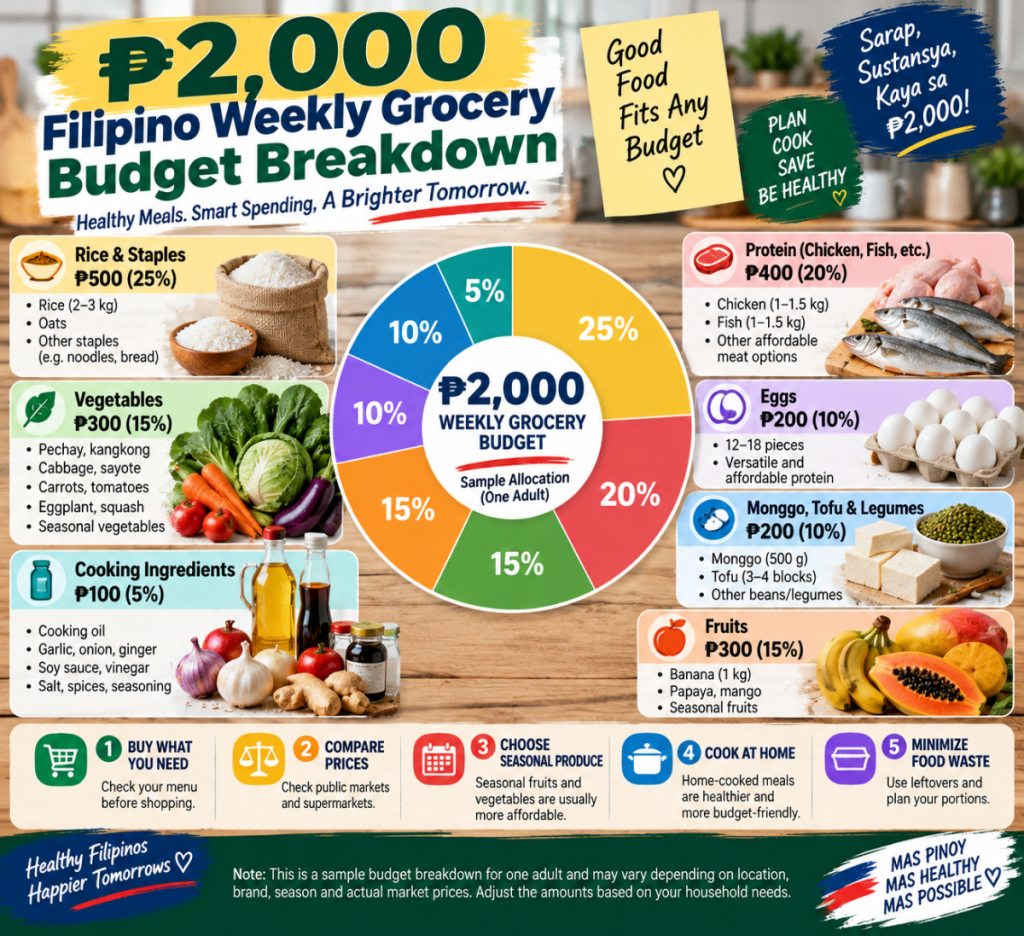
For one adult who cooks most meals at home, a planning budget of approximately ₱1,800–₱2,500 per week can provide room for a menu based on rice, eggs, legumes, fish, chicken, vegetables and fruit.
That is approximately:
₱257–₱357 per day.
However, this is not an official Philippine recommended food budget.
Actual spending depends on:
- Location
- Household size
- Portion requirements
- Market versus supermarket
- Brand choices
- Seasonal availability
- Meat and fish prices
- Existing pantry supplies
- Food waste
- Dining out
A reader in one municipality may spend less or more than someone following exactly the same menu elsewhere.
Sample Grocery List for One Adult
A practical weekly grocery list could include:
| Ingredient | Suggested purchase | Primary use |
|---|---|---|
| Rice | 2–3 kg | Main carbohydrate |
| Eggs | 12–18 pieces | Breakfast/protein |
| Chicken | 1–1.5 kg | Main protein |
| Local fish | 1–1.5 kg | Main protein |
| Tofu | 3–4 blocks | Protein |
| Monggo | 500 g | Legume/protein |
| Oats | 500 g | Breakfast |
| Pechay/kangkong | 2–3 bunches | Vegetables |
| Cabbage | 1 head | Vegetables |
| Sayote | 4–6 pieces | Vegetables |
| Tomatoes | About 500 g | Vegetable/flavor |
| Carrots | About 500 g | Vegetables |
| Bananas | About 1 kg | Fruit |
| Papaya/seasonal fruit | 1–2 pieces | Fruit |
| Onion | About 500 g | Cooking |
| Garlic | Small pack | Cooking |
| Ginger | Small amount | Cooking |
| Cooking oil | 250–500 ml | Cooking |
These quantities are starting points.
The actual amount should be adjusted according to your portions and what you already have at home.
Grocery Purchase Versus Estimated Weekly Use
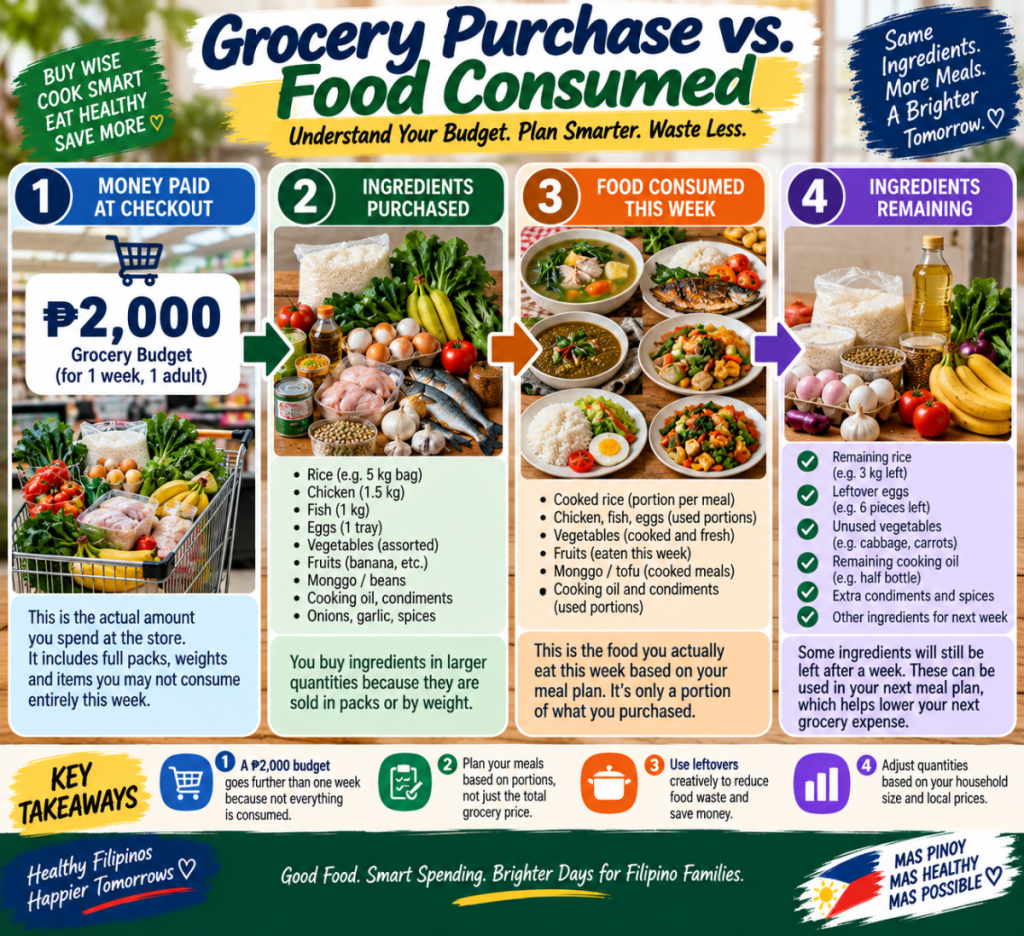
This is where a meal plan becomes more practical.
| Ingredient | Example purchase | Approximate weekly use | What happens to the remainder? |
|---|---|---|---|
| Rice | 3 kg | 2–3 kg | Pantry stock |
| Eggs | 18 | 12–15 | Remaining eggs can carry into next week |
| Monggo | 500 g | 250–350 g | Remaining amount stored dry |
| Chicken | 1.5 kg | About 1.0–1.3 kg | Freeze remaining portion |
| Fish | 1.5 kg | About 1.0–1.2 kg | Freeze remaining portion |
| Cooking oil | 500 ml | About 200–300 ml | Remaining amount carries forward |
This illustrates why a weekly grocery bill should not be compared directly with the calculated cost of food consumed.
A household can spend ₱2,000 during a shopping trip and still have ingredients remaining for the following week.
How to Reduce the Cost Without Reducing Food Quality
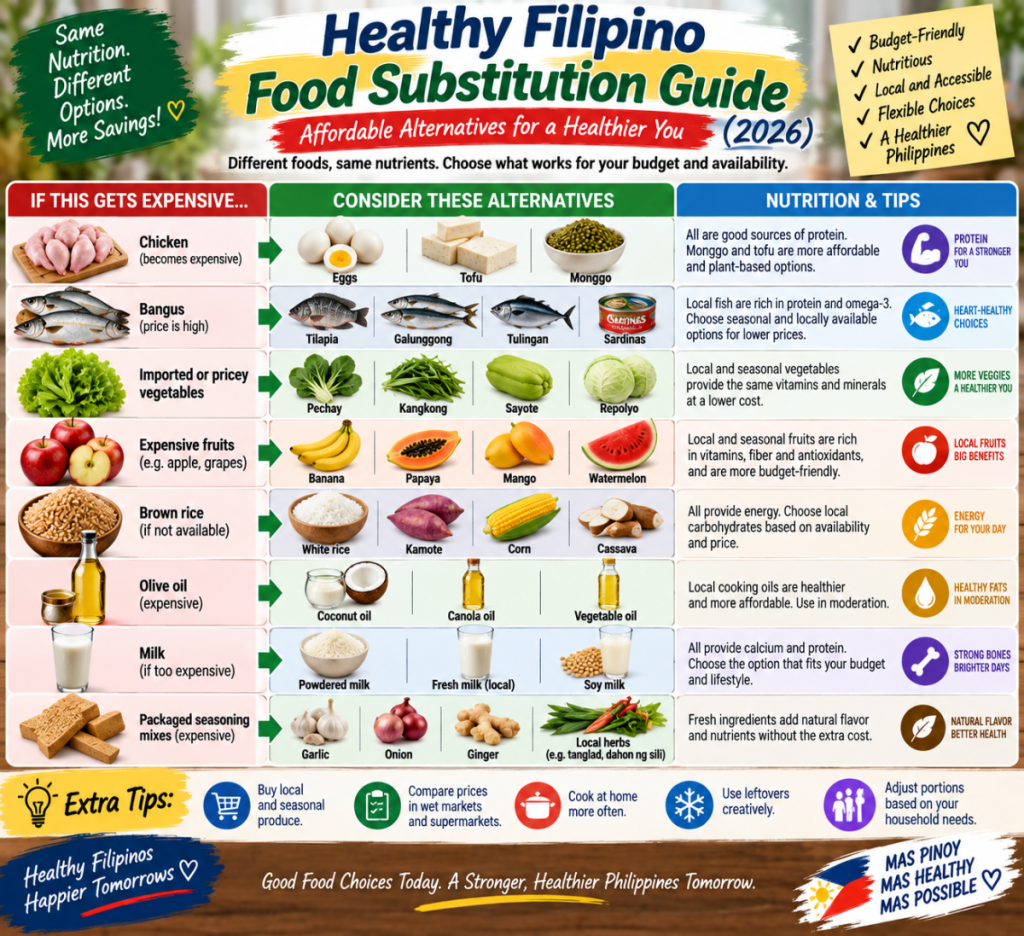
When prices increase, start with substitutions rather than eliminating entire food groups.
If chicken becomes expensive:
Try eggs, tofu, monggo or affordable fish.
If bangus becomes expensive:
Compare galunggong, tilapia or other locally available fish.
If one vegetable becomes expensive:
Choose another seasonal vegetable.
If fruit prices rise:
Compare several locally available seasonal options.
The goal is not to preserve the exact menu.
The goal is to preserve the meal structure.
Affordable Protein Rotation
A useful weekly strategy is to rotate protein sources.
For example:
Eggs → chicken → fish → monggo → tofu → fish → eggs/tofu
This can help prevent the grocery budget from becoming overly dependent on one expensive protein.
The NNC’s nutrition guidance supports including a variety of protein-rich foods such as fish, lean meat, poultry, eggs and beans. (National Nutrition Council)
Why Monggo Is Useful for Budget Meal Planning
Monggo is particularly practical because it can be prepared as a larger batch and combined with vegetables and other ingredients.
A batch can provide multiple servings.
Adding vegetables such as malunggay can also increase the variety of the meal.
The important point is not to describe monggo as a magical food. It is simply a versatile, familiar and potentially economical ingredient that works well in Filipino cooking.
Why Eggs Are Useful for a Budget Meal Plan
Eggs are convenient because they can be:
- Boiled
- Scrambled
- Added to vegetables
- Used in omelets
- Combined with rice
- Included in quick breakfasts
They also require relatively little preparation time.
However, no single food needs to appear at every meal. Variety remains important.
Don’t Automatically Remove Rice
Rice is an important Filipino staple and can remain part of a balanced meal.
Pinggang Pinoy includes rice and other carbohydrate-rich foods as one component of the Filipino plate. (National Nutrition Council)
The more useful question is how much food an individual needs overall and what accompanies the rice.
Compare:
Large serving of rice alone
with:
Appropriate rice portion + fish + vegetables + fruit.
The second meal provides greater variety.
This article therefore does not promote eliminating rice simply because it is a carbohydrate.
Is Brown Rice Required?
No.
Brown rice can be included if you enjoy it and it fits your budget.
But it is not necessary to purchase brown rice to follow the general Pinggang Pinoy approach.
For many Filipino households, the practical priority may be improving the overall composition of meals rather than replacing every serving of white rice.
How to Use Vegetables Without Wasting Them
Vegetables can become expensive if a household buys more than it can consume.
A better strategy is to combine short-lived and longer-lasting produce.
For example:
Use first:
- Leafy vegetables
- Ripe tomatoes
- Very ripe fruit
Use later:
- Cabbage
- Carrots
- Sayote
- Squash
- Other produce that stores longer under appropriate conditions
This simple ordering system can reduce waste.
Meal Preparation for Busy Filipino Households
Meal preparation does not have to mean spending an entire Sunday cooking 21 meals.
Instead, prepare building blocks.
For example:
Protein
Cook chicken or fish portions in advance.
Vegetables
Wash and prepare vegetables so they are ready to cook.
Breakfast
Boil eggs and portion oats.
Legumes
Cook monggo in a batch.
Rice
Prepare according to your household’s normal schedule and storage practices.
This makes it easier to assemble a meal when you’re tired or busy.
Food Safety Is Part of Healthy Eating
Nutrition is not the only consideration.
The NNC’s nutrition guidance also includes food and water safety. (National Nutrition Council)
When preparing meals:
- Keep raw and cooked food separate.
- Use clean preparation surfaces.
- Refrigerate perishable food appropriately.
- Avoid leaving cooked food at unsafe temperatures for prolonged periods.
- Reheat leftovers properly.
- Discard food when there is a reasonable concern that it has spoiled.
Saving ₱50 on food is not worth taking a food-safety risk.
How to Avoid Food Waste
Before shopping, check four areas:
Refrigerator
What needs to be eaten first?
Freezer
What meat or fish is already stored?
Pantry
Do you already have rice, oats, monggo, oil or seasonings?
Fruit and vegetable area
Which produce needs to be consumed soon?
Then buy only what is missing.
This simple habit can make a bigger difference to a household food budget than constantly searching for a slightly cheaper ingredient.
Five Rules for Staying Within a Weekly Food Budget
1. Shop with a menu.
Do not walk into the market without knowing what meals you intend to make.
2. Compare protein prices.
Fish, eggs, chicken, tofu and monggo can vary significantly in value.
3. Buy seasonal produce.
Use what is affordable and available.
4. Cook once, use twice.
Turn leftovers into another meal when food-safety practices allow.
5. Keep an ingredient substitution list.
A flexible menu survives price increases better than a rigid one.
What If Your Budget Is Only ₱1,500?
A ₱1,500 weekly food budget for one adult would be approximately ₱214 per day.
That is tighter and may require:
- More eggs
- More monggo
- More tofu
- More seasonal vegetables
- More careful fish selection
- Less expensive meat
- Fewer convenience foods
- Minimal food delivery
Existing pantry supplies can also make a large difference.
The objective should not be to force every household into the same number.
What If Your Budget Is ₱3,000?
A ₱3,000 weekly food budget provides more flexibility.
Rather than simply increasing meat portions, consider using the additional budget for:
- More vegetable variety
- More fruit
- Different fish
- Milk or yogurt if appropriate
- Nuts or seeds if desired and affordable
- Higher-quality ingredients that the household actually uses
A larger food budget does not automatically create a healthier diet.
Can This Meal Plan Help With Weight Management?
It can provide a balanced framework, but it is not an individualized weight-loss program.
Body-weight changes are influenced by overall energy intake, physical activity, body size, age, sex and other factors.
Two people can eat the same foods while needing different quantities.
For weight management, focus on the overall pattern rather than eliminating one food.
Can People With Diabetes Follow This Plan?
Not automatically.
People with diabetes may have individualized carbohydrate, medication, meal-timing and blood-glucose considerations.
A general online meal plan should not replace advice from a physician or registered nutritionist-dietitian.
The appropriate portion and carbohydrate distribution can differ from person to person.
What About Kidney Disease?
People with kidney disease may have individualized requirements involving protein, sodium, potassium, phosphorus or fluids, depending on their condition and treatment.
Therefore, this general meal plan should not be used as a therapeutic kidney diet without professional guidance.
What About Pregnancy and Children?
Pregnant women, breastfeeding women and children have nutritional requirements that differ from a generic adult meal plan.
This seven-day menu should therefore not be treated as a complete nutritional prescription for those groups.
Common Budget Meal-Planning Mistakes
Buying Only the Cheapest Food
The cheapest food is not automatically the most nutritious choice.
Buying Too Much Meat
A meat-heavy grocery basket can quickly consume the budget.
Buying Vegetables Without a Plan
Fresh vegetables that spoil before being eaten represent wasted money.
Treating Old Prices as Current
Food prices change, so old blog posts should not be treated as current grocery-price references.
Giving Exact Costs Without Showing the Calculation
A precise-looking number can create false confidence.
Transparent assumptions are better.
Spending the Food Budget on Convenience
Delivery fees, restaurant meals, sugary drinks and convenience snacks can consume money that could otherwise purchase several home-cooked meals.
Frequently Asked Questions
What is the cheapest healthy meal in the Philippines?
There is no single cheapest healthy meal nationwide because food prices vary by location and season. Meals combining affordable staples with eggs, monggo, tofu, local fish and vegetables can be practical options.
Can I eat healthy on ₱2,000 a week?
For some adults and locations, ₱2,000 can serve as a reasonable meal-planning target, particularly when most food is prepared at home. Actual spending varies considerably.
How much does a Filipino meal cost in 2026?
There is no single national price. Meal cost depends on ingredients, quantities, location and cooking method. This guide demonstrates how to calculate the cost using reference prices.
Do I have to stop eating rice?
No. Rice can be part of a balanced Filipino meal. Portion requirements vary between individuals.
Is brown rice healthier than white rice?
Brown rice can be a nutritious choice, but it is not mandatory for healthy eating. Overall dietary pattern and portioning are important.
What are affordable Filipino protein sources?
Eggs, monggo, tofu, local fish, chicken and beans can all be useful options depending on prices and individual dietary needs.
How can I make healthy meals cheaper?
Plan meals before shopping, compare protein prices, choose seasonal produce, cook at home, reuse ingredients and minimize food waste.
Should I follow the same portions every day?
Not necessarily. Individual energy and nutrient requirements differ. The portions in this article are planning references rather than individualized prescriptions.
Final Thoughts
A healthy Filipino meal plan does not need to be expensive, complicated or disconnected from the foods people actually eat.
The most practical approach is to start with familiar ingredients and build meals around variety:
Rice or another staple + protein-rich food + vegetables + fruit when appropriate + water.
Then adapt the menu according to your budget and local prices.
The 2026 PSA data show why flexibility matters. National food inflation reached 4.6% in August 2026, while individual commodities and regional prices can move differently. (Philippine Statistics Authority)
In Davao Region, for example, the PSA reported an average regular-milled rice price of ₱54.22/kg, bangus at ₱223.75/kg and Lakatan bananas at ₱66/kg during the second phase of August 2026. (Philippine Statistics Authority – Davao Region)
Those numbers should not become permanent assumptions.
Instead, they demonstrate the method:
Check current prices → calculate the ingredient cost → compare alternatives → build the week’s menu → minimize waste.
That is more sustainable than following a rigid meal plan that becomes unaffordable when one ingredient increases in price.
The goal is not to create the cheapest possible diet.
The goal is to create a nutritious, affordable and realistic Filipino eating pattern that you can maintain over time.
Editorial and Research Methodology
BuzzPH developed this guide as an original meal-planning resource using Philippine nutrition references, official government price data and transparent editorial calculations.
The nutritional framework is based primarily on resources from the National Nutrition Council and DOST-FNRI, including Pinggang Pinoy, the Nutritional Guidelines for Filipinos and the Philippine Dietary Reference Intakes. (National Nutrition Council) (DOST-FNRI)
Price examples are based on Philippine Statistics Authority data. The Davao Region examples specifically use the PSA’s second-phase August 2026 price situationer covering August 15–17, 2026. (Philippine Statistics Authority – Davao Region)
The meal combinations, weekly menu, budgeting framework, substitution strategy and ingredient-cost demonstrations were developed specifically for this guide.
Where an official price was unavailable for an ingredient, the article does not present an invented figure as an official PSA price. Planning estimates are identified as estimates, and readers are encouraged to substitute their own local prices.
Sources and References
Philippine Statistics Authority — Consumer Price Index and Inflation Rate
Used for national August 2026 food-inflation information.
(PSA)
Philippine Statistics Authority — Davao Region Price Situationer
Used for regional commodity-price examples covering the second phase of August 2026.
(PSA Davao Region)
National Nutrition Council — Pinggang Pinoy
Used as the primary Filipino plate-planning framework.
(NNC)
National Nutrition Council — 10 Kumainments
Used for general Philippine dietary guidance.
(NNC)
DOST-FNRI — Philippine Dietary Reference Intakes
Used as a reference for Philippine nutrient requirements and population nutrition guidance.
(DOST-FNRI)
Health Disclaimer
This article provides general nutrition and meal-planning information for educational purposes. It is not medical advice and does not provide an individualized dietary prescription.
Nutritional requirements vary according to age, sex, body size, activity level, health status and other factors.
People with diabetes, kidney disease, hypertension requiring dietary management, food allergies, pregnancy-related nutritional needs or other medical conditions should consult an appropriate healthcare professional or registered nutritionist-dietitian before making significant dietary changes.


 Facebook
 Twitter