
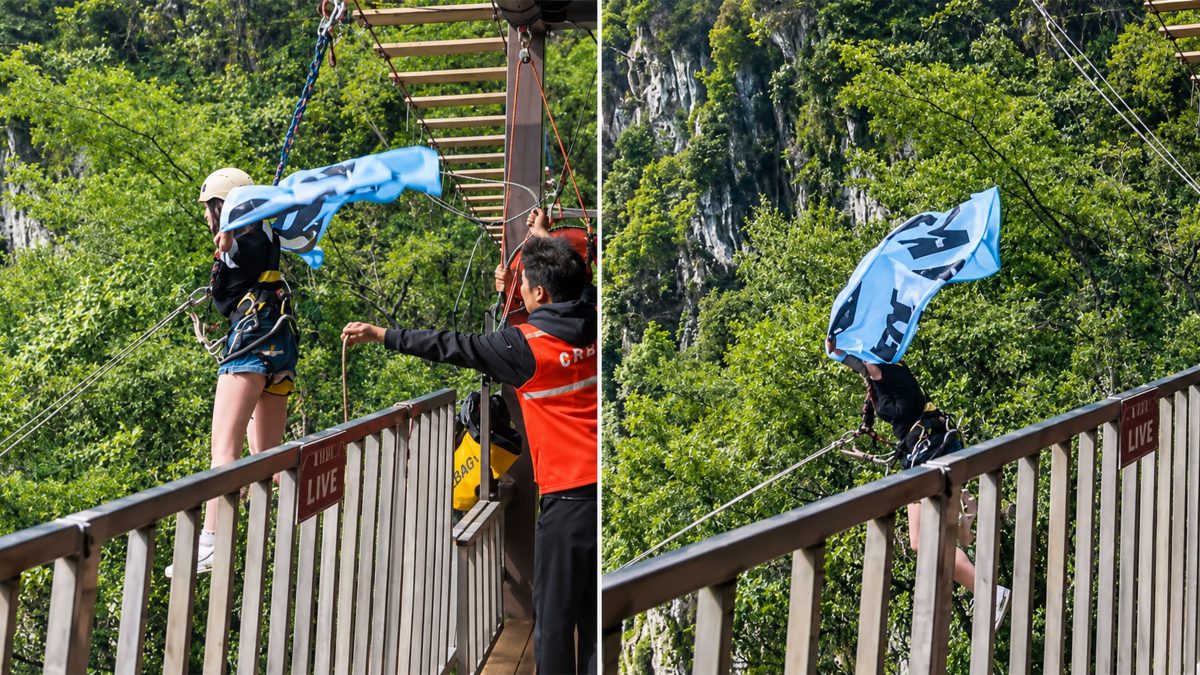
China bungee swing tragedy discussions online are revealing growing public anxiety over how viral adventure tourism shapes perceptions of safety. Across Philippine social media platforms, the incident quickly evolved beyond shock over a fatal accident and into wider debates about whether internet-driven thrill attractions are being trusted too easily because of constant online exposure.
The public reaction to the fatal bungee swing incident in China this week revealed something larger than shock over a viral accident. Across Philippine social media platforms, the discussion quickly evolved into a broader conversation about whether internet-driven adventure tourism is encouraging people to trust experiences they barely understand, especially when those attractions are designed first for visibility online.
Videos shared widely on Facebook, TikTok, and X showed a woman at an adventure park in Sichuan reportedly expressing concern that her safety ropes were not properly secured moments before she fell into a canyon during a bungee swing activity on May 3. Chinese media reports later stated that she died while being transported to a hospital.
But while the footage itself spread rapidly, the deeper online reaction focused less on the tragedy alone and more on how modern tourism increasingly operates around social media expectations. Observers noted that many adventure attractions today are marketed through short-form videos that emphasize thrill, scenery, and emotional reactions while offering little visibility into safety systems or operational standards.
In the Philippines, where travel content consistently performs strongly online, many users said the incident felt uncomfortably familiar. Adventure parks, cliff swings, zip lines, and extreme rides have become regular fixtures in influencer content and travel promotions aimed at younger audiences seeking “bucket-list” experiences.
The development highlights a broader pattern in digital tourism culture where perceived safety is often built through repetition rather than actual understanding. When viewers repeatedly see influencers and tourists completing risky activities without incident, the experience gradually begins to look routine rather than dangerous.
“People stop thinking about the risk because they’ve already watched hundreds of similar videos online,” one commenter wrote.
That observation reflects growing concern among online users about how algorithms normalize high-risk activities by presenting them as visually exciting lifestyle content. Unlike traditional tourism advertising, viral clips are designed to create emotional immediacy, making viewers feel as though the activity is already socially approved and widely trusted.
The conversation also raised questions about operational accountability in destinations that rely heavily on online exposure to attract visitors. Some users pointed out that many travelers now select attractions based on how “shareable” they appear on social media rather than on publicly available safety information.
“Now people are realizing that beautiful scenery and viral videos don’t automatically mean proper safety standards,” another user commented.
Industry observers have previously warned that the rise of “experience-first tourism” places pressure on operators to continuously offer more visually dramatic attractions to remain competitive online. In Southeast Asia, where tourism recovery after the pandemic has become closely tied to digital promotion, adventure-based destinations have increasingly leaned into high-engagement content strategies.
This raises wider questions about how tourism businesses balance online marketing with risk communication. While most legitimate operators follow established safety procedures, viral tourism culture often compresses complex activities into short clips that remove context, preparation, and caution from public perception.
The online response in the Philippines also reflected growing skepticism toward repost pages and content accounts that circulated the footage primarily for engagement. Several users criticized the monetization of tragedy-driven content, arguing that social platforms increasingly reward emotionally intense videos regardless of whether they contribute meaningful public discussion.
“Everything becomes content now, even accidents,” one post read.
As authorities continue investigating the incident in China, the discussion surrounding it has already expanded far beyond one adventure park. For many online users, the tragedy became a reminder that in the age of viral tourism, public trust is often shaped by visibility and repetition — even when the real risks remain largely unseen.








 Facebook
 Twitter