
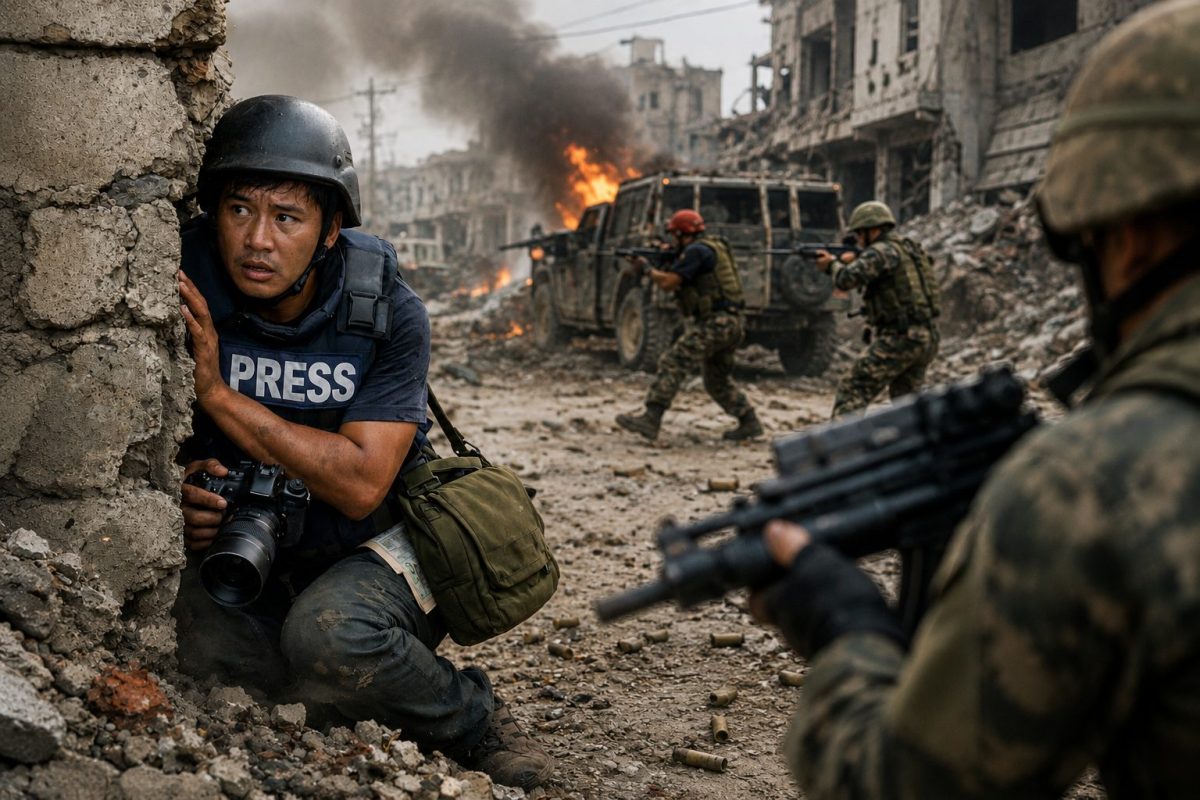
Peace reporting highlights the role of responsible journalism in promoting understanding, reducing conflict, and encouraging informed public discourse. While searching through my bookshelf, I came across a 32-page booklet containing a thought-provoking statement: “Since wars begin in the minds of men, it is in the minds of men where the defenses for peace must be constructed.” Those words immediately underscored the importance of accurate reporting in building a more peaceful society.
I was searching for something yesterday in my bookshelves when a 32-page booklet caught my attention. This statement was too interesting to be dismissed outright: “Since wars begin in the minds of men, it is in the minds of men where the defenses for peace must be constructed.”
I found out that those words — which remind us of the power of ideas and how it shapes people — were from the charter of the United Nations Educational, Scientific and Cultural Organization (UNESCO).
“Men act as they think. They think as they are informed. They form opinions, decide and move on the basis of information at hand. If people think peace, they will act peace,” the booklet says.
“People are informed, and their values are formed, through the formal educational system,” it continues. “The schools and the mass media, indeed, are powerful instruments that shape the minds and steer the actions of men.”
The strife in Mindanao — mistakenly labelled as a conflict between Muslims and Christians — is one of the biggest threats to peace in the Philippines. “It is commonly believed that the misunderstanding in Mindanao and about Mindanao is due to biases, prejudices and misconceptions brought about by decades of mis-education and mis-information of the Filipino,” it points out.
It sounds very interesting, indeed. If you are still at loss the title of the booklet, it’s A Manual on Peace Reporting in Mindanao. I don’t remember how I was able to get a copy of the book; maybe when I visited the office of Press Foundation of Asia some years ago. It is published by Philippine Press Institute, an association of Philippine newspapers and magazines.
The author of the manual is Dr. Crispin C. Maslog, who once worked in 1987 as communication director of the Peace and Development Panel for Mindanao and the Cordilleras. A former journalist with Agence France-Presse, he was honored by the Philippines Jaycees as The Outstanding Filipino awardee in literature and journalism in 1995. A Fulbright scholar, he got his Ph.D. in mass communication from the University of Minnesota.
The manual gives 10 general guidelines — just like God gave Moses the 10 commandments — to be observed when reporting on Mindanao and the people of Mindanao. These are:
There is no such thing as Muslim-Christian conflict. “The Philippines is a pluralist society,” it explains. “Its Constitution allows freedom of worship. In practice, Filipinos of different religious beliefs are not persecuted.” And if there are fights among them, those are not ethnic or religious in nature, “but are rooted in political, economic, land and other causes.”
There has been a Muslim-Christian brotherhood since 1913. “Muslims and Christians traditionally lived as neighbors. They joined the same civic clubs, transacted business with each other, went to the same public markets, enrolled in the same schools, rode in the same buses, and observed each other’s holiday,” it says.
Although there are ethnic differences, they also have a lot of common cultural practices. And these should be projected in the best light. “Mass media must avoid mentioning anything offensive to their cultural sensibilities,” it says, “like the pork-eating habits of Christians or the polygamous practice of Muslims.”
There are similarities between Muslims and Christian names. Let’s take some Biblical names: Eve (Hawa), Noah (Nuh), Abraham (Ibrahim), Moses (Musa), Solomon (Sulaiman), John (Yahya), Mary (Miriam), and Jesus (Isa).
There are ethnic differences among Muslims and Christians. Ethnic group refers to Maguindanao, Tausug, Yakan, Ilongo, Ilocano, Waray, Boholano, etc. “Each ethnic group has pride in its ethnicity and even claims of superiority over the others,” it says. “Mass media should avoid reports which would tend to pit one ethnic group against each other.”
Historical perceptions of Muslims and Christians differ. “The Muslims believe that historically, Mindanao is theirs. They have claimed ownership of Mindanao since pre-Hispanic times. Many Christians question this view, especially since territorial boundaries change because of conquest.” The advice: “media must be careful in reporting or discussing the conflicting historical claims.”
The challenge of Moro National Liberation Front and its splinter groups against the Philippine government is not a fight between Muslims and Christians.
People are sensitive about their religious beliefs. “News reports derogatory to any religion may foment religious dissension and can only result in quarrels,” it says.
Sensationalized reports on Mindanao can spawn more conflict and should be avoided. “Sensational reports often distort the real situation and create anxiety among non-Muslims in Mindanao and in other parts of the country,” the manual explains. “In their anxiety, they may start arming themselves, thus worsening the division between Muslims and Mindanao.”
Balanced reporting is imperative. “The voices of the masses, and not only of the political, military and religious leaders, should be reported,” it suggests. “Mass media should also report about the civilians caught in the crossfire, and the evacuees in order to get a well-rounded view of how the people of Mindanao feel about their situation.”
The manual also urges the use of ethnic identities when reporting about culture, language, customs, arts and tools, among others. Instead of using the word “Muslim,” the following can be used: Maranao language, Maguindanao culture, Yakan art, Tausug legend.
Migrants from Luzon and Visayas should not be referred to as Christians but ethnically as Ilocano, Cebuano, Waray, Bicolano, Pampangueno, etc.
But criminals should not be identified by their ethnic origins. You don’t use “Tausug bandit” or “Tagalog gangster” because over time, it may create the wrong impression that all Tausugs are bandits and all Tagalogs are gangsters.
Yes, there are just some of the reminders being discussed in the manual. And there are more ideas that tyro journalists — even seasoned ones — can learn from it.


 Facebook
 Twitter