

Funny relationship habits often start as small annoyances but slowly become part of what keeps couples emotionally connected. From stealing each other’s fries to arguing over where to eat for an hour, these strange routines usually reveal comfort, familiarity, and the kind of closeness people only build over time.
There’s a point in every relationship where romance quietly stops looking polished and starts becoming weird.
Not bad weird. Surviving-each-other’s-daily-habits weird.
One person suddenly develops selective hearing whenever it’s time to decide where to eat. The other starts dramatic investigations over a three-minute late reply while also taking two hours to answer messages themselves. Somebody says “I’m not hungry,” then steals half the fries five minutes later like it was part of the original agreement.
And somehow, these ridiculous little habits end up becoming the reason couples feel close.
A lot of people imagine strong relationships as nonstop sweetness, deep conversations, and Instagram-worthy moments. But real long-term relationships usually look far less cinematic. Most couples spend more time arguing over aircon temperature, sharing random Facebook memes at midnight, or deciding whose turn it is to order food than having dramatic romantic moments.

That’s partly why relationships often feel more genuine after the “trying to impress each other” stage disappears. The performance fades first. What remains is routine, comfort, and a strange level of honesty people rarely show anyone else.
One of the funniest relationship habits is the completely unnecessary recurring argument every couple somehow keeps alive for years. It could be about slow replies, forgetting tiny errands, leaving wet towels on the bed, or refusing to admit they got lost even after making three wrong turns.
The funny part is that many couples already know exactly how the argument will end before it even starts.
One person gets slightly dramatic.
The other pretends not to care.
Eventually someone sends food, memes, or a random “nakauwi ka na?” message like a peace offering.
Problem solved.
It sounds childish from the outside, but these repeated little interactions often create emotional familiarity. Human beings naturally become attached to patterns. Even small predictable behaviors can feel comforting when life becomes stressful everywhere else.
That’s why people sometimes miss even the annoying parts after a breakup. Familiarity creates emotional rhythm. The tiny fights, sarcastic comments, and repeated jokes become part of daily life without couples even realizing it.
Long-term relationships also create a strange ability to read each other almost too well.
Some couples can identify an entire mood from a single sigh.
“You’re irritated.”
“No, I’m not.”
“You’re hungry.”
Ten minutes later, somebody is silently ordering milk tea and chicken because the emotional investigation turned out to be correct again.
This kind of emotional decoding matters more than people think. Feeling understood without needing to explain every emotion out loud creates emotional safety, something closely connected to emotional intimacy between couples in long-term relationships.
That’s probably why many couples eventually communicate in ways that look completely unserious to everyone else.
They create nicknames that would sound embarrassing in public. They bully each other affectionately over tiny mistakes. They send blurry selfies, random stickers, or badly cropped memes instead of formal conversations. Some couples even continue fake arguments purely for entertainment because boredom eventually becomes part of long-term love too.
In Filipino relationships especially, humor often becomes a substitute for emotional vulnerability.
Not everyone grows up openly expressive. Many people are more comfortable teasing than directly saying they feel stressed, jealous, insecure, or emotionally tired. So instead of dramatic emotional speeches, affection appears in smaller ways.
“Text me pag-uwi mo.”
“Kumain ka na ba?”
“May pasalubong ako.”
“Bahala ka” — which almost never actually means bahala ka.
These phrases sound ordinary because they are ordinary. But ordinary habits are usually what carry relationships through difficult seasons.
A lot of couples survive stressful periods not because they constantly feel butterflies, but because they continue finding ways to make each other feel emotionally lighter. Humor becomes a pressure release valve for adulthood itself.
Bills arrive.
Work becomes exhausting.
Traffic drains patience.
Family problems appear without warning.
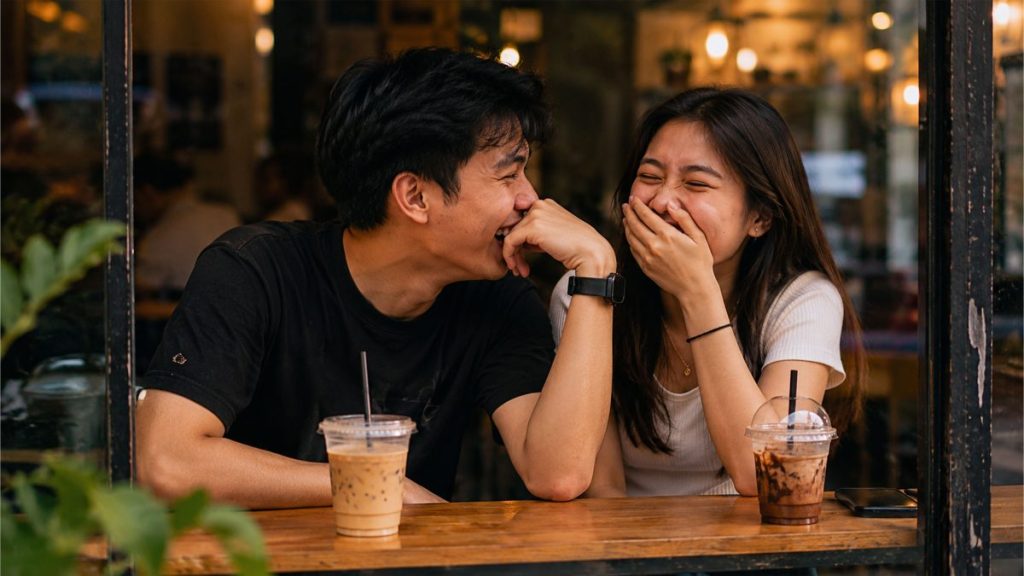
And yet somebody beside you still finds a way to joke about your terrible singing during karaoke or your emotional attachment to one specific fast-food order.
That kind of lightness matters more than people admit. Research and relationship therapists have long discussed how humor strengthens relationships by reducing emotional tension during conflict.
Couples who laugh together often recover from conflict faster because humor softens emotional tension before resentment fully settles in. It becomes harder to treat every disagreement like a relationship-ending disaster when both people still know how to make each other laugh in the middle of irritation.
Even passive-aggressive habits somehow evolve into forms of affection over time.
One person says, “Do whatever you want,” while secretly hoping the correct answer magically appears.
The other person responds like a contestant in an emotional survival game, carefully analyzing tone, facial expression, and typing speed before making any decision.
Then somebody arrives with the correct iced coffee order, and suddenly peace is restored.
Relationships are full of these tiny negotiations that sound ridiculous when explained out loud. But beneath them is something surprisingly meaningful: attention.
People remember details when they care.
They remember the exact way someone likes their coffee after a stressful day. They remember which food improves a bad mood. They remember the stories their partner repeats every month and still react like it’s the first time hearing them.
These habits rarely look impressive online because they are too small and repetitive to go viral. Social media usually highlights grand gestures, expensive surprises, or dramatic romance. Real relationships often survive because of accumulated ordinary moments nobody else notices.
Saving the last piece of chicken without being asked.
Waiting for the other person to get home before sleeping.
Sending updates during the day that have absolutely no urgency.
Pretending to hate the series your partner watches while secretly following the plot anyway.
None of these moments seem life-changing individually. Together, they create emotional consistency. In fact, many psychologists believe healthy relationship habits matter more long term than constant romantic intensity.
Modern relationships sometimes struggle because people expect constant excitement. But long-term love is not built from permanent butterflies. It’s built from repeated behavior that quietly says, “I still choose you even after seeing your weird habits up close.”
That’s also why couples often become less filtered around each other over time. Eventually somebody sees the unflattering sleepy face, the stress mood swings, the irrational overthinking, the random jealousy, the laziness during weekends, and the terrible online shopping decisions.
And somehow they stay anyway.
Not because the relationship is perfect, but because it becomes safe enough for imperfection. Over time, that kind of comfort often develops through healthy communication in relationships rather than grand romantic gestures alone.
Maybe that’s the real reason funny relationship habits matter more than people think. They are evidence that two people stopped performing and started living honestly together.
Underneath all the teasing, repeated arguments, dramatic “tampo,” stolen fries, and chaotic late-night conversations is something surprisingly comforting: the feeling that somebody knows your strangest version and still wants to stay.







 Facebook
 Twitter