

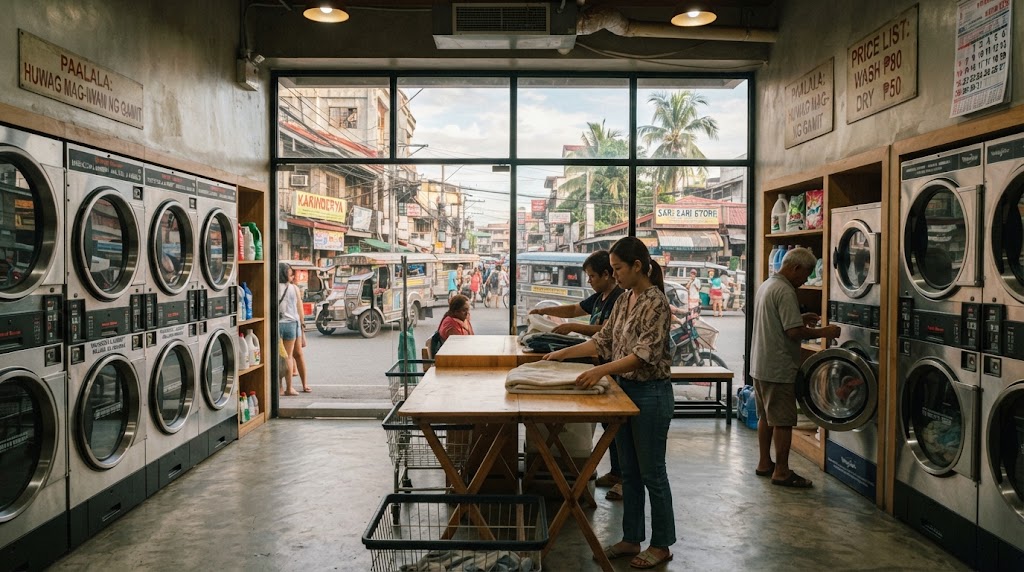
Laundromat business Philippines opportunities represent one of the most stable, high-retention ventures an entrepreneur can undertake in Southeast Asia’s growing urban centers. Because clean clothing is an essential, everyday requirement, commercial laundry shops boast high customer lifetime value, steady recession resistance, and robust recurring cash flow. However, modern success requires moving beyond legacy coin-drop setups. Today’s consumers and strict Google quality guidelines demand high information density, clear financial modeling, and operational transparency tailored to local market conditions.
Market Research & Business Model Architecture
Before purchasing equipment or signing a commercial lease, you must define your operational model and identify underserved geographic corridors across the country.
- Choose Your Operational Model:
- Self-Service (Traditional Laundromat): Card- or coin-operated machines with minimal on-site labor overhead and high initial equipment CapEx.
- Wash-Dry-Fold & Commercial Delivery: Full-service operations yielding higher margins per pound by serving busy professionals, local Airbnbs, boutique spas, and salons.
- The Hybrid Ecosystem: Combining self-service convenience with drop-off services and app-driven mobile pickup and delivery to maximize revenue per square foot.
- Demographic & Location Targeting: Focus on high-density residential zones, rental-heavy corridors, multi-family apartment complexes lacking in-unit hookups, and student housing hubs in major metropolitan areas across Metro Manila, Cebu, and Davao.
Financial Planning & Startup Capital Requirements in PHP
Opening a modern, tech-enabled laundromat business in the Philippines requires significant upfront capital, but it rewards operators with predictable cash flow. According to industry data benchmarks from local commercial laundry equipment distributors and SME franchising consultants, setting up a standard 5-washer and 5-dryer commercial shop typically requires an initial capital expenditure (CapEx) ranging from ₱1.2 million to ₱2.5 million, broken down as follows:
- Commercial Equipment (Washers & Dryers): ₱700,000 – ₱1,500,000 (depending on heavy-duty industrial import brands like Speed Queen or Girbau).
- Renovation, Plumbing & Electrical Upgrades: ₱200,000 – ₱400,000 (reinforced drainage, heavy-duty electrical wiring, and LPG/gas-line setups).
- Working Capital & Permits: ₱150,000 – ₱300,000 to cover initial utility bills (Meralco or local cooperatives), rent deposits, and regulatory compliance.
- Expected Break-Even Timeline: Typically between 12 to 24 months, with mature shops generating steady monthly net profit margins of 25% to 40% after operating expenses.
Philippine Regulatory Compliance & Municipal Workflows
Operating legally requires navigating national and local government units (LGUs). Ensure your paperwork is complete by following this step-by-step regulatory checklist:
- Business Registration: Register your trade name with the Department of Trade and Industry (DTI) for sole proprietorships or the Securities and Exchange Commission (SEC) for corporations.
- Local Government Units (LGUs): Secure your Barangay Clearance and Mayor’s Permit from your local municipal or city hall.
- Tax Compliance: Obtain your Certificate of Registration (COR) and books of accounts from the Bureau of Internal Revenue (BIR).
- Environmental & Safety Standards:
- Secure a Fire Safety Inspection Certificate (FSIC) from the Bureau of Fire Protection (BFP).
- Comply with Department of Environment and Natural Resources (DENR) wastewater discharge guidelines and local Laguna Lake Development Authority (LLDA) or environmental protection codes regarding commercial detergent runoff and grease/lint trap installations.
Lessons from a Local Owner: Real Operational Challenges
To bridge the gap between textbook theory and ground-level reality, we spoke with seasoned Metro Manila laundry enterprise operator Engr. Mateo Cruz, who manages three thriving branches across Quezon City and Makati.
“The biggest mistake first-time investors make is underestimating utility overhead and water quality,” Cruz shares. “In the Philippines, electricity and commercial water rates can eat up 30% to 40% of your gross monthly revenue if you aren’t careful. Furthermore, many urban areas suffer from hard water laden with minerals. Without investing in a heavy-duty industrial water softener system right from day one, your heating elements will calcify, and your stainless steel drums will stain within six months.”
Cruz also emphasizes the importance of robust preventive maintenance schedules, keeping spare parts on hand for solenoid valves and belts, and training staff to handle customer service issues promptly during peak weekend rushes.
Author Expert Background
John Mark R. Reyes is a senior business development consultant and SME strategist specializing in retail franchising and operational efficiency across Southeast Asia. With over a decade of experience helping Filipino entrepreneurs scale brick-and-mortar enterprises, John Mark combines rigorous financial modeling with grounded, on-the-ground regulatory insights to guide investors through sustainable business growth.



 Facebook
 Twitter