

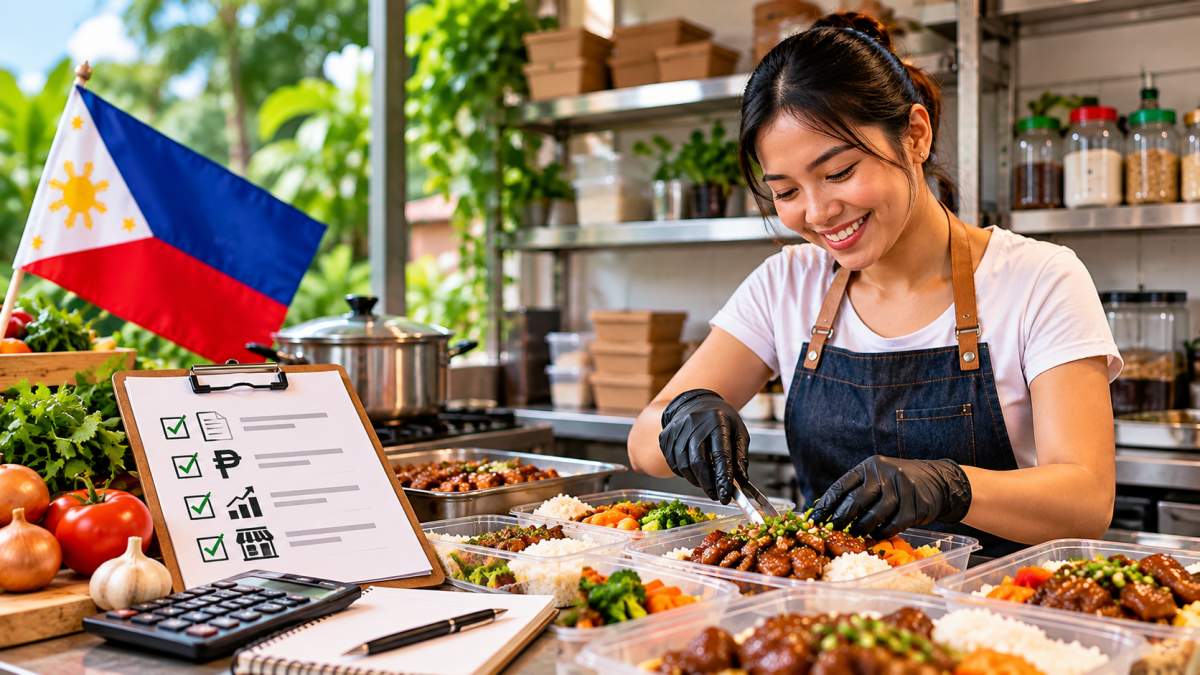
Small food business Philippines opportunities remain accessible to entrepreneurs who start with a focused menu, control costs, test demand, and understand the permits and food-safety requirements that apply to their operation. From home-based meal services and pre-order businesses to food stalls and specialty products, a small operation can be tested before committing to larger expenses such as commercial rent, major equipment, and additional staff.
The difficult part is not simply deciding what food to sell. You also need to determine whether people will actually buy it, calculate the real cost of every serving, set a sustainable selling price, maintain enough working capital, and comply with the requirements that apply to your particular business.
The Philippine food-service sector provides useful market context. The Philippine Statistics Authority’s (PSA) Annual Survey of Philippine Business and Industry counted 37,500 formal-sector establishments engaged in accommodation and food service activities. Restaurants and mobile food service activities accounted for 27,638 establishments, or 73.7% of the total, generating ₱874.70 billion in revenue.
For a new entrepreneur, however, national industry figures should be treated as context rather than a promise of profitability. Success on the ground requires listening closely to those who have already navigated the landscape.
“When I started my home-based pastry business in Marikina during the pandemic, my biggest mistake was trying to cater to everyone’s palate,” shares Clarissa Santos, founder of Tahanan Treats. “It wasn’t until I narrowed my menu down to just three hero items—ensaymada, cheese rolls, and banana bread—that my ingredient waste dropped to near zero and my profit margins finally stabilized.”
This guide focuses on what a beginner actually needs to understand: startup capital, food costing, pricing, break-even analysis, registration, permits, food safety, marketing, real operator insights, and practical ways to test a food business before committing more money.
How We Researched This Guide
This Buzz PH guide combines information from Philippine government sources with original financial calculations, illustrative business scenarios, and qualitative interviews with micro-entrepreneurs.
- Official Data: Information from the Philippine Statistics Authority (PSA) is used for industry statistics. Department of Trade and Industry (DTI) guidelines govern business-name registration. Bureau of Internal Revenue (BIR) regulations outline tax compliance. Food and Drug Administration (FDA) Philippines materials cover food-safety and packaging requirements.
- Original Calculations: The startup budgets, ₱15,000 micro-capital case study, food-cost formulas, break-even calculations, and scaling scenarios are original Buzz PH calculations created to provide realistic financial models rather than guaranteed results.
- Operator Perspectives: Direct insights and quotes are gathered from small-scale home-bakers and cloud-kitchen founders operating across Metro Manila and regional hubs to reflect authentic local challenges.
Phase 1: Choosing a Low-Risk Business Model
Before spending capital on commercial leases or industrial equipment, choose a format that matches your budget and operational capacity.
- The Pre-Order Home Kitchen: Ideal for starting with under ₱15,000. You cook or bake out of your domestic kitchen on scheduled days, eliminating heavy rental and utility overhead.
- The Cloud Kitchen / Ghost Kitchen: Focuses strictly on delivery via apps (GrabFood, Foodpanda) or direct social media orders from a modest shared kitchen space or residential extension.
- The Mobile Food Stall or Kiosk: Suited for heavy-foot-traffic areas like school zones, barangay commercial strips, or weekend community markets.
“Operating a cloud kitchen in Cebu taught us that logistics can make or break your margins,” notes Marco Dizon, co-owner of Sugbo Bites cloud kitchen. “Grab and Foodpanda take substantial commission cuts. If your food cost exceeds 30% and delivery platform fees take another 20% to 25%, your operational cushion becomes razor-thin unless your volume is high.”
Phase 2: Micro-Startup Budgeting (The ₱15,000 Case Study)
To demonstrate how a micro-food business starts lean, consider this illustrative model for a weekend artisanal empanada or pasta delivery service:
- Initial Ingredients & Packaging (Batch 1 & 2): ₱6,000
- Basic Cooking Utensils & Food-Grade Containers: ₱3,500
- Digital Marketing (Meta Ads / Grab/Foodpanda setup fees): ₱2,000
- Transport & Delivery Reserve (Lalamove/Grab instant wallet): ₱1,500
- Emergency Cash Buffer: ₱2,000
- Total Estimated Startup Capital: ₱15,000
Phase 3: Mastering Food Costing and Pricing
Many small food businesses fail not because the food lacks quality, but because of poor math. Every single plate or package must account for:
- Raw Material Cost (COGS): Direct ingredients (meat, dairy, spices, packaging).
- Indirect Expenses: Cooking gas (LPG), electricity, and cleaning supplies apportioned per batch.
- Markup Multiplier: Standard food-service models aim for a food cost percentage of 30% to 35%, meaning your retail price should ideally be 3x your raw ingredient cost.
Break-Even Scenario Example:
If your fixed monthly overhead (home kitchen utilities, permits, marketing) totals ₱6,000, and your net profit contribution per meal box is ₱60:
Break-Even Target=Profit per UnitFixed Costs=₱60₱6,000=100 meal boxes per month
Selling fewer than 100 boxes means operating at a loss; selling beyond that yields pure operating profit.
Phase 4: Government Registration & Compliance
Operating legally protects your brand and builds consumer trust. Depending on your scale, complete these steps:
- DTI Business Name Registration: Secures your trade name (approximate online fee ranges from ₱200 to ₱500 depending on scope: Barangay, City/Municipality, Regional, or National).
- Barangay Clearance & City/Municipal Permit (Mayor’s Permit): Secures local operational approval.
- BIR Registration (Form 1901/1903): Obtains your Certificate of Registration (COR) and Authority to Print (ATP) receipts/invoices. Note that under recent Ease of Paying Taxes (EOPT) laws, compliance has been streamlined for micro-enterprises.
- FDA License to Operate (LTO): Required if you manufacture packaged processed food products for wider retail distribution. Home-cooked ready-to-eat meals sold direct-to-consumer generally fall under local sanitary permits, but packaged goods sold in groceries require FDA compliance.
Final Checklist for Launching Your Food Venture
- [ ] Test your recipe on friends, family, and neutral focus groups before launching commercially.
- [ ] Take clean, high-resolution natural-lighting photos of your food for social media.
- [ ] Establish clear delivery radius rules to avoid cold, soggy food upon arrival.
- [ ] Keep personal finances strictly separated from business earnings from Day 1.


 Facebook
 Twitter