

How to start a coffee shop in the Philippines depends on your available capital, target customers, location, and operating costs. In 2026, aspiring café owners need to assess startup expenses, business registration, local permits, equipment, ingredient costs, staffing, and working capital before opening. This guide explains the main requirements, compares sample kiosk and storefront budgets, and shows how estimated sales and per-drink costs affect break-even targets. The figures are planning estimates, not guaranteed costs or profits, and should be checked against current local quotations before investing.
The first decision is not whether to open a kiosk or a stylish storefront. It is whether the expected sales can support the costs of the specific location and business model.
This guide explains how to start a coffee shop in the Philippines in 2026, including startup capital, business registration, equipment, menu pricing, employee costs, break-even calculations, and cash-flow planning. It uses a small takeaway kiosk and a small storefront café as illustrative examples, with Philippine peso estimates and sources readers can check themselves.
Important: The financial models in this article are planning scenarios, not audited forecasts or guaranteed results. Published supplier prices and government announcements are identified separately from estimates. Obtain current quotations and verify applicable regulations before investing.
How Much Does It Cost to Start a Coffee Shop in the Philippines?
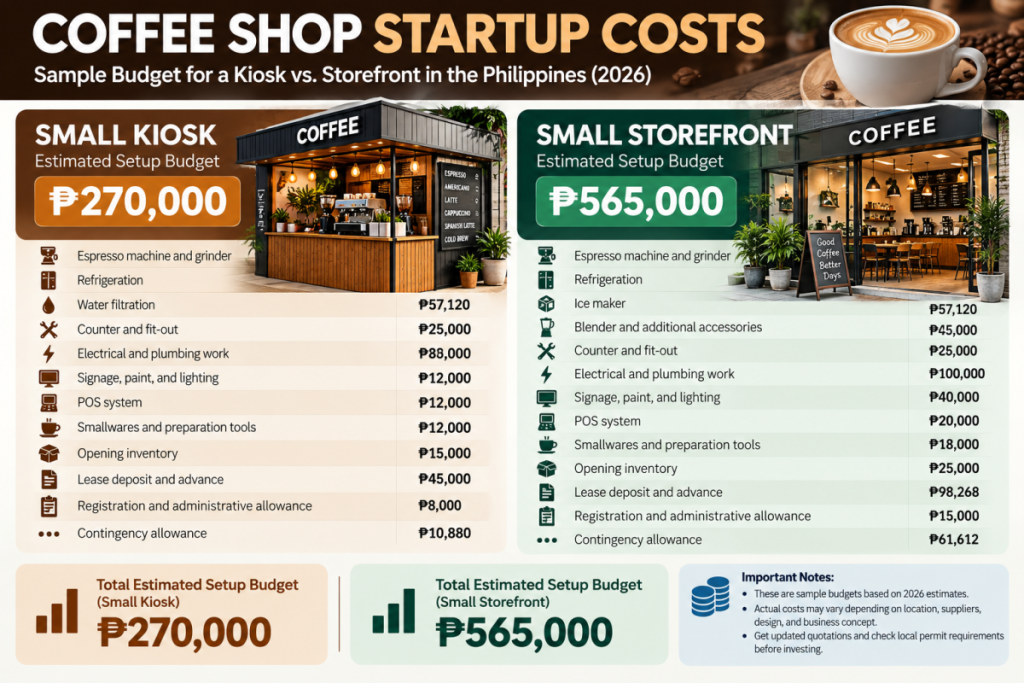
For the examples in this guide, the estimated setup budget is ₱270,000 for a small kiosk and ₱565,000 for a small storefront café. These are illustrative budgets, not national averages.
| Expense category | Small kiosk | Small storefront |
|---|---|---|
| Espresso machine and grinder | ₱57,120 | ₱57,120 |
| Refrigeration | ₱25,000 | ₱45,000 |
| Water filtration | ₱8,000 | ₱12,000 |
| Ice maker | — | ₱25,000 |
| Blender and additional accessories | — | ₱8,000 |
| Counter and fit-out | ₱45,000 | ₱100,000 |
| Electrical and plumbing work | ₱20,000 | ₱40,000 |
| Signage, paint, and lighting | ₱12,000 | ₱40,000 |
| POS system | ₱12,000 | ₱20,000 |
| Smallwares and preparation tools | ₱12,000 | ₱18,000 |
| Opening inventory | ₱15,000 | ₱25,000 |
| Lease deposit and advance | ₱45,000 | ₱98,268 |
| Registration and administrative allowance | ₱8,000 | ₱15,000 |
| Contingency allowance | ₱10,880 | ₱61,612 |
| Total estimated setup budget | ₱270,000 | ₱565,000 |
The arithmetic is consistent: the kiosk items total ₱270,000, and the storefront items total ₱565,000.
The equipment allowance uses a published Gemilai CRM3149/G9015C bundle listing priced at ₱51,000 before VAT. Adding 12% VAT gives ₱57,120, assuming the listed price and VAT treatment remain applicable. This is one supplier example, not proof that the same equipment is ideal for every commercial café.
The remaining amounts are budgeting assumptions. They are not independently verified quotations for every item. The renovation cost, refrigeration requirements, electrical work, furniture, and lease terms can vary substantially.
Before using this budget, obtain quotations for the actual premises. Ask whether each price includes VAT, delivery, installation, warranty, and other charges. For renovation work, request an itemized quotation instead of relying on a single lump-sum estimate.
Coffee Kiosk vs. Storefront Café
A kiosk generally needs less space and may be suitable for takeaway coffee. A storefront can accommodate seating and a wider menu, but it may require more renovation, equipment, staff, and working capital.
| Factor | Small kiosk | Small storefront |
|---|---|---|
| Estimated setup budget | ₱270,000 | ₱565,000 |
| Modeled monthly rent | ₱15,000 | ₱32,756 |
| Menu | Focused drinks menu | Drinks and possible food menu |
| Seating | Limited or none | Usually available |
| Operating complexity | Relatively simple | More equipment and upkeep |
| Main financial challenge | Generating enough transactions | Covering higher fixed costs |
Neither format guarantees profitability. A low-rent kiosk can struggle if too few customers pass by, while a well-designed storefront can lose money if its rent and staffing costs are too high for its sales volume.
Choose the format by testing demand and estimating costs—not by comparing appearance alone.
Validate the Location Before Signing a Lease
A café’s location affects customer traffic, rent, visibility, and the time of day when sales are likely to occur. A busy road does not necessarily produce enough paying customers, particularly if parking is difficult or pedestrians cannot easily access the shop.
Before committing to a property, visit it during morning rush hours, lunchtime, late afternoon, and weekends. Record pedestrian traffic in consistent time intervals, observe nearby competitors, and estimate how many people could realistically become customers.
Use a simple site comparison:
| Location factor | What to check |
|---|---|
| Foot traffic | Count people passing during several time periods |
| Customer fit | Identify nearby offices, schools, residences, or transport routes |
| Competition | Compare nearby menus, prices, queues, and opening hours |
| Accessibility | Check pedestrian access, parking, visibility, and entry points |
| Lease terms | Confirm rent, deposit, advance, escalation, and permitted use |
| Utilities | Verify water, electricity, drainage, and internet availability |
| Legal suitability | Confirm zoning and other applicable requirements before signing |
For a local reference, published listings in Ma-a, Davao City have included a retail space of approximately 50.394 square meters at ₱32,756 per month and another of 61.25 square meters at ₱33,687 per month. These are individual property listings, not verified rental averages for Davao City.
Readers can inspect the first Ma-a listing and second Ma-a listing. Confirm current availability, actual lease terms, and whether the premises are suitable for food and beverage operations.
Do not sign a lease until the expected sales can plausibly cover the rent and other costs. A landlord’s approval to rent a space does not automatically mean every permit or building requirement for a café has been satisfied.
Register the Business and Check the Required Permits
A coffee shop must complete the registrations and obtain the permits that apply to its legal structure, premises, and activities. The process can differ between local government units.
Common steps include:
- Choose the business structure. Decide whether to operate as a sole proprietorship, partnership, or corporation.
- Register the business name or entity. Sole proprietors generally register through the Department of Trade and Industry, while corporations and partnerships generally register through the Securities and Exchange Commission.
- Register with the BIR. Complete the applicable tax registration and comply with invoicing, bookkeeping, filing, and payment requirements.
- Apply for the local business permit. Confirm the current requirements and fees with the city or municipality where the café will operate.
- Check zoning and occupancy requirements. Confirm that the premises can legally be used for the intended business.
- Check fire-safety requirements. Ask which clearances and inspections apply to the premises.
- Confirm sanitation and food-service requirements. Consult the local health office about sanitary permits, inspections, and employee health certificates.
- Register as an employer where applicable. Comply with SSS, PhilHealth, Pag-IBIG, and labor requirements when hiring staff.
For a Davao City business, the City Government’s Business Bureau provides information on new business permits, renewal, and related services. The city also provides an online business permit system.
The city’s published requirements include documents such as identification, a business-location map, and relevant registration or lease documents, depending on the applicant and business circumstances. Check the latest checklist directly with the Business Bureau instead of treating an older checklist as universally current.
Official national starting points include the DTI, SEC, and BIR.
The ₱8,000 kiosk and ₱15,000 storefront registration allowances in this article are budgeting assumptions, not official permit-fee schedules. Actual fees depend on the applicable requirements and local assessments.
Buy Equipment That Matches the Menu and Expected Volume
A small espresso-based café commonly needs an espresso machine, grinder, refrigerator, water filtration system, scales, timers, milk pitchers, cleaning tools, cups, lids, and a suitable sales-recording system.
A storefront serving iced drinks may also need an ice maker, blender, additional refrigeration, and more preparation space.
Do not select equipment based only on its purchase price. Check the expected drinks per hour, machine capacity, water requirements, warranty, service availability, spare parts, and the cost of consumables.
An inexpensive machine may be unsuitable if it cannot handle peak demand. Conversely, an oversized machine can consume capital that would be more useful as working cash.
Ask suppliers for written quotations showing the exact model, inclusions, VAT treatment, warranty, delivery, and installation. The published Gemilai bundle used in this guide is a reference point, not an endorsement that it is the best equipment choice for every business.
Estimate Coffee Bean Costs Per Drink
Coffee beans are an important direct ingredient in espresso-based drinks. A supplier’s price per kilogram can be converted into a cost per dose to help build a recipe budget.
Agross lists its Blend 5, a 50% Arabica and 50% Robusta blend, at ₱835 per kilogram before VAT for purchases of 1–49 kilograms. The supplier lists a lower price for orders of 50 kilograms or more. Check the published Blend 5 price before ordering.
Using ₱835 per kilogram, the cost of an 18-gram dose is:
₱835 ÷ 1,000 grams × 18 grams = ₱15.03 before VAT.
If 12% VAT is added to the listed price, the dose costs approximately ₱16.83 before shipping, waste, and other adjustments. The appropriate cost for a particular business depends on its invoice, tax treatment, recipe, and supplier.
An 18-gram dose is an illustrative assumption, not a universal recipe. Test the dose and yield that suit the chosen beans and equipment.
Calculate the True Cost of Each Drink
Bean cost alone does not determine whether a drink is profitable. Include milk, syrup, cups, lids, water, ice, and other ingredients. Account for waste, remakes, and supplier price changes.
The following estimates use the ₱15.03 bean cost before VAT and assumed costs for other ingredients and packaging. These non-bean figures are not verified supplier quotations.
| Drink | Coffee beans | Other direct ingredients and packaging | Estimated direct recipe cost |
|---|---|---|---|
| Americano | ₱15.03 | ₱11.00 | ₱26.03 |
| Hot latte | ₱15.03 | ₱31.00 | ₱46.03 |
| Iced flavored latte | ₱15.03 | ₱35.00 | ₱50.03 |
For a more reliable result, weigh or measure each ingredient in a test recipe. Divide the purchase price by the usable quantity, multiply by the amount used per drink, and add packaging costs. Update the calculations whenever supplier prices or recipes change.
Keep a separate record of waste and remakes. If ingredients spoil or drinks are prepared incorrectly, those costs still affect the business even if no sale is recorded.
Set Menu Prices That Cover More Than Ingredients
A drink’s selling price must contribute toward rent, wages, utilities, maintenance, and other operating expenses. A large markup on ingredients does not automatically mean a café is profitable.
The following prices and variable costs are illustrative model inputs, not claims about typical prices across the Philippines.
| Drink | Kiosk price | Kiosk direct recipe cost | Storefront price | Storefront modeled variable cost |
|---|---|---|---|---|
| Americano | ₱100.00 | ₱26.03 | ₱120.00 | ₱35.00 |
| Hot latte | ₱130.00 | ₱46.03 | ₱155.00 | ₱52.00 |
| Iced flavored latte | ₱155.00 | ₱50.03 | ₱175.00 | ₱63.75 |
The storefront variable-cost estimates include additional allowances beyond the direct recipe costs. They are not supplier-verified amounts.
For the kiosk model, the weighted direct recipe cost is approximately ₱41.63 per drink. The break-even model adds ₱2.97 per drink for other variable expenses, producing a modeled average variable cost of ₱44.60.
The additional ₱2.97 is a planning allowance. Replace it with actual sales-related expenses when reliable records are available, and avoid counting any cost twice.
Before finalizing prices, compare competitors, test customer willingness to pay, and calculate the actual cost of each recipe. If customers will not accept a price that covers costs, reconsider the recipe, portion size, sourcing, rent, or business concept instead of assuming that higher sales volume will solve the problem.
Estimate Employee Wages and Employer Contributions
Staffing is a significant recurring expense. According to the Department of Labor and Employment, the Davao Region non-agriculture daily minimum wage increased to ₱540 effective September 1, 2026, under Wage Order No. RB XI-24. The published monthly equivalent is ₱14,085. This rate applies to the relevant wage order and should not be applied automatically to every role or location.
Sources: DOLE Davao Region wage announcement and National Wages and Productivity Commission.
The model below assumes two employees earning ₱14,085 in basic monthly wages each. The employer contribution amounts are planning figures for this example and should be checked against the current schedules and each employee’s applicable contribution base.
| Monthly cost per employee | Planning amount |
|---|---|
| Basic wage | ₱14,085.00 |
| Employer SSS contribution allowance | ₱1,400.00 |
| Employees’ Compensation contribution | ₱10.00 |
| Employer PhilHealth contribution allowance | ₱352.13 |
| Employer Pag-IBIG contribution allowance | ₱200.00 |
| Monthly 13th-month-pay provision | ₱1,173.75 |
| Modeled monthly employment cost | ₱17,220.88 |
Two employees would cost approximately ₱34,442 per month under these assumptions.
The SSS allowance assumes a ₱14,000 monthly salary credit at a 10% employer share. The ₱10 Employees’ Compensation amount is separate and follows the applicable salary-credit band. See the official SSS contribution schedule and Employees’ Compensation information.
For 2026, the PhilHealth premium rate for employed members is 5% of the applicable monthly basic salary, shared equally by employer and employee. The employer share in this model is estimated at 2.5% of ₱14,085, or ₱352.13. Confirm the applicable contribution base and rules using PhilHealth’s official website. The Pag-IBIG amount is a planning allowance; confirm the applicable contribution and compensation cap with the Pag-IBIG Fund.
The monthly 13th-month-pay provision is one-twelfth of the assumed monthly basic wage. Actual eligibility and payment obligations must follow Philippine labor law.
The model excludes overtime, holiday premiums, additional staffing, recruitment costs, and other benefits not shown. A café with long opening hours may need more than two employees. Prepare a real staffing schedule before using this figure in a final business plan.
Calculate the Monthly Operating Budget
The monthly model combines payroll, rent, utilities, marketing, maintenance, owner compensation, and illustrative loan payments.
| Monthly expense | Kiosk | Storefront |
|---|---|---|
| Two employees, including modeled benefits provision | ₱34,442 | ₱34,442 |
| Rent | ₱15,000 | ₱32,756 |
| Utilities | ₱5,000 | ₱8,000 |
| Marketing | ₱3,000 | ₱4,000 |
| Cleaning, maintenance, and miscellaneous | ₱5,000 | ₱8,000 |
| Owner compensation allowance | ₱15,000 | ₱20,000 |
| Illustrative loan payment | ₱7,061 | ₱14,122 |
| Total modeled monthly fixed costs | ₱84,503 | ₱121,320 |
These totals are arithmetic results of the assumptions above, not verified operating costs for a typical Philippine café.
The rent figures are individual property-listing examples. The loan payments assume a ₱150,000 kiosk loan and a ₱300,000 storefront loan, each repaid over 24 months at a nominal annual interest rate of 12%. The estimated monthly payments are approximately ₱7,061 and ₱14,122 before fees. Actual lender terms may differ.
The model excludes some expenses, including taxes, payment-processing fees where applicable, delivery-platform commissions, insurance, depreciation, major repairs, and any additional staffing. Include relevant costs in your own forecast. Some expenses are fixed, while others rise with sales.
Calculate the Break-Even Point
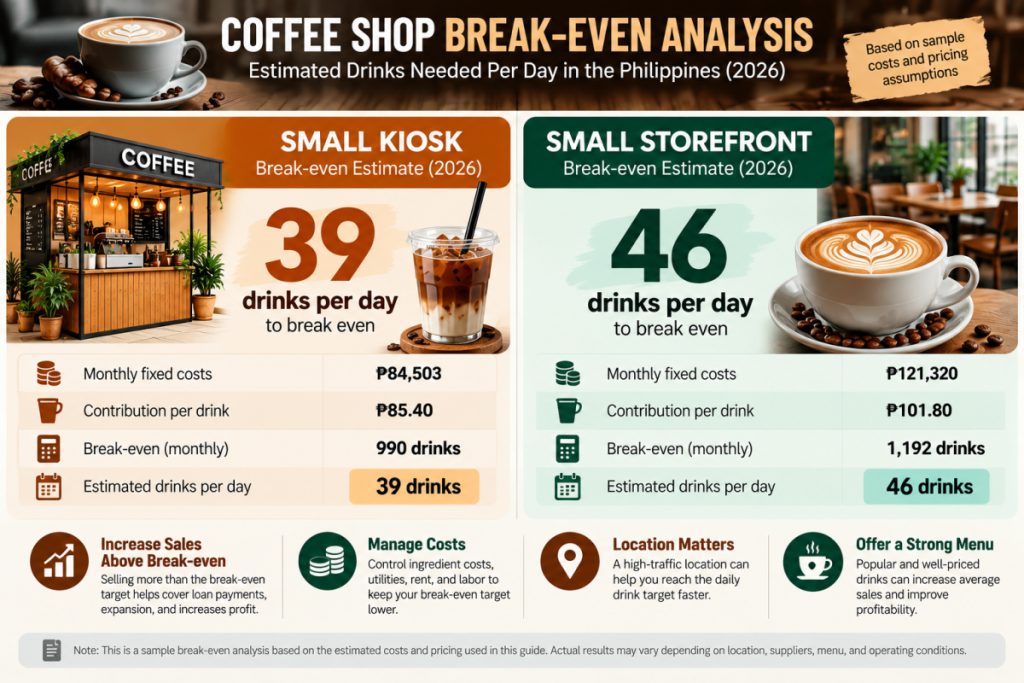
Break-even analysis estimates the number of drinks the café must sell to cover the modeled costs.
Break-even drinks per month = Monthly fixed costs ÷ Contribution per drink
Contribution per drink equals the average selling price minus the modeled variable cost. It is not the same as net profit.
For the kiosk, the assumed menu mix is 30% Americano, 30% hot latte, and 40% iced flavored latte.
- Average selling price: ₱130.00
- Weighted direct recipe cost: approximately ₱41.63
- Additional variable-cost allowance: ₱2.97
- Total modeled variable cost: ₱44.60
- Contribution per drink: ₱85.40
- Monthly fixed costs: ₱84,503
The calculation is ₱84,503 ÷ ₱85.40 = approximately 990 drinks per month, or about 39 drinks per operating day over 26 days.
For the storefront, the assumed menu mix is 25% Americano, 35% hot latte, and 40% iced flavored latte.
- Average selling price: ₱154.25
- Weighted modeled variable cost: ₱52.45
- Contribution per drink: ₱101.80
- Monthly fixed costs: ₱121,320
The calculation is ₱121,320 ÷ ₱101.80 = approximately 1,192 drinks per month, or about 46 drinks per operating day over 26 days.
These are planning estimates based on the stated menu mix and cost assumptions. They include modeled loan payments, owner compensation, and the monthly 13th-month-pay provision, but exclude some taxes and operating expenses. Recalculate them using actual rent, payroll, supplier prices, loan terms, and menu mix before investing.
Compare Daily Sales Scenarios
The following scenarios assume 26 operating days per month and the average prices, variable costs, and fixed costs stated above.
| Kiosk drinks per day | Monthly revenue | Modeled variable costs | Fixed costs | Modeled result |
|---|---|---|---|---|
| 25 | ₱84,500 | ₱28,990 | ₱84,503 | -₱28,993 |
| 40 | ₱135,200 | ₱46,384 | ₱84,503 | ₱4,313 |
| 50 | ₱169,000 | ₱57,980 | ₱84,503 | ₱26,517 |
| Storefront drinks per day | Monthly revenue | Modeled variable costs | Fixed costs | Modeled result |
|---|---|---|---|---|
| 25 | ₱100,262.50 | ₱34,092.50 | ₱121,320 | -₱55,150 |
| 40 | ₱160,420 | ₱54,548 | ₱121,320 | -₱15,448 |
| 50 | ₱200,525 | ₱68,185 | ₱121,320 | ₱11,020 |
The modeled result is revenue minus modeled variable and fixed costs. It is not guaranteed net profit and excludes unmodeled expenses and taxes.
The scenarios show why location research and conservative sales forecasts matter. Under these assumptions, selling 40 drinks per day leaves the kiosk with a small cushion, while the storefront remains below break-even. A modest change in customer demand, rent, waste, or ingredient prices can materially affect the result.
Prepare Working Capital Before Opening
Startup equipment and fit-out costs are only part of the capital requirement. A café may take time to build repeat customers, and sales can be uneven during the first few months.
Using three months of modeled fixed costs as a basic reserve:
| Capital requirement | Kiosk | Storefront |
|---|---|---|
| Setup budget | ₱270,000 | ₱565,000 |
| Three months of modeled fixed costs | ₱253,509 | ₱363,960 |
| Setup plus three-month reserve | ₱523,509 | ₱928,960 |
The totals are calculated as setup budget plus three times the modeled monthly fixed costs. For the storefront, this uses the corrected ₱565,000 setup budget—not the earlier, incorrect ₱610,000 figure.
This is a starting reserve target, not a complete estimate of all cash needs. It does not separately add every possible tax, ongoing variable inventory purchase, repair, or unexpected expense. Opening inventory is already included in the setup budget, but replenishment must be funded from operating cash.
Prepare a month-by-month cash-flow forecast covering sales, collections, supplier payments, payroll, rent, utilities, loan payments, tax obligations, and a contingency buffer. Test the plan using lower sales and higher costs than your most optimistic forecast.
Understand the Tax Obligations
A coffee shop must comply with applicable BIR registration, invoicing, bookkeeping, filing, and payment requirements. Tax treatment depends on the business structure, registration status, revenue, and applicable rules.
The 8% income tax option is conditional; it is not automatically available to every coffee shop or business entity. Under BIR Revenue Regulations No. 8-2018, eligible individual taxpayers may elect the option subject to the applicable conditions, including rules concerning VAT registration and the relevant gross-sales threshold.
The tax treatment can differ for corporations, mixed-income earners, and taxpayers who do not qualify for the option. Consult the BIR or a qualified accountant before choosing a tax treatment. Do not estimate tax by simply subtracting a flat percentage from the sales scenarios in this article.
Build a Simple Inventory and Waste-Control System
Inventory control helps prevent cash from being tied up in ingredients that expire or are used inconsistently.
Track coffee beans, milk, syrups, cups, lids, ice, and other frequently used ingredients. Record opening stock, purchases, usage, waste, and closing stock. Compare ingredient usage with the number of drinks sold.
Standardize recipes and train staff to use measured portions. If a recipe uses 200 milliliters of milk, calculate its cost from the actual purchase price and quantity. Record remakes and spoilage instead of assuming every purchased ingredient becomes a sale.
Review stock levels regularly and order according to sales patterns. Do not buy large quantities solely to qualify for a supplier discount unless the savings outweigh storage, cash-flow, and expiry risks.
Market the Coffee Shop Locally
Marketing should help nearby customers discover the business and give them reasons to return.
Useful activities include:
- Create and maintain a Google Business Profile with accurate hours and contact details.
- Post the menu, location, and opening announcements on social media.
- Offer a modest launch promotion with a clear end date and cost limit.
- Encourage genuine customer reviews without buying or fabricating them.
- Partner with nearby offices, schools, residential communities, or local events where appropriate.
- Track which promotions lead to repeat purchases rather than only one-time traffic.
Do not treat social-media views or follower counts as proof of profitability. Track daily transactions, average order value, best-selling items, repeat purchases, and promotion costs.
Common Mistakes to Avoid
Spending too much on interiors: Expensive fit-outs can leave too little money for payroll and operating expenses.
Choosing a location without measuring demand: A busy area is not necessarily profitable. Rent, customer behavior, competition, and accessibility must be considered together.
Underpricing drinks: Ingredient cost is only one part of the cost structure. Prices must contribute toward labor, rent, utilities, waste, and other expenses.
Using estimates as quotations: Online listings and example supplier prices are reference points. Obtain current written quotations before investing.
Hiring too few staff: Employees need breaks, rest days, and legally compliant working arrangements. Plan staffing around actual opening hours and labor requirements.
Ignoring working capital: A business can run short of cash even when sales are growing. Reserve money for supplier payments, payroll, rent, and unexpected costs.
Assuming break-even means the business is safe: The model excludes some costs and relies on estimated sales and menu mix. Aim for a sustainable cushion above break-even.
A Practical Pre-Opening Checklist
Before opening the café, confirm that you have:
- Chosen a business concept and defined your target customers.
- Researched the location and observed customer traffic at different times.
- Obtained current rental, equipment, renovation, and supplier quotations.
- Prepared a detailed startup budget and cash-flow forecast.
- Confirmed registration, tax, local permit, fire-safety, and sanitation requirements.
- Standardized recipes and calculated actual drink costs.
- Set menu prices based on customer demand and realistic costs.
- Planned staffing, wages, contributions, and employee schedules.
- Established an inventory and waste-control process.
- Reserved enough working capital for a slower-than-expected launch.
- Calculated break-even using the final rent, payroll, loan terms, and menu mix.
- Created a launch plan and a method for tracking daily performance.
Financial Assumptions and Verification Notes
This guide separates published reference prices from planning estimates so readers can judge how much confidence to place in each figure.
- Equipment: The Gemilai bundle price is a published listing. Confirm current price, VAT, inclusions, delivery, and warranty before purchase.
- Coffee beans: The ₱835/kg price is a supplier example. Confirm current pricing, availability, shipping, and VAT treatment.
- Rent: The Ma-a, Davao City figures are individual property listings, not verified citywide averages. Confirm written lease terms with the landlord.
- Payroll: The DOLE wage announcement is a reference for the applicable Davao Region wage order. Calculate SSS, EC, PhilHealth, Pag-IBIG, and 13th-month pay using the rules applicable to actual employees.
- Ingredient costs: Milk, syrup, cups, lids, water, ice, and waste allowances require current quotations and measured recipes.
- Loan payments: Monthly payments are illustrative estimates based on the stated principal, term, and interest rate. Actual lender terms and fees may differ.
- Break-even and sales scenarios: These are modeled estimates, not audited forecasts or guaranteed net profits. Taxes, unlisted expenses, and differences in actual sales mix can materially affect results.
Before signing a lease or buying equipment, obtain written quotations, verify permits with the relevant authorities, and prepare a cash-flow forecast that includes slower sales, unexpected expenses, and sufficient working capital.
Sources and References
- Department of Labor and Employment: Davao Region minimum wage announcement, effective September 1, 2026. https://dole.gov.ph/news/davao-region-minimum-wage-workers-get-2nd-tranche-wage-hike/
- National Wages and Productivity Commission: Regional wage orders and rates. https://nwpc.dole.gov.ph/
- Social Security System: Official contribution schedule and Employees’ Compensation information. https://www.sss.gov.ph/pay-contribution/ and https://www.sss.gov.ph/employees-compensation-program/
- PhilHealth: Official website and contribution guidance. https://www.philhealth.gov.ph/
- Pag-IBIG Fund: Official website and contribution guidance. https://www.pagibigfund.gov.ph/
- Agross: Published coffee-bean prices for Blend 5, before VAT. https://agross.ph/products/blend-5-50-arabica-50-robusta
- Koryaiko: Published Gemilai equipment and grinder bundle listing. https://koryaiko.com/product/bundle-gemilai-g3149-g9015c/
- Bureau of Internal Revenue: Revenue Regulations No. 8-2018 on the conditional 8% income tax option. https://bir-cdn.bir.gov.ph/local/pdf/RR%20No.%208-2018.pdf
- City Government of Davao: Business Bureau, permit services, and current application guidance. https://davaocity.gov.ph/business-bureau/
- DotProperty: Individual Ma-a, Davao City retail-space listings used as rental examples. https://www.dotproperty.com.ph/ads/retail-space-for-rent-in-ma-a-davao-del-sur_cf7927de692e-2d1e-a332-7574-b8532089 and https://www.dotproperty.com.ph/ads/retail-space-for-rent-in-ma-a-davao-del-sur_81c09bd76271-60d1-a262-59ce-b8532089
Financial transparency note: Equipment and coffee-bean prices are based on published supplier listings. Davao rental figures are individual property listings. Other startup costs, ingredient allowances, employer contribution estimates, monthly operating expenses, loan payments, and sales scenarios are planning assumptions unless explicitly identified otherwise. Obtain current quotations and verify applicable legal requirements before relying on these figures for an investment decision.


 Facebook
 Twitter