
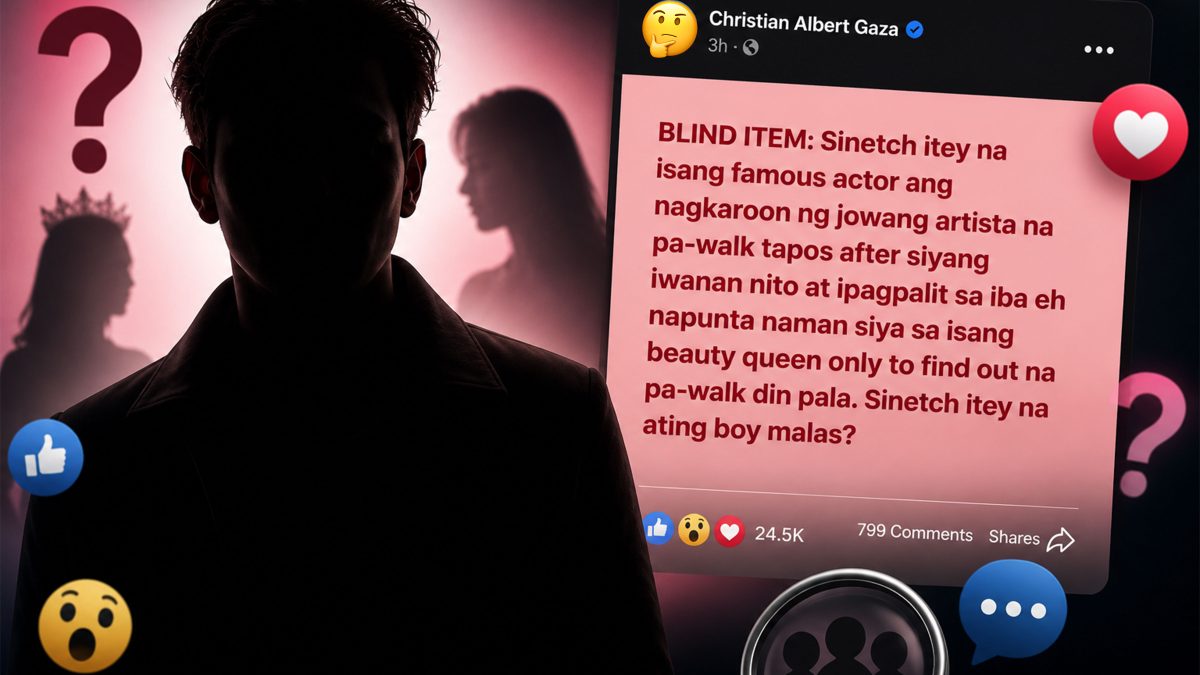
Christian Gaza blind item discussions quickly spread across Filipino social media this week, not because identities were confirmed, but because online audiences increasingly treat vague celebrity rumors as interactive entertainment. The viral post triggered thousands of reactions, theories, and debates, revealing how digital participation now drives engagement faster than verified information.
A viral blind item shared by social media personality Christian Gaza this week revealed more than the public’s fascination with celebrity rumors — it highlighted how Filipino online culture increasingly rewards participation over verification. Long before any information could be confirmed, thousands of users were already building theories, naming possible personalities, and treating the discussion like a collaborative online puzzle.
The now widely circulated post described a supposed situation involving complicated celebrity relationship claims and personal controversy. No identities were mentioned, yet the ambiguity appeared to strengthen public engagement rather than weaken it.
Observers noted that blind items have evolved into a form of digital interaction where audiences become part of the content itself. In many entertainment discussions today, attention no longer depends on verified details or official confirmation. Instead, it thrives on participation, speculation, and emotional reaction.
Within hours of the post gaining traction, social media users began dissecting old interviews, archived photos, and previous celebrity pairings in an attempt to decode the story. The development highlights a broader pattern in Philippine online spaces where vague narratives often generate stronger engagement than direct reporting.
Unlike conventional entertainment news, blind items invite audiences to “solve” a mystery. Analysts noted that this format encourages repeated sharing because users feel personally involved in uncovering hidden identities. The result is an online environment where rumors gain momentum through collective curiosity rather than factual clarity.
“People are not even asking if it’s true anymore. They just want to guess who it is,” one user commented in a discussion thread.
That reaction reflected how digital entertainment consumption has shifted in recent years. For many Filipinos online, celebrity gossip now functions as social participation — something to react to, debate, and decode in real time with other users.
At the same time, some commenters questioned the ethical side of anonymous insinuations that can quickly point toward real individuals.
“Online speculation can become harmful when unverified claims are repeated as fact,” another user wrote.
The concern carries growing relevance in an era where screenshots, edited timelines, and speculative “evidence” spread rapidly across platforms. Even without direct naming, internet users often narrow discussions toward a small group of personalities, exposing them to scrutiny and online criticism.
Observers noted that the popularity of these discussions also reflects the uniquely Filipino blending of humor, intrigue, and community interaction on social media. Unlike in other online cultures where rumors remain isolated within fan groups, Filipino audiences frequently turn entertainment speculation into mainstream conversation.
“Everyone joins because it feels interactive, almost like a game,” another reaction stated.
That sense of participation may explain why blind items continue to dominate engagement despite repeated criticism. They offer suspense, familiarity, and emotional investment — elements that social media algorithms tend to amplify.
Still, media watchers say the growing normalization of rumor-driven interaction raises questions about digital responsibility. The development highlights how entertainment culture online can blur the boundary between harmless discussion and reputational harm, especially when speculation spreads faster than clarification.
No individuals mentioned in public speculation have confirmed the claims circulating online. While the identities connected to Gaza’s viral post remain publicly unverified, the larger conversation surrounding it revealed a more significant trend: in today’s Philippine social media environment, the act of guessing has become just as influential as the information itself.
Observers also noted that the popularity of anonymous celebrity discussions may influence how younger audiences consume information online. As entertainment content increasingly blends with speculation-driven engagement, some digital literacy advocates believe social media users are becoming more comfortable sharing unverified assumptions as part of everyday conversation. The trend reflects a broader shift in online behavior where emotional reaction and community participation often outweigh factual confirmation, particularly in fast-moving entertainment discussions.







 Facebook
 Twitter