
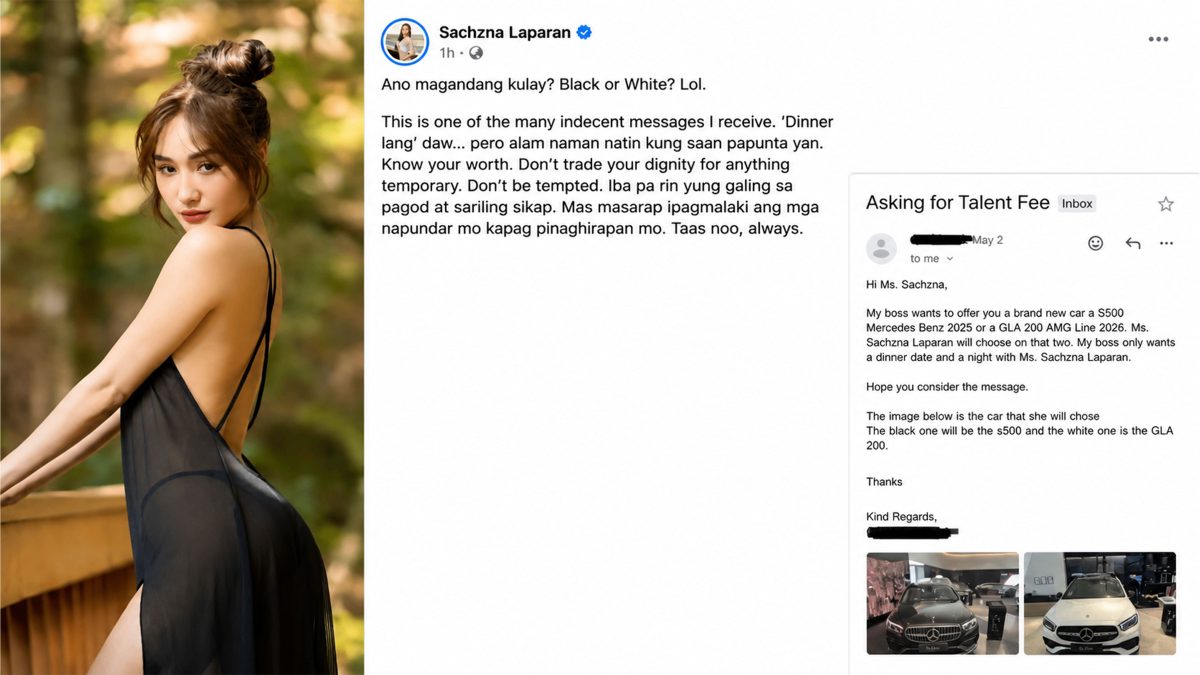
Sachzna Laparan viral post discussions have gained traction after she shared a screenshot of a message she characterized as unsolicited on her official social media account. Instead of focusing on the message itself, the response highlighted a growing shift in how Filipino netizens view personal boundaries in online interactions.
What made a recent post by content creator Sachzna Laparan resonate widely was not simply the message it exposed, but how it reframed a common digital experience into a public standard for behavior. By sharing a screenshot of a message she described as unsolicited and responding with a firm stance on self-respect, Laparan shifted attention toward a growing expectation: that online interactions should be guided by clearly defined personal limits.
Observers noted that the post gained traction not because of outrage, but because of recognition. Many users saw in it a familiar scenario—unsolicited offers delivered through private messages—yet rarely discussed openly. The development highlights how visibility is now being used not just to call out behavior, but to normalize the act of setting boundaries in spaces where access is often immediate and informal.
Rather than escalating the situation, Laparan’s response emphasized dignity and long-term perspective. This approach introduced a different tone into the conversation, one that contrasts with the reactive nature of many viral exchanges. It suggests that influence online is no longer measured solely by how strongly one responds, but by how clearly one communicates values.
“Maganda na may ganitong reminder para sa lahat, hindi lang sa mga content creators,” one user wrote, pointing to the broader relevance of the issue.
This reflects a broader pattern in Filipino online culture, where personal experiences often evolve into shared reference points. When such posts circulate, they contribute to an informal but influential framework of what is considered acceptable behavior. The repetition of similar stories has gradually built a collective awareness that boundaries are not just individual preferences, but necessary elements of respectful interaction.
At the same time, the post raises questions about how opportunities are framed in digital environments. Direct messaging has lowered barriers between individuals, but it has also introduced ambiguity in communication. Offers that may appear transactional on the surface can carry underlying expectations, making it difficult to distinguish between professional outreach and personal intrusion.
“Hindi porket private message, okay na agad—may limit pa rin dapat,” another comment read, highlighting concerns about how easily boundaries can be overlooked.
Observers noted that this ambiguity is particularly relevant in the Philippine context, where social media engagement often blends personal and professional spaces. The normalization of informal communication has created environments where clarity is not always present, making boundary-setting a necessary skill rather than an optional one.
The timeline of the discussion further illustrates how quickly individual experiences can shape broader discourse. A single post, once shared, becomes a catalyst for reflection, prompting others to examine their own encounters. Each reaction adds to a growing conversation about how digital interactions should be navigated.
“Mas okay na malinaw ang boundaries kaysa pinapalampas lang,” a user noted, reinforcing the value of directness.
This development highlights a shift in how online behavior is understood. Boundaries are no longer seen as private matters to be quietly managed, but as principles that can be openly expressed and collectively reinforced. For Filipino audiences, this signals a move toward more defined expectations in digital communication—where respect is actively practiced rather than assumed.
As platforms continue to shape how people connect, posts like Laparan’s demonstrate that influence can extend beyond visibility. They contribute to an evolving culture where personal limits are acknowledged as part of responsible interaction, offering a framework that others can adopt in navigating increasingly connected spaces.
The continued attention surrounding the Sachzna Laparan viral post also underscores how social media platforms amplify conversations tied to values and behavior. Content that touches on personal dignity and boundaries tends to generate more engagement, not only because it is relatable, but because it invites reflection. Observers noted that this type of discourse signals a shift from passive consumption to active interpretation, where audiences are no longer just reacting to content but evaluating the principles behind it. This evolving dynamic suggests that online influence is increasingly tied to the ability to shape conversations around social norms, rather than simply attracting attention.








 Facebook
 Twitter