


Small house renovation cost Philippines homeowners should expect in 2026 can vary widely depending on the property’s condition, renovation scope, materials, labor, location and required permits. A modest home may need only targeted repairs and cosmetic improvements, while a more extensive renovation can involve the kitchen, bathroom, flooring, electrical system, plumbing, ceiling or roof. Instead of relying on a single nationwide price, this guide breaks down realistic planning budgets and explains how to build a renovation budget based on the actual work your house needs.
Renovating a small house in the Philippines can cost around ₱100,000 to ₱500,000 or more, depending on the condition of the property, the size and scope of the renovation, materials, labor, location, permits, and whether the project involves major electrical, plumbing, roofing, or structural work.
A simple renovation focused on painting, flooring, lighting, and minor repairs can require considerably less money than a full interior renovation involving the kitchen, bathroom, electrical system, plumbing, ceiling, doors, windows, and roof.
There is also no single official Philippine renovation price per square meter that can accurately apply to every house.
The Philippine Statistics Authority (PSA) reported an average construction cost of ₱13,058.66 per square meter for residential construction in July 2026, based on approved building permits. However, that figure refers to reported residential construction—not a standard renovation rate. PSA separately records alteration and repair projects and excludes them from its average cost per square meter because these projects do not have reported floor areas in the same way.
That distinction matters when preparing a renovation budget.
This guide uses current Philippine government data where appropriate and provides clearly labeled planning scenarios to help homeowners estimate how much money they may need before requesting actual contractor quotations.
Quick Answer: How Much Does It Cost to Renovate a Small House?

For preliminary budgeting, a small-house renovation can be thought of in four broad levels:
| Budget | Possible Scope |
|---|---|
| ₱100,000 | Basic repairs, painting, selected flooring, lighting and minor improvements |
| ₱200,000 | More extensive cosmetic work plus selected kitchen, bathroom or system upgrades |
| ₱300,000 | Substantial renovation across several areas of a small house |
| ₱500,000+ | Major renovation involving multiple rooms, systems and higher-quality finishes |
These figures are planning scenarios created for this guide, not official national averages or contractor quotations.
The actual amount can vary substantially between projects.
A 50-square-meter house with a sound roof, good plumbing and recently upgraded electrical system could cost much less to renovate than another 50-square-meter house with leaks, deteriorated wiring, damaged flooring and outdated plumbing.
What Is Considered a Small House?
There is no single national definition of a “small house” specifically for renovation budgeting.
For this guide, a practical working range is approximately 40 to 80 square meters of floor area, covering many compact bungalows and modest family homes.
Floor area is only one part of the calculation.
The condition of the existing house can have a greater effect on the final cost than its size.
For example, renovating a 60-square-meter home that needs only repainting and flooring is very different from renovating a 60-square-meter home that requires electrical rewiring, plumbing replacement, bathroom reconstruction and roof repairs.
This is why homeowners should budget based on scope and condition, not square meters alone.
Why Renovation Cost Is Different From New Construction Cost
A new house and a renovated house have very different cost structures.
With new construction, the project starts with a defined building plan and proceeds through construction stages.
Renovation starts with an existing property.
That means the project may involve:
- demolition
- removal and hauling
- repairing existing surfaces
- working around existing walls
- modifying electrical circuits
- modifying plumbing
- repairing hidden water damage
- matching old and new materials
- protecting existing areas
- correcting previous construction problems
The PSA’s July 2026 statistics illustrate why caution is necessary when using construction statistics for renovation planning.
Residential construction had an average reported cost of ₱13,058.66 per square meter, while alteration and repair were recorded separately at a total value of ₱4.42 billion for the month. PSA specifically states that alteration and repair are excluded from its average construction-cost calculation because there is no reported floor area for those projects.
Therefore, multiplying ₱13,058.66 by the floor area of an existing house would not produce a reliable renovation estimate.
The Four-Bucket Renovation Budget
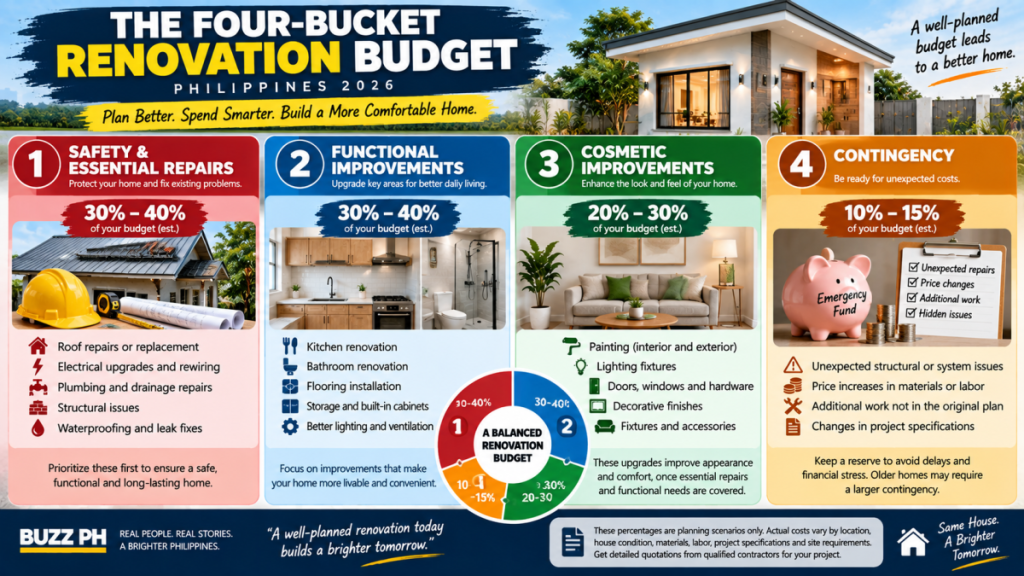
A useful way to plan a small-house renovation is to divide the money into four categories.
| Budget Bucket | Examples |
|---|---|
| Safety & essential repairs | Roof, electrical, plumbing, structural issues |
| Functional improvements | Kitchen, bathroom, flooring, storage |
| Cosmetic improvements | Paint, lighting, decorative finishes |
| Contingency | Unexpected repairs and project changes |
This approach prevents a common budgeting mistake: spending most of the available money on cosmetic improvements and discovering later that there is no budget left for necessary repairs.
What a ₱100,000 Renovation Budget Can Cover
A ₱100,000 budget is generally more appropriate for a targeted renovation than a complete transformation.
An illustrative allocation could look like this:
| Category | Planning Allocation |
|---|---|
| Painting and wall repairs | ₱20,000 |
| Selected flooring work | ₱20,000 |
| Electrical and lighting improvements | ₱12,000 |
| Minor plumbing repairs | ₱8,000 |
| Doors, hardware and fixtures | ₱10,000 |
| Basic kitchen improvements | ₱10,000 |
| Labor and miscellaneous work | ₱10,000 |
| Contingency | ₱10,000 |
| Total | ₱100,000 |
This is a budget allocation model, not a quotation.
It assumes that the house is generally usable and does not require major structural, roofing or system replacement.
If serious electrical, plumbing or roofing problems are discovered, the homeowner may need to redirect money away from cosmetic improvements.
What a ₱200,000 Renovation Budget Can Cover
A ₱200,000 budget provides more flexibility and can potentially combine cosmetic work with selected functional improvements.
A planning model could allocate:
| Category | Planning Allocation |
|---|---|
| Kitchen improvements | ₱30,000 |
| Bathroom improvements | ₱25,000 |
| Flooring | ₱30,000 |
| Painting and surface preparation | ₱20,000 |
| Electrical work | ₱15,000 |
| Plumbing | ₱10,000 |
| Doors, lighting and fixtures | ₱15,000 |
| Labor and project expenses | ₱35,000 |
| Contingency | ₱20,000 |
| Total | ₱200,000 |
The goal at this budget level should not necessarily be to renovate everything.
A better strategy is to identify the areas that most affect safety, daily functionality and long-term durability.
What a ₱300,000 Renovation Budget Can Cover
At approximately ₱300,000, a small house can potentially undergo a more comprehensive renovation if the existing structure is in reasonably good condition.
An illustrative allocation:
| Category | Planning Allocation |
|---|---|
| Kitchen renovation | ₱50,000 |
| Bathroom renovation | ₱35,000 |
| Flooring | ₱40,000 |
| Painting and ceiling work | ₱30,000 |
| Electrical improvements | ₱25,000 |
| Plumbing | ₱15,000 |
| Doors and windows | ₱25,000 |
| Labor and project expenses | ₱50,000 |
| Contingency | ₱30,000 |
| Total | ₱300,000 |
This type of budget may support improvements across several rooms, but homeowners should still obtain actual quotations before committing to the project.
What a ₱500,000+ Renovation Budget Can Cover

A ₱500,000 or larger budget can provide considerably more flexibility for a small house.
Depending on the property’s condition, it may allow for:
- complete flooring replacement
- kitchen renovation
- bathroom renovation
- ceiling replacement
- electrical upgrades
- plumbing improvements
- doors and windows
- repainting
- built-in storage
- lighting upgrades
- selected exterior improvements
- roof repairs
- professional design or engineering services where required
However, ₱500,000 should not be interpreted as a guaranteed maximum.
Major structural repairs, extensive roofing work, foundation problems, additional floors, serious water damage, or significant layout changes can push a renovation well beyond that amount.
How We Built These 2026 Budget Scenarios
The budget scenarios in this article are original planning models, not claimed national averages.
They are designed to answer a practical question:
“If I have a certain amount of money, how might I divide it among the major renovation categories?”
The models use broad renovation categories rather than pretending that every Philippine contractor charges the same amount.
Actual quotations should replace these planning figures before construction begins.
The main assumptions are:
- the house already exists
- the renovation does not involve building an entirely new structure
- the house is relatively small
- the homeowner defines the scope before construction
- major structural problems are not automatically included
- prices can vary by location and material specification
- labor and materials should be confirmed through current quotations
- contingency money is retained for unexpected work
This approach is more useful than presenting a single “average renovation cost” without explaining what the figure includes.
Kitchen Renovation Costs
The kitchen can become one of the most expensive areas of a small-house renovation because several trades and materials can be involved.
Depending on the scope, the work may include:
- cabinets
- countertop
- sink
- faucet
- backsplash
- plumbing
- electrical outlets
- lighting
- wall repairs
- flooring
- appliance provisions
A simple refresh may involve repainting cabinets, replacing handles, improving lighting and repairing selected surfaces.
A full renovation may involve removing existing cabinets, changing the countertop, modifying plumbing, adding electrical circuits and installing new storage.
One of the easiest ways to control costs is to keep the existing kitchen layout when possible.
Moving a sink, drainage line or electrical connection can create additional work.
Bathroom Renovation Costs
Bathrooms often require more than new tiles and fixtures.
A renovation may involve:
- demolition
- waterproofing
- floor preparation
- wall tiles
- floor tiles
- toilet
- sink
- shower
- faucets
- drainage
- plumbing
- ventilation
- electrical work
If the plumbing layout is retained, the project may be simpler than one involving major relocation.
Waterproofing and drainage should receive priority over decorative upgrades.
A visually attractive bathroom can still become an expensive problem if water gets behind the finished surfaces.
Flooring Costs
Flooring prices depend on the selected material, floor condition, room size, installation requirements and whether old flooring must be removed.
The complete flooring budget can include:
- old-floor demolition
- hauling
- surface preparation
- materials
- adhesive or mortar
- installation
- grout
- trims
- finishing
This is why homeowners should avoid budgeting based solely on the retail price of tiles.
A material that costs less per box may not produce a cheaper completed floor if extensive preparation or installation is required.
Painting Costs
Painting can create a significant visual improvement without changing the house layout.
However, the cost is not simply the price of paint.
A proper painting project may include:
- cleaning
- scraping
- crack repair
- patching
- sanding
- primer
- paint
- labor
- masking
- protection of existing surfaces
If the walls are in poor condition, surface preparation can become a meaningful part of the cost.
Painting over damaged surfaces without proper preparation can produce a short-lived result.
Ceiling Renovation
Ceiling work can range from repainting to replacing damaged ceiling boards.
Before repairing a stained or sagging ceiling, determine whether the cause is:
- roof leakage
- plumbing leakage
- condensation
- structural movement
- previous water damage
Repairing the ceiling without addressing the source of the moisture can lead to repeated expenses.
Electrical Renovation
Electrical work deserves particular attention in older houses.
Potential improvements include:
- additional outlets
- lighting
- switches
- circuit organization
- breaker upgrades
- replacement of damaged wiring
- dedicated circuits for appliances
Homeowners should not treat electrical work as an ordinary DIY cost-saving opportunity when it involves the electrical system itself.
Where professional electrical work is required, use appropriately qualified personnel and follow applicable local requirements.
Plumbing Renovation
Plumbing can become more expensive when walls or floors need to be opened.
Potential work includes:
- pipe replacement
- leak repairs
- drainage improvements
- fixture replacement
- valve replacement
- kitchen plumbing
- bathroom plumbing
Keeping existing plumbing points in their current locations can sometimes reduce unnecessary work, but the actual condition of the plumbing should be assessed before deciding.
Roofing and Water Damage
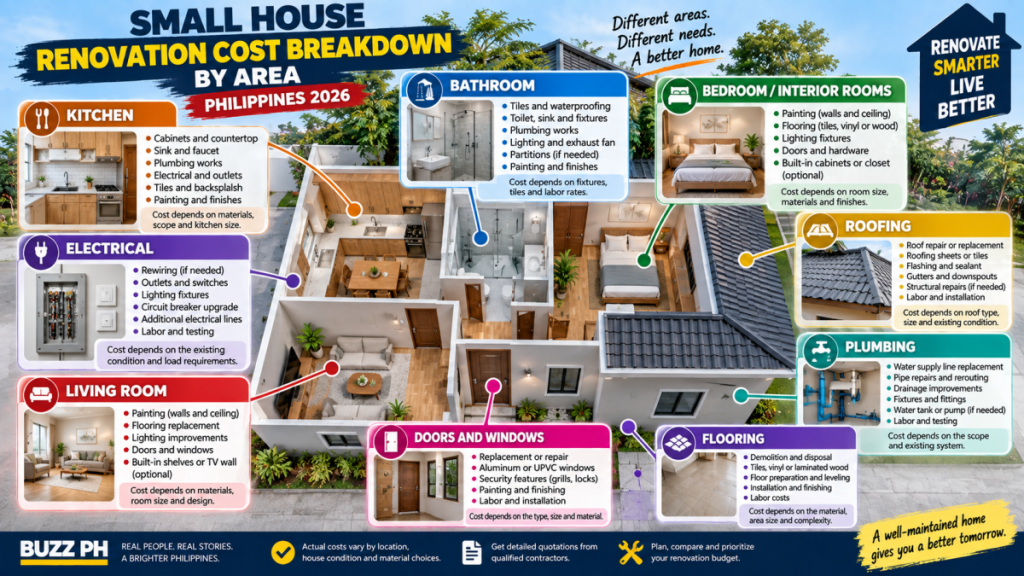
A leaking roof can undermine an otherwise good renovation.
Before spending heavily on interior paint, ceilings, cabinets or flooring, inspect the roof and address active leaks.
Look for:
- water stains
- damaged roofing sheets
- deteriorated flashing
- blocked gutters
- damaged roof framing
- recurring damp areas
If water enters the house, repairing the source should take priority over cosmetic work.
Labor and Materials: What Should You Compare?
There is no single labor percentage that can accurately apply to every renovation project in the Philippines.
Labor varies with:
- location
- trade
- project duration
- complexity
- worker experience
- demolition requirements
- site accessibility
- contractor involvement
- professional requirements
For this reason, homeowners should compare complete quotations rather than labor percentages alone.
A quotation should make clear whether it includes:
- materials
- labor
- demolition
- hauling
- installation
- delivery
- cleanup
- professional fees
- permits or permit assistance
- taxes, where applicable
- warranties or correction work
How to Compare Contractor Quotations
Try to obtain several quotations using the same scope of work.
Give each contractor the same information about:
- house size
- rooms
- materials
- preferred finishes
- electrical requirements
- plumbing requirements
- demolition
- project schedule
Then compare the actual inclusions.
A quotation that looks cheaper on the first page may exclude demolition, hauling, installation or finishing work.
The objective is not simply to find the lowest number.
It is to understand what you are actually paying for.
How Much Contingency Should You Keep?
A renovation contingency is money reserved for unexpected expenses.
For preliminary planning, a 10% to 15% reserve can be a useful starting point for many ordinary projects. Older homes or properties with uncertain conditions may justify a larger reserve.
| Base Budget | 10% Reserve | 15% Reserve |
|---|---|---|
| ₱100,000 | ₱10,000 | ₱15,000 |
| ₱200,000 | ₱20,000 | ₱30,000 |
| ₱300,000 | ₱30,000 | ₱45,000 |
| ₱500,000 | ₱50,000 | ₱75,000 |
This reserve is not intended for optional upgrades.
Keep it available until the major renovation work is substantially complete.
Hidden Costs That Homeowners Often Miss
A renovation budget can increase because of expenses that were not obvious during the initial planning stage.
Potential examples include:
- demolition
- debris hauling
- delivery charges
- surface preparation
- waterproofing
- electrical upgrades
- plumbing modifications
- replacement of damaged materials
- temporary storage
- site protection
- professional fees
- permits
- additional hardware
- transportation
- unexpected structural repairs
Ask contractors to identify exclusions in writing.
A detailed quotation is much easier to manage than a single lump-sum figure with no explanation.
Do You Need a Building Permit for a House Renovation?
This should be checked before work begins, not after construction has started.
The National Building Code of the Philippines, Presidential Decree No. 1096, states in Section 301 that a person, firm or corporation may not erect, construct, alter, repair, move, convert or demolish a building or structure without first obtaining a building permit from the Building Official, subject to the Code’s provisions and applicable rules.
The exact requirements depend on the nature of the project and the local Building Official.
For that reason, homeowners should contact the Office of the Building Official in the city or municipality where the property is located before starting renovation work.
Do not assume that a project is exempt from permitting simply because the house is small.
Why Local Permit Requirements Matter
Building-permit processes are administered locally, so documentation can vary depending on the project and jurisdiction.
For example, local government offices can require plans, bills of materials, cost estimates, proof of ownership and documents from licensed professionals depending on the application.
The National Building Code provides the national framework, while the local Building Official handles the applicable permit process.
Therefore, this guide does not present one nationwide “renovation permit fee” as though it applies to every homeowner.
Instead, confirm the actual requirements and fees with the appropriate local government office.
Example: Building a ₱250,000 Renovation Budget
Consider a hypothetical 50-square-meter house that has a usable structure but needs an interior update.
A planning allocation could be:
| Category | Allocation |
|---|---|
| Kitchen | ₱40,000 |
| Bathroom | ₱30,000 |
| Flooring | ₱35,000 |
| Painting and wall preparation | ₱20,000 |
| Electrical improvements | ₱20,000 |
| Plumbing | ₱15,000 |
| Doors, lighting and fixtures | ₱20,000 |
| Labor and project expenses | ₱45,000 |
| Contingency | ₱25,000 |
| Total | ₱250,000 |
This example is deliberately presented as a planning model, not as a claim that a 50-square-meter renovation always costs ₱250,000.
If an inspection reveals a serious roof problem, for example, the homeowner might reduce cosmetic work and redirect funds toward roofing.
The value of a budget model is that it helps identify trade-offs before money is spent.
How to Estimate Your Own Renovation Budget
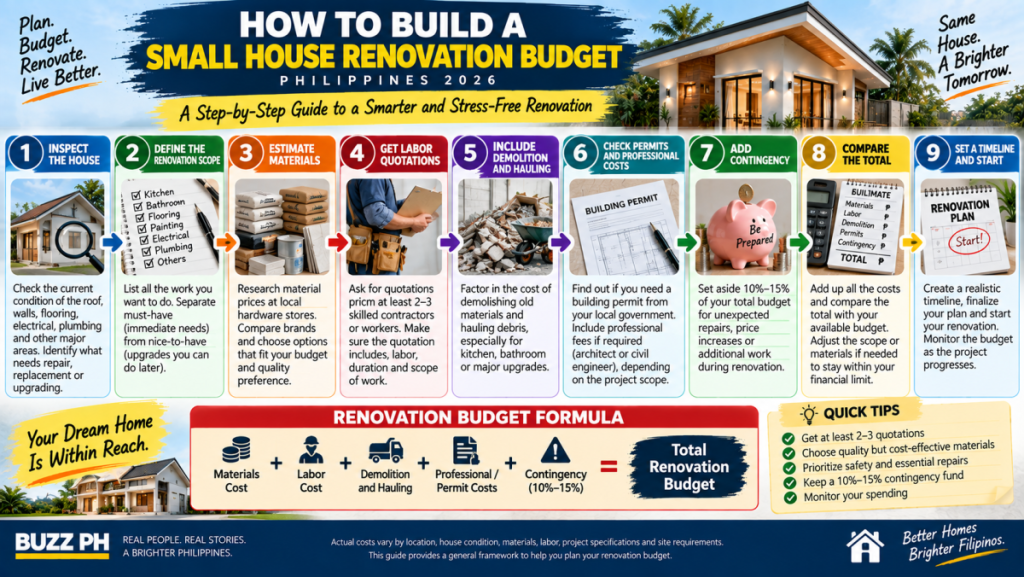
You can create a preliminary budget using this formula:
Estimated renovation budget = Materials + Labor + Demolition/Hauling + Professional/Permit Costs + Contingency
Start by listing every area that needs work.
Then divide the project into:
Essential repairs
Roof, electrical, plumbing, structural and water-related problems.
Functional improvements
Kitchen, bathroom, flooring, storage and lighting.
Cosmetic improvements
Paint, decorative finishes, fixtures and accessories.
Finally, add your contingency reserve.
This produces a more realistic starting point than simply deciding on a round number such as ₱200,000 and trying to force the entire renovation into it.
How to Renovate a Small House on a Limited Budget
When money is limited, prioritize work in this order:
1. Safety
Address dangerous electrical, structural and plumbing conditions.
2. Water and moisture
Fix leaks, drainage and waterproofing problems.
3. Function
Improve the kitchen, bathroom, storage and lighting.
4. Durability
Choose materials that can withstand normal household use.
5. Appearance
Spend the remaining budget on paint, decorative finishes and accessories.
This approach can reduce the risk of paying for the same problem twice.
Ways to Reduce Renovation Costs
You do not necessarily need the cheapest materials to control the renovation budget.
Instead, look for unnecessary work.
Potential cost-saving strategies include:
- retaining the existing room layout
- keeping serviceable doors
- repainting usable cabinets
- avoiding unnecessary demolition
- comparing multiple suppliers
- purchasing according to the construction schedule
- reducing material waste
- selecting standard-size fixtures
- renovating in phases
- comparing complete contractor quotations
Avoid compromising safety-related work simply to reduce the budget.
Electrical systems, structural repairs, waterproofing and essential plumbing deserve proper attention.
Should You Renovate Everything at Once?
Not always.
A phased renovation can be useful when the available cash is limited.
For example:
Phase 1: Roof, leaks, electrical and plumbing problems
Phase 2: Bathroom and kitchen
Phase 3: Flooring, ceiling and painting
Phase 4: Cabinets, lighting and cosmetic improvements
Phasing can help homeowners avoid spending their entire savings on one project.
However, it is worth checking whether combining certain work is more efficient. For example, opening a wall for electrical work may provide an opportunity to address other concealed services at the same time.
Common Small House Renovation Mistakes
Starting without a defined scope
Without a written scope, renovation projects can expand quickly.
Spending the entire budget before work begins
A contingency reserve protects against unexpected problems.
Ignoring the roof
Interior improvements can be damaged by unresolved water leaks.
Changing the layout unnecessarily
Moving plumbing and electrical points can increase labor and material requirements.
Choosing materials before measuring
Buying too early can result in excess materials or incorrect quantities.
Selecting the cheapest quotation automatically
A low price may exclude important work.
Making large upfront payments without clear milestones
Payments should follow a documented agreement and project progress.
Treating cosmetic improvements as more important than safety
Paint and decorative finishes should not take priority over unsafe wiring, serious leaks or structural problems.
How to Know If You Can Afford the Renovation
A renovation budget should be based on what you can comfortably finance—not simply what a contractor says the project could cost.
Before starting, consider:
- available cash
- emergency savings
- monthly household expenses
- existing debts
- temporary accommodation
- expected project duration
- contingency funds
- possible cost overruns
If a ₱300,000 renovation would leave you without enough money for emergencies, reducing the scope or completing the project in phases may be more practical.
The purpose of renovating your house is to improve it without creating an avoidable financial problem.
Small House Renovation Checklist

Before signing a renovation agreement, review this checklist:
- Define the exact renovation scope
- Inspect the roof
- Check for water leaks
- Inspect electrical systems
- Check plumbing and drainage
- Measure areas that will be renovated
- Set a maximum budget
- Reserve contingency funds
- Obtain comparable quotations
- Confirm what each quotation includes
- Check whether permits are required
- Confirm professional requirements
- Agree on materials and specifications
- Establish payment milestones
- Establish a target completion period
- Keep receipts and project records
- Inspect completed work before final payment
Final Takeaway
A small-house renovation in the Philippines can cost around ₱100,000 to ₱500,000 or more, but that range should be treated as a planning framework rather than a universal price list.
A ₱100,000 budget may be appropriate for targeted repairs and cosmetic improvements when the house is already in good condition. Around ₱200,000 to ₱300,000 can provide more room for kitchen, bathroom, flooring, painting and selected system upgrades. A ₱500,000-plus budget can support a much broader renovation, but major structural, roofing or layout changes can push costs considerably higher.
The most important step is to avoid relying on a single national cost-per-square-meter figure.
The PSA’s latest July 2026 construction statistics are useful for understanding the broader residential construction market, but PSA treats alteration and repair separately from its floor-area-based average construction cost.
For an actual renovation, build the budget from the condition of the house, defined scope of work, current material and labor quotations, applicable permit requirements and a contingency reserve.
That approach gives homeowners a much more realistic starting point than simply asking how much one square meter of renovation costs.
Editorial note: The budget amounts and allocations in this guide are illustrative planning scenarios created to help homeowners organize a renovation budget. They are not contractor quotations or official national renovation averages. Actual costs vary by location, house condition, materials, labor, project specifications and site requirements.
Sources and Research Notes
Philippine Statistics Authority — Construction Statistics from Approved Building Permits, July 2026
The PSA reported ₱13,058.66 per square meter as the average cost for residential construction in July 2026. The same release separately reported alteration and repair activity and explains that alteration and repair are excluded from the average cost-per-square-meter calculation because these projects have no reported floor area.
Presidential Decree No. 1096 — National Building Code of the Philippines
Section 301 establishes the building-permit requirement for covered construction, alteration, repair, moving, conversion and demolition work.
Department of Public Works and Highways — National Building Code materials
DPWH publishes materials and issuances concerning the National Building Code of the Philippines (PD 1096) and its Revised Implementing Rules and Regulations.
Local government building-permit offices
Actual renovation documentation, procedures and applicable fees should be confirmed with the Office of the Building Official in the city or municipality where the property is located because local implementation and project requirements can vary.


 Facebook
 Twitter