
Emergency fund Philippines planning starts with one important question: how much money would you need if your income suddenly stopped or an unexpected expense appeared? There is no single peso amount that works for every Filipino household because rent, food, transportation, debt payments, family responsibilities, and income stability can vary widely. This guide explains how to calculate a realistic emergency-fund target, set smaller savings milestones, choose an appropriate place to keep the money, and gradually build a financial buffer without relying on an unrealistic one-size-fits-all rule.
An emergency fund is money set aside specifically for unexpected expenses or financial disruptions, such as losing a job, dealing with an illness, paying for urgent home repairs, or handling another situation that cannot reasonably wait until your next paycheck. For many Filipinos, the difficult part is not understanding why an emergency fund matters but deciding exactly how much is enough.
A common starting point is three to six months of essential expenses, a range also reflected in financial education materials from the Bangko Sentral ng Pilipinas (BSP) and the Bureau of the Treasury. The right amount, however, depends on your income stability, household responsibilities, debt obligations, insurance coverage, number of dependents, and how quickly you could replace your income if you lost your job.
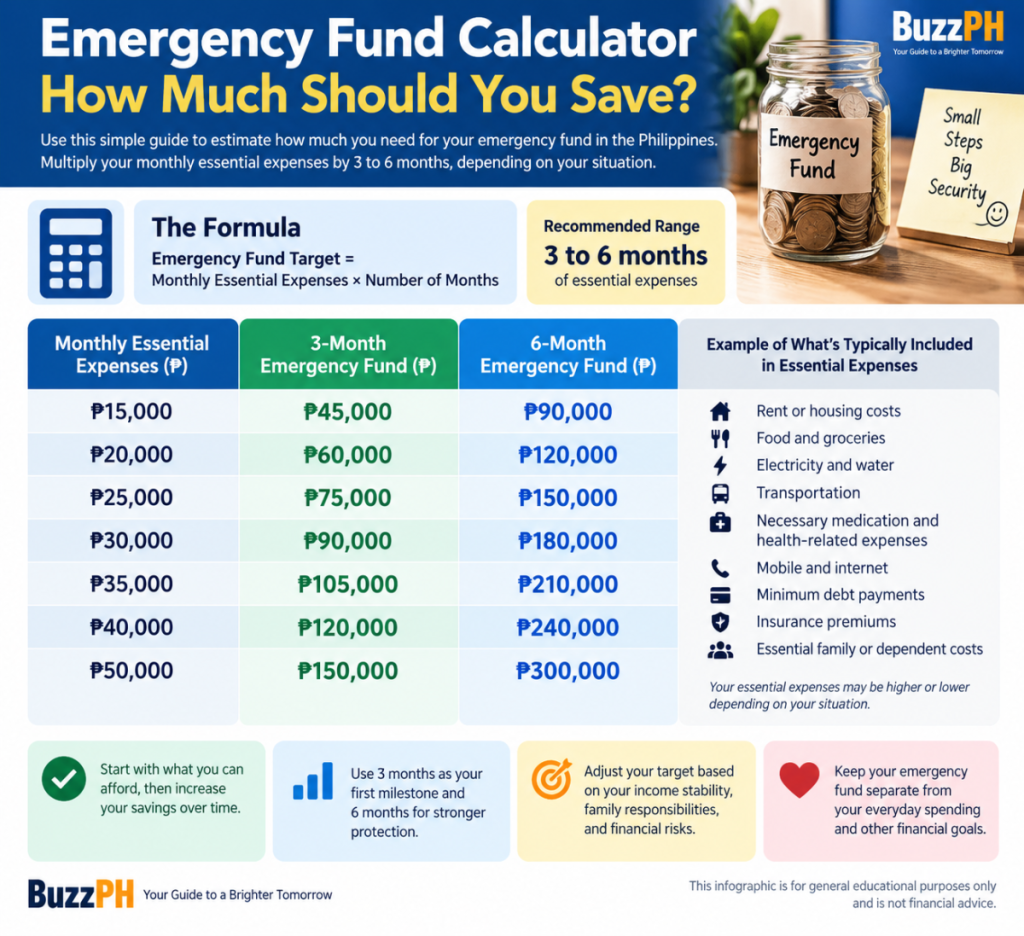
For example, someone whose essential expenses total ₱20,000 a month would need ₱60,000 for a three-month emergency fund and ₱120,000 for six months. Someone with ₱40,000 in essential monthly expenses would need ₱120,000 to ₱240,000 for the same targets.
This guide explains how to calculate your own emergency-fund target, when three months may be enough, when six months or more makes sense, what expenses should be included, where to keep the money, how to build the fund on a limited income, and what to do after you use it.
The examples in this article are original calculations created to illustrate different Philippine household situations. They are not claims about what a particular individual should save. Your own target should be based on your actual essential expenses and financial circumstances.
Why an Emergency Fund Matters
An emergency fund is different from ordinary savings.
Money for a vacation, new phone, car upgrade, home renovation, or investment is generally saved for a planned purpose. An emergency fund has a different job: it is there to protect your finances when something unexpected happens.
The Bureau of the Treasury’s FiLi financial-planning resources explain that an emergency fund can help when circumstances such as health problems, job loss, home repairs, and other unexpected events affect a person’s finances. Its guidance recommends keeping emergency savings separate from other financial goals and building approximately three to six months of monthly expenses.
The BSP similarly teaches that an emergency fund should be based on a person’s circumstances and projected needs. Its financial-education materials describe three to six months of expenses as a common benchmark, while also noting that some people may need six to nine months or more depending on their situation.
This is important because there is no single peso amount that works for everyone.
A ₱100,000 emergency fund could be substantial for one person and inadequate for another.
Consider two households.
A single employee living with family may have essential expenses of only ₱15,000 per month. A six-month fund for that person would be ₱90,000.
A family paying rent, utilities, food, transportation, school-related costs, insurance, and other essential expenses could spend ₱60,000 per month. A six-month fund would therefore be ₱360,000.
The difference is not because one person is better at saving. Their financial responsibilities are simply different.
That is why an emergency fund should be calculated from essential monthly expenses, not from an arbitrary amount seen on social media.
The 3-to-6-Month Rule
The simplest way to estimate an emergency fund is:
Emergency Fund Target = Essential Monthly Expenses × Number of Months
If your essential monthly expenses are ₱25,000:
3 months: ₱25,000 × 3 = ₱75,000
6 months: ₱25,000 × 6 = ₱150,000
If your essential expenses are ₱35,000:
3 months: ₱105,000
6 months: ₱210,000
If your essential expenses are ₱50,000:
3 months: ₱150,000
6 months: ₱300,000
These figures are examples rather than official savings requirements. The three-to-six-month range is a planning benchmark supported by Philippine financial-education materials, but your personal target can reasonably fall below or above it depending on your circumstances.
The key is to understand what your monthly number actually represents.
You should not automatically multiply your entire lifestyle budget by three or six.
An emergency fund is primarily intended to cover essential expenses.
That generally means costs that are necessary to maintain basic household needs and meet important financial obligations.
For example, essential expenses may include:
- Rent or basic housing costs
- Electricity
- Water
- Basic food
- Transportation needed for work
- Necessary medication
- Health-related expenses not covered elsewhere
- Minimum debt payments
- Insurance premiums that must remain active
- Basic communication expenses
- Essential family or dependent-related costs
Meanwhile, expenses such as restaurant meals, entertainment, vacations, luxury purchases, expensive hobbies, and other discretionary spending may not need to be included in your emergency-fund baseline.
This distinction can make a major difference.
Suppose your total monthly spending is ₱40,000, but only ₱28,000 is necessary to keep your household operating.
Using total spending would produce:
₱40,000 × 6 = ₱240,000
Using essential spending would produce:
₱28,000 × 6 = ₱168,000
Neither calculation is automatically “correct.” The important point is that you should understand what your number represents.
If your lifestyle could be reduced substantially during an emergency, your emergency-fund calculation may reasonably focus on the lower essential amount.
If you have dependents, medical needs, unstable income, or expenses that cannot easily be reduced, a higher target may make more sense.
Three Months or Six Months?
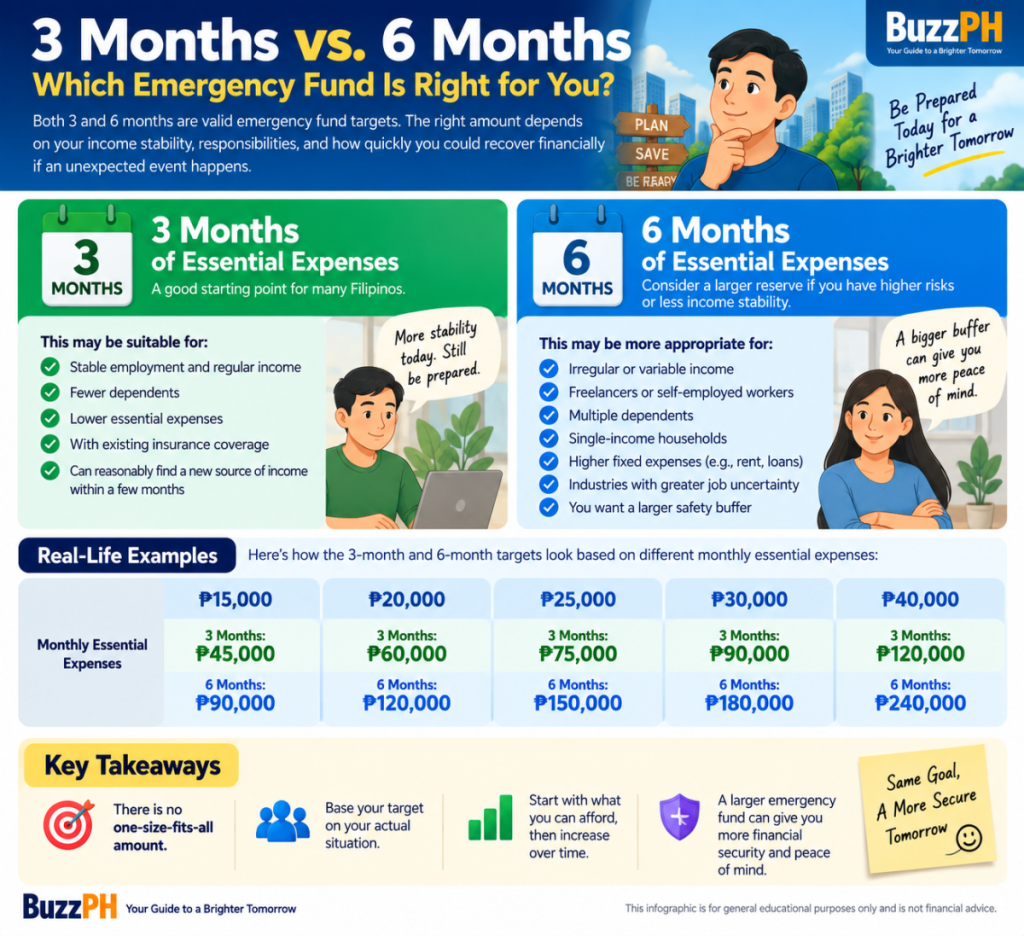
Three months is often a reasonable initial milestone.
It gives you a meaningful financial buffer without requiring you to save an extremely large amount before feeling protected.
For someone with ₱20,000 in essential monthly expenses, three months means ₱60,000.
That can already provide an important cushion for a short period of unemployment or a major unexpected expense.
Six months provides a larger margin of safety.
It may be more appropriate if your household relies heavily on one income, you have children or other dependents, your employment is uncertain, your income fluctuates, or finding another job could take considerable time.
For example, imagine a household with ₱45,000 in essential monthly expenses.
Three months:
₱45,000 × 3 = ₱135,000
Six months:
₱45,000 × 6 = ₱270,000
The additional ₱135,000 creates a much larger buffer.
There is also nothing preventing someone from setting an even higher target.
The BSP’s financial-education materials acknowledge that some situations may call for six to nine months or more of expenses.
A self-employed person whose income changes substantially from month to month may want a larger reserve than an employee with a highly stable salary.
Likewise, a household with several dependents may reasonably choose a larger target.
The goal isn’t to follow a rule blindly. The goal is to create enough liquidity to give yourself time to respond to an emergency without immediately relying on high-cost debt.
Who Should Aim for Three Months?
A three-month emergency fund can be a reasonable first major target for people with relatively predictable finances.
You may consider starting with three months if you:
- Have stable employment
- Have predictable monthly income
- Have few or no dependents
- Have health or insurance protection that reduces certain financial risks
- Have relatively low essential expenses
- Have access to other legitimate financial support if necessary
- Are still building your first meaningful cash reserve
Three months does not mean your financial preparation is finished.
It can simply be your first major milestone.
For someone starting from zero, trying to immediately save six months of expenses may feel impossible. Setting a three-month target can make the goal more achievable.
Once you reach it, you can reassess.
If your circumstances suggest that six months would be safer, continue building.
Who Should Consider Six Months or More?
A larger emergency fund can be especially useful when income is unpredictable or financial responsibilities are high.
Consider aiming toward six months or more if you:
- Are self-employed
- Work on a contract basis
- Earn primarily through commissions
- Have irregular freelance income
- Are the main income earner in your household
- Support children or other dependents
- Have significant necessary monthly debt payments
- Have limited insurance coverage
- Work in an industry where finding another job may take time
- Have elderly family members who depend on your income
- Have unusually high essential expenses
- Operate a small business and have limited personal cash reserves
The important distinction is between income volatility and expense flexibility.
A person with a stable ₱50,000 salary and ₱20,000 in essential expenses may have a different risk profile from a freelancer earning an average of ₱50,000 whose essential expenses are also ₱20,000.
Their average income may be identical, but the stability of that income is not.
How to Calculate Your Personal Emergency Fund
Start by reviewing the previous two or three months of spending.
Look at your bank transactions, e-wallet records, bills, receipts, credit-card statements, and other payment records.
Do not rely entirely on memory.
Create two categories:
Essential
and
Non-essential
Then identify the minimum amount you would realistically need each month if you were temporarily without your normal income.
For example:
| Essential Expense | Monthly Amount |
|---|---|
| Rent | ₱10,000 |
| Food | ₱8,000 |
| Electricity and water | ₱3,000 |
| Transportation | ₱2,500 |
| Phone/internet | ₱1,500 |
| Medication | ₱1,000 |
| Minimum debt payments | ₱2,000 |
| Total | ₱28,000 |
The emergency-fund calculation would therefore be:
₱28,000 × 3 = ₱84,000
₱28,000 × 6 = ₱168,000
So the household’s practical target range could be ₱84,000 to ₱168,000, depending on its financial situation.
This is more useful than saying, “Everyone should have ₱100,000.”
Emergency Fund Examples for Filipinos
To make the calculation easier to understand, here are several original examples.
A single worker with ₱18,000 in essential expenses would have:
Three months: ₱54,000
Six months: ₱108,000
A worker with ₱25,000 in essential expenses would have:
Three months: ₱75,000
Six months: ₱150,000
A household with ₱35,000 in essential expenses would have:
Three months: ₱105,000
Six months: ₱210,000
A household with ₱50,000 in essential expenses would have:
Three months: ₱150,000
Six months: ₱300,000
A household with ₱70,000 in essential expenses would have:
Three months: ₱210,000
Six months: ₱420,000
These examples illustrate why income alone isn’t the best way to determine an emergency fund.
Two people earning the same salary can need very different emergency reserves.
Emergency Fund Based on Income vs. Expenses
Some people calculate emergency savings as a percentage of their salary.
That can be useful when establishing a savings habit, but it is not the best way to determine the final emergency-fund target.
For example, saving 20% of a ₱30,000 salary means:
₱30,000 × 20% = ₱6,000 per month
That tells you how quickly you are saving.
It does not tell you how much you ultimately need.
Your final target should be based primarily on your essential expenses and financial risk.
This distinction is important.
If you earn ₱30,000 but spend only ₱18,000 on essential costs, a six-month emergency fund is ₱108,000.
If another person earns ₱60,000 but requires ₱40,000 to cover essential household expenses, a six-month fund is ₱240,000.
The second person earns more but also needs a larger cash reserve.
How Much Should You Save Every Month?
There is no universal percentage that every Filipino should save.
A 2026 Philippine Information Agency report citing BSP guidance says the three-to-six-month emergency-fund range is a useful target, while also emphasizing that saving percentages depend on an individual’s financial circumstances. The same report notes the BSP’s “income minus savings equals expenses” approach, which prioritizes saving rather than treating savings as whatever happens to remain at the end of the month.
Suppose your target is ₱120,000.
If you save ₱5,000 a month:
₱120,000 ÷ ₱5,000 = 24 months
At ₱7,500 per month:
₱120,000 ÷ ₱7,500 = 16 months
At ₱10,000 per month:
₱120,000 ÷ ₱10,000 = 12 months
At ₱3,000 per month:
₱120,000 ÷ ₱3,000 = 40 months
The important thing is consistency.
The Bureau of the Treasury also recommends regular deposits and building savings as a financial habit rather than treating saving as a one-time activity.
If your income is limited, starting with ₱500 or ₱1,000 per month can still establish the habit.
The first objective is not to reach a large number immediately.
It is to build a financial buffer that did not exist before.
What If You Can Only Save ₱1,000 a Month?
Do not assume that an emergency fund is impossible because you cannot save several thousand pesos each month.
Suppose you start with zero and save ₱1,000 every month.
After one year:
₱12,000
After two years:
₱24,000
After three years:
₱36,000
That may not represent a full three-month emergency fund, but it is still a meaningful financial reserve.
If you receive a bonus, tax refund, side-income payment, gift, or other legitimate windfall, you can choose to direct part of it toward the emergency fund.
The objective is to gradually increase the reserve without creating another financial problem.
A savings plan that forces you to borrow money for everyday expenses is not sustainable.
What If You Have Debt?
This is one of the most difficult questions because people often hear conflicting advice.
Should you build an emergency fund first or pay debt first?
There is no single answer for every household.
If you have no emergency savings at all, building a small initial cash buffer can be useful. Without any reserve, even a relatively small unexpected expense can force you to use a credit card, borrow from another person, or take another loan.
Once a basic buffer exists, you can evaluate your higher-interest debt and your emergency-fund target together.
The Philippine Information Agency reported in January 2026 that BSP guidance encourages saving while also addressing existing debt, with debt strategies including prioritizing high-interest balances.
The practical approach is to avoid treating your emergency fund and debt repayment as completely separate problems.
For example, you might initially build ₱10,000 to ₱20,000 of accessible emergency savings while aggressively paying expensive debt. After the costly debt is reduced or eliminated, you can redirect the money that had been going toward debt into your emergency fund.
The exact balance depends on interest rates, income stability, and your household’s risk.
Where Should You Keep Your Emergency Fund?
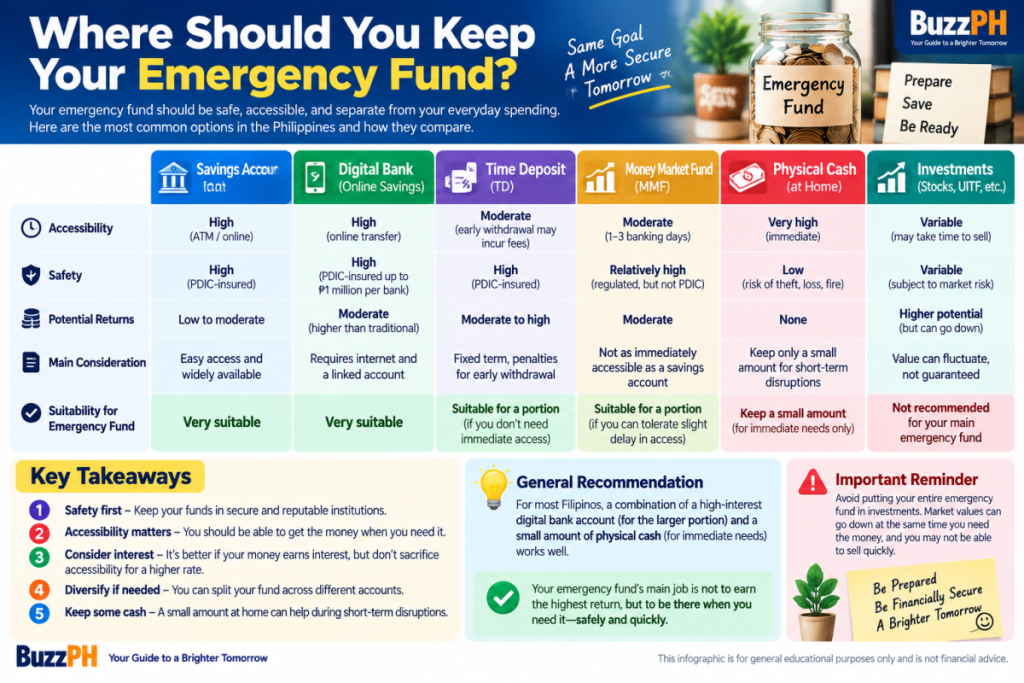
An emergency fund needs two qualities:
Accessibility
and
Safety
The money is supposed to be available when you actually need it.
That generally means an emergency fund should not be placed entirely in assets that can experience substantial price fluctuations or may take time to sell.
The Bureau of the Treasury’s FiLi financial-education materials recommend keeping emergency savings in a separate savings account and emphasize the importance of regular saving.
For many households, a bank savings account can be a practical location for at least part of the emergency fund because the money is relatively accessible.
You should also consider separating your emergency fund from your daily spending account.
If your emergency money sits in the same account you use for food delivery, shopping, entertainment, and everyday purchases, it can be easier to spend without realizing it.
A separate account creates a psychological barrier.
You can still access the money when a genuine emergency occurs, but it is less visible during ordinary spending.
Is a Bank Account Safe for Emergency Savings?
If you keep deposits in a PDIC member bank, deposit insurance is an important consideration.
As of 2026, the Philippine Deposit Insurance Corporation provides maximum deposit insurance coverage of ₱1 million per depositor, per bank. The increased coverage took effect on March 15, 2025.
This does not mean every financial product is automatically covered.
Deposit insurance applies according to PDIC rules and covered deposit categories. It is therefore important to understand what type of account you are using and whether the institution is a PDIC member.
If your emergency savings eventually become large enough to exceed the maximum insured amount at one bank, you can research how deposit coverage works and whether spreading deposits across member banks is appropriate for your situation.
PDIC also encourages depositors to verify their bank’s membership and maintain accurate account information.
The emergency fund’s purpose is not to maximize investment returns.
Its primary purpose is financial resilience.
Should Your Emergency Fund Earn Interest?
Ideally, your emergency savings should not simply sit unused if there is a safe, accessible account that pays interest.
However, interest should not be the only factor.
A savings product that offers a higher rate but makes withdrawals difficult may not be suitable for the entire emergency fund.
Think of the money according to its job.
If you need it for an emergency tomorrow, accessibility matters.
If part of the fund can remain untouched for longer, you can research appropriate savings products and compare their terms, withdrawal rules, minimum balances, fees, and interest conditions.
Avoid putting the entire emergency fund into investments simply because an investment might generate a higher return.
An investment can decline in value at precisely the time you need the money.
How Much Cash Should You Keep at Home?
A small amount of physical cash can be useful during temporary disruptions involving electricity, internet connectivity, banking systems, or other payment difficulties.
But keeping an entire emergency fund in cash at home introduces other risks, including theft, loss, fire, and lack of interest.
For that reason, the question isn’t whether you should keep your entire emergency fund in physical cash.
Instead, consider how much accessible cash would reasonably help your household deal with a short-term disruption while keeping the larger reserve in a safer financial account.
The appropriate amount depends on your household and circumstances.
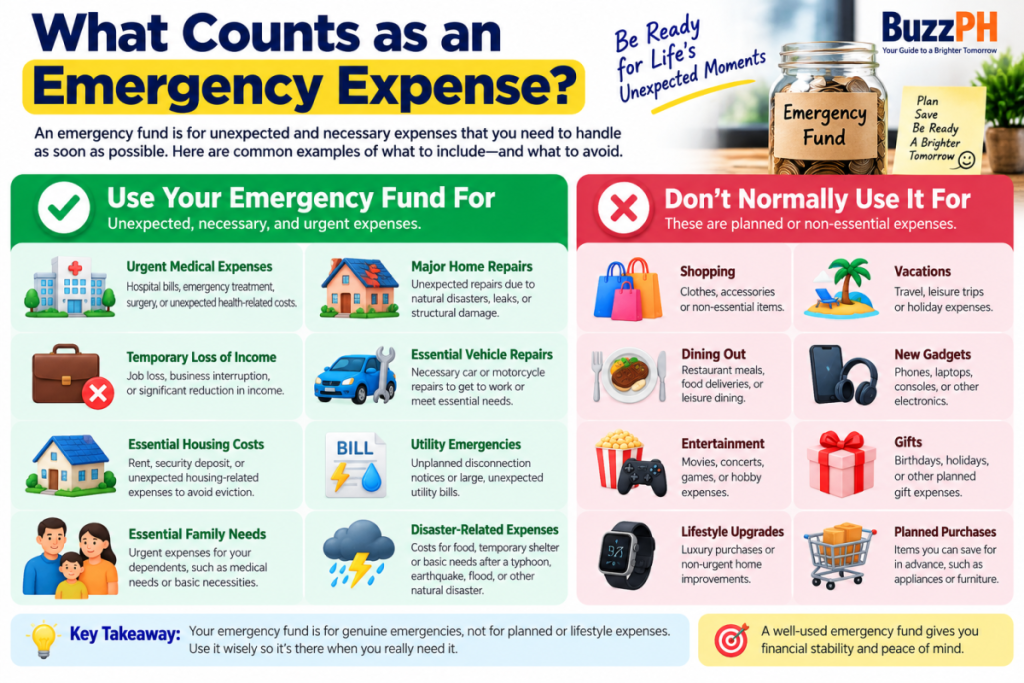
What Counts as a Real Emergency?
One of the biggest problems with emergency funds is that people sometimes use them for expenses that are unexpected but not truly emergencies.
An emergency is generally something that is:
- Unexpected
- Necessary
- Difficult to postpone
- Financially significant enough to affect your normal budget
Examples could include:
- Sudden medical expenses
- A necessary repair after serious home damage
- Unexpected essential transportation repairs
- Temporary loss of employment
- Emergency travel involving an immediate family situation
- Essential expenses during a major disruption
Meanwhile, a new smartphone because your current model feels outdated is not generally an emergency.
Neither is an unplanned vacation.
Neither is a sale on something you have wanted to buy.
Creating a clear definition before an emergency occurs can make it easier to protect the fund.
Emergency Fund vs. Sinking Fund
Not every irregular expense is an emergency.
A sinking fund is money you intentionally save for a known or predictable future expense.
For example:
- Annual insurance
- School expenses
- Vehicle registration
- Property taxes
- Holiday spending
- Planned home repairs
- Appliance replacement
- Birthdays
- Travel
These expenses may not occur every month, but you can anticipate them.
If your car insurance costs ₱12,000 annually, you could save ₱1,000 per month for it.
That is better than treating the annual payment as an emergency.
The same principle applies to school expenses or annual bills.
Separating predictable irregular expenses from genuine emergencies helps protect the emergency fund.
Emergency Fund vs. Investments
An emergency fund and an investment portfolio have different purposes.
Emergency savings are designed for stability and access.
Investments are generally designed for longer-term growth and can involve risk.
It is therefore possible to have both without confusing their roles.
For example:
Emergency fund: Money needed for unexpected events.
Short-term savings: Money for upcoming planned expenses.
Investments: Money intended for longer-term goals.
The Bureau of the Treasury’s financial-planning guidance similarly separates emergency savings from long-term savings and investments.
The mistake is treating investments as a substitute for an emergency fund simply because the investment has a higher expected return.
When an emergency happens, you may not have the luxury of waiting for a favorable market price.
Should You Include Insurance When Calculating Your Emergency Fund?
Insurance can reduce some financial risks, but it should not automatically be treated as a replacement for emergency savings.
For example, health insurance or HMO coverage may reduce the amount you personally pay for certain medical events, but there may still be deductibles, exclusions, uncovered services, transportation costs, medication, or other expenses.
Likewise, insurance can help with certain property or vehicle losses without necessarily covering every related cost.
Insurance and emergency savings can therefore complement each other.
The stronger your protection against major financial risks, the more confidently you can assess how large your cash reserve needs to be.
Should Families Have a Larger Emergency Fund?
Often, yes.
A household with several dependents has more variables to consider than a single person.
If one person loses their income, the entire household may be affected.
For example, imagine a family with ₱45,000 in essential monthly expenses.
A three-month reserve is:
₱135,000
A six-month reserve is:
₱270,000
If the household is supported primarily by one income and the income could disappear unexpectedly, the six-month target may provide a stronger buffer.
The household should still consider its actual circumstances rather than blindly choosing six months.
What About Freelancers and Self-Employed Workers?
People with irregular income often need to think beyond the standard three-month rule.
A salaried employee may know approximately when the next paycheck will arrive.
A freelancer may have a strong month followed by a weak month.
A small-business owner may have revenue without necessarily having consistent personal income.
In those situations, a larger emergency reserve may make sense.
For example, if essential monthly personal expenses are ₱30,000:
Three months = ₱90,000
Six months = ₱180,000
Nine months = ₱270,000
The higher target can provide additional time to find new clients, replace lost income, or adjust business operations.
However, self-employed workers should distinguish their personal emergency fund from business operating cash.
Money needed to pay employees, suppliers, rent, taxes, or business obligations should not automatically be counted as personal emergency savings.
What If Your Income Is Irregular?
Instead of saving exactly the same peso amount every month, you can use a percentage-based system.
For example, if you decide to direct 20% of irregular income toward your emergency fund:
A ₱25,000 month could produce ₱5,000 in savings.
A ₱40,000 month could produce ₱8,000.
A ₱60,000 month could produce ₱12,000.
This approach allows your contribution to rise when income rises without forcing you to save an unrealistic fixed amount during weaker months.
The BSP has emphasized that saving rates should reflect individual financial circumstances rather than assuming one percentage works for everyone.
What If You Already Have ₱100,000 Saved?
Don’t automatically assume that ₱100,000 means you have a complete emergency fund.
Calculate your essential expenses first.
If your essential expenses are ₱15,000:
₱100,000 ÷ ₱15,000 = approximately 6.7 months
That’s a substantial reserve.
If your essential expenses are ₱30,000:
₱100,000 ÷ ₱30,000 = approximately 3.3 months
That’s around the lower end of the common target range.
If your essential expenses are ₱50,000:
₱100,000 ÷ ₱50,000 = 2 months
That household may need to continue building.
This is why the question “Is ₱100,000 enough?” cannot be answered without knowing the person’s expenses.
What If You Have More Than Six Months Saved?
Once you have reached six months of essential expenses, you can reassess your financial priorities.
You might decide that your emergency fund is complete.
You might also decide that a larger reserve is appropriate because your income is unstable or you have significant dependents.
If your emergency fund is already comfortably funded, additional money may be directed toward other goals such as debt reduction, retirement savings, education, home ownership, or long-term investments, depending on your circumstances.
The important point is that emergency savings should not become an excuse to avoid every other financial goal indefinitely.
What Happens When You Use Your Emergency Fund?
Using the emergency fund is not a failure.
That is exactly what it exists for.
If you lose your job and use ₱40,000 to cover essential expenses, the fund has performed its purpose.
The next step is to rebuild it.
Suppose your original target was ₱150,000 and you used ₱40,000.
Your remaining balance is:
₱110,000
Your rebuilding target is:
₱40,000
If you can save ₱5,000 per month, rebuilding takes eight months.
If you save ₱8,000 per month, it takes five months.
If you receive a legitimate bonus or additional income during that period, you can decide whether to accelerate the rebuilding process.
The key is not to feel discouraged because the balance temporarily decreased.
An emergency fund is meant to be used when a genuine emergency happens.
An Original Emergency Fund Calculation You Can Use
Here’s a simple worksheet readers can copy:
Step 1: Calculate essential monthly expenses.
Step 2: Remove discretionary spending from the calculation.
Step 3: Multiply essential expenses by three.
Step 4: Multiply essential expenses by six.
Step 5: Consider whether your income stability and household responsibilities justify a larger target.
For example:
Monthly essential expenses: ₱32,000
Three-month target:
₱32,000 × 3 = ₱96,000
Six-month target:
₱32,000 × 6 = ₱192,000
If you have unstable income and dependents, you might decide that the higher end is more appropriate.
This isn’t a government-mandated amount. It is a personal planning calculation based on your circumstances.
A Practical Emergency Fund Roadmap
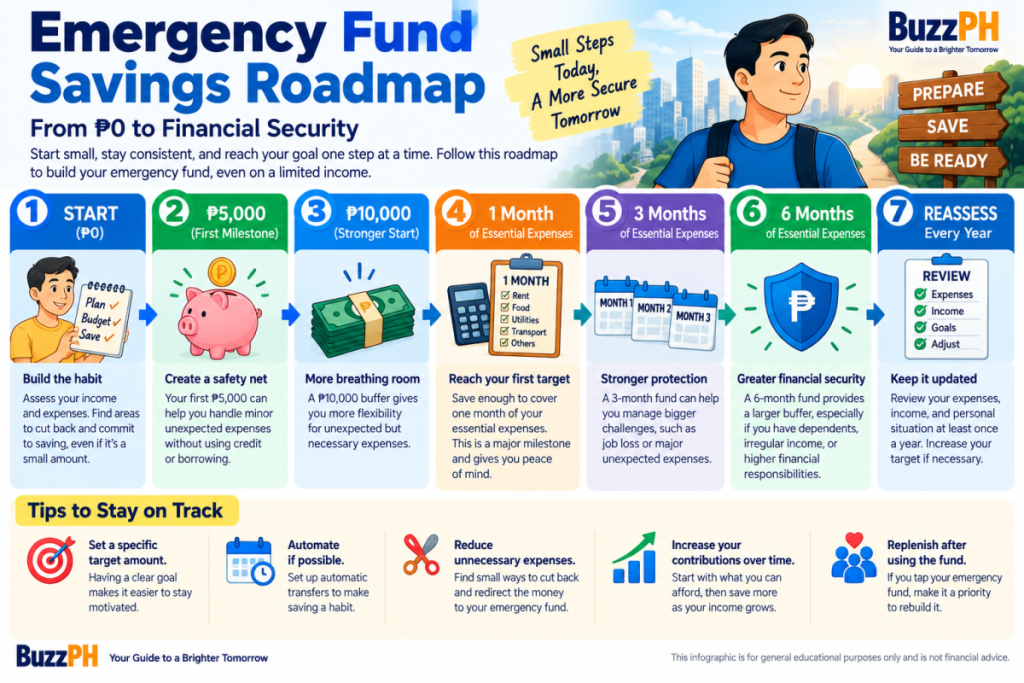
Someone starting from zero doesn’t have to think immediately about saving hundreds of thousands of pesos.
Break the goal into milestones.
Milestone 1: ₱5,000
This creates the first small buffer.
Milestone 2: ₱10,000
This can help cover some smaller unexpected expenses.
Milestone 3: One month of essential expenses
This becomes your first meaningful emergency reserve.
Milestone 4: Three months
This is a major financial-safety milestone.
Milestone 5: Six months
This provides a larger cushion for people who need additional protection.
Milestone 6: Reassess annually
Your emergency fund should change when your life changes.
If your rent increases, you have a child, your income changes, you take on debt, or you become self-employed, your target may need to be recalculated.
How Much Should You Keep in 2026?
For most people, a sensible starting framework is:
Minimum initial goal: Build a small cash buffer.
First major goal: Three months of essential expenses.
Stronger target: Six months of essential expenses.
Higher-risk situation: Six to nine months or more may be reasonable.
This aligns with Philippine financial-education guidance while leaving room for individual circumstances. The BSP and Bureau of the Treasury both emphasize that the appropriate amount depends on a person’s situation rather than one universal number.
The Philippine Statistics Authority’s 2023 Family Income and Expenditure Survey also demonstrates why a single peso target cannot reasonably apply to every Filipino household. The survey estimated average annual family income at ₱353.23 thousand and average annual family expenditure at ₱258.05 thousand in 2023, but household finances varied significantly by region and income group.
For example, the PSA reported average annual family expenditure of approximately ₱204.33 thousand in the Davao Region in 2023, while NCR’s average was approximately ₱385.05 thousand.
These statistics should not be interpreted as recommended emergency-fund amounts. They simply illustrate why financial planning needs to account for differences in household circumstances and location.
Original Research and How This Guide Was Developed
This guide was developed using primary and government sources rather than relying solely on generic personal-finance articles.
The research included financial-education materials from the Bangko Sentral ng Pilipinas, the Bureau of the Treasury’s FiLi program, the Philippine Deposit Insurance Corporation, and the Philippine Statistics Authority.
The BSP’s financial-education resources explain the role of emergency funds, the importance of building financial reserves, and the idea that the appropriate amount depends on individual circumstances.
The Bureau of the Treasury’s FiLi financial-planning materials specifically discuss emergency funds and recommend approximately three to six months of monthly expenses while encouraging regular deposits and a separate savings account.
PDIC information was reviewed to verify the current maximum deposit insurance coverage. As of 2026, the maximum coverage is ₱1 million per depositor per bank.
PSA’s 2023 Family Income and Expenditure Survey was used to provide Philippine household-income and spending context rather than relying on foreign household statistics. The PSA identifies FIES as the country’s primary source of family income and expenditure information.
The calculations and household examples throughout this guide were independently calculated for illustration. They are not copied from the government sources and should not be interpreted as official recommendations.
This distinction matters because a high-quality financial guide should separate verified facts, original calculations, and personal financial-planning suggestions.
Practical Experience Without Inventing Personal Claims
This guide does not claim that Buzz PH personally experienced a job loss, medical emergency, or other financial crisis in order to manufacture first-hand experience.
Instead, the practical guidance is based on applying the documented financial-planning principles to realistic Philippine household situations.
For example, the calculations demonstrate how the same three-to-six-month principle produces very different targets depending on essential expenses. The article also separates emergency funds from sinking funds, investments, everyday savings, insurance, and business operating cash because these categories serve different financial purposes.
That distinction is particularly important for readers who are trying to build their first emergency fund.
The goal is not to tell every Filipino to save an arbitrary amount.
The goal is to give readers a repeatable method:
Identify essential expenses → calculate three months → calculate six months → assess personal risk → choose a realistic target → save consistently → rebuild after use.
That method can be applied again whenever a person’s financial circumstances change.
Frequently Asked Questions
How much should I have in an emergency fund in 2026?
A common benchmark is three to six months of essential expenses. For higher-risk situations, six to nine months or more may be appropriate. The correct amount depends on income stability, household responsibilities, debt, insurance, and other circumstances. Philippine financial-education materials from the BSP and Bureau of the Treasury use the three-to-six-month range as a useful guide.
Is ₱100,000 enough for an emergency fund?
It depends on your essential monthly expenses. If you need ₱20,000 per month, ₱100,000 represents five months of essential expenses. If you need ₱40,000, it represents only 2.5 months.
Should I save three or six months of expenses?
Three months can be a useful first major target. Six months may be more appropriate for households with unstable income, dependents, high essential expenses, or other financial risks.
Should my emergency fund be based on salary?
It is generally more useful to base the final target on essential expenses rather than salary. Salary can help determine how quickly you can build the fund, while essential expenses help determine how much you actually need.
Where should I keep my emergency fund?
A separate, accessible savings account can be practical for emergency savings. Consider safety, accessibility, fees, withdrawal rules, and applicable deposit insurance rather than focusing only on the interest rate. PDIC’s maximum deposit insurance coverage is currently ₱1 million per depositor per bank.
Should I invest my emergency fund?
The primary purpose of an emergency fund is accessibility and financial protection. Investments can fluctuate in value, so putting the entire emergency reserve into investments may expose money you need urgently to market risk.
Should I build an emergency fund if I have debt?
You may still benefit from maintaining a basic cash buffer while addressing debt. The appropriate balance depends on your debt interest rates, income stability, and financial situation. High-interest debt generally deserves particular attention.
Can I use my emergency fund for a vacation?
A vacation is normally better handled through a separate sinking fund. Keeping planned expenses separate helps protect emergency savings for genuine unexpected situations.
What if I can only save ₱500 or ₱1,000 a month?
Start with what you can realistically sustain. Saving ₱1,000 monthly produces ₱12,000 after one year, before considering any interest. A smaller emergency fund is generally more useful than having no reserve at all.
Should I keep six months of my total spending?
Not necessarily. Many emergency-fund calculations focus on essential expenses rather than discretionary spending. However, households with higher financial risks may intentionally choose a larger reserve.
Does insurance replace an emergency fund?
No. Insurance can reduce certain financial risks, but it may not cover every expense associated with an emergency. An emergency fund provides accessible cash for costs that insurance does not cover.
How often should I recalculate my emergency fund?
Review it whenever your major financial circumstances change. An annual review is also useful. Recalculate if your rent, household size, income, debt, medical needs, or other essential expenses change.
What is the biggest mistake people make with emergency funds?
One common mistake is choosing an arbitrary peso target without calculating essential expenses. Another is keeping emergency savings in an account that is too easy to spend from or investing money that may be needed immediately.
Final Takeaway
There is no single emergency-fund amount that every Filipino needs in 2026.
A better approach is to calculate your own number.
Start with your essential monthly expenses and multiply that amount by three to establish a basic target. Then multiply it by six to establish a stronger target.
For example:
₱20,000 monthly essentials → ₱60,000 to ₱120,000
₱30,000 monthly essentials → ₱90,000 to ₱180,000
₱40,000 monthly essentials → ₱120,000 to ₱240,000
₱50,000 monthly essentials → ₱150,000 to ₱300,000
If your income is unpredictable or your household has significant responsibilities, consider whether six months or more would provide better protection.
Most importantly, don’t wait until you can save a huge amount before starting.
An emergency fund is built gradually.
Save consistently, keep the money separate from everyday spending, protect its accessibility, and replenish it after you use it.
The purpose of an emergency fund isn’t to make you wealthy.
Its purpose is to give you financial breathing room when something goes wrong.
Editorial Transparency
Publisher: Buzz PH
Article topic: Personal finance and emergency savings
Last reviewed: September 2026
Research basis: Official Philippine government financial-education, deposit-insurance, and household-income/expenditure sources.
Methodology: Review of official Philippine sources, supported by original calculations and Philippine household scenarios developed for this guide.
Disclosure: This article is for general educational purposes and is not individualized financial, investment, tax, or legal advice.
Primary Sources Used
- Bangko Sentral ng Pilipinas — Economic and Financial Education
- Bureau of the Treasury — FiLi Financial Planning 101
- Philippine Deposit Insurance Corporation — Deposit Insurance
- Philippine Statistics Authority — Family Income and Expenditure Survey






 Facebook
 Twitter