
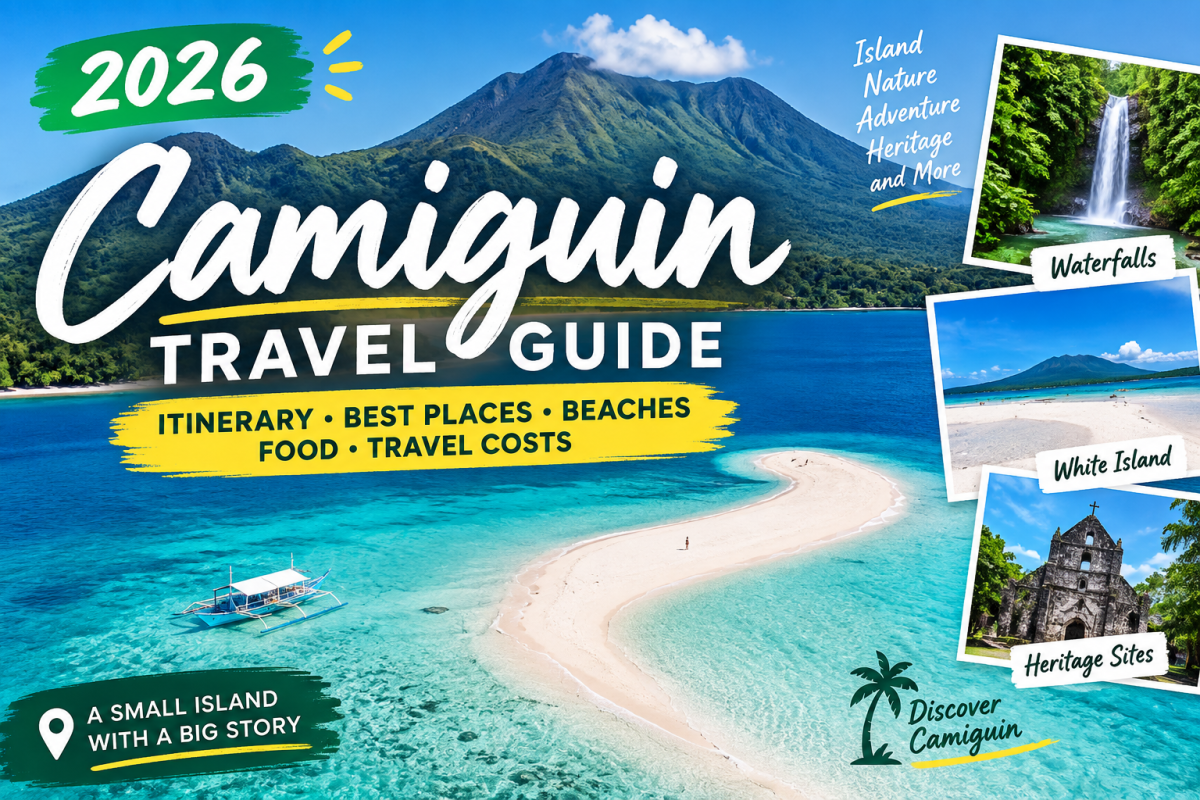
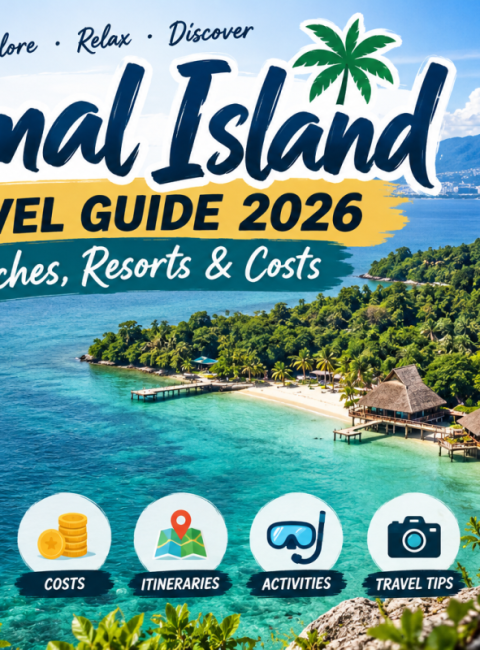
Camiguin travel guide 2026 planning is easier when you understand how the island’s beaches, waterfalls, volcanic landscapes, heritage sites and boat excursions fit together. From White Island and Mantigue Island to Katibawasan Falls, the Sunken Cemetery and Guiob Church Ruins, Camiguin offers a mix of nature, adventure and history within a relatively compact destination. This guide brings together a practical itinerary, current travel-cost references, transportation information, food ideas and planning tips to help you build a realistic trip.
Camiguin is one of the Philippines’ most distinctive island destinations, combining volcanic landscapes, waterfalls, natural springs, beaches, marine sanctuaries and historic sites within a relatively compact province.
Known as the “Island Born of Fire,” Camiguin’s landscape was shaped by volcanic activity. That history remains visible in destinations such as the Sunken Cemetery, Guiob Church Ruins and the slopes of its volcanic mountains.
But Camiguin is not simply a destination where travelers move from one tourist attraction to another.
A good Camiguin itinerary needs to consider geography, transportation, weather, boat availability and travel time. White Island and Mantigue Island depend on sea conditions and boat arrangements, while waterfalls, springs and heritage sites can generally be incorporated more flexibly.
This 2026 guide is designed to help travelers plan a realistic Camiguin trip rather than simply provide a list of places to visit. It covers how to get there, where to go, how many days to stay, what to eat, where to stay, transportation, current cost references and practical planning considerations.
Research & Editorial Review
Research & Editorial Review: Patricia G. Ramos
Last researched: September 2026
This guide prioritizes official government and tourism sources for destination, heritage and transportation information. Current prices are treated separately because ferry fares, hotel rates, boat fees and entrance charges can change.
Where a price could be verified from a current listing, it is identified as a current observed price or published reference price, rather than a permanent rate.
Buzz PH does not claim first-hand visits unless they actually occurred. Practical recommendations in this guide are based on documented information, geographic considerations, transportation logistics and itinerary analysis.
Last Updated
Last Updated: September 16, 2026
Information checked: September 2026
Important: Ferry schedules, fares, boat rates, accommodation prices, entrance fees and operating conditions may change. Confirm time-sensitive information with the relevant operator or tourism office before traveling.
Camiguin at a Glance
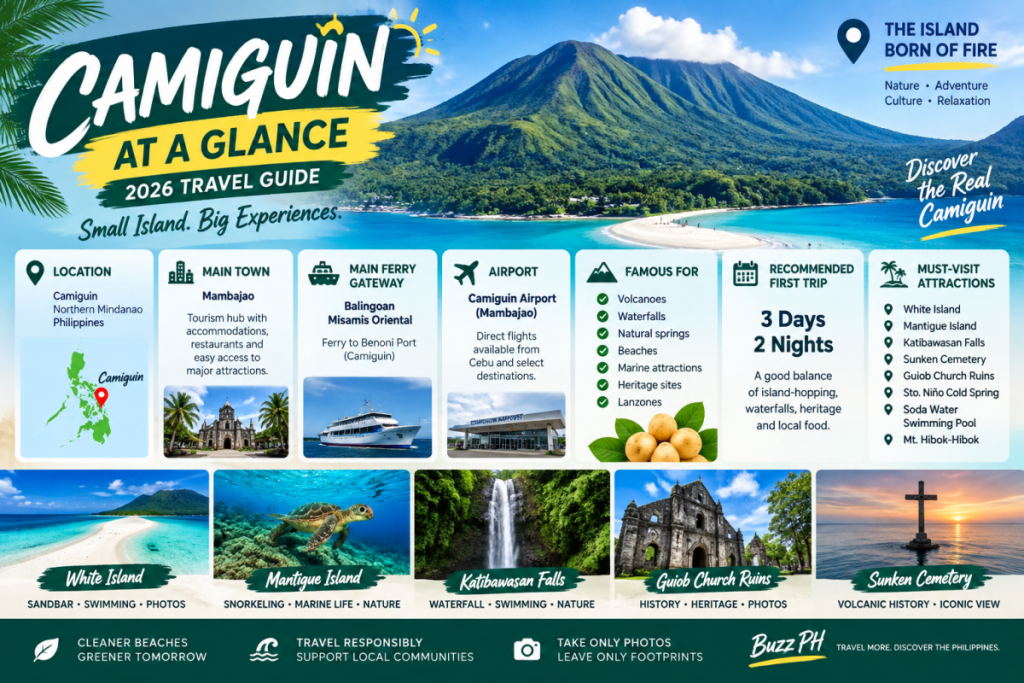
| Travel Detail | Information |
|---|---|
| Province | Camiguin |
| Region | Northern Mindanao |
| Main tourism center | Mambajao |
| Major mainland ferry gateway | Balingoan, Misamis Oriental |
| Major Camiguin ferry gateway | Benoni Port |
| Airport | Camiguin Airport |
| Known for | Volcanoes, waterfalls, springs, beaches and heritage |
| Recommended first trip | 3 days / 2 nights |
| Major marine excursions | White Island and Mantigue Island |
| Famous agricultural product | Lanzones |
| Flexible local transport | Motorcycle or private vehicle |
What We Verified vs. What You Should Recheck
Information verified or cross-checked for this guide:
- Major Camiguin tourist attractions
- Key heritage sites
- Official tourism information
- Balingoan–Camiguin transportation information
- 2026 Benoni Port development
- Current published ferry-price reference
- Current observed accommodation listings
- Geography and itinerary-planning considerations
Information travelers should recheck before departure:
- Exact ferry departure time
- Final ferry fare
- Fuel surcharge
- Island-hopping boat availability
- Current boat rates
- Attraction entrance fees
- Hotel price for exact travel dates
- Weather and sea conditions
- Trail access and local restrictions
This distinction is important because some information about Camiguin remains relatively stable, while transportation and commercial prices can change quickly.
Why Camiguin Is Different
Many Philippine island destinations are primarily marketed around beaches and resorts.
Camiguin offers a broader combination of attractions.
A visitor can see a volcanic heritage site in the morning, visit a waterfall later in the day, swim in a natural spring and then eat local food in Mambajao.
The variety is one of Camiguin’s defining characteristics.
It also creates a common planning mistake: assuming that every attraction should be included in one tightly packed itinerary.
Instead, it is better to group activities according to location, transportation requirements and activity type.
Camiguin Attraction Comparison Table
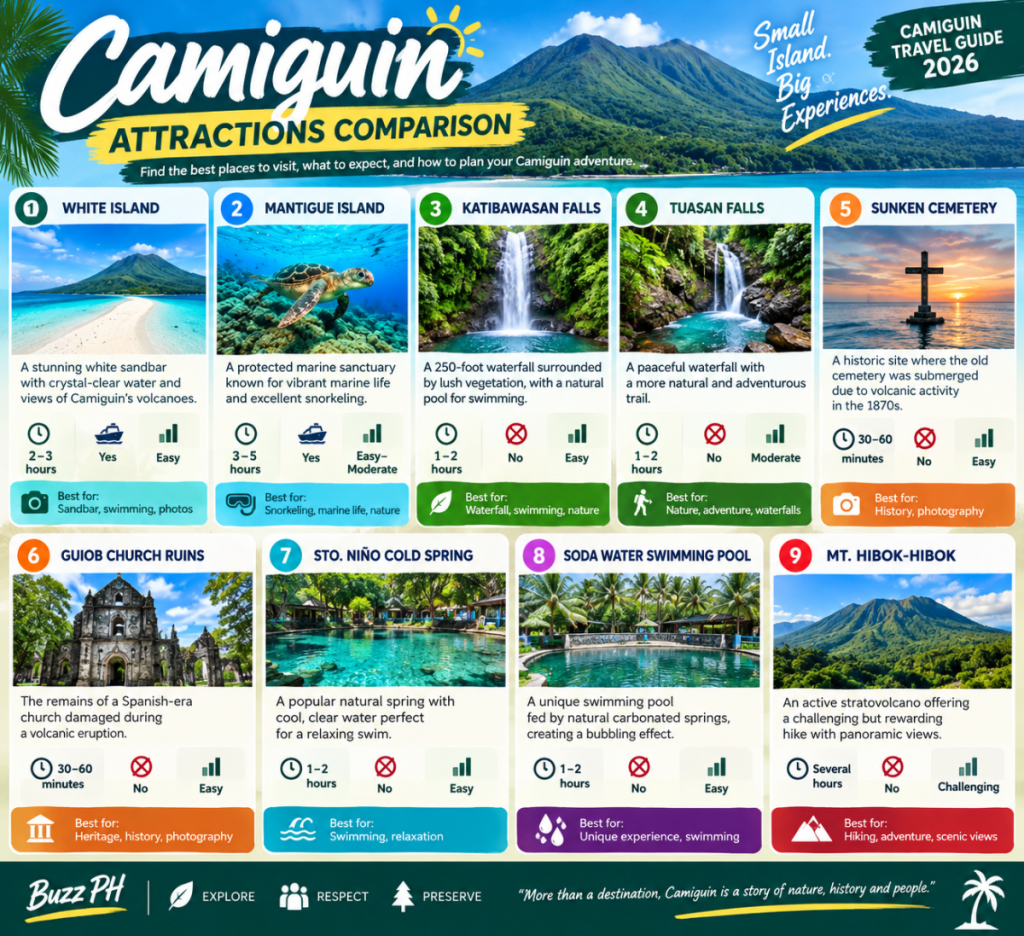
This comparison is intended to help travelers decide where to spend limited vacation time.
| Attraction | Best For | Time to Allow* | Boat Required? | Activity Level | Planning Priority |
|---|---|---|---|---|---|
| White Island | Sandbar, swimming, photos | 2–3 hrs | Yes | Easy | High |
| Mantigue Island | Snorkeling, marine life, nature | 3–5 hrs | Yes | Easy–Moderate | High |
| Katibawasan Falls | Waterfall, swimming | 1–2 hrs | No | Easy | High |
| Tuasan Falls | Nature and waterfall | 1–2 hrs | No | Moderate | Medium–High |
| Sunken Cemetery | History and photography | 30–60 min | No | Easy | High |
| Guiob Church Ruins | Heritage and photography | 30–60 min | No | Easy | High |
| Sto. Niño Cold Spring | Swimming and relaxation | 1–2 hrs | No | Easy | Medium |
| Soda Water Swimming Pool | Unique swimming experience | 1–2 hrs | No | Easy | Medium |
| Mt. Hibok-Hibok | Hiking and adventure | Several hrs | No | Challenging | Optional |
*Time figures are practical planning allowances, not official attraction durations. Actual time can vary with weather, queues, transportation, swimming and personal pace.
How Many Days Do You Need in Camiguin?
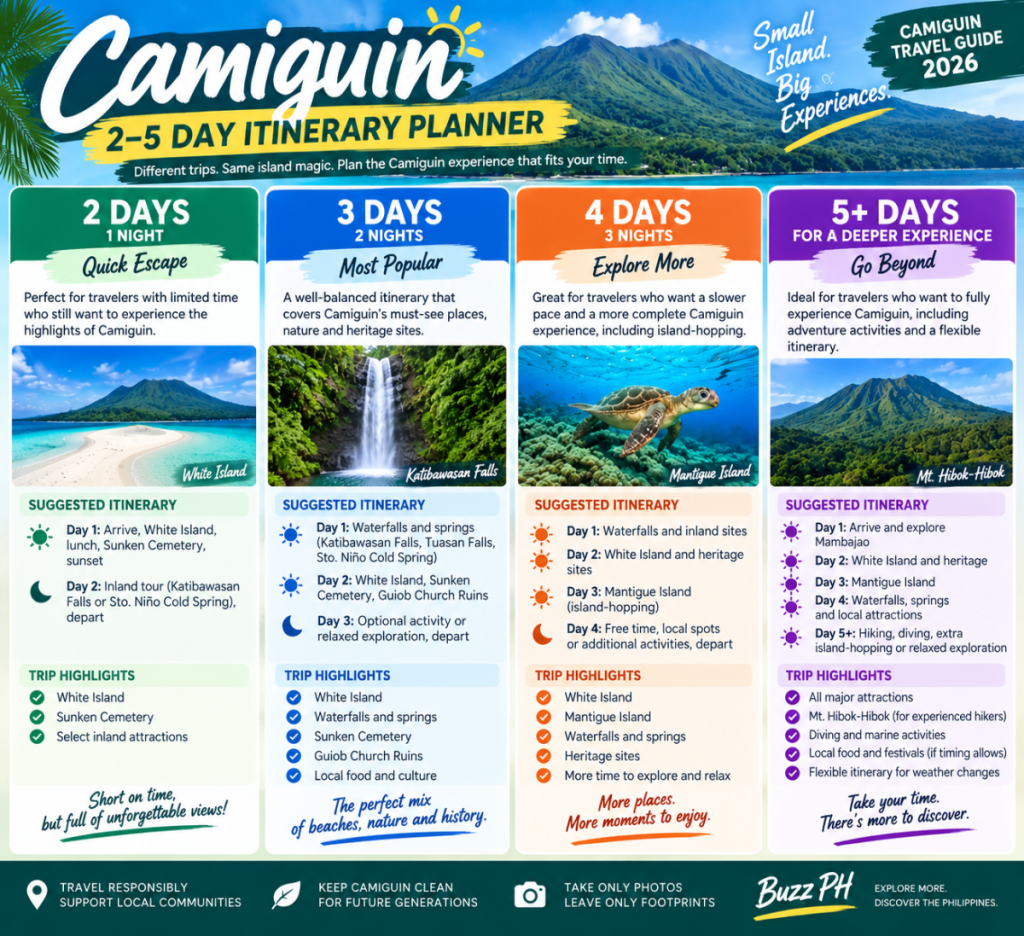
A three-day, two-night trip works well for many first-time visitors, but the ideal length depends on what you want to experience.
| Trip Length | Suggested Focus |
|---|---|
| 2 Days / 1 Night | White Island + selected inland attractions |
| 3 Days / 2 Nights | White Island + waterfalls + heritage + another major activity |
| 4 Days / 3 Nights | Add Mantigue, springs and slower exploration |
| 5+ Days | Hiking, diving, additional activities and weather flexibility |
If your schedule is limited, prioritize experiences instead of attempting to visit every attraction.
How to Get to Camiguin
For travelers coming from Northern Mindanao, one of the most practical routes is traveling overland to Balingoan, Misamis Oriental, followed by a ferry to Camiguin.
The basic route is:
Cagayan de Oro → Balingoan → Camiguin → accommodation
The total journey involves more than the ferry itself. Travelers should allow time for road travel, port procedures, boarding and disembarkation.
Balingoan–Camiguin Ferry Cost in 2026
A current August 2026 Super Shuttle listing gives a published reference passenger fare of approximately ₱359 one way for the Balingoan–Benoni/Balbagon route.
Using that published reference:
₱359 × 2 = approximately ₱718 round trip
This is a calculation based on the published reference fare, not a guarantee of the final amount paid.
Fuel surcharges, passenger categories, vehicle charges or operator changes may affect the final cost.
For this reason, travelers should check the latest operator information before departure.
2026 Benoni Port Development
Transportation infrastructure is an important part of Camiguin’s current travel picture.
In July 2026, the government inaugurated the Benoni Port Light Craft Landing Station and highlighted improvements involving Benoni Port.
Because Benoni is a major maritime gateway for Camiguin, travelers planning a 2026 trip should use current transportation information rather than relying exclusively on older travel blogs.
Should You Fly to Camiguin?
Flying can reduce overland travel time for travelers who have a convenient current flight connection.
However, schedules can change.
If flying is your preferred option, check the airline’s current schedule before booking your accommodation and activities.
For travelers already traveling through Northern Mindanao, the Balingoan–Camiguin ferry remains an important transportation option.
How We Built This Camiguin Itinerary
The itinerary follows four practical considerations:
Location: Group nearby destinations when possible.
Activity type: Separate boat-dependent activities from inland sightseeing.
Weather: Leave flexibility for marine activities.
Departure safety: Avoid placing a critical connection immediately after a weather-dependent activity.
This approach is more useful than simply arranging attractions according to popularity.
Day 1 — Waterfalls, Springs and Inland Camiguin
The first full day is ideal for attractions that don’t depend on island-hopping schedules.
Morning — Katibawasan Falls
Katibawasan Falls is one of Camiguin’s best-known natural attractions.
The Camiguin Provincial Government describes the waterfall as approximately 250 feet high, dropping into a natural pool surrounded by vegetation.
Allow around one to two hours for the stop if you plan to explore, photograph the area or swim.
Because it is an inland attraction, it provides a useful anchor for the first day.
Late Morning — Tuasan Falls
Tuasan Falls offers another waterfall experience.
The provincial tourism information notes a route involving large boulders and uneven terrain before reaching the waterfall area.
Wear suitable footwear and be particularly careful when surfaces are wet.
If there has been heavy rain, ask locally about current conditions before entering the area.
Afternoon — Sto. Niño Cold Spring
Sto. Niño Cold Spring provides a slower-paced activity after the waterfalls.
It works well as an afternoon swimming and relaxation stop rather than trying to fill the schedule with another major attraction.
Late Afternoon — Flexible Exploration
Leave the final part of Day 1 open.
Depending on your energy and weather, you can use the time for:
- A coastal drive
- A local restaurant
- A market visit
- A sunset stop
- Rest at your accommodation
Keeping this period flexible also gives you some protection against delays earlier in the day.
Day 2 — White Island and Camiguin Heritage
Day 2 combines Camiguin’s marine attractions with its volcanic and cultural history.
Early Morning — White Island
White Island is technically a sandbar, not a permanently formed island.
It is one of Camiguin’s most recognizable destinations and is known for its white sand, surrounding water and views toward Camiguin’s volcanic landscape.
An early visit is practical because the exposed sandbar provides very little natural shade.
Bring:
- Sunscreen
- Hat
- Drinking water
- Waterproof phone protection
- Swimwear
- Dry bag
Most importantly, remember that conditions at sea can differ from conditions on land.
Midday — Return for Lunch
After the boat excursion, return to the main island for lunch.
This creates a useful break before visiting the heritage sites.
Afternoon — Sunken Cemetery
The Sunken Cemetery is one of Camiguin’s most recognizable landmarks.
Volcanic activity in the 19th century caused part of the old settlement and cemetery area to sink.
The site therefore represents more than a scenic viewpoint. It demonstrates how volcanic activity physically changed Camiguin’s landscape and communities.
Late Afternoon — Guiob Church Ruins
Guiob Church Ruins provide another important connection between Camiguin’s history and its volcanic environment.
The ruins are associated with the Spanish colonial period and the 1871 eruption of Mt. Vulcan.
The Camiguin Provincial Government identifies the Sunken Cemetery and Old Bonbon Church ruins among the province’s National Cultural Treasures.
Visiting both locations provides a stronger understanding of Camiguin’s heritage than treating them as isolated photo stops.
Day 3 — Mantigue Island and Flexible Exploration
If weather and boat arrangements permit, use Day 3 for Mantigue Island.
Morning — Mantigue Island Nature Park
Mantigue provides a different experience from White Island.
While White Island is known primarily for its exposed sandbar, Mantigue combines beach, vegetation and marine ecosystems.
The island’s protected environment makes responsible tourism particularly important.
Visitors should avoid:
- Touching coral
- Feeding marine animals
- Collecting shells
- Leaving trash
- Damaging vegetation
Marine tourism depends on maintaining the environment that attracts visitors in the first place.
Afternoon — Choose According to Your Departure
If you’re staying another night, use the afternoon for an additional attraction or relaxed exploration.
If you’re leaving Camiguin that day, don’t attempt to squeeze another major boat activity into the schedule.
Your priority should be reaching the port with enough time for your departure.
Best Places to Visit in Camiguin
White Island
Best for: Sandbar scenery, swimming, snorkeling and photography.
White Island is one of Camiguin’s signature experiences and a natural choice for first-time visitors interested in the island’s iconic scenery.
Mantigue Island Nature Park
Best for: Snorkeling, marine life and nature.
Mantigue provides a more substantial island environment than White Island and is particularly appealing to travelers interested in marine ecosystems.
Katibawasan Falls
Best for: Waterfalls and swimming.
At approximately 250 feet, Katibawasan is one of Camiguin’s most prominent waterfalls.
Tuasan Falls
Best for: Nature and waterfall scenery.
Its terrain requires more attention to footing than some easier sightseeing stops.
Sto. Niño Cold Spring
Best for: Swimming and relaxation.
It works particularly well after a more active morning.
Sunken Cemetery
Best for: History, photography and volcanic heritage.
The site connects Camiguin’s geological history with its human history.
Guiob Church Ruins
Best for: Heritage and photography.
The ruins provide a physical reminder of Camiguin’s Spanish-era history and volcanic past.
Soda Water Swimming Pool
Best for: A different swimming experience.
The attraction is associated with naturally carbonated water and offers an alternative to beaches and waterfalls.
Mt. Hibok-Hibok
Best for: Experienced hikers.
A climb should not be treated as an ordinary sightseeing stop. Confirm current trail access, requirements, weather and local guidance before attempting it.
Camiguin’s Heritage Matters
A trip focused entirely on beaches misses a major part of Camiguin’s identity.
The province’s official information highlights several important heritage sites, including the Sunken Cemetery, Old Bonbon Church and a Spanish-era watchtower in Guinsiliban.
The combination of volcanic history and cultural heritage is one reason Camiguin has a different character from a destination centered primarily on resort tourism.
White Island vs. Mantigue Island
The two island excursions are not interchangeable.
Choose White Island if you want:
- An iconic sandbar
- Scenic photographs
- Swimming
- A relatively short island excursion
Choose Mantigue if you want:
- Snorkeling
- Marine life
- More natural island surroundings
- A longer nature-focused excursion
If you have enough time, visiting both provides two distinctly different experiences.
If your trip is short, choose according to your interests rather than trying to fit both into an already crowded day.
What to Eat in Camiguin
Lanzones is Camiguin’s best-known agricultural product.
The province celebrates the fruit through the annual Lanzones Festival, traditionally held in October.
Travelers can also look for:
- Fresh seafood
- Grilled fish
- Filipino rice meals
- Coconut-based dishes
- Local snacks
- Native desserts
- Lanzones products
A practical way to manage food costs is to combine local eateries with restaurant meals instead of relying exclusively on tourist-oriented restaurants.
Where to Stay in Camiguin
Mambajao is a practical base for many first-time visitors because it offers access to accommodation, restaurants and transportation services.
Current online prices vary considerably depending on travel dates, room type, occupancy, promotions and cancellation conditions.
During September 2026 research, some Mambajao accommodation listings were displaying rooms from approximately ₱760–₱1,300 per night.
These are current observed online rates, not guaranteed prices.
A property displaying ₱1,000 today may show a different price tomorrow or for a different travel date.
For example, if you find a room at an observed rate of ₱1,300 per night:
₱1,300 × 2 nights = ₱2,600
That calculation does not include possible taxes, fees or later price changes.
How to Choose Your Accommodation
Instead of choosing solely by nightly price, compare:
- Distance to your planned activities
- Parking
- Breakfast
- Air-conditioning
- Wi-Fi
- Cancellation policy
- Room capacity
- Transportation access
- Total booking cost
A slightly more expensive room can sometimes reduce transportation costs or save time.
Getting Around Camiguin
Motorcycles can provide considerable flexibility for qualified and experienced riders.
Before renting, confirm:
- Helmet availability
- Rental conditions
- Fuel arrangement
- Damage policy
- Required documents
- Road conditions
For families or larger groups, private transportation may be more practical.
The cheapest transportation option isn’t necessarily the lowest-cost choice overall if it creates additional transfers or wasted time.
Camiguin Travel Costs 2026
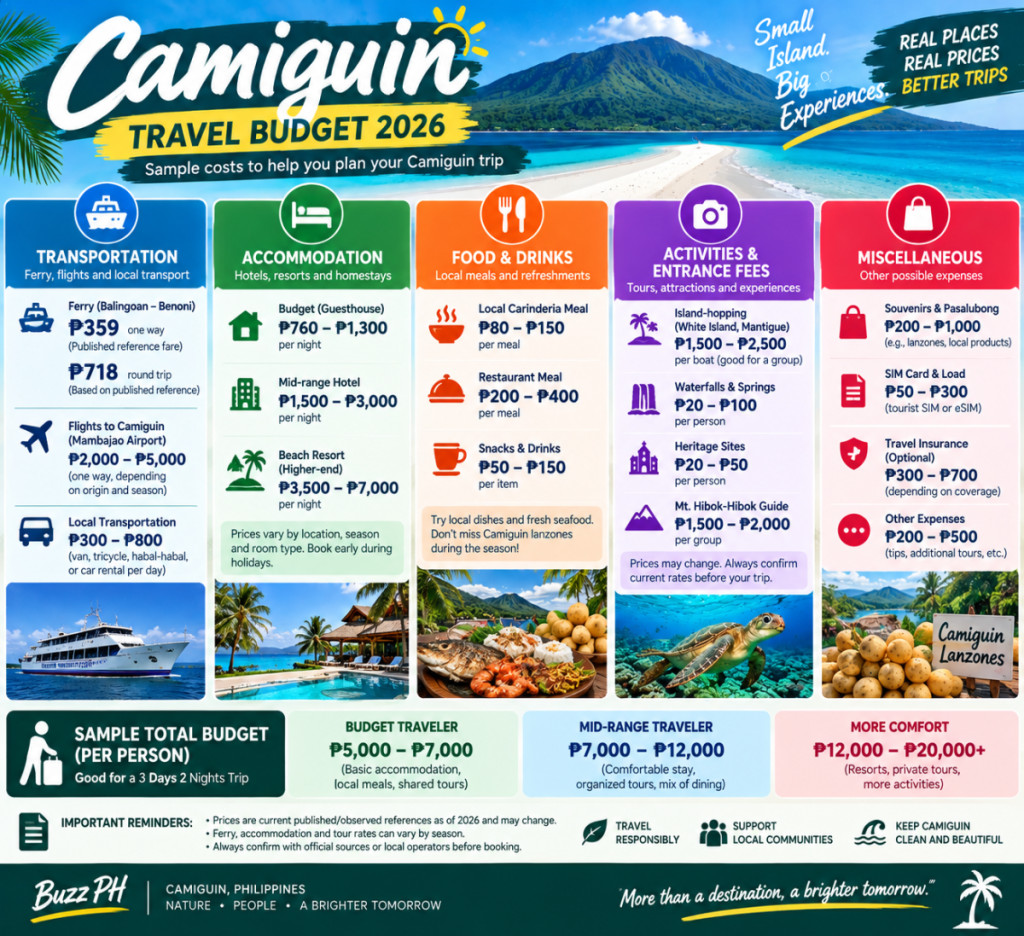
The most useful way to budget for Camiguin is to separate published/current references from expenses that need confirmation.
Current 2026 Cost References
| Expense | Current Reference | Status |
|---|---|---|
| Super Shuttle passenger fare | About ₱359 one way | Published reference price |
| Super Shuttle passenger round trip | About ₱718 | Calculated from published reference |
| Budget accommodation examples | Around ₱760–₱1,300/night | Current observed online rates |
| Attraction entrance fees | Confirm before travel | Variable |
| Island-hopping boats | Confirm with current operator | Variable |
| Motorcycle rental | Confirm with current operator | Variable |
| Food | Depends on dining style | Variable |
The ferry figure should be treated as a published reference price, while hotel figures are current observed online rates.
Neither should be interpreted as a permanent province-wide price.
Building a 3-Day/2-Night Budget
A practical budget calculation can start with the following:
Transportation: Approximately ₱718 round trip using the published ₱359 one-way passenger reference, before applicable changes or surcharges.
Accommodation: If you find a room at an observed ₱760–₱1,300 per night, two nights would be approximately ₱1,520–₱2,600 before applicable taxes or fees.
Food: Set a daily allowance according to your preferred dining style.
Local transportation: Add motorcycle rental, fuel, tricycle or private transportation.
Activities: Add the current boat and entrance fees after confirming them.
This method is more reliable than claiming that every visitor will spend exactly one fixed amount.
Budget Traveler
A budget-conscious traveler can reduce expenses by:
- Choosing a simple guesthouse
- Eating at local establishments
- Sharing transportation
- Selecting priority attractions
- Avoiding unnecessary private tours
- Comparing accommodation locations
The largest savings generally come from accommodation and transportation decisions.
Mid-Range Traveler
A mid-range trip can include:
- Comfortable accommodation
- Convenient transportation
- Local and restaurant meals
- White Island
- Several inland attractions
- Optional Mantigue Island
The final amount will depend heavily on hotel choice and activities.
Comfort Traveler
Travelers prioritizing convenience can choose:
- Higher-quality accommodation
- Private transportation
- Organized excursions
- Restaurant dining
- Flexible scheduling
The main difference is greater convenience and less need to coordinate individual transportation.
How to Save Money Without Sacrificing the Experience
Stay near the areas that fit your itinerary.
Share transportation when practical.
Eat some meals at local establishments.
Choose the marine excursion that best matches your interests.
Compare the total cost of a booking, rather than only its advertised nightly rate.
A room that costs slightly more but saves transportation expenses may produce a lower overall trip cost.
Common Camiguin Planning Mistakes
Trying to Visit Everything
Camiguin has enough attractions to fill several days.
Trying to visit everything during a short trip can turn a relaxing island vacation into a transportation schedule.
Scheduling a Boat Activity Immediately Before Departure
Marine activities depend on sea conditions and boat availability.
Avoid placing a critical departure connection immediately after an important island excursion.
Treating Old Prices as Current Prices
Older articles can still be useful for destination ideas, but prices from previous years should not automatically be treated as 2026 rates.
Use current operator or booking information when calculating your actual budget.
Ignoring Busy Periods
Festival dates, holidays and weekends can affect accommodation demand and transportation times.
Reserve important accommodation and transportation arrangements early when traveling during busy periods.
Camiguin Travel Safety
Before island-hopping, check current local conditions.
Before hiking, confirm trail access and weather.
When riding a motorcycle, wear a helmet and follow Philippine traffic laws.
For swimming:
- Follow local instructions.
- Respect warning signs.
- Avoid unsafe water conditions.
- Supervise children appropriately.
- Be aware of currents and changing weather.
Responsible Tourism in Camiguin
Camiguin’s natural environment is central to its tourism economy.
Visitors can help protect it by:
- Taking trash with them
- Reducing unnecessary single-use plastics
- Avoiding coral contact
- Not feeding marine animals
- Not collecting shells
- Staying on designated paths
- Respecting heritage sites
- Following local visitor rules
- Supporting legitimate local businesses
What to Pack for Camiguin
For a three-day trip, consider bringing:
- Lightweight clothing
- Swimwear
- Rash guard
- Comfortable sandals
- Closed shoes
- Sunscreen
- Hat
- Sunglasses
- Reusable water bottle
- Waterproof phone pouch
- Power bank
- Personal medication
- Toiletries
- Insect repellent
- Small dry bag
Hikers should bring footwear appropriate for the specific trail.
Is Camiguin Good for Families?
Camiguin can work well for families, but activities should be selected according to age, mobility and swimming ability.
Pay particular attention to:
- Water depth
- Boat conditions
- Weather
- Sun exposure
- Slippery surfaces
- Travel time
- Life-jacket requirements
Is Camiguin Good for Couples?
Camiguin can suit couples who enjoy nature, road trips, beaches and quieter destinations.
The island allows couples to combine marine activities with waterfalls, heritage sites, local food and scenic drives without needing to schedule every hour.
Is Camiguin Good for Solo Travelers?
Solo travelers can explore independently, particularly if they are comfortable and legally permitted to ride a motorcycle.
However, transportation and boat activities may cost more per person when expenses cannot be shared.
Group activities can sometimes reduce the per-person cost.
Best Time to Visit Camiguin
There is no single date that guarantees perfect weather.
For island-hopping, sea conditions are particularly important.
October is notable because of the annual Lanzones Festival.
Travelers planning around the festival should consider increased demand for accommodation and transportation.
What to Prioritize on a Short Trip
If you only have limited time:
For iconic scenery: White Island
For marine life: Mantigue Island
For waterfalls: Katibawasan Falls and Tuasan Falls
For history: Sunken Cemetery and Guiob Church Ruins
For swimming: Sto. Niño Cold Spring
For adventure: Mt. Hibok-Hibok, subject to current access and conditions
This approach lets travelers customize the trip according to their interests.
Camiguin 3-Day Sample Itinerary
Day 1
Katibawasan Falls → Tuasan Falls → Sto. Niño Cold Spring → dinner/rest
Day 2
White Island → lunch → Sunken Cemetery → Guiob Church Ruins → relaxed evening
Day 3
Mantigue Island → lunch → flexible exploration → departure or additional overnight stay
This itinerary should be treated as a framework rather than a fixed schedule. Weather, ferry operations and boat availability can require adjustments.
Camiguin Travel Checklist
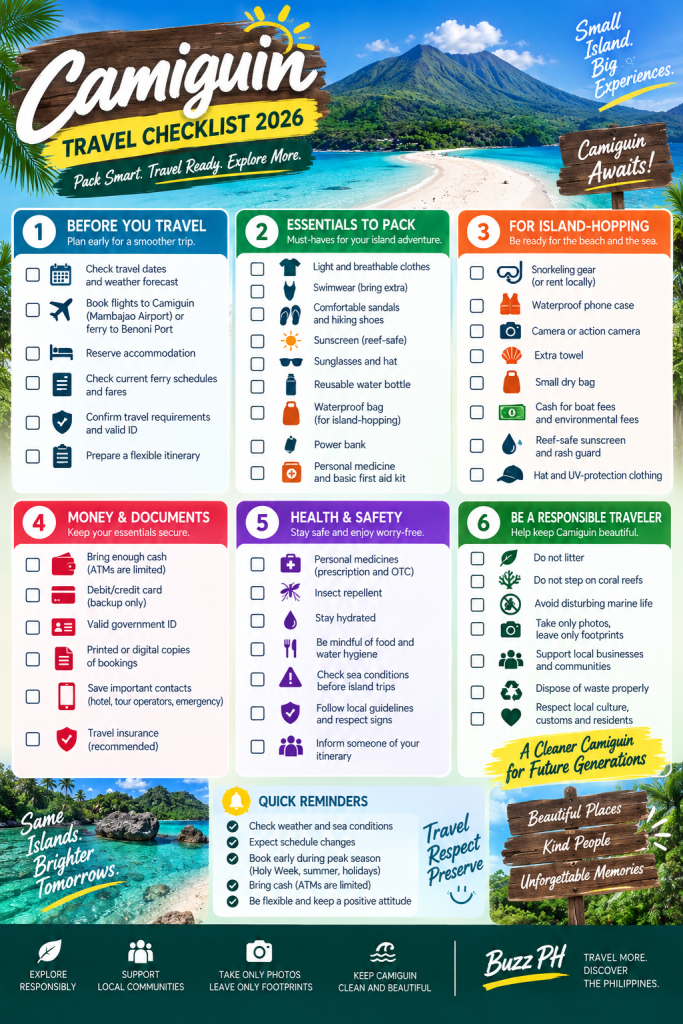
Before leaving:
- Confirm transportation to Camiguin
- Check the latest ferry schedule
- Confirm the current ferry fare
- Book accommodation
- Check island-hopping arrangements
- Verify current attraction fees
- Prepare cash
- Check weather and sea conditions
- Prepare sunscreen
- Bring waterproof protection
- Bring appropriate footwear
- Save important contacts
- Keep a departure-day buffer
Frequently Asked Questions
How many days are enough for Camiguin?
Three days and two nights is a practical first-trip length. Four or more days provide additional flexibility for hiking, marine activities, weather changes and slower exploration.
What is Camiguin famous for?
Camiguin is known for its volcanic landscape, White Island, Mantigue Island, waterfalls, natural springs, Sunken Cemetery, Guiob Church Ruins, marine ecosystems and lanzones.
What is the best way to get to Camiguin?
For many travelers from Northern Mindanao, traveling overland to Balingoan and taking a ferry to Camiguin is a practical option. Flying may also be available depending on current schedules.
How much is the Camiguin ferry in 2026?
A current August 2026 Super Shuttle listing gives a published reference passenger fare of approximately ₱359 one way on the Balingoan–Camiguin route. The actual amount may change because of surcharges, operator updates or passenger categories.
Is White Island really an island?
White Island is technically a sandbar. Its appearance can change according to tides and coastal conditions.
Which is better for snorkeling, White Island or Mantigue?
They offer different experiences. White Island is primarily known for its sandbar and surrounding waters, while Mantigue offers a broader nature and marine environment.
Can I tour Camiguin by motorcycle?
Motorcycles can provide flexibility for qualified riders. Wear a helmet, follow Philippine traffic laws and confirm the rental requirements before riding.
Is Camiguin expensive?
Camiguin can accommodate different budgets. Accommodation, transportation, food and marine activities are the main variables.
What food is Camiguin famous for?
Lanzones is Camiguin’s best-known agricultural product and is celebrated through the annual Lanzones Festival.
Should I visit White Island and Mantigue Island?
If you have enough time and favorable sea conditions, visiting both gives you two different island experiences. If your trip is short, choose according to your priorities.
Should I stay in Mambajao?
Mambajao is a convenient base for many first-time visitors because of its accommodation, restaurants and transportation options.
Do Camiguin prices change?
Yes. Ferry fares, boat rates, entrance fees, hotel prices and food costs can change.
Who is Camiguin best suited for?
Camiguin is particularly suitable for travelers interested in nature, volcanic landscapes, waterfalls, marine activities, heritage and road-trip-style exploration.
Travelers looking primarily for large resort complexes or nightlife may want to prioritize destinations that specialize more heavily in those experiences.
Final Thoughts
Camiguin is best experienced as a combination of nature, volcanic history, marine environments and cultural heritage, rather than simply as a beach destination.
For first-time visitors, three days and two nights provides a practical starting point.
Use one day for inland attractions such as waterfalls and springs, another for White Island and heritage sites, and another for Mantigue or flexible exploration.
The most important planning principle is to build your itinerary around transportation, weather and personal priorities.
Check the ferry schedule. Confirm current prices. Allow extra time during busy periods. Keep marine activities flexible.
And remember that the most successful Camiguin trip is not necessarily the one that visits the most attractions.
It is the one that gives you enough time to actually enjoy the island.
Official and Research Sources
This guide prioritizes the following source types:
Camiguin Provincial Government — Official information on attractions, tourism, heritage and local tourism programs.
Department of Tourism — National tourism information and destination context.
Maritime Industry Authority (MARINA) — Maritime transportation and nautical-highway information.
Philippine Information Agency / Presidential Communications Office — Government information concerning transportation infrastructure and the 2026 Benoni Port development.
Current transportation and accommodation listings — Used only for time-sensitive price references and identified as published or observed rates.
Final Travel Reminder
Before leaving for Camiguin, check these five things:
Ferry schedule → current fare → accommodation → activity availability → weather.
Those details can change much faster than a travel article can be updated.
Research status: Updated September 2026.





 Facebook
 Twitter