
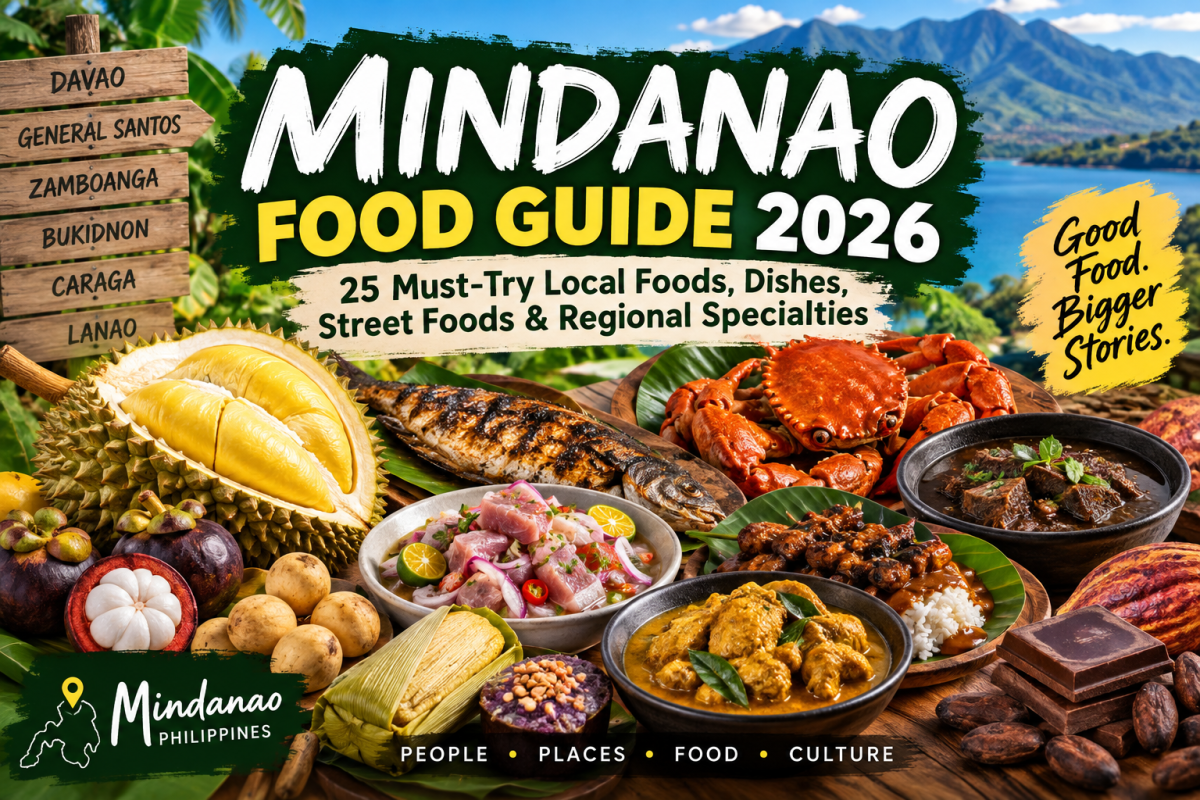
Mindanao food guide searches often lead travelers to the island’s best-known specialties, but the region’s culinary identity extends far beyond durian and tuna. From Davao’s tropical fruits and seafood to Zamboanga’s satti and Tausug dishes, and from Maranao specialties to Northern Mindanao’s corn and rice delicacies, Mindanao offers a wide range of foods shaped by geography, agriculture, fishing communities, and cultural traditions.
Mindanao is one of the Philippines’ most diverse food destinations, but its cuisine cannot be reduced to a single style.
The island’s food changes with its geography, communities, agriculture, fishing industries and cultural traditions. Davao is strongly associated with tropical fruits, cacao and seafood. General Santos has a deep connection with tuna. Zamboanga is known for seafood, satti and its major sardine industry, while Maranao and Tausug food traditions introduce dishes built around coconut, spices, rice, meat and seafood.
Northern Mindanao and Caraga add their own rice cakes, corn delicacies, seafood and regional specialties.
That diversity is what makes a food trip through Mindanao different from simply looking for the most famous Filipino dishes.
The Philippine Department of Tourism has documented Mindanao culinary traditions through its Halal Culinary Heritage program, including food associated with Maranao, Tausug, Maguindanaoan, Kaagan and other communities. The program was designed not only to promote food tourism but also to document culinary practices and improve understanding of Mindanao’s food heritage.
This guide covers 25 must-try local foods, prepared dishes, fruits, snacks, seafood specialties, condiments and regional food products.
The list intentionally includes more than prepared dishes because Mindanao’s food identity is also closely connected to what its farmers and fishing communities produce.
For 2026, the guide also considers current developments in Davao’s durian and cacao industries and the Zamboanga Peninsula’s sardine fishery.
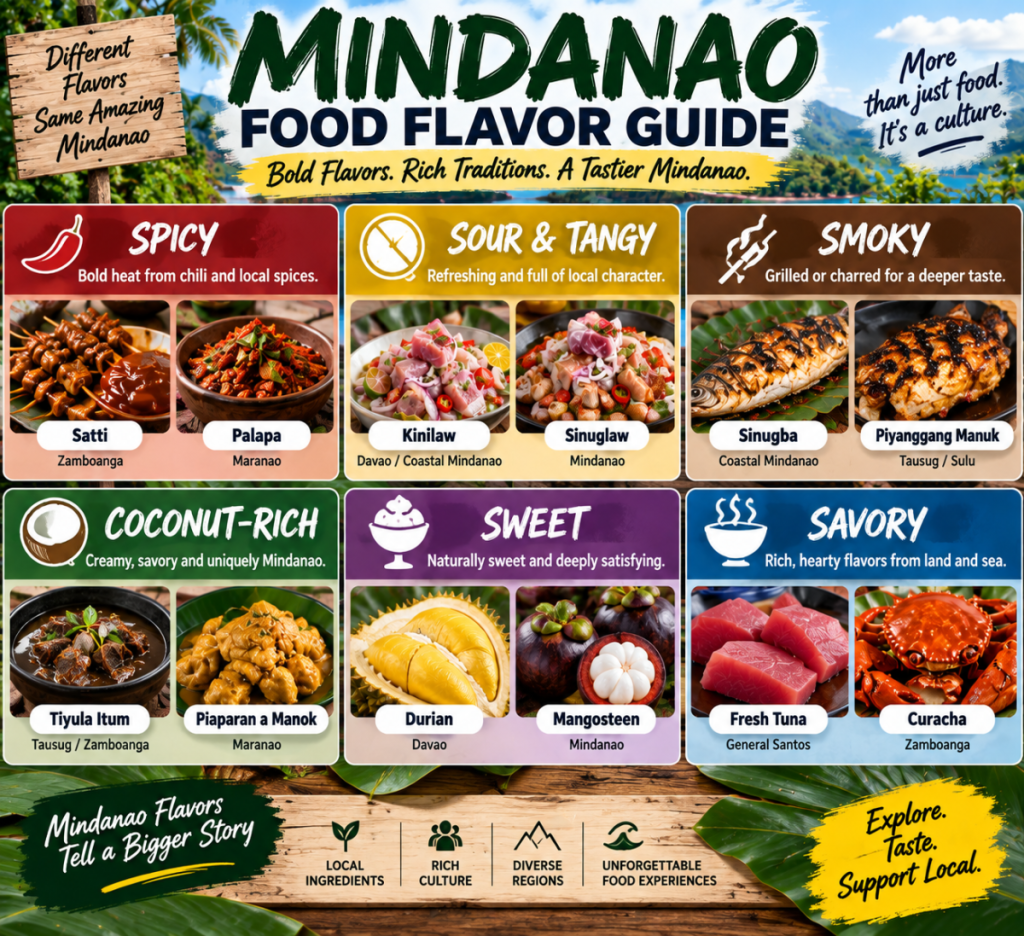
1. Kinilaw
Kinilaw is one of the most recognizable seafood preparations associated with Mindanao.
The basic concept involves fresh seafood dressed with vinegar and combined with ingredients such as ginger, onions, chili and other aromatics. The exact recipe varies between communities and cooks.
Davao is particularly associated with seafood kinilaw. The Department of Tourism describes kinilaw as a local version of ceviche and identifies it alongside freshly grilled seafood as part of Davao’s food experience.
Tuna is commonly used in some Mindanao preparations, although other fish and seafood may also be used.
One reason kinilaw is worth trying is that the dish emphasizes the quality and texture of the seafood rather than relying on a heavy sauce.
Because the seafood is raw or lightly cured, food handling matters. Choose a reputable establishment with good turnover and proper refrigeration rather than simply buying raw seafood from an unfamiliar vendor.
2. Sinugba
Sinugba refers broadly to food cooked over a grill or open flame.
In coastal parts of Mindanao, seafood is a natural choice. Fish, squid, prawns and other seafood can be grilled and served with rice, vinegar or other dipping sauces.
The Department of Tourism specifically identifies freshly grilled seafood, or sinugba, among the specialties associated with Davao.
The appeal is straightforward: fresh ingredients, high heat and minimal preparation.
Sinugba is also one of the easiest starting points for travelers who are unfamiliar with Mindanao cuisine. You do not need to understand a complicated recipe to appreciate well-prepared grilled seafood.
3. Sinuglaw
Sinuglaw combines the ideas behind sinugba and kinilaw in one dish.
A common version combines grilled pork with raw fish prepared in a vinegar-based mixture. Recipes vary, but the contrast between smoky grilled meat and acidic seafood is central to the dish.
Northern Mindanao is particularly associated with sinuglaw. Culinary coverage of Cagayan de Oro describes it as a fusion of grilled and kinilaw preparations, while Tourism Promotions Board and regional food material also associate the dish with Mindanao cuisine.
Some versions use additional local ingredients such as tabon-tabon or other souring and aromatic ingredients.
If you see sinuglaw on a menu, ask what seafood and grilled meat are being used because recipes can differ substantially between restaurants.
4. Davao Durian
Durian is one of the foods most strongly associated with Davao.
The fruit has a thick, spiky shell and creamy flesh with a distinctive aroma. Its flavor can be rich, sweet, bitter and savory depending on variety and ripeness.
People’s reactions to durian vary considerably. Some enjoy it immediately, while others need time to become accustomed to its aroma and texture.
Davao’s durian industry is also more than a tourism attraction.
In August 2026, the Department of Agriculture reported the first trial shipment of fresh Davao durian to Oman after a six-year effort involving an Omani buyer and a Davao grower. The shipment represented a new potential export market for Philippine durian.
The Bureau of Plant Industry also held a Davao durian stakeholders’ meeting in May 2026 involving growers, researchers and government experts. Discussions covered production challenges, market opportunities and industry development.
That makes fresh durian an especially interesting food to try while visiting Davao: you are tasting a product that is simultaneously part of local culture and a growing agricultural export story.
5. Davao Pomelo
Pomelo is another important fruit associated with Davao.
The large citrus fruit has thick skin and juicy segments with a flavor that can range from sweet to mildly tart.
The Davao Regional Agriculture dashboard identifies pomelo as one of the region’s signature crops and describes Davao Pomelo as a regional commodity associated with sweetness and pink flesh.
Davao Pomelo was also included by the Department of Agriculture among the products prioritized for geographical-indication protection in 2026, alongside Davao cacao and Davao durian.
For visitors, pomelo is an easy fresh-fruit introduction to Davao’s agricultural identity.
6. Marang
Marang is a tropical fruit that deserves attention when exploring Mindanao’s markets.
It belongs to the same broader botanical group as jackfruit and breadfruit but has its own appearance, aroma and flavor.
The fruit contains soft, creamy flesh surrounding its seeds and is generally eaten fresh when ripe.
Marang is particularly associated with Mindanao and is among the tropical fruits cultivated in the region. The Department of Agriculture’s Bureau of Agricultural Research has documented marang as a fruit that thrives in Mindanao.
Availability is seasonal, so travelers should not expect to find it everywhere throughout the year.
If you see fresh marang at a local fruit market, it is worth trying alongside more familiar fruits such as mango or pomelo.
7. Mangosteen
Mangosteen has a thick purple outer shell and soft white segments inside.
Its flavor is generally sweet with a mild acidity, making it a refreshing contrast to richer tropical fruits.
Davao’s agricultural sector includes mangosteen among its tropical fruit crops, and the Bureau of Plant Industry’s Davao research center lists mangosteen among its priority fruit-tree commodities.
For visitors, mangosteen is particularly enjoyable when purchased fresh during its available season.
It also works well as a counterpoint to durian: both are strongly associated with tropical fruit culture, but their flavor and aroma profiles are very different.
8. Lanzones
Lanzones are small fruits that grow in clusters and contain juicy segments inside a thin outer skin.
The flavor can be sweet or slightly tart depending on variety and maturity.
Lanzones are among the tropical crops cultivated in the Davao Region, where the Bureau of Plant Industry’s Davao research center identifies lanzones among its priority fruit-tree commodities.
Like many tropical fruits, availability depends on harvest conditions.
This makes local markets especially useful for food travelers. Instead of planning around a fruit being available on a particular date, check what local vendors are actually carrying during your visit.
9. Fresh Tuna
Tuna is central to the food identity of General Santos City.
The city is closely connected to tuna fishing, processing and seafood distribution, making tuna more than simply another ingredient on a restaurant menu.
Visitors can encounter tuna in grilled preparations, soups, kinilaw-style dishes and other local recipes.
The Department of Tourism’s Mindanao Halal culinary material specifically highlights General Santos tuna dishes, including buntot ng tuna served with curry sauce and palapa.
Trying tuna in General Santos therefore gives travelers an opportunity to connect the food with the fishing economy that supports the city.
For seafood lovers, this is one of the clearest examples in Mindanao of how local industry and cuisine overlap.
10. Curacha
Curacha is a distinctive crustacean associated with Zamboanga.
The Department of Tourism specifically identifies curacha among the seafood specialties visitors can explore in Zamboanga, together with local seafood such as imbao, kulo and lato.
The appearance may be unfamiliar to visitors, but the meat is the main attraction.
Preparation varies. Some restaurants emphasize the natural seafood flavor, while others serve curacha with sauces or seasonings.
Because seafood prices and availability can change, ask whether the curacha is priced per piece, portion or weight before ordering.
11. Satti
Satti is one of the foods most closely associated with Zamboanga’s local food culture.
It consists of skewered pieces of meat, commonly beef, chicken or liver, served with rice and a strongly seasoned sauce.
The Department of Tourism identifies satti as a Zamboanga breakfast staple and documents specialized satti houses serving their own versions.
That breakfast tradition is part of what makes satti interesting.
It is not simply a dish created for tourists. It is connected to everyday eating and local food businesses.
Trying satti in the morning can also provide a different experience from the typical Filipino breakfast of fried meat, eggs and rice.
12. Tiyula Itum
Tiyula itum is a Tausug soup recognized by its dark-colored broth.
The Department of Tourism’s Mindanao culinary heritage material identifies tiyula itum as a Tausug dish and explains that its dark color is associated with burnt coconut. Beef is commonly used, although variations may exist.
The appearance can initially surprise visitors.
The important thing is not to judge the dish by its color. The cooking technique produces a distinctive broth with deep savory and aromatic characteristics.
For travelers interested in the culinary traditions of Muslim Mindanao, tiyula itum offers a much different experience from the more familiar grilled and fried dishes found throughout the Philippines.
13. Piyanggang Manuk
Piyanggang manuk is a traditional chicken dish associated with Tausug cuisine and Sulu.
The Department of Tourism describes it as grilled free-range chicken served with a burnt-coconut sauce.
The dark appearance comes from the treatment of coconut used in the sauce.
The dish demonstrates how coconut can play a very different role in regional cooking depending on technique.
Rather than functioning only as a sweet ingredient or creamy sauce, it can contribute roasted and deeply savory flavors.
14. Piaparan a Manok
Piaparan a Manok is a Maranao-associated chicken dish documented by the Department of Tourism.
The DOT describes it as chicken stewed in coconut milk and turmeric with palapa, a spicy aromatic mixture that can include scallions, ginger and turmeric.
A local culinary event in Davao also presented piaparan a manok as a Maranao dish, reinforcing its connection with Maranao culinary heritage.
The combination of coconut, turmeric and palapa makes the dish distinctly different from ordinary Filipino chicken stews.
For travelers, this is a good example of why Mindanao food should not be treated as one uniform cuisine.
15. Pastil
Pastil is a simple rice-based meal associated with Muslim Filipino food traditions.
A typical preparation consists of rice topped with shredded chicken, beef or fish and wrapped in banana leaf.
The Department of Tourism includes pastil among the Mindanao foods featured in its culinary heritage work.
Pastil is particularly interesting from a practical perspective because it is portable and filling.
It can work well for travelers looking for a relatively inexpensive local meal rather than a restaurant-style dining experience.
The exact filling and seasoning can differ between sellers, so trying pastil from more than one location can reveal local variations.
16. Palapa
Palapa is a spicy condiment strongly associated with Maranao food traditions.
It commonly combines aromatic ingredients such as native scallions, ginger and chili, although recipes vary.
Unlike a dish such as kinilaw or satti, palapa is primarily a flavor component.
It can accompany rice, meat, seafood and other dishes or be incorporated directly into cooking.
The Department of Tourism’s culinary material specifically discusses palapa as part of Mindanao food traditions and includes it in several regional dishes.
If you are sensitive to spicy food, ask about the level of heat before adding a generous amount.
17. Piyaren a Udang
Piyaren a Udang is a prawn dish associated with Lanao culinary traditions.
The Department of Tourism documented a version featuring prawns, coconut meat and palapa scallion relish.
The dish demonstrates a recurring pattern in Mindanao cooking: seafood combined with coconut and aromatic or spicy ingredients.
It also illustrates why regional culinary documentation matters. Similar ingredients can appear throughout the Philippines, but the combinations, techniques and cultural context can be different.
18. Pisawawan a Sapi
Pisawawan a Sapi is a beef dish from Lanao documented by the Department of Tourism.
The DOT’s culinary heritage material describes a preparation involving beef shoulder, turmeric, chili and cassia-leaf broth, accompanied by roasted bone marrow.
This is a substantially richer and more aromatic dish than many everyday Filipino beef soups.
Its documented association with Lanao makes it especially relevant to travelers looking beyond mainstream Philippine dishes.
Availability may be more limited than widely known foods such as kinilaw or grilled seafood, so checking with restaurants that specialize in regional cuisine before visiting is sensible.
19. Dinilutan a Seda
Dinilutan a Seda is a seafood preparation documented in the Department of Tourism’s Mindanao culinary heritage material.
The DOT describes a version using grilled swordfish with coconut and lime dressing and associates it with Maguindanao.
The dish combines grilled seafood with tropical acidity and coconut.
It is another example of how coastal ingredients can be paired with flavors commonly found in southern Philippine cooking.
20. Buntot ng Tuna
Buntot ng tuna refers to tuna tail and provides another way to experience one of Mindanao’s most important seafood products.
The Department of Tourism documents a General Santos preparation featuring tuna tail with curry sauce and palapa.
For visitors accustomed to tuna steaks or canned tuna, this offers a different approach to the fish.
It also reflects a broader Filipino food principle: making use of different parts of an ingredient rather than limiting cooking to the most familiar cuts.
21. Amik
Amik is a traditional confection associated with the Kaagan community in the Davao Region.
The Department of Tourism describes it as a thin, sweetened ground-rice batter fried in hot oil and formed by practiced hands.
Its importance goes beyond taste.
Amik is an example of how food can preserve community identity and traditional preparation techniques.
When encountering indigenous or community-associated foods, travelers should treat the food as part of a living cultural tradition rather than simply as a novelty.
22. Sayongsong
Sayongsong is a traditional rice-based delicacy associated with Surigao and the wider Caraga food landscape.
It is commonly prepared using rice-based ingredients, coconut and sugar, then shaped in a distinctive wrapper.
Local references describe sayongsong as one of the traditional delicacies encountered in Surigao, alongside other rice cakes and snacks.
The food is particularly useful for understanding how rice appears throughout Mindanao cuisine in forms beyond ordinary steamed rice.
Depending on the seller and locality, recipes and wrapping methods may vary.
23. Binaki
Binaki is a corn-based delicacy associated with Northern Mindanao and Bukidnon.
The National Museum describes binaki as a preparation made from ground yellow corn combined with ingredients such as butter, sugar, baking powder, milk and cheese, then wrapped in the inner layer of a corn husk and boiled.
The museum also explains that the name is related to the appearance of the folded husk, which resembles a frog’s leg.
Binaki provides a different perspective on Mindanao food because it comes from an agricultural environment where corn is an important crop.
For travelers exploring Bukidnon and Northern Mindanao, it is a useful local snack to look for in markets and roadside food stalls.
24. Zamboanga Sardines
Sardines are deeply connected to Zamboanga’s fishing and food-processing industries.
The connection is not limited to the familiar canned product sold nationwide. The sardine industry supports fishing communities, processing facilities and other businesses throughout the region.
The industry also provides an excellent example of why food and environmental management are connected.
In February 2026, the Department of Agriculture–Bureau of Fisheries and Aquatic Resources Region IX reopened the sardine fishing season after a three-month seasonal closure covering important fishing areas including the East Sulu Sea, Basilan Strait and Sibuguey Bay. The closure is intended to support sardine reproduction and growth.
In July 2026, BFAR’s Scientific Advisory Group for Fisheries Management Area 4 approved a 12-centimeter benchmark for juvenile sardines and supported expanding the annual closed-season coverage to municipal fishers.
For travelers, Zamboanga sardines therefore represent much more than a souvenir product. They connect local food with fisheries, employment, conservation and regional industry.
25. Davao Cacao and Local Chocolate
Cacao is another important part of Davao’s food identity.
The Davao Regional Agriculture dashboard identifies Region XI as a major cacao-producing area and describes Davao City as the country’s Chocolate Capital.
Travelers can encounter local cacao through chocolate bars, drinks, desserts, pastries and farm-based products.
The Department of Agriculture included Davao Cacao among the Philippine products prioritized for geographical-indication protection in 2026, alongside Davao Pomelo and Davao Durian.
That makes locally produced chocolate particularly interesting as a food souvenir: it connects an agricultural commodity with a finished product that visitors can take home.
Mindanao Food by Region
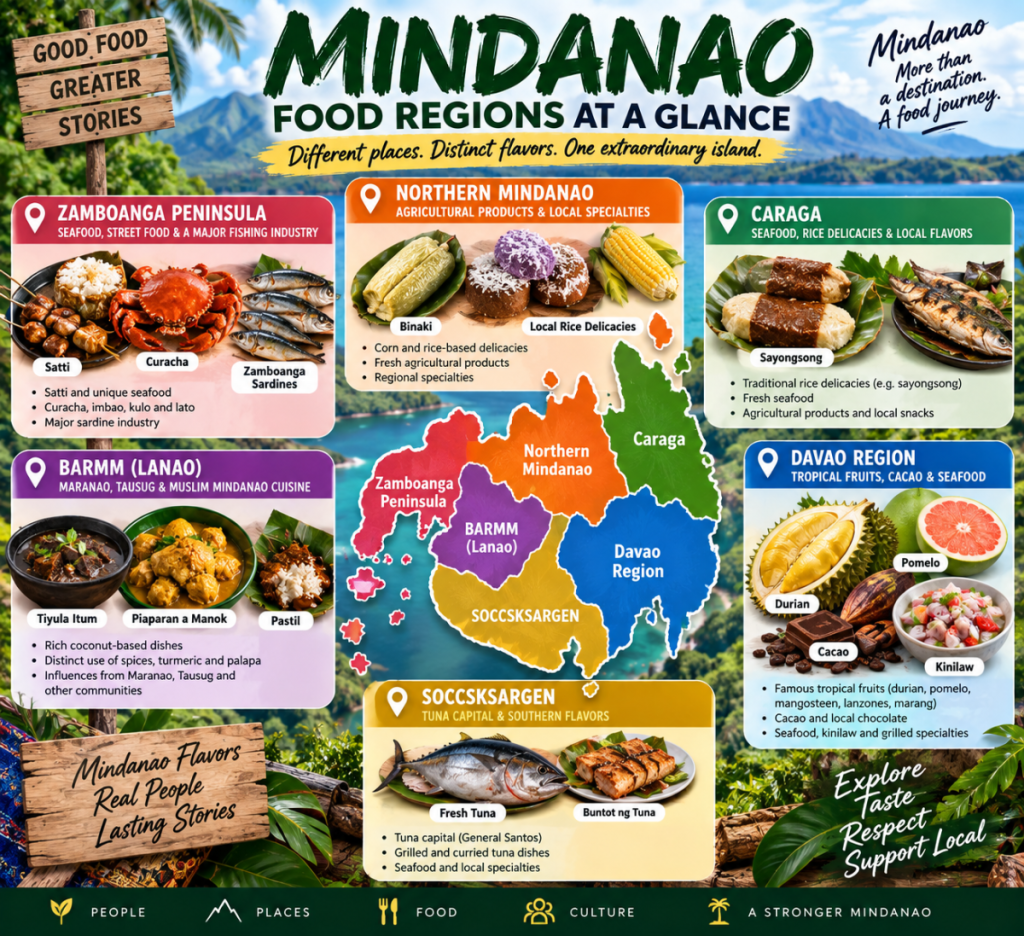
Mindanao becomes easier to understand as a food destination when its major food traditions are viewed geographically.
Davao Region is particularly associated with tropical fruits, cacao, seafood, kinilaw and grilled food. The region’s agricultural identity includes durian, pomelo, lanzones, mangosteen and cacao.
SOCCSKSARGEN, particularly General Santos, has a strong tuna identity. Tuna appears in grilled dishes, kinilaw-style preparations and other regional recipes.
Zamboanga Peninsula provides a different culinary experience, with satti, curacha, other seafood and a major sardine industry.
Lanao and Bangsamoro communities offer food traditions involving coconut, turmeric, chili, rice, meat and seafood. DOT documentation includes dishes such as piaparan a manok, piyaren a udang and pisawawan a sapi.
Sulu and Tausug culinary traditions include foods such as tiyula itum and piyanggang manuk.
Northern Mindanao and Bukidnon provide agricultural food traditions including binaki and other corn- and rice-based products.
Caraga contributes its own seafood, agricultural products and traditional rice delicacies such as sayongsong.
These boundaries should not be treated as rigid culinary borders. Food traditions move between communities, and restaurants may adapt traditional recipes for contemporary diners.
25 Mindanao Foods at a Glance
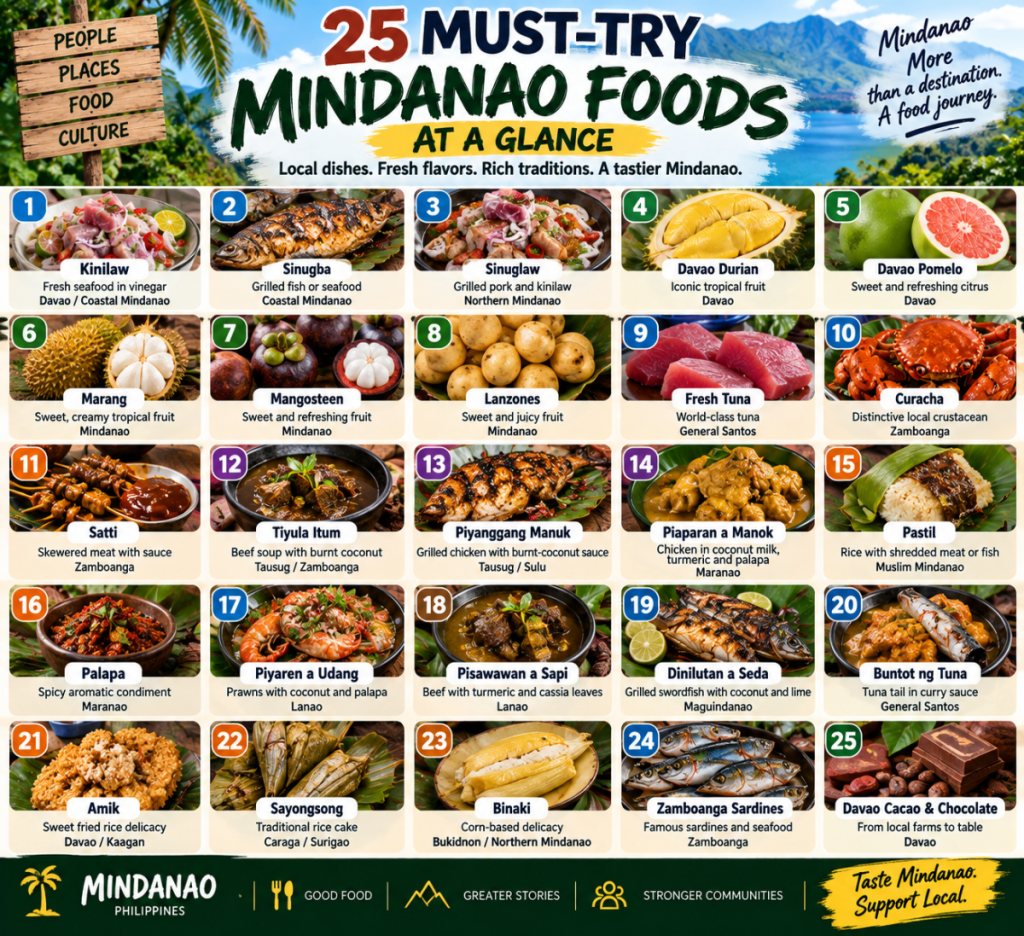
| Food | Main association | Food type | Flavor profile | Why try it |
|---|---|---|---|---|
| Kinilaw | Davao / coastal Mindanao | Seafood dish | Fresh, sour, savory | A signature seafood preparation |
| Sinugba | Coastal Mindanao | Grilled food | Smoky, savory | Simple preparation highlighting fresh ingredients |
| Sinuglaw | Northern Mindanao / Mindanao | Mixed dish | Smoky, tangy | Combines grilled and kinilaw traditions |
| Durian | Davao | Fruit | Rich, sweet-savory | One of Davao’s signature products |
| Pomelo | Davao | Fruit | Sweet, mildly tart | Important regional agricultural product |
| Marang | Mindanao | Fruit | Sweet, aromatic | Distinctive tropical fruit |
| Mangosteen | Davao / Mindanao | Fruit | Sweet, mildly acidic | Refreshing seasonal fruit |
| Lanzones | Davao / Mindanao | Fruit | Sweet, lightly tart | Seasonal tropical favorite |
| Tuna | General Santos | Seafood | Rich, meaty | Central to local fishing culture |
| Curacha | Zamboanga | Seafood | Sweet, briny | Distinctive regional crustacean |
| Satti | Zamboanga | Breakfast / street food | Spicy, savory | Important local breakfast tradition |
| Tiyula Itum | Tausug | Soup | Deep, savory | Distinctive burnt-coconut broth |
| Piyanggang Manuk | Tausug / Sulu | Chicken dish | Smoky, coconut-rich | Traditional burnt-coconut preparation |
| Piaparan a Manok | Maranao | Chicken dish | Coconut-rich, aromatic | Maranao culinary tradition |
| Pastil | Muslim Mindanao | Rice meal | Savory | Portable and filling |
| Palapa | Maranao | Condiment | Spicy, aromatic | Versatile regional flavor component |
| Piyaren a Udang | Lanao | Seafood | Coconut-rich, savory | Combines prawns and palapa |
| Pisawawan a Sapi | Lanao | Beef dish | Rich, aromatic | Distinctive turmeric and chili broth |
| Dinilutan a Seda | Maguindanao | Seafood | Grilled, citrusy | Combines fish, coconut and lime |
| Buntot ng Tuna | General Santos | Seafood | Savory, spicy | Another use of local tuna |
| Amik | Davao / Kaagan | Confection | Sweet, crisp | Community-associated traditional food |
| Sayongsong | Caraga / Surigao | Rice delicacy | Sweet, coconut-rich | Regional rice-based specialty |
| Binaki | Bukidnon / Northern Mindanao | Corn snack | Mildly sweet | Distinctive corn-based delicacy |
| Sardines | Zamboanga | Seafood / processed food | Savory | Connected to a major regional industry |
| Cacao / chocolate | Davao | Agricultural product | Rich, bitter-sweet | Links local farming with chocolate production |
How Much Does Food Cost in Mindanao in 2026?
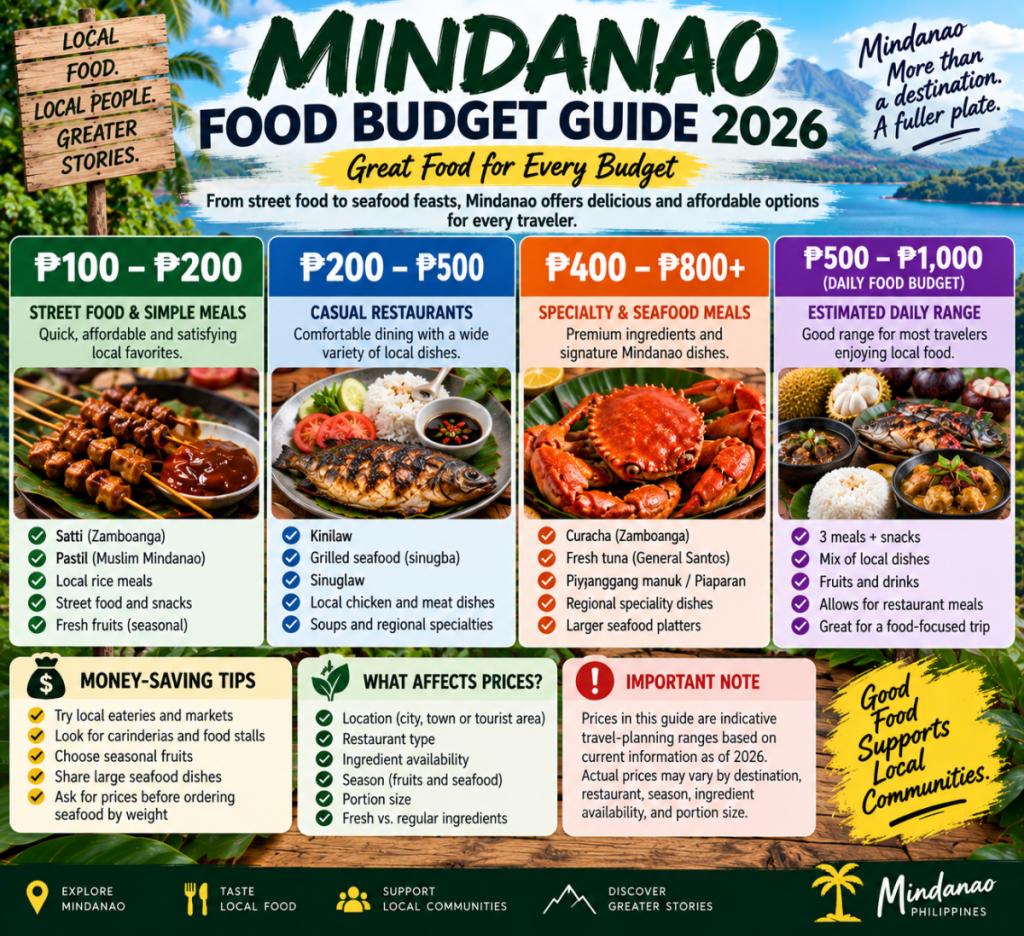
Food prices vary too much across Mindanao to present one “average price” as if it applies to every city.
A meal from a neighborhood eatery, a seafood restaurant in a tourist area and a specialty restaurant serving traditional cuisine can have very different prices.
For that reason, the figures below should be treated as travel-planning bands rather than a formal 2026 price survey:
- Simple local meal: roughly ₱100–₱200 per person
- Casual restaurant meal: roughly ₱200–₱500 per person
- Specialty or seafood meal: roughly ₱400–₱800+ per person
- Premium seafood or destination dining: potentially higher
These are practical budgeting estimates, not official regional averages. Seafood sold by weight can change the final bill substantially, while seasonal fruits can become cheaper or more expensive depending on supply.
A traveler who wants to explore mostly local food could reasonably start with a ₱500–₱1,000 daily food budget, then increase it for specialty seafood, desserts, premium restaurants and food experiences.
The important point is to check current menu prices or vendor prices rather than treating these figures as fixed 2026 rates.
When Is the Best Time to Explore Mindanao Food?
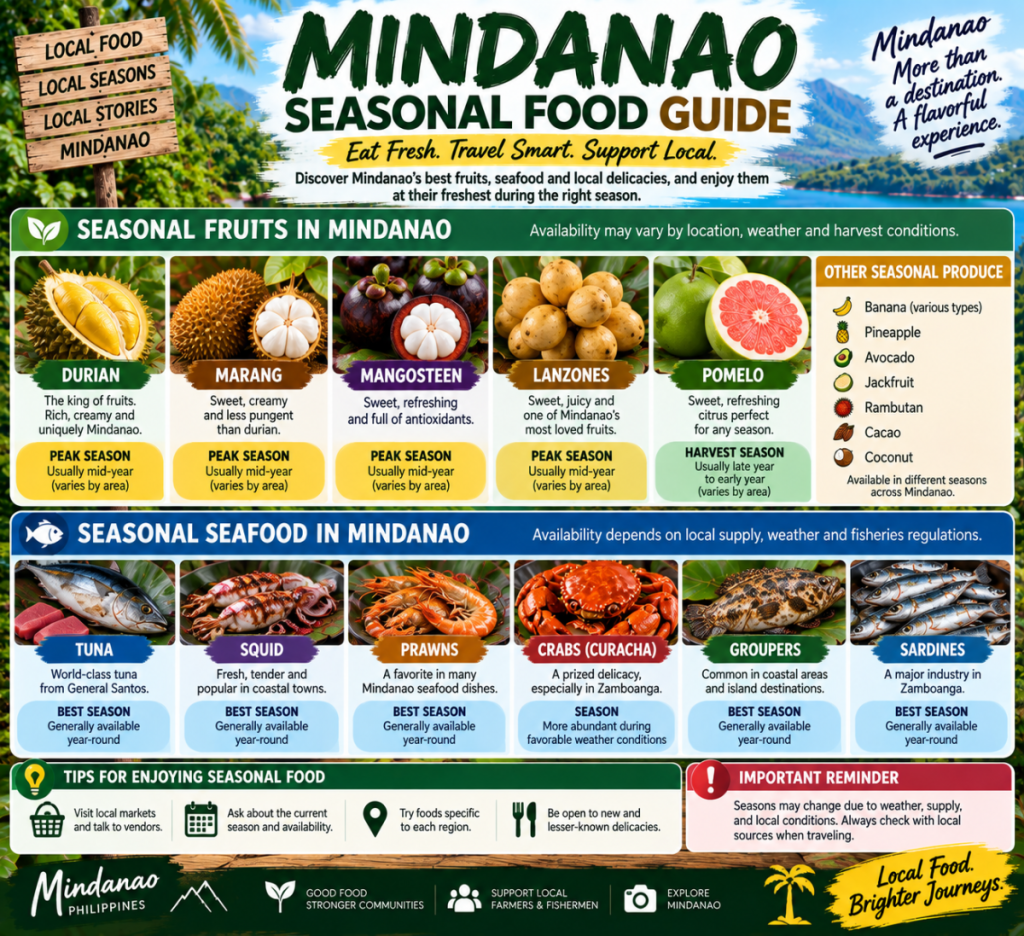
There is no single season when every Mindanao specialty is available.
Tropical fruits are particularly seasonal. Durian, marang, mangosteen and lanzones can have different harvest periods and local supply patterns.
The Bureau of Plant Industry’s Davao research center lists durian, citrus, lanzones, mangosteen and cacao among its tropical fruit research priorities, reflecting the importance of these crops to the region.
Seafood availability is also affected by fishing regulations.
The Zamboanga sardine industry provides a clear example. BFAR’s 2026 fishing season reopened on February 15 after a three-month conservation closure.
Therefore, travelers interested in one particular ingredient should check local availability shortly before their trip.
A Practical Mindanao Food Budget
You do not need to eat at expensive restaurants to experience Mindanao cuisine.
A practical day could include:
Breakfast: a simple local rice meal or street food.
Lunch: rice with a regional dish or grilled seafood.
Snack: seasonal fruit, local rice cake or another regional delicacy.
Dinner: a casual restaurant serving seafood or a regional specialty.
For budget-conscious travelers, local eateries, public markets, food stalls and community businesses can provide access to regional food at lower prices than destination restaurants.
For seafood, always ask whether the price is by serving or by weight.
Food Safety When Exploring Mindanao
Food tourism should still involve basic safety precautions.
Choose restaurants and food stalls that appear clean and have good customer turnover. Perishable seafood should be properly chilled or cooked.
Kinilaw deserves particular attention because its seafood is raw or lightly cured. Vinegar changes the flavor and texture but should not be treated as a substitute for proper food-safety practices.
People with seafood, shellfish, coconut or other allergies should ask about ingredients before ordering.
When buying fresh fruit, choose clean, properly handled produce and wash it when appropriate before eating.
Travelers with specific dietary or religious requirements should also ask about preparation methods rather than assuming that a dish is suitable based solely on its name.
Respecting Mindanao’s Food Traditions
Food in Mindanao is closely connected with community identity.
Maranao, Tausug, Kaagan, Maguindanaoan and other culinary traditions should not be treated as interchangeable.
The Department of Tourism’s culinary heritage work specifically identifies foods with different communities and locations. Its documentation includes Maranao-associated piaparan a manok, Tausug dishes such as tiyula itum and piyanggang manuk, Lanao dishes and Kaagan Amik.
That context matters.
A dish is not simply a combination of ingredients. Its name, preparation, community association and history can all be part of what makes it significant.
Travelers can support responsible food tourism by buying from legitimate local businesses, respecting community traditions, asking before photographing people or food-making activities and avoiding descriptions that reduce traditional cuisine to a tourist novelty.
Food Tourism and Mindanao’s Agriculture
Mindanao’s food culture is closely tied to agriculture.
Davao’s current agricultural profile demonstrates this clearly. The regional agriculture dashboard identifies cacao, durian, pomelo, lanzones and other crops among the region’s important commodities.
The connection between food and place is becoming increasingly important in national agricultural policy.
In July 2026, the Department of Agriculture and IPOPHL renewed their partnership on geographical indications. The priority products identified for GI protection include Davao Pomelo, Davao Cacao and Davao Durian.
For travelers, this provides another reason to pay attention to local food products.
Buying a regional product is not only about taking home a souvenir. It can also introduce visitors to the farmers, processors and communities behind that product.
Why Davao Food Is More Than Durian
Durian often dominates discussions about Davao food, but the region’s culinary identity is considerably broader.
The Department of Tourism identifies Davao with fruits including pomelo and durian and highlights seafood dishes such as kinilaw and sinugba.
Cacao is another important part of the region’s food economy. The current DA regional dashboard describes Davao as a major cacao-producing region and identifies Davao City as the country’s Chocolate Capital.
That means a Davao food trip can combine:
- fresh durian
- pomelo
- marang
- mangosteen
- lanzones
- kinilaw
- grilled seafood
- cacao
- locally made chocolate
This broader approach gives travelers a better picture of Davao’s food system than focusing on one famous fruit.
Why Zamboanga Food Deserves Special Attention
Zamboanga’s food identity is shaped strongly by its coastal environment and cultural diversity.
The Department of Tourism highlights seafood such as curacha, imbao, kulo and lato, while satti and other dishes add a different dimension to the city’s food culture.
The sardine industry adds another layer.
BFAR’s 2026 reports show that sardine production is closely connected with seasonal fishing closures, scientific monitoring and conservation measures.
This makes Zamboanga particularly interesting for food travelers who want to understand not only what people eat but also how local food industries operate.
How This Guide Was Researched
This guide draws primarily from Philippine government and institutional sources, including the Department of Tourism, Department of Agriculture, Bureau of Plant Industry, Bureau of Agricultural Research and Bureau of Fisheries and Aquatic Resources.
The Department of Tourism’s culinary heritage material was used to verify cultural associations and descriptions for several Mindanao dishes.
Agricultural information was checked against current Department of Agriculture and Bureau of Plant Industry material, particularly for Davao’s durian, cacao and pomelo industries.
The Zamboanga sardine section incorporates 2026 BFAR information on the fishing season and scientific fisheries-management developments.
For foods where authoritative documentation is less extensive, the article uses cautious wording rather than presenting uncertain details as established facts.
Price figures are explicitly identified as planning estimates, not as a comprehensive restaurant-price survey.
No first-hand experiences have been invented. The guide does not claim that the writer personally visited every restaurant, market, farm or community mentioned.
25 Foods to Put on Your Mindanao Food Checklist
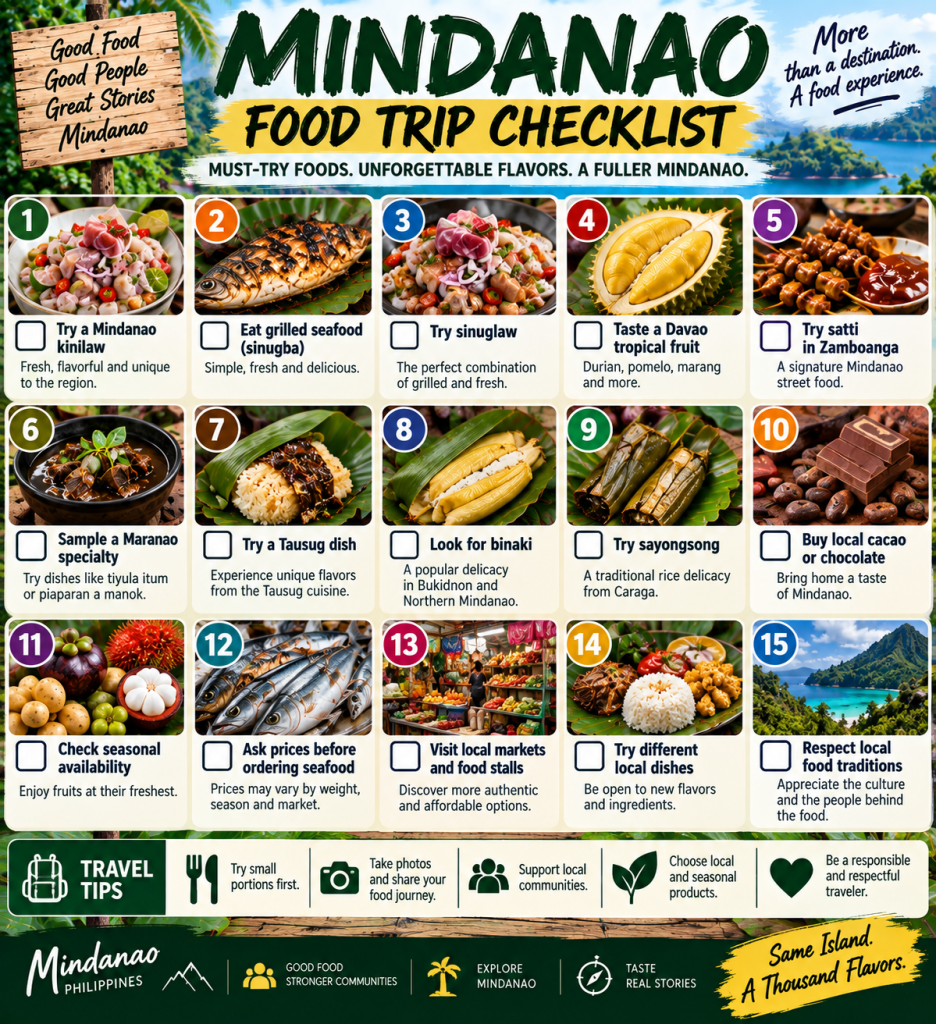
For an easy reference before your trip:
- Kinilaw
- Sinugba
- Sinuglaw
- Davao durian
- Davao pomelo
- Marang
- Mangosteen
- Lanzones
- Fresh tuna
- Curacha
- Satti
- Tiyula itum
- Piyanggang manuk
- Piaparan a manok
- Pastil
- Palapa
- Piyaren a udang
- Pisawawan a sapi
- Dinilutan a seda
- Buntot ng tuna
- Amik
- Sayongsong
- Binaki
- Zamboanga sardines
- Davao cacao and local chocolate
You do not need to find all 25 during one trip.
In fact, exploring them across different destinations will give you a better understanding of how Mindanao’s cuisine changes between coastal communities, agricultural regions and culturally distinct food traditions.
Final Thoughts
Mindanao’s food cannot be reduced to one cuisine.
Davao’s fruits and cacao tell one story. General Santos tuna reflects another. Zamboanga’s seafood and sardine industry provide another perspective, while Maranao, Tausug, Kaagan and other community traditions add further layers of culinary history and identity.
The agricultural side is just as important.
Durian, pomelo, marang, mangosteen, lanzones and cacao connect what visitors eat with the farms and growers behind those products. Current government efforts to strengthen the origin-based identity of Davao Pomelo, Davao Cacao and Davao Durian demonstrate how closely food, agriculture and regional identity are connected.
Seafood tells another part of the story.
Kinilaw, grilled seafood, tuna, curacha and sardines connect restaurants and markets with fishing communities and marine resources. The 2026 BFAR sardine-management developments demonstrate why food traditions and resource conservation can also be part of the same story.
For first-time visitors, the best approach is to stay curious.
Try the famous foods, but also look for the less familiar ones. Ask what is in season. Visit local markets. Learn how a dish is prepared. Respect the cultural traditions behind the food.
Most importantly, do not think of Mindanao food as a single list of dishes.
Think of it as a collection of regional ingredients, cooking traditions, agricultural products, fishing communities and cultural histories.
That is what makes a food journey through Mindanao worth exploring.
Sources and References
Department of Tourism — Taste the Philippines Through Its Halal Food and Heritage Destinations
The DOT’s culinary heritage material documents Mindanao food traditions including piaparan a manok, satti, tiyula itum, pastil, Amik and other regional dishes. Department of Tourism — Mindanao Halal Food and Heritage
Department of Tourism — Local Communities and Culinary Tourism
The DOT identifies Davao kinilaw and sinugba and Zamboanga seafood such as curacha, imbao, kulo and lato. Department of Tourism — Local Communities and Food Tourism
Department of Agriculture — Davao Durian Export Development, 2026
The DA reported the first trial shipment of fresh Davao durian to Oman in August 2026. Department of Agriculture — Davao Durian to Oman
Bureau of Plant Industry — Davao Durian Stakeholders Meeting, 2026
BPI documented its May 2026 stakeholder meeting involving Davao durian growers, researchers and government experts. Bureau of Plant Industry — Davao Durian Stakeholders
Department of Agriculture — Geographical Indications, 2026
The DA identified Davao Pomelo, Davao Cacao and Davao Durian among priority products for geographical-indication protection. Department of Agriculture — Origin-Based Agricultural Products
DA Regional Field Office XI — Davao Agriculture
The regional agriculture dashboard provides current information on Davao’s cacao, durian, pomelo, lanzones, mangosteen and other commodities. DA Regional Field Office XI — Davao Agriculture Dashboard
National Museum of the Philippines — Binaki
The National Museum documents binaki as a corn-based delicacy associated with Cebu and Northern Mindanao and explains its preparation and name. National Museum — Binaki and Philippine Corn Foods
BFAR Region IX — 2026 Sardine Fishing Season
BFAR documented the reopening of the 2026 Zamboanga Peninsula sardine fishing season following the annual conservation closure. BFAR Region IX — 2026 Sardine Fishing Season
BFAR Region IX — Sardine Fisheries Science, 2026
BFAR reported the July 2026 scientific recommendations concerning juvenile sardines and fisheries-management measures in FMA 4. BFAR Region IX — 2026 Sardine Management Recommendations
Food availability, seasonal produce, restaurant menus and prices can change. Travelers should verify current local information before visiting a particular establishment or planning a food itinerary.








 Facebook
 Twitter