
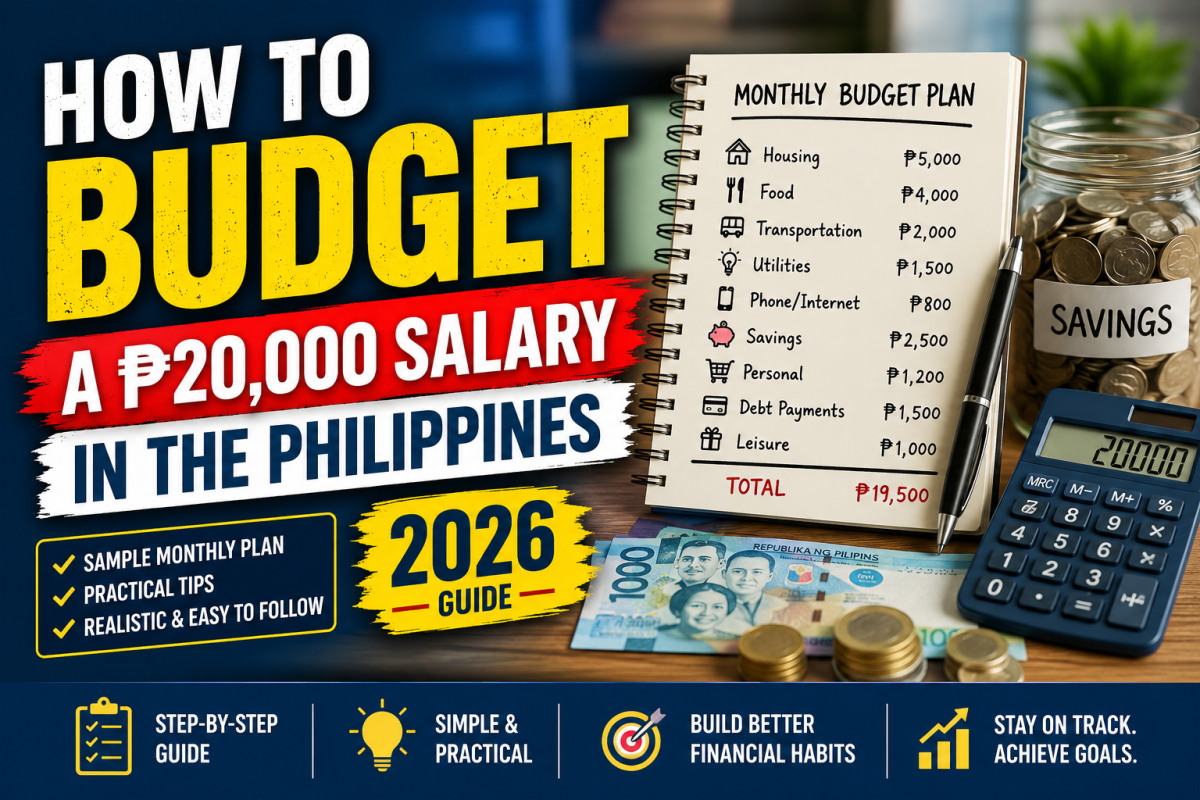
Budget a ₱20,000 salary in the Philippines by giving priority to essential expenses, setting aside savings and keeping flexible spending under control. With food, housing, transportation, utilities and other everyday costs competing for the same income, a realistic monthly plan can help you understand where your money goes and make better financial decisions.
The goal is not to follow one perfect budgeting formula. A realistic budget should reflect where you live, whether you rent, whether you support family members, how you commute and whether you have existing debts.
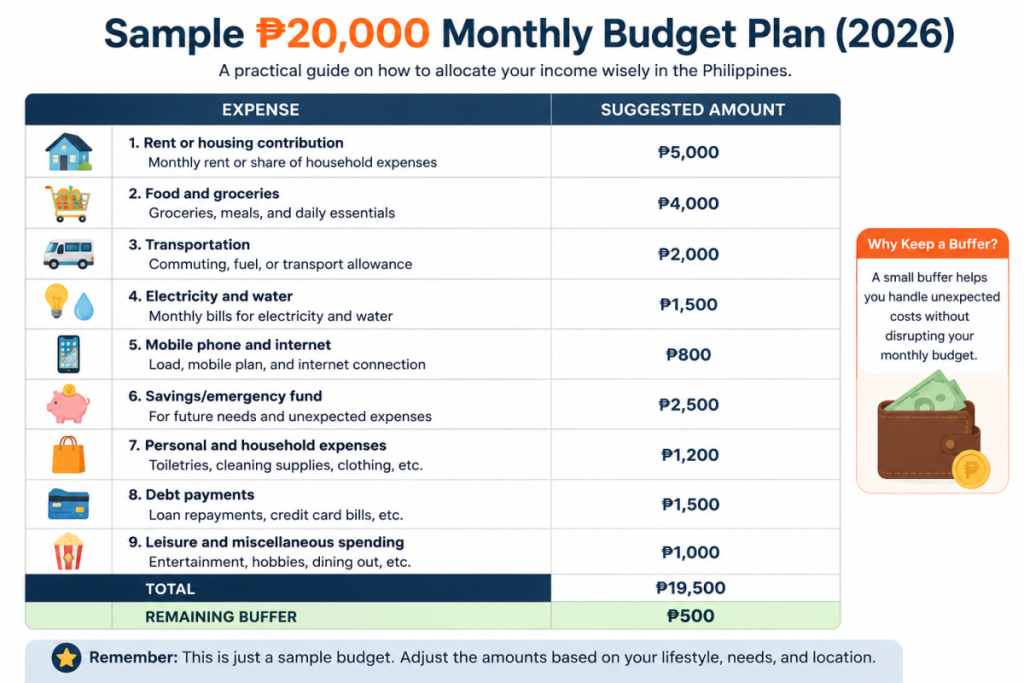
For someone earning ₱20,000 a month, the first step is to separate essential expenses from flexible spending and savings. A practical starting point is to create a budget before the month begins rather than waiting to see what money remains at the end.
A sample ₱20,000 monthly budget could look like this:
| Expense | Suggested Amount |
|---|---|
| Rent or housing contribution | ₱5,000 |
| Food and groceries | ₱4,000 |
| Transportation | ₱2,000 |
| Electricity and water | ₱1,500 |
| Mobile phone and internet | ₱800 |
| Savings/emergency fund | ₱2,500 |
| Personal and household expenses | ₱1,200 |
| Debt payments | ₱1,500 |
| Leisure and miscellaneous spending | ₱1,000 |
| Total | ₱19,500 |
| Remaining buffer | ₱500 |
This is only a sample. Someone living with family may spend much less on housing, while someone renting alone in a major city may need to allocate substantially more. The important idea is to build the budget around actual expenses instead of forcing your finances into a fixed percentage rule.
Start With Your Take-Home Pay
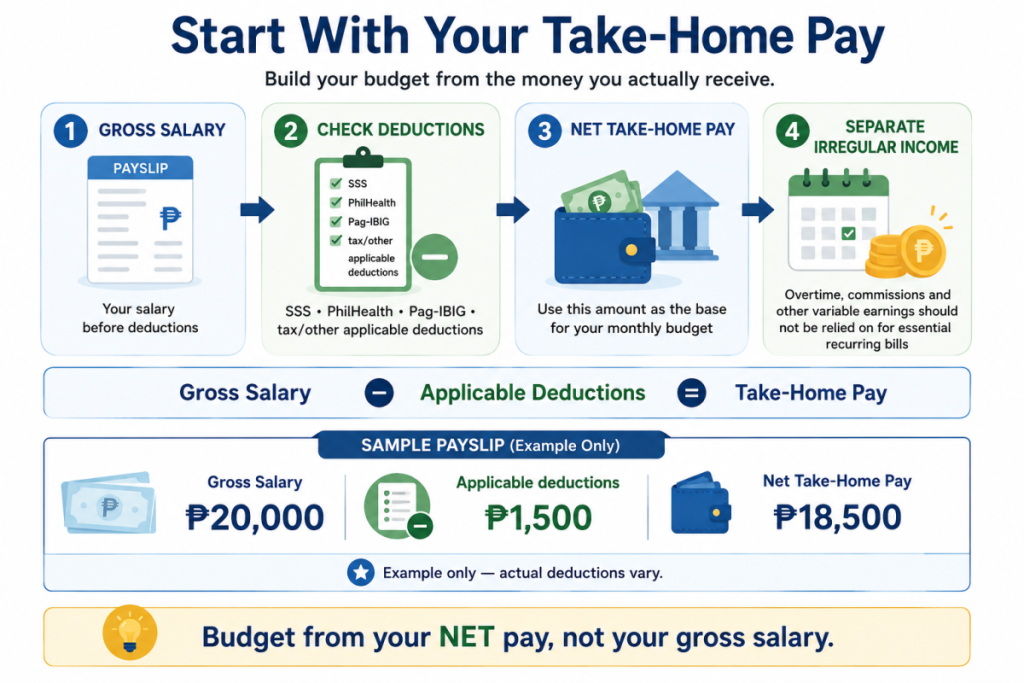
Before making a budget, determine how much money actually reaches your bank account or wallet each month.
A ₱20,000 salary does not necessarily mean you have ₱20,000 available for spending. Depending on your employment arrangement and applicable deductions, your take-home pay may be lower because of mandatory contributions, taxes or other deductions.
Use your actual payslip as the starting point.
For example, if your take-home pay is ₱18,500 rather than ₱20,000, your budget should be based on ₱18,500. Do not create a spending plan using gross salary and then wonder why you run out of money before payday.
If your income changes because of overtime, commissions or other variable earnings, consider your regular salary the foundation of your budget. Treat irregular income separately rather than depending on it to pay essential bills.
Give Housing a Realistic Limit
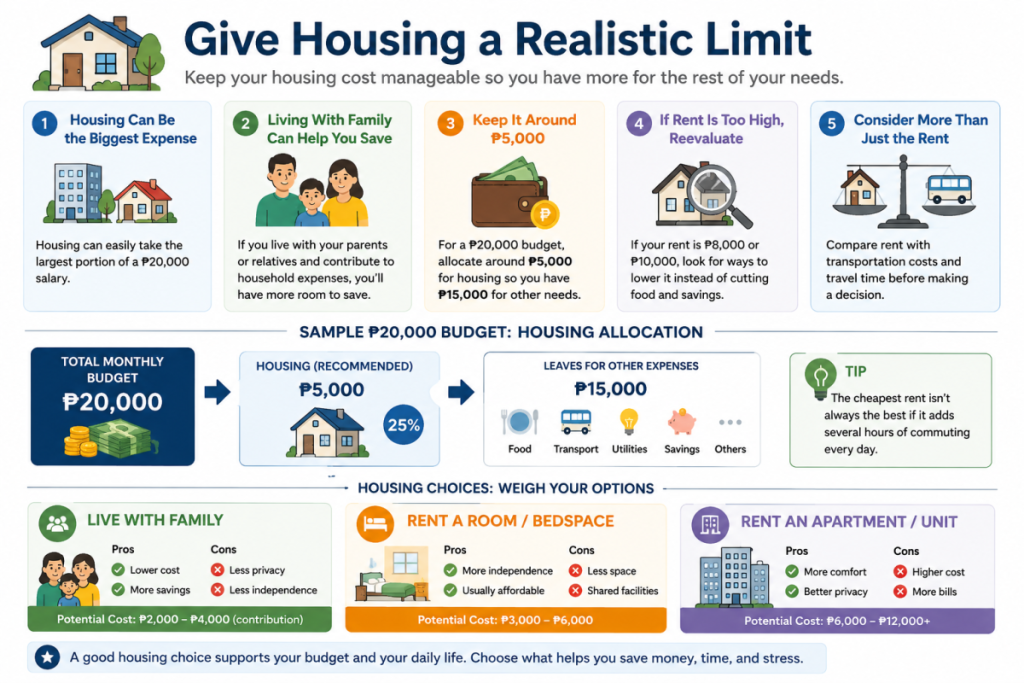
Housing can easily become the largest expense for a worker earning ₱20,000.
If you live with your parents or relatives and contribute to household expenses, you may have more room for savings. If you rent a room or bed space, however, rent can consume a significant part of your salary.
For a sample ₱20,000 budget, allocating around ₱5,000 for housing leaves ₱15,000 for everything else.
If your rent is already ₱8,000 or ₱10,000, don’t simply cut food and savings to make the numbers work. Consider whether you can reduce housing costs by sharing accommodation, moving closer to work or living with family temporarily.
The cheapest housing option is not always the best if it adds several hours of commuting every day. Compare rent with transportation costs and travel time before making a decision.
Plan Food Spending Before You Go Shopping
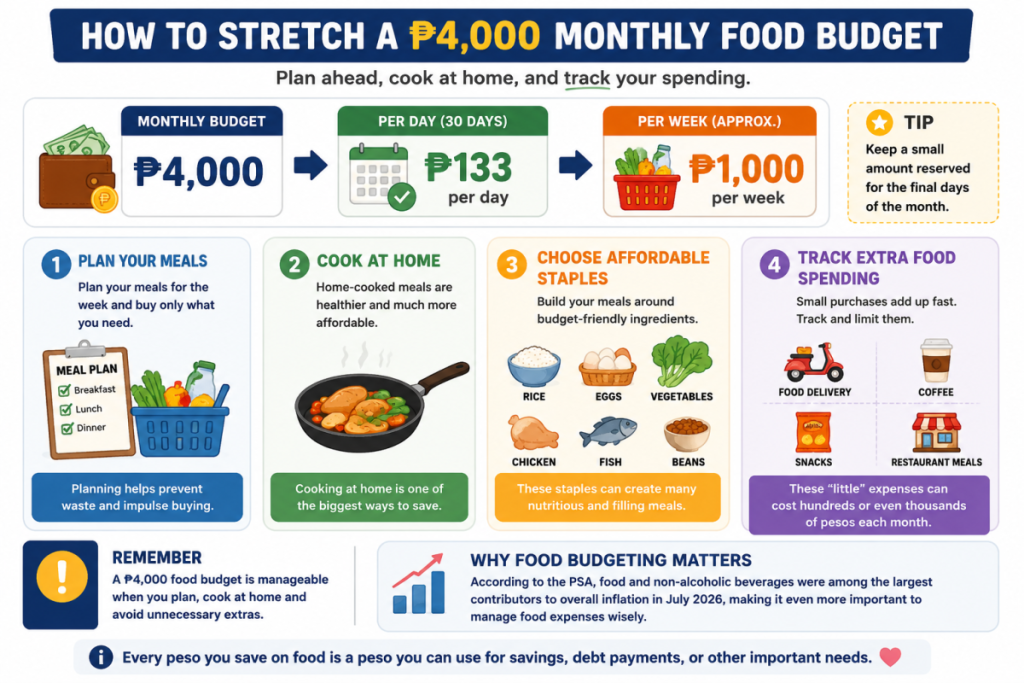
A ₱4,000 monthly food budget is approximately ₱133 per day if spread evenly across 30 days.
That amount can be difficult for someone who buys every meal from restaurants or convenience stores, but it can be more manageable for someone who prepares meals at home.
One approach is to divide your food budget into weekly limits. A ₱4,000 monthly budget could be divided into roughly ₱1,000 per week, with a small amount reserved for the final days of the month.
Buy basic ingredients according to your actual meal plan rather than purchasing food simply because it is on sale. Rice, eggs, vegetables, chicken, fish, beans and other affordable staples can form the foundation of many home-cooked meals.
You should also track food delivery, coffee, snacks and restaurant meals separately. These small purchases can quietly consume hundreds or even thousands of pesos each month.
The PSA reported that food and non-alcoholic beverages were among the largest contributors to overall inflation in July 2026, making food budgeting especially important for households trying to control monthly expenses.
Set a Transportation Limit
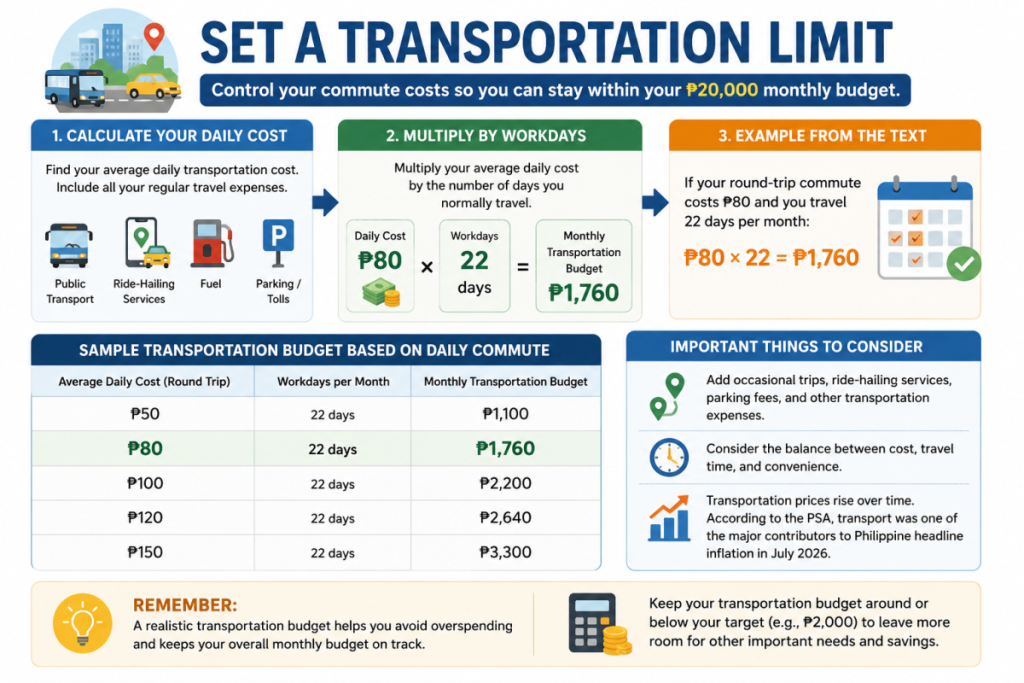
Transportation deserves its own category because commuting costs can become substantial over an entire month.
A sample budget might allocate ₱2,000 for transportation, but your actual amount depends heavily on where you live and how far you travel.
Calculate your average daily transportation cost and multiply it by the number of days you normally travel.
For example, if your round-trip commute costs ₱80 and you travel to work 22 days per month:
₱80 × 22 = ₱1,760
That gives you a much more realistic transportation budget than simply choosing a random percentage of your salary.
Also consider occasional trips, ride-hailing services, parking and other transportation expenses.
Transportation costs can be particularly important when prices rise. In July 2026, transport was one of the major contributors to Philippine headline inflation, according to the PSA.
Keep Utilities Under Control
Electricity and water should be treated as essential expenses, but that doesn’t mean they cannot be managed.
A sample budget might set aside ₱1,500 for electricity and water combined, but actual household bills vary significantly depending on the number of people sharing the home, appliances, air-conditioning use and location.
If you live alone, monitor your electricity consumption rather than assuming the bill will remain the same every month.
Simple changes can help, such as turning off unused appliances, limiting unnecessary air-conditioning use and checking for appliances that consume electricity even when they appear to be switched off.
If you share a household, establish in advance how much each person contributes toward utilities.
Control Mobile and Internet Spending
Communication expenses can be easy to overlook because individual payments may seem small.
A practical starting point might be ₱800 per month for mobile and internet expenses, depending on your situation.
If your household already has Wi-Fi, avoid paying for unnecessary duplicate data plans. On the other hand, don’t choose an unreliable internet service simply because it is cheaper if you depend on connectivity for work or school.
Review subscriptions regularly. Streaming services, cloud storage, gaming subscriptions and other recurring charges should be included in your budget.
Pay Yourself Before Spending
One of the most important changes you can make is to treat savings as an expense rather than whatever is left over.
In the sample budget, ₱2,500 is assigned to savings or an emergency fund.
If ₱2,500 is too difficult initially, start with an amount you can consistently maintain. Even ₱500 or ₱1,000 per month creates the habit of saving.
For example:
₱2,500 × 12 months = ₱30,000
If you can consistently save ₱2,500 every month and do not withdraw it for ordinary spending, you could build ₱30,000 in a year before considering any interest or investment returns.
A separate savings account can make this easier because the money is less visible during everyday spending.
The Bangko Sentral ng Pilipinas includes budgeting, saving, debt management and financial planning among the areas covered by its financial education initiatives.
Build an Emergency Fund Before Increasing Lifestyle Spending
An emergency fund is designed for unexpected expenses such as medical bills, urgent repairs, temporary loss of income or other genuine emergencies.
Don’t worry if you cannot immediately save several months of expenses. Start with a smaller target.
A practical progression could be:
First target: ₱5,000
Second target: ₱10,000
Third target: ₱20,000
After reaching those milestones, you can work toward a larger emergency reserve based on your essential monthly expenses.
Keep emergency savings separate from money intended for vacations, shopping or entertainment.
Deal With Debt Without Ignoring Your Other Needs
If you have credit-card balances, personal loans or other debts, include the required payments in your monthly budget.
The sample budget assigns ₱1,500 to debt payments, but your actual requirement may be higher or lower.
If your debt has a high interest rate, consider directing extra money toward it after covering essential expenses and maintaining a small emergency reserve.
Avoid taking on new debt simply because your budget has reached its limit. Before using a loan or credit card, ask whether the payment will still fit comfortably into your future monthly income.
Give Yourself Some Spending Money
A budget that allows no enjoyment can be difficult to maintain.
The sample budget includes ₱1,000 for leisure and miscellaneous spending. You might use this for an occasional meal out, coffee, entertainment or another personal expense.
The purpose isn’t to encourage unnecessary spending. It is to give you a controlled amount that you can spend without feeling that every peso is restricted.
Once the monthly amount is used, wait until the next budget cycle rather than borrowing from your savings.
Use a Weekly Spending Limit
Monthly budgets can sometimes feel too abstract.
Instead, convert selected expenses into weekly limits.
Suppose you have ₱4,000 for food and ₱1,200 for personal expenses. Rather than thinking about ₱5,200 for the entire month, establish a weekly spending target and monitor it.
This makes it easier to identify overspending early.
If you spend ₱1,500 during the first week because of several restaurant meals, you know immediately that you need to adjust the following weeks.
A simple spreadsheet, notebook or budgeting app can be enough. You don’t need an expensive financial tool.
What If ₱20,000 Isn’t Enough?
Sometimes the problem isn’t poor budgeting. Your essential expenses may genuinely be higher than your income.
If your rent, food, transportation, utilities and debt payments already consume your entire salary, cutting small discretionary expenses may not solve the underlying problem.
In that situation, look at the largest expenses first.
Could you reduce rent? Could you move closer to work? Can you share accommodation? Can you refinance expensive debt? Could you increase your income through overtime, freelance work or a higher-paying job?
Increasing income can be more effective than trying to eliminate every small expense.
However, additional income should not automatically lead to additional spending. If your salary increases, consider directing part of the increase toward savings, debt repayment or important financial goals.
A Simple Rule for Every Payday
When your salary arrives, give your money a job.
For a sample ₱20,000 take-home income, you could immediately separate:
₱5,000 for housing
₱4,000 for food
₱2,000 for transportation
₱1,500 for utilities
₱800 for communication
₱2,500 for savings
₱1,200 for personal and household needs
₱1,500 for debt
₱1,000 for leisure and miscellaneous expenses
₱500 as a monthly buffer
The buffer is important. Real life rarely follows a spreadsheet perfectly. An unexpected fare increase, medicine purchase, household expense or small bill can disrupt an otherwise balanced budget.
If you don’t use the ₱500 buffer, transfer it to savings at the end of the month.
The Bottom Line
Living on a ₱20,000 salary in the Philippines in 2026 requires planning, but it is possible to create a workable budget by prioritizing necessities, controlling flexible spending and saving consistently.
The biggest mistake is trying to copy someone else’s budget exactly. A person living in Davao may have a completely different rent and transportation situation from someone living in Manila. A worker living with family will also have different expenses from someone renting alone.
Start with your actual take-home pay and your actual bills. Track your spending for one month, identify where your money is going, and then adjust the following month’s budget.
Most importantly, don’t wait until you earn more before learning how to manage money. Developing the habit of budgeting, saving and controlling debt while earning ₱20,000 can make it much easier to manage your finances when your income eventually increases.



 Facebook
 Twitter