


13th month pay Philippines 2026 is an important year-end benefit for covered private-sector employees. The amount is generally calculated by taking the total basic salary earned during the calendar year and dividing it by 12.
If you are a private-sector employee in the Philippines, your 13th month pay is generally based on the total basic salary you earned during the calendar year, divided by 12.
The formula is simple:
13th Month Pay = Total Basic Salary Earned During the Year ÷ 12
The difficult part is determining what should actually be included in “basic salary.”
Your calculation can change if you:
- started working during 2026;
- received a salary increase;
- resigned or were terminated before December;
- had periods of unpaid leave;
- receive commissions or piece-rate wages;
- receive allowances separately from your basic salary; or
- have a compensation arrangement that differs from a regular monthly salary.
This 2026 guide explains how to calculate your 13th month pay, what normally counts as basic salary, how resignation and salary increases affect the amount, how the benefit is taxed, and how to check your employer’s computation.
Important: This article explains the statutory minimum rules. Your employment contract, collective bargaining agreement (CBA), or company policy may provide a more favorable benefit.
Quick answer: How is 13th month pay calculated?
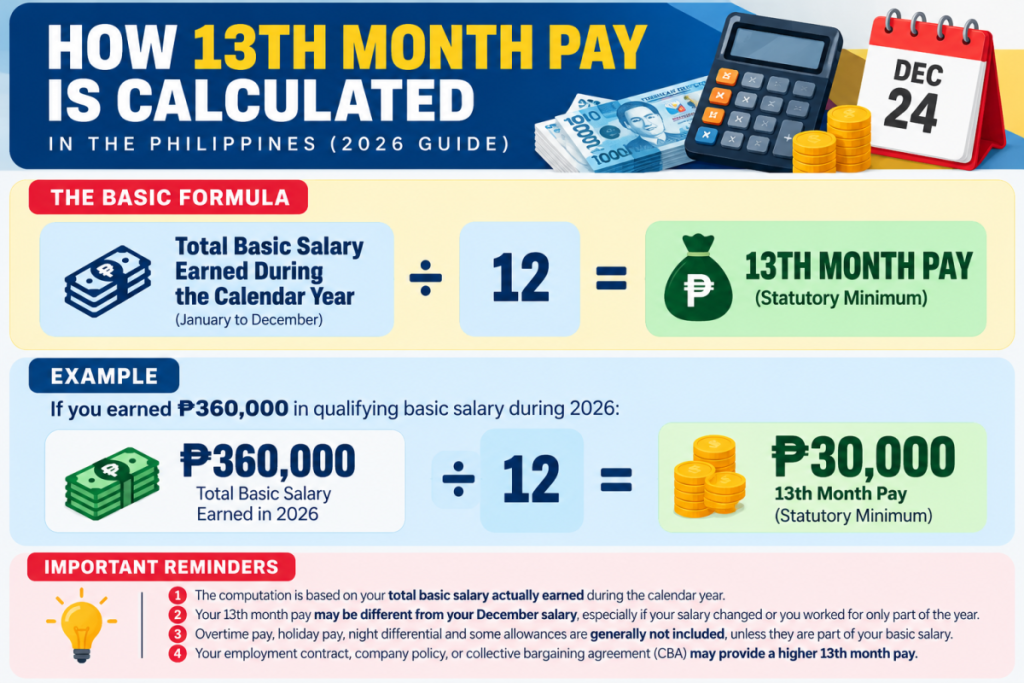
For a covered employee, the basic statutory formula is:
Total qualifying basic salary earned during the calendar year ÷ 12
For example, if you earned ₱360,000 in qualifying basic salary during 2026:
₱360,000 ÷ 12 = ₱30,000
Your statutory 13th month pay would therefore be ₱30,000, assuming the entire ₱360,000 qualifies as basic salary.
The important point is that the calculation is based on basic salary actually earned during the year, not simply your December salary.
The National Wages and Productivity Commission (NWPC) defines 13th month pay as one-twelfth of the total basic salary earned within a calendar year.
Who is entitled to 13th month pay in the Philippines?
Under the applicable private-sector rules, covered rank-and-file employees who have worked for at least one month during the calendar year are entitled to 13th month pay.
DOLE’s latest specific guidance on the benefit, Labor Advisory No. 16, Series of 2025, reiterates coverage of rank-and-file employees regardless of position, designation, employment status, or method of wage payment, provided the employee has worked for at least one month during the calendar year.
The guidance also addresses situations involving:
- piece-rate employees;
- employees receiving a fixed or guaranteed wage plus commission;
- employees with multiple employers;
- employees who resigned;
- employees who were terminated; and
- women who received salary differential while on maternity leave.
The rank-and-file distinction matters because the statutory private-sector rules under Presidential Decree No. 851 are not simply applied to managerial employees in the same way.
Government employees are also governed by separate compensation and year-end benefit rules rather than the private-sector PD 851 framework.
Domestic workers are covered by the Batas Kasambahay, which separately provides for 13th month pay.
What is the 13th month pay formula?
The standard formula is:
13th Month Pay = Total Basic Salary Earned During the Calendar Year ÷ 12
Suppose an employee earns ₱25,000 in basic salary every month from January through December.
Annual basic salary:
₱25,000 × 12 = ₱300,000
13th month pay:
₱300,000 ÷ 12 = ₱25,000
In this simple situation, the 13th month pay happens to equal one month’s basic salary.
But that is not a universal rule.
If your salary changed during the year or you worked for only part of the year, your 13th month pay may be different from your December salary.
The easiest way to calculate your 13th month pay
Instead of starting with your December salary, start with your actual basic salary earned each month.
Use these four steps:
Step 1: Gather your 2026 payslips.
Look for the amount identified as basic salary.
Step 2: Record your basic salary for each month.
If your salary stayed the same all year, this is easy.
Step 3: Account for changes.
Separate periods with different basic salaries, such as before and after a salary increase.
Step 4: Add the qualifying basic salary and divide by 12.
For example:
January–June: ₱25,000 × 6 = ₱150,000
July–December: ₱30,000 × 6 = ₱180,000
Total basic salary:
₱150,000 + ₱180,000 = ₱330,000
13th month pay:
₱330,000 ÷ 12 = ₱27,500
Estimated statutory 13th month pay: ₱27,500
Why your December salary may not be your 13th month pay
This is one of the most common sources of confusion.
Suppose your December basic salary is ₱30,000.
It does not automatically mean your 13th month pay should be ₱30,000.
That would only be the straightforward result if:
- you worked throughout the year;
- your qualifying basic salary stayed at ₱30,000; and
- there were no other circumstances affecting the amount of basic salary actually earned.
If you received a raise in July, for example, the first six months and last six months have to be considered separately.
Example: You started working in April
Suppose you started on April 1, 2026, with a monthly basic salary of ₱30,000.
You earned basic salary for nine months:
₱30,000 × 9 = ₱270,000
Then:
₱270,000 ÷ 12 = ₱22,500
Estimated 13th month pay: ₱22,500
Notice that you divide by 12, not nine.
The statutory formula is based on the total basic salary earned during the calendar year divided by 12.
Example: You started working in July
Suppose you started in July and earned ₱24,000 per month.
July through December represents six months:
₱24,000 × 6 = ₱144,000
13th month pay:
₱144,000 ÷ 12 = ₱12,000
Estimated 13th month pay: ₱12,000
What happens if your salary increased during 2026?
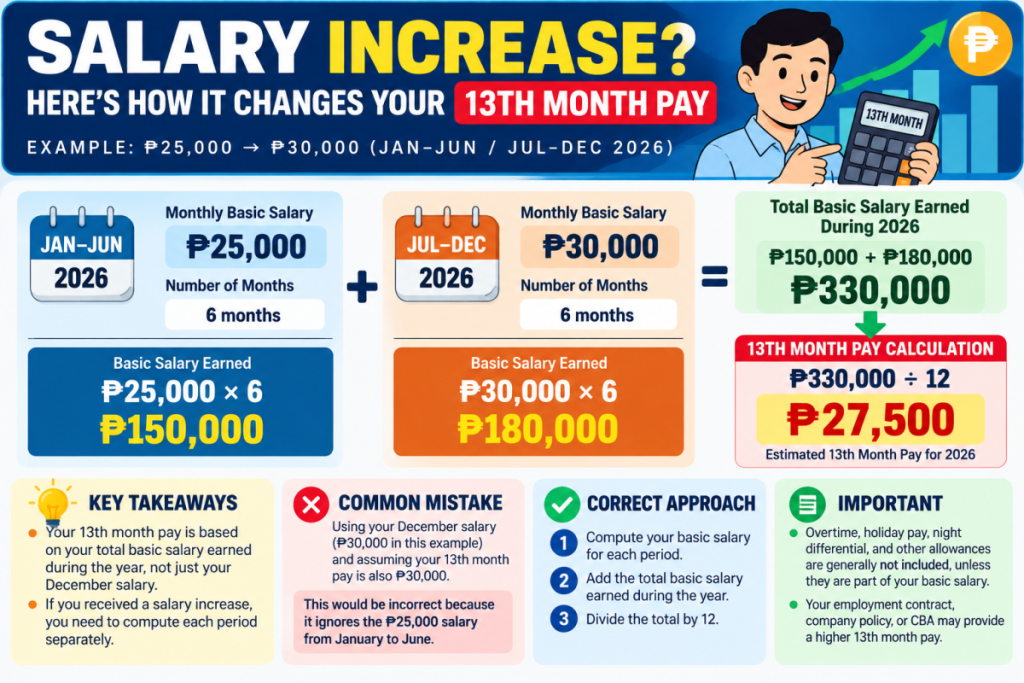
A salary increase is one of the clearest reasons your 13th month pay may not match your December salary.
Suppose your basic salary was:
| Period | Monthly basic salary | Months | Basic salary earned |
|---|---|---|---|
| January–June | ₱25,000 | 6 | ₱150,000 |
| July–December | ₱30,000 | 6 | ₱180,000 |
| Total | 12 | ₱330,000 |
Now calculate:
₱330,000 ÷ 12 = ₱27,500
Your estimated statutory 13th month pay is ₱27,500.
You should not simply multiply your December salary of ₱30,000 by 12 because that would ignore the lower salary you actually earned during the first six months.
What if you received several salary increases?
The same method applies.
Suppose your 2026 basic salary was:
- January–March: ₱22,000
- April–September: ₱25,000
- October–December: ₱28,000
Calculate each period:
₱22,000 × 3 = ₱66,000
₱25,000 × 6 = ₱150,000
₱28,000 × 3 = ₱84,000
Total basic salary:
₱66,000 + ₱150,000 + ₱84,000 = ₱300,000
13th month pay:
₱300,000 ÷ 12 = ₱25,000
This method works regardless of how many times your salary changed.
Does overtime pay count toward 13th month pay?
Generally, overtime pay is not included when it is separately paid and is not treated as part of basic salary.
DOLE guidance identifies overtime pay, premium pay, night shift differential, holiday pay and certain other payments as generally excluded from basic salary. However, the treatment can change when an individual or collective agreement, company practice, or company policy treats a payment as part of basic salary.
For example, a payslip might show:
- Basic salary: ₱25,000
- Overtime: ₱3,000
- Night differential: ₱1,500
You should not automatically use ₱29,500 as your monthly basic salary.
The first question is how each payment is classified under your employment terms and applicable company rules.
Do allowances count?
Not every allowance automatically forms part of basic salary.
For example, a transportation allowance that appears separately on your payslip does not automatically become basic salary simply because you receive it every month.
The relevant issue is whether the payment is considered or integrated into basic salary under the applicable employment agreement, CBA, company practice, or policy.
This is why using your total gross compensation as the basis for the 13th month calculation can produce the wrong result.
What about holiday pay, premium pay and night differential?
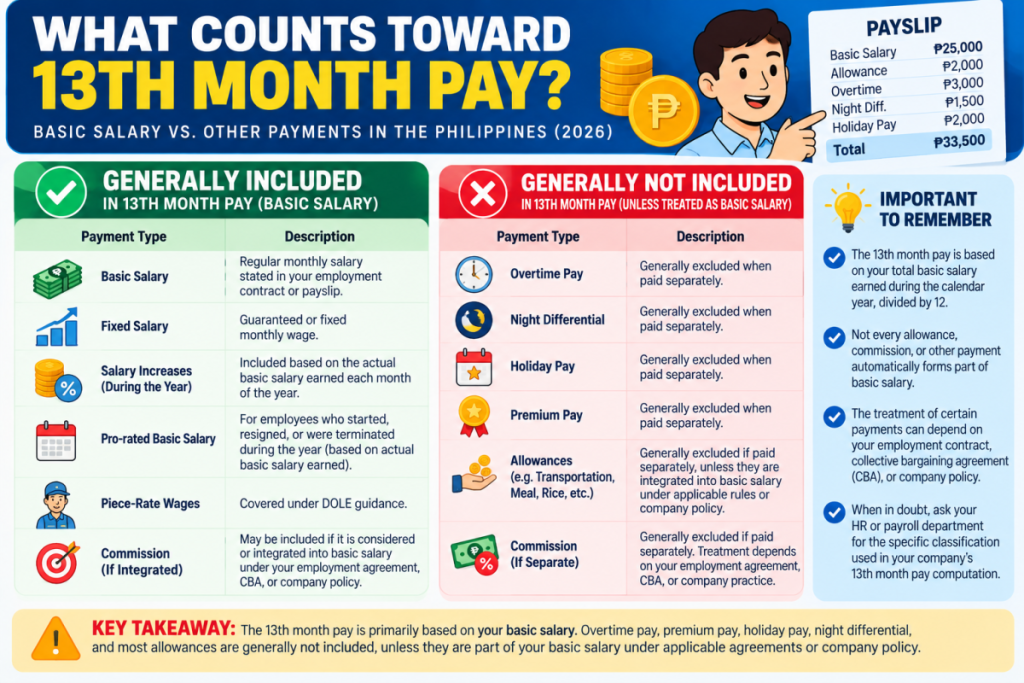
These payments are generally excluded from the statutory basic-salary computation when they are separately paid.
That includes:
- overtime pay;
- premium pay;
- holiday pay;
- night shift differential; and
- allowances or monetary benefits that are not integrated into basic salary.
However, there can be exceptions when applicable agreements, company policy, or established company practice treat particular payments as part of basic salary.
If you are unsure, don’t guess. Ask your payroll or HR department for the classification used in the company’s computation.
Do commissions count?
Commission arrangements require more care because different compensation structures can have different treatment.
DOLE’s 2025 guidance specifically recognizes employees receiving a fixed or guaranteed wage plus commission among those entitled to 13th month pay. It also identifies piece-rate workers and employees with multiple employers in its coverage discussion.
If you receive a fixed salary plus commission, do not automatically assume that the entire amount shown on your payslip is basic salary.
Check how your employment agreement and payroll system classify the commission.
Can piece-rate workers receive 13th month pay?
Yes. Piece-rate employees should not automatically assume that they are excluded.
DOLE’s 2025 guidance specifically includes piece-rate workers among employees covered by the 13th month pay rules.
The exact computation depends on the applicable compensation arrangement and payroll records.
If you are paid per piece, unit, output, or task, keep your payment records and ask the employer how the qualifying amount was determined.
What if you have more than one employer?
DOLE’s guidance recognizes employees with multiple employers among those entitled to 13th month pay.
The practical point is that you should consider each employment relationship separately.
For example, if you work for Employer A and Employer B, you should not simply add both salaries together and expect one employer to calculate the entire benefit.
Each employer generally has its own employment relationship and corresponding calculation.
What happens if you resign before December?
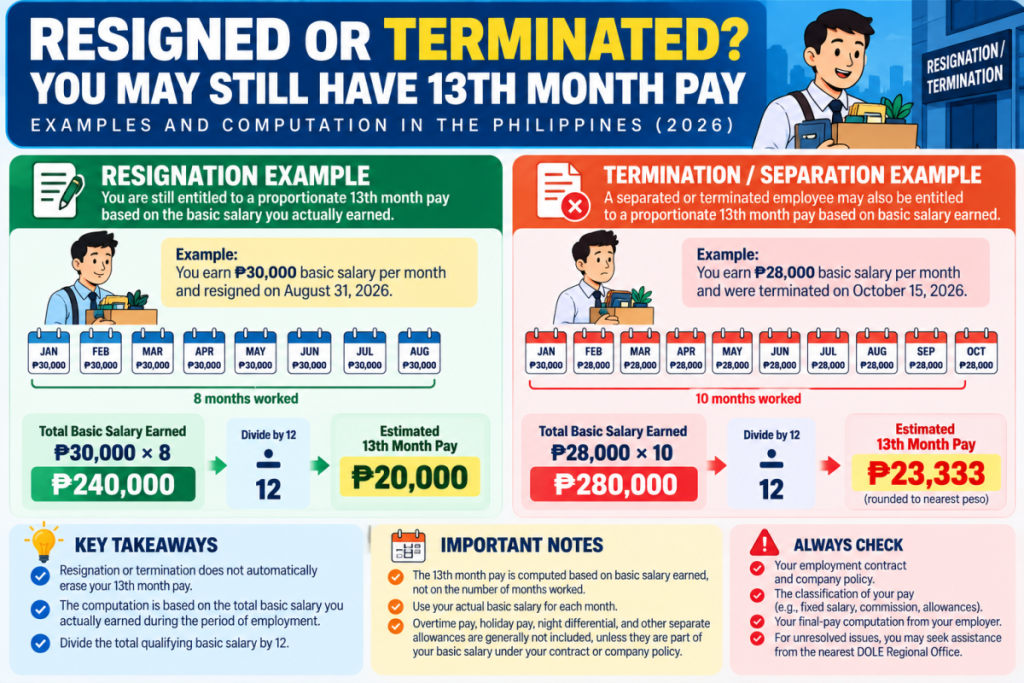
Resigning before December does not automatically erase the 13th month pay you have already earned.
DOLE guidance recognizes resigned or separated employees as entitled to a proportionate 13th month benefit based on qualifying basic salary earned during the period of employment.
For example, suppose you earned ₱30,000 in qualifying basic salary each month and resigned at the end of August.
Basic salary earned:
₱30,000 × 8 = ₱240,000
Proportionate 13th month pay:
₱240,000 ÷ 12 = ₱20,000
Estimated amount: ₱20,000
The amount should be reflected in your final-pay computation.
What if you are terminated?
A covered employee who is separated or terminated during the year may likewise be entitled to a proportionate 13th month benefit based on qualifying basic salary earned before separation. DOLE specifically recognizes separated and terminated employees in its guidance.
The basic calculation remains:
Qualifying basic salary earned before separation ÷ 12
Keep your payslips and final-pay documents so you can compare the employer’s calculation with your own records.
Does unpaid leave reduce 13th month pay?
It can, depending on how the unpaid period affects the basic salary actually earned during the year.
The statutory formula is based on basic salary earned, rather than simply taking your contractual monthly salary and multiplying it by 12.
For example, if your monthly basic salary is ₱30,000 but an unpaid period causes you to receive less qualifying basic salary during a month, the amount actually earned needs to be considered.
However, employees should not automatically treat every type of leave as unpaid leave. Different leave situations can have different rules.
How does maternity leave affect 13th month pay?
Maternity leave requires particular care because the treatment of maternity benefits and salary differential should not simply be combined.
DOLE’s current guidance identifies women on maternity leave who received salary differential among workers covered by the 13th month pay rules. At the same time, DOLE’s earlier Q&A states that maternity leave benefits themselves are not included in the 13th month pay computation.
The practical lesson is:
Do not automatically add maternity benefits to your basic salary.
If maternity leave affected your 2026 payroll, compare your employer’s computation with the applicable DOLE guidance and your payroll records.
When should 13th month pay be paid?
For covered private-sector employees, the statutory deadline is December 24.
DOLE’s Labor Advisory No. 16, Series of 2025, reiterated that private employers must release the mandatory benefit on time. DOLE’s Bureau of Working Conditions also explained that the full amount can be distributed earlier or in installments, provided the required amount is paid within the applicable deadline.
As of September 27, 2026, the DOLE Bureau of Working Conditions’ 2026 advisory list does not show a new 13th-month-pay advisory replacing the 2025 guidance. Workers should still check for any later issuance before the end of the year.
Is 13th month pay the same as a Christmas bonus?
No.
They are different benefits.
13th month pay is a statutory benefit for covered employees.
A Christmas bonus is an additional benefit that may depend on company policy, employment agreements, CBA provisions, or established company practice.
For example:
- 13th month pay: ₱25,000
- Christmas bonus: ₱10,000
The employee could receive ₱35,000 in combined benefits, assuming the bonus is separately provided by the employer.
DOLE has specifically distinguished the mandatory 13th month benefit from a discretionary Christmas bonus.
Is 13th month pay taxable?
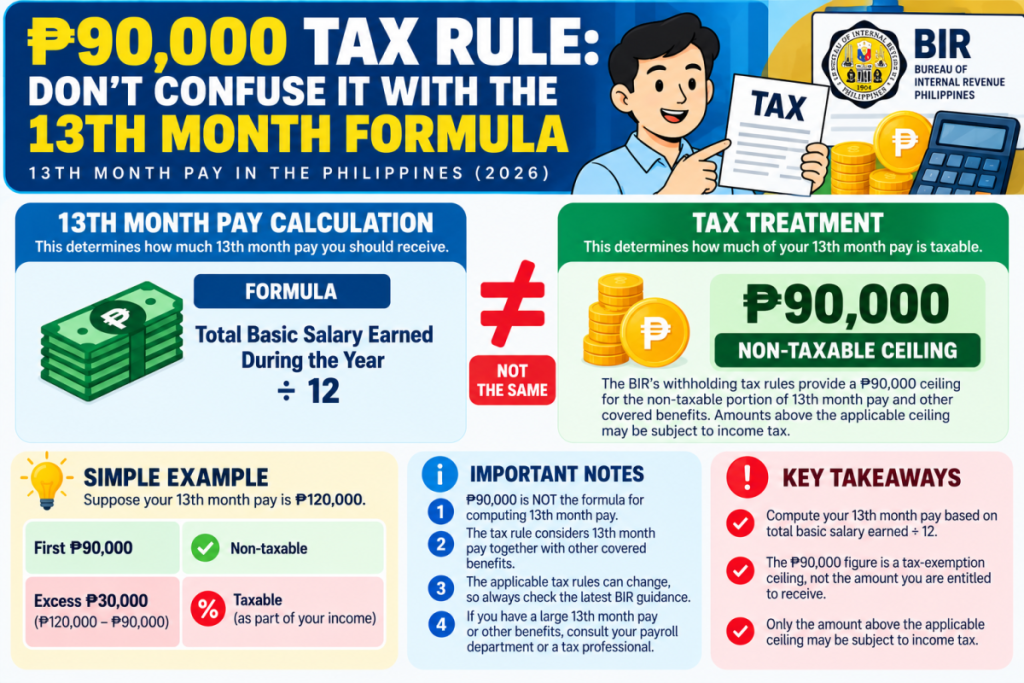
The calculation of 13th month pay and its tax treatment are two separate questions.
The BIR’s current withholding-tax calculator provides a ₱90,000 ceiling for the non-taxable portion of 13th month pay and other covered benefits. Amounts above the applicable ceiling can become taxable compensation.
This means ₱90,000 is not the formula for calculating 13th month pay.
For example, if your statutory 13th month pay is ₱80,000, you should not interpret that as meaning you automatically have another separate ₱90,000 tax-free allowance for other covered benefits.
The applicable tax rules consider 13th month pay together with qualifying other benefits.
Because tax rules can change, employees dealing with unusually high benefits or complicated compensation should check the latest BIR guidance rather than relying on an old social-media post or calculator.
13th month pay worksheet for 2026
If your salary changed during the year, use a simple monthly worksheet.
| Month | Basic salary earned |
|---|---|
| January | ₱_____ |
| February | ₱_____ |
| March | ₱_____ |
| April | ₱_____ |
| May | ₱_____ |
| June | ₱_____ |
| July | ₱_____ |
| August | ₱_____ |
| September | ₱_____ |
| October | ₱_____ |
| November | ₱_____ |
| December | ₱_____ |
| Total | ₱_____ |
Then calculate:
Total qualifying basic salary ÷ 12 = Estimated 13th month pay
This approach is especially useful when you received one or more salary increases during 2026.
A practical example using a real payroll-style breakdown
Suppose your payslip for one month shows:
| Payroll item | Amount |
|---|---|
| Basic salary | ₱25,000 |
| Overtime | ₱4,000 |
| Night differential | ₱1,500 |
| Transportation allowance | ₱2,000 |
| Total compensation | ₱32,500 |
It would be a mistake to automatically assume that ₱32,500 is your monthly basic salary for 13th month purposes.
Your starting point is the ₱25,000 basic salary.
The other payments need to be assessed according to their classification and the applicable employment terms.
This distinction is important because a payslip’s total compensation is not necessarily the same thing as basic salary for 13th month computation.
What if your employer’s computation is different?
A difference does not automatically prove that your employer made an error.
First, compare the underlying figures.
Check:
- your employment start date;
- your separation date, if applicable;
- basic salary for each month;
- salary increases;
- unpaid periods;
- overtime;
- holiday and premium pay;
- night differential;
- allowances;
- commissions;
- company-specific salary classifications; and
- any 13th month amount already paid earlier in the year.
Then ask your HR or payroll department for a detailed computation.
A written breakdown is much more useful than simply comparing the final peso amount because it lets you identify exactly where the difference occurred.
What records should you keep?
You do not need complicated accounting software to check your 13th month pay.
Keep copies of:
- employment contract;
- payslips;
- payroll summaries;
- salary-increase notices;
- relevant company policies;
- leave records;
- final-pay documents if you leave the company; and
- your employer’s 13th month computation.
A simple spreadsheet or monthly list can be enough.
The goal is to maintain a record of how much qualifying basic salary you actually earned during the year.
Seven common 13th month pay mistakes
1. Using your December salary for the entire year
This can be wrong when you received a salary increase.
2. Adding overtime automatically
Overtime is generally separate from basic salary unless applicable rules or company arrangements treat it differently.
3. Including every allowance
An allowance does not automatically become basic salary merely because you receive it regularly.
4. Dividing by the number of months you worked
The statutory formula divides qualifying annual basic salary by 12, not by the number of months worked.
For example:
₱120,000 ÷ 12 = ₱10,000
Not:
₱120,000 ÷ 6 = ₱20,000
5. Assuming resignation cancels the benefit
Covered employees who resign or are separated can be entitled to a proportionate amount.
6. Treating a Christmas bonus as the same thing as 13th month pay
They are separate benefits.
7. Treating ₱90,000 as the 13th month formula
The ₱90,000 figure relates to BIR tax treatment. It is not the formula for calculating the statutory benefit.
13th month pay checklist for Filipino employees
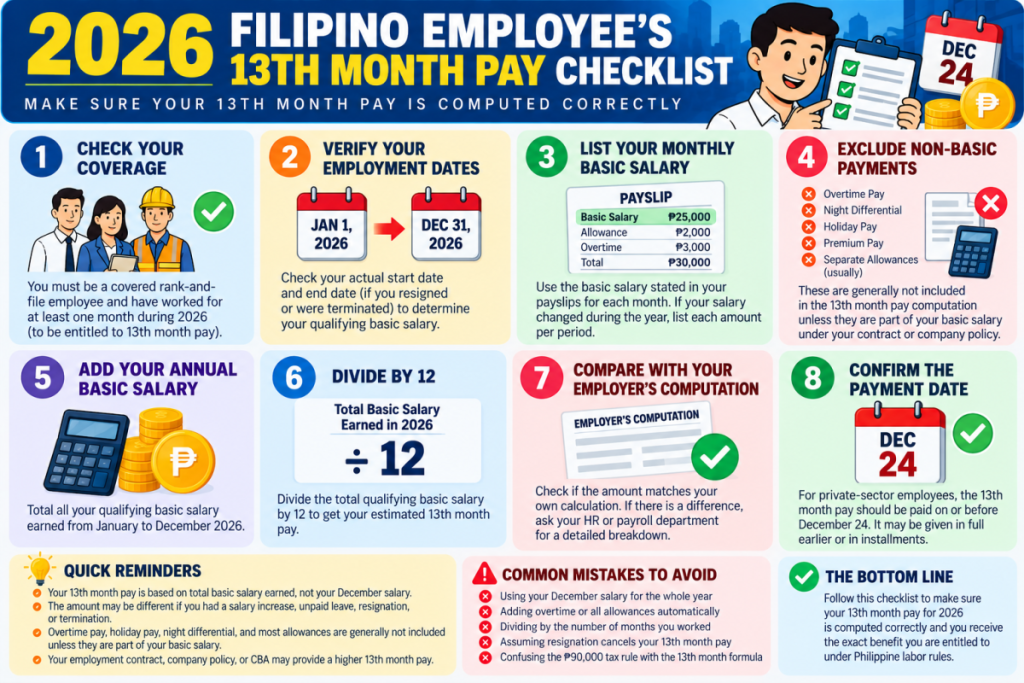
Before accepting your 2026 13th month pay, check:
☐ Am I covered by the applicable rules?
☐ What was my employment start date?
☐ Did my salary change during 2026?
☐ What was my basic salary each month?
☐ Did I have any unpaid periods?
☐ Which payments on my payslip are overtime or other benefits?
☐ Are my allowances separate from basic salary?
☐ Do I receive commissions or piece-rate compensation?
☐ Did I resign or leave the company during the year?
☐ What is my total qualifying basic salary?
☐ Did I divide that amount by 12?
☐ Does my employer’s calculation match?
☐ If not, did I ask payroll for a breakdown?
☐ Was the benefit paid within the applicable deadline?
What to do if you believe your 13th month pay was not properly paid
Start with your payroll or HR department.
Ask for a written explanation of:
- the total basic salary used;
- the months included;
- salary adjustments;
- excluded payments; and
- the final 13th month calculation.
Compare that explanation with your payslips and employment records.
If the issue remains unresolved, workers can seek assistance from the appropriate DOLE Regional Office. DOLE has stated that concerns involving non-payment or labor-standard issues may be brought to the appropriate DOLE office for assistance.
How much should your 13th month pay be?
There is no single amount that applies to every Filipino employee.
Your amount depends on the qualifying basic salary you actually earned during the calendar year.
Here are simplified examples:
| Basic salary situation | Annual basic salary | 13th month pay |
|---|---|---|
| ₱20,000 × 12 months | ₱240,000 | ₱20,000 |
| ₱30,000 × 12 months | ₱360,000 | ₱30,000 |
| ₱30,000 × 9 months | ₱270,000 | ₱22,500 |
| ₱24,000 × 6 months | ₱144,000 | ₱12,000 |
| ₱25,000 × 6 + ₱30,000 × 6 | ₱330,000 | ₱27,500 |
| ₱28,000 × 9 + ₱32,000 × 3 | ₱348,000 | ₱29,000 |
These are illustrations only. Your actual computation can differ if your payroll includes different salary classifications, unpaid periods, commissions, allowances, or other circumstances.
The bottom line
For most covered private-sector employees, the basic 13th month pay calculation is straightforward:
Total qualifying basic salary earned during the calendar year ÷ 12
The difficult part is identifying the correct amount of basic salary.
Do not automatically use your December salary.
Do not automatically add overtime.
Do not automatically include every allowance.
And do not divide the amount by the number of months you worked.
Instead, gather your payslips, determine your qualifying basic salary for each period of 2026, add those amounts, and divide the total by 12.
For employees with salary changes, resignation, commission arrangements, piece-rate compensation, maternity leave, multiple employers, or unusual payroll structures, the details matter.
The latest specific DOLE 13th-month-pay guidance currently listed is Labor Advisory No. 16, Series of 2025, while the NWPC handbook provides the underlying statutory framework. Because government rules can be updated, check the latest DOLE and BIR issuances when dealing with a disputed or unusual case.
This guide is for general educational information and is not individualized legal, labor, or tax advice.
Sources
- Department of Labor and Employment (DOLE), Labor Advisory No. 16, Series of 2025 — Guidelines on the Payment of the Thirteenth-Month Pay.
- DOLE Bureau of Working Conditions — Workers’ Statutory Monetary Benefits Handbook / 13th Month Pay guidance.
- DOLE Bureau of Working Conditions — 13th Month Pay Q&A.
- Bureau of Internal Revenue — Withholding Tax Calculator.
- DOLE 2026 Labor Advisories — current advisory listing.









 Facebook
 Twitter