
Philippine driver’s license 2026 applicants need to complete several requirements before they can legally operate a motor vehicle, including the required driver education, Student-Driver’s Permit, practical training, medical certification, examinations, and LTO processing. Understanding each stage in advance can help first-time applicants prepare the correct documents, budget for the associated expenses, and avoid delays during the licensing process.
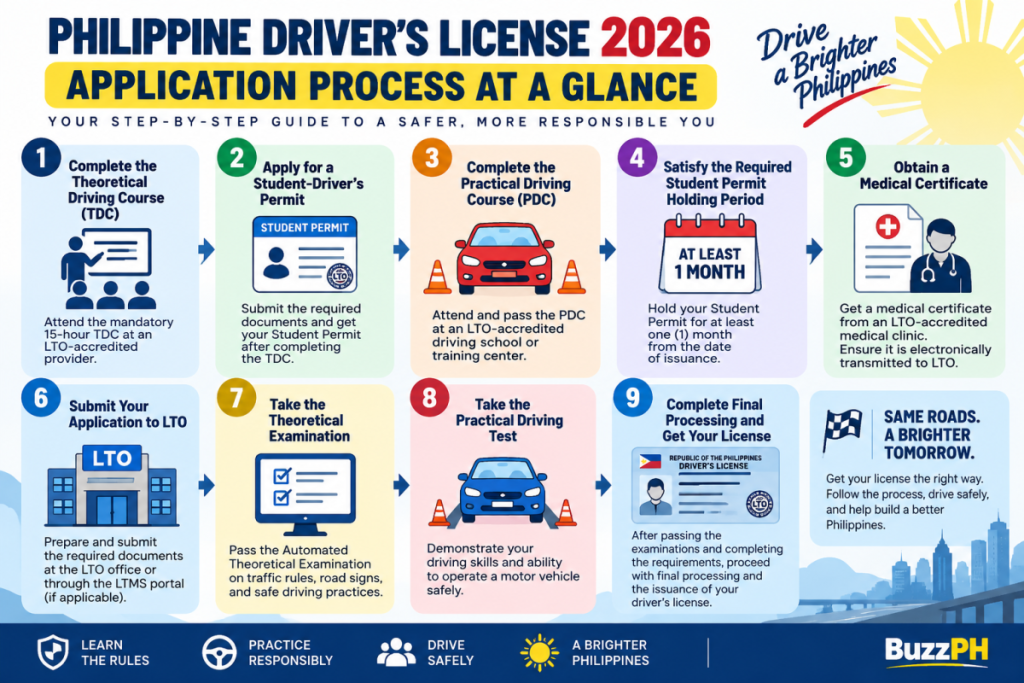
For a first-time Filipino applicant seeking a Non-Professional Driver’s License, the process generally involves completing the required Theoretical Driving Course, obtaining a Student-Driver’s Permit, completing the Practical Driving Course, satisfying the required Student Permit holding period, obtaining the appropriate medical certificate, submitting the required documents, and passing the required theoretical and practical examinations.
The Land Transportation Office (LTO) administers driver’s licensing in the Philippines and publishes the requirements, procedures, and fees for its licensing services. Because these requirements and fees can change, applicants should verify the latest information through official LTO channels before proceeding.
This guide focuses primarily on first-time applicants for a Non-Professional Driver’s License (NPDL). Professional Driver’s License transactions have additional considerations and are discussed separately.
The goal is not simply to provide a checklist. It is to explain what each stage means, what documents are involved, what costs should be budgeted for, and which information should be verified directly with LTO.
Quick Answer: How Do You Get a Driver’s License in the Philippines?
For a typical first-time Non-Professional applicant, the process can be understood as:
Theoretical Driving Course → Student-Driver’s Permit → Practical Driving Course → required Student Permit holding period → medical certificate → LTO application → theoretical examination → practical driving test → biometric/issuance procedures
LTO’s published qualifications for a new Non-Professional Driver’s License state that a Filipino applicant must generally be at least 17 years old, be able to read and write in Filipino and/or English, have held a Student-Driver’s Permit for at least one month from issuance, complete and pass the required Practical Driving Course, be physically and mentally fit to drive, have no unsettled traffic violation, and pass the Automated Theoretical Examination and Practical Driving Test.
Who Can Apply for a Non-Professional Driver’s License?
For a new Non-Professional Driver’s License, LTO’s published qualification requirements state that Filipino applicants must be at least 17 years old.
Foreign applicants are subject to a different minimum age requirement under the LTO checklist.
Applicants must also be able to read and write in Filipino and/or English, must have held a Student-Driver’s Permit for at least one month from issuance, and must have completed and passed the required Practical Driving Course.
LTO also requires applicants to be physically and mentally fit to operate a motor vehicle, have no unsettled traffic violation, and pass the required theoretical and practical examinations.
These qualifications are important because Philippine law requires the LTO licensing system to establish that drivers possess sufficient driving skills, road-safety knowledge, and proper road courtesy. Republic Act No. 10930 specifically requires theoretical and practical examinations designed to measure driver competency.
Student Permit vs. Driver’s License
A Student-Driver’s Permit is not the same as a regular driver’s license.
The Student Permit is an authority granted to someone who wants to learn to operate a motor vehicle while accompanied by a duly licensed driver who holds the appropriate license code or restriction for the vehicle being operated. LTO rules describe the Student Permit as valid for one year.
This means a Student Permit should not be treated as permission to drive independently in the same way as a regular driver’s license.
The Student Permit is part of the progression toward a Non-Professional or Professional Driver’s License.
The Theoretical Driving Course Requirement
The Theoretical Driving Course, or TDC, provides foundational knowledge for people learning to drive.
LTO rules require a mandatory 15-hour TDC before a Student-Driver’s Permit can be issued. The course covers areas including traffic rules and regulations, traffic signs and signals, pavement markings, right-of-way, hazard recognition, vehicle safety, road courtesy, defensive driving, and basic driving concepts.
LTO’s rules also provide for registration of the learner through the LTMS Client ID and attendance monitoring during the course. The TDC includes examinations, with LTO rules specifying a final examination after completion of the course.
Applicants should therefore make sure their TDC is completed through an LTO-authorized or accredited provider applicable to the transaction.
How the TDC Helps With the License Process
The TDC is more than an administrative requirement.
It introduces the concepts that later appear in the licensing process, including traffic signs, road markings, right-of-way, defensive driving, road courtesy, hazard recognition, and driver responsibilities.
For a first-time applicant, studying these concepts early can make the theoretical examination easier to understand.
The practical value is even greater after licensing. A driver who understands why a traffic rule exists is better prepared to apply it when road conditions become complicated.
The Practical Driving Course
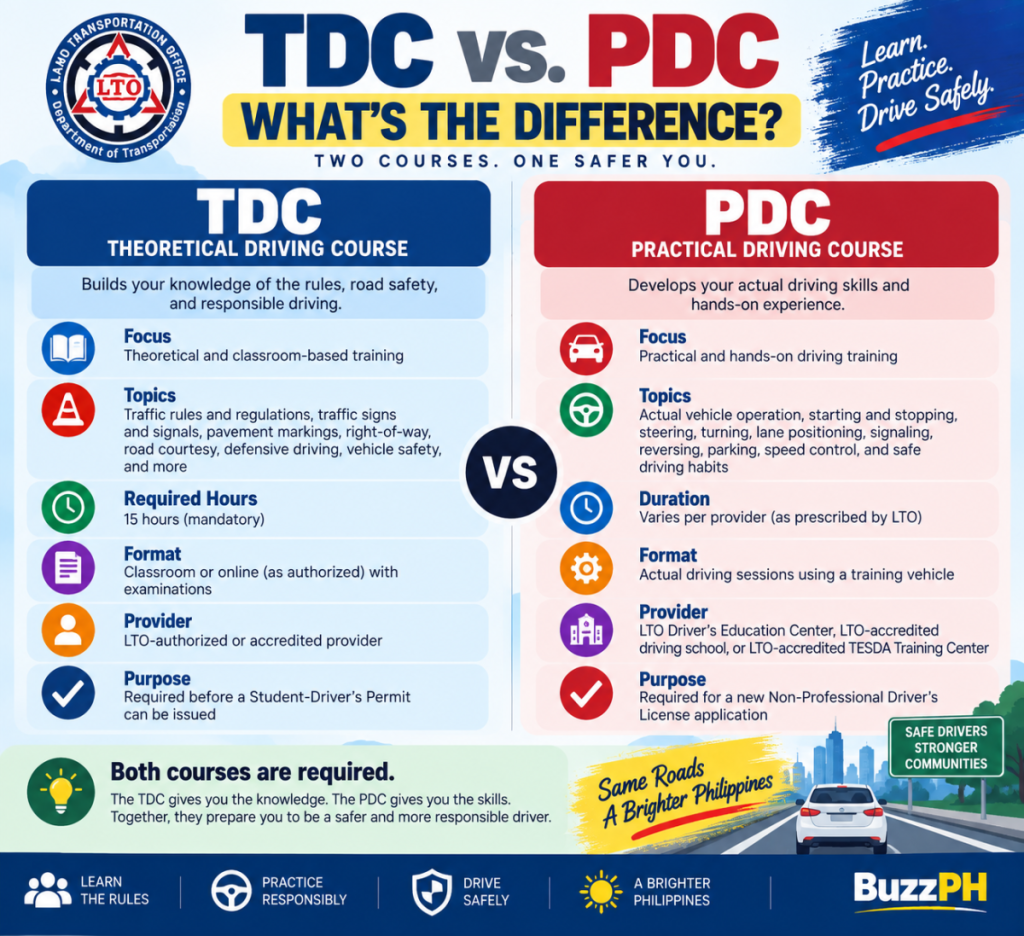
The Practical Driving Course, or PDC, focuses on actual driving skills.
For a new Non-Professional Driver’s License, LTO’s published requirements specify that the applicant must have attended and passed the PDC through an LTO Driver’s Education Center, LTO-accredited driving school, or LTO-accredited TESDA Training Center.
The PDC should not be confused with the TDC.
TDC: theoretical knowledge and road-safety concepts.
PDC: practical vehicle operation and driving skills.
PDC prices can vary because training is generally provided through accredited institutions and may depend on the vehicle type, training package, location, and other factors.
For this reason, a driving school’s price should not automatically be described as an official LTO fee.
LTO Requirements for a New Non-Professional Driver’s License
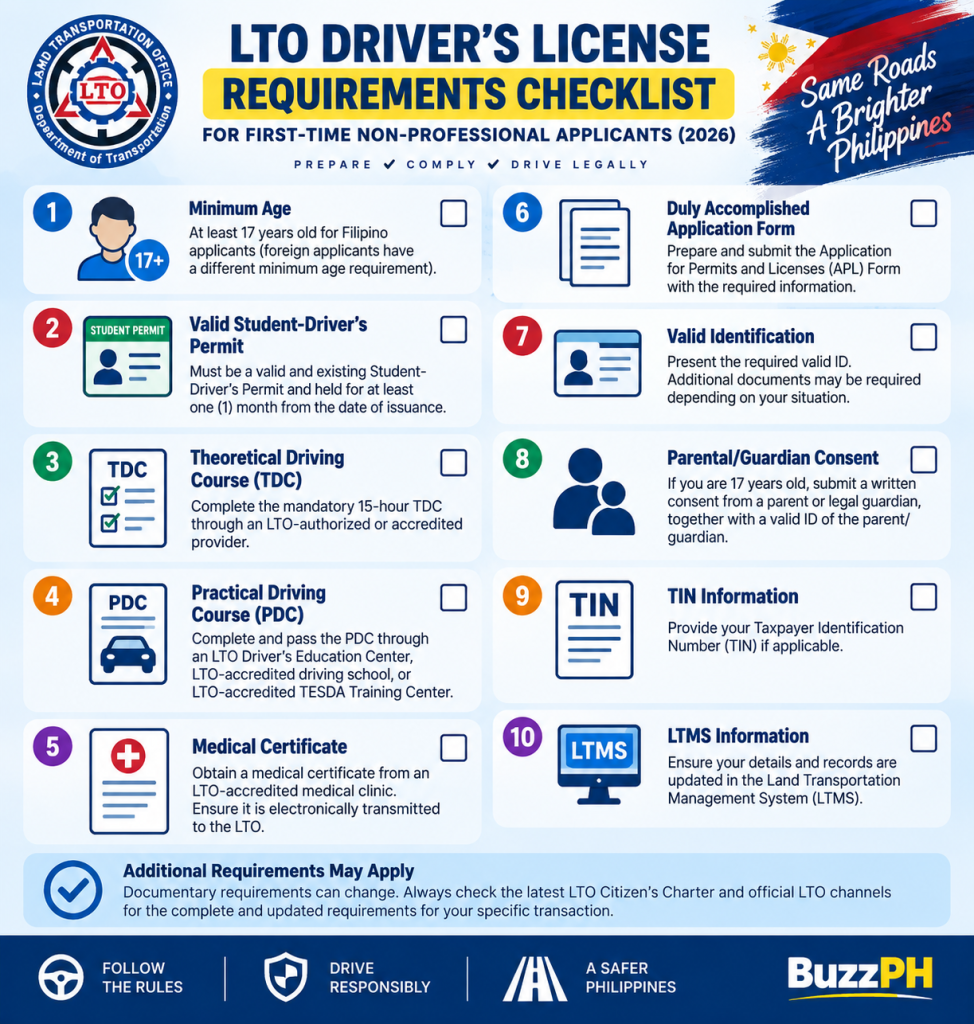
The LTO’s published checklist for a new Non-Professional Driver’s License includes the following major documents:
- Duly accomplished Application for Permits and Licenses (APL) Form
- Electronically transmitted medical certificate from an LTO-accredited medical clinic
- Original and photocopy of the medical certificate as specified in the checklist
- Original and photocopy of the Practical Driving Course certificate, including the electronically transmitted PDC record
- Valid Student-Driver’s Permit
- Parental or guardian consent with appropriate identification when the applicant is 17 years old
- TIN information when applicable
The current LTO Citizen’s Charter also identifies the electronically transmitted medical certificate and PDC certificate among the requirements for the new Non-Professional transaction.
Requirements for special circumstances can differ, so applicants should always check the current LTO checklist for their particular transaction.
Medical Certificate Requirement
The medical certificate must come from an LTO-accredited medical clinic for the applicable licensing transaction.
LTO’s published checklist specifies an electronically transmitted medical certificate and requires presentation of the original and submission of a photocopy in the cited transaction.
This is an important practical detail.
A medical certificate from an ordinary clinic should not automatically be assumed to satisfy the LTO requirement.
Before leaving the clinic, confirm that the medical record has been properly transmitted to LTO according to the current procedure.
Medical expenses should also be budgeted separately from the driver’s-license fees.
Step-by-Step: How to Apply for a Driver’s License
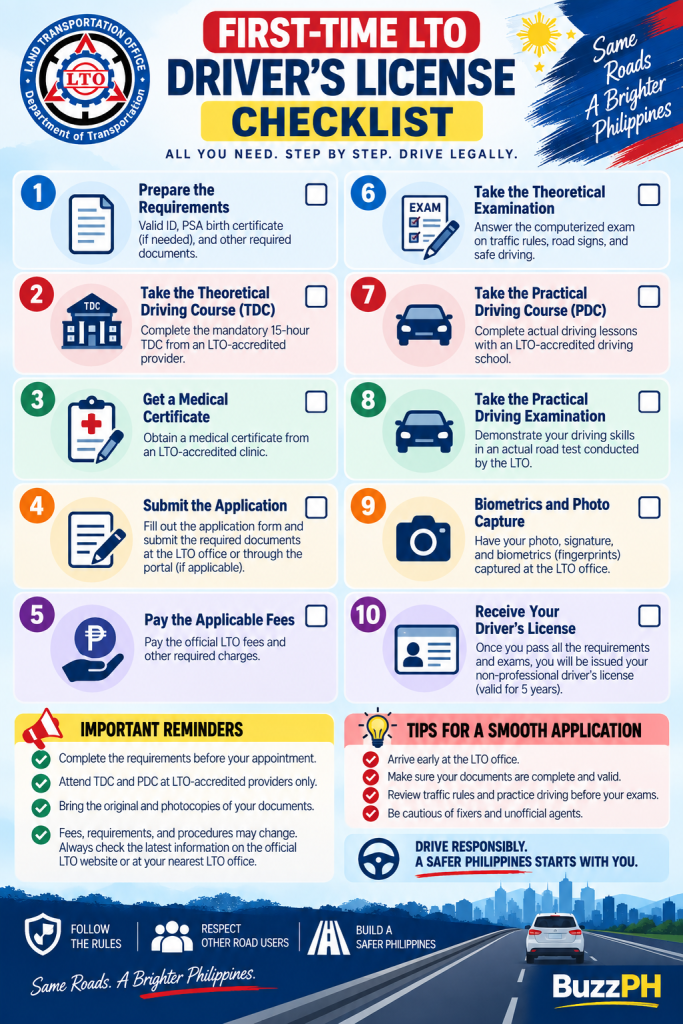
Step 1: Complete the Theoretical Driving Course
Complete the mandatory 15-hour TDC through an LTO-authorized or accredited provider applicable to the transaction.
The TDC includes traffic rules, road signs, road markings, right-of-way, defensive driving, hazard recognition, vehicle safety, and other subjects relevant to safe driving.
Keep your course records and make sure the provider properly records your completion in the LTO system where required.
Step 2: Apply for a Student-Driver’s Permit
After completing the required TDC and preparing the necessary documents, apply for the Student-Driver’s Permit.
LTO’s published rules identify the Student Permit as the authorization used by a person who wants to learn to operate a motor vehicle while accompanied by an appropriately licensed driver.
The Student Permit stage is important because a new Non-Professional applicant must subsequently satisfy the required holding period before applying for the regular license.
Step 3: Start Practical Driving Training
Once you have the Student Permit, begin your practical driving training.
Practice should cover more than basic vehicle movement.
A learner should develop competence in:
- Starting and stopping
- Steering
- Turning
- Reversing
- Parking
- Lane positioning
- Signaling
- Observation
- Speed control
- Interacting safely with pedestrians
- Responding to road signs
- Maintaining safe following distance
The objective is to develop actual driving ability, not merely to memorize a test route.
Step 4: Complete the Required Student Permit Holding Period
For a new Non-Professional Driver’s License, LTO’s published qualifications require the applicant to have held the Student-Driver’s Permit for at least one month from issuance.
This requirement means that completing the PDC does not necessarily allow an applicant to immediately obtain the Non-Professional license.
The application should be planned around the required holding period.
Step 5: Obtain the Medical Certificate
Visit an LTO-accredited medical clinic and complete the required medical assessment.
Confirm that the certificate has been electronically transmitted to LTO.
Keep the original and photocopy if required by the applicable checklist.
Step 6: Prepare the Application Documents
Before going to LTO, organize the documents that apply to your transaction.
A useful checklist is:
☐ Student-Driver’s Permit
☐ TDC completion record
☐ PDC certificate
☐ LTO-accredited medical certificate
☐ Valid identification
☐ APL Form/application information
☐ Parental or guardian documents if applicable
☐ TIN information if applicable
☐ LTMS information/client details
☐ Additional documents required for special circumstances
The exact checklist should always be confirmed against the current LTO transaction requirements.
Step 7: Use the Official LTMS Portal
The Land Transportation Management System is LTO’s official online platform.
The current LTO system includes portal-based driver’s-license transactions, while the Citizen’s Charter also lists walk-in transactions.
The LTMS also provides official educational resources, including driver’s-license information and driving-related learning materials.
Use official LTO channels when creating an account, checking licensing information, or accessing an online transaction.
Be cautious with websites or social-media accounts that imitate government services.
Step 8: Submit the Application
At the appropriate LTO licensing office or through the applicable portal transaction, submit the application and required documents.
The LTO evaluates the application before the remaining licensing stages.
Incomplete requirements can delay the transaction, so document preparation should be completed before the appointment or visit whenever possible.
Step 9: Pay the Applicable Fees
This is where applicants need to distinguish between published LTO charges and the total cost of becoming licensed.
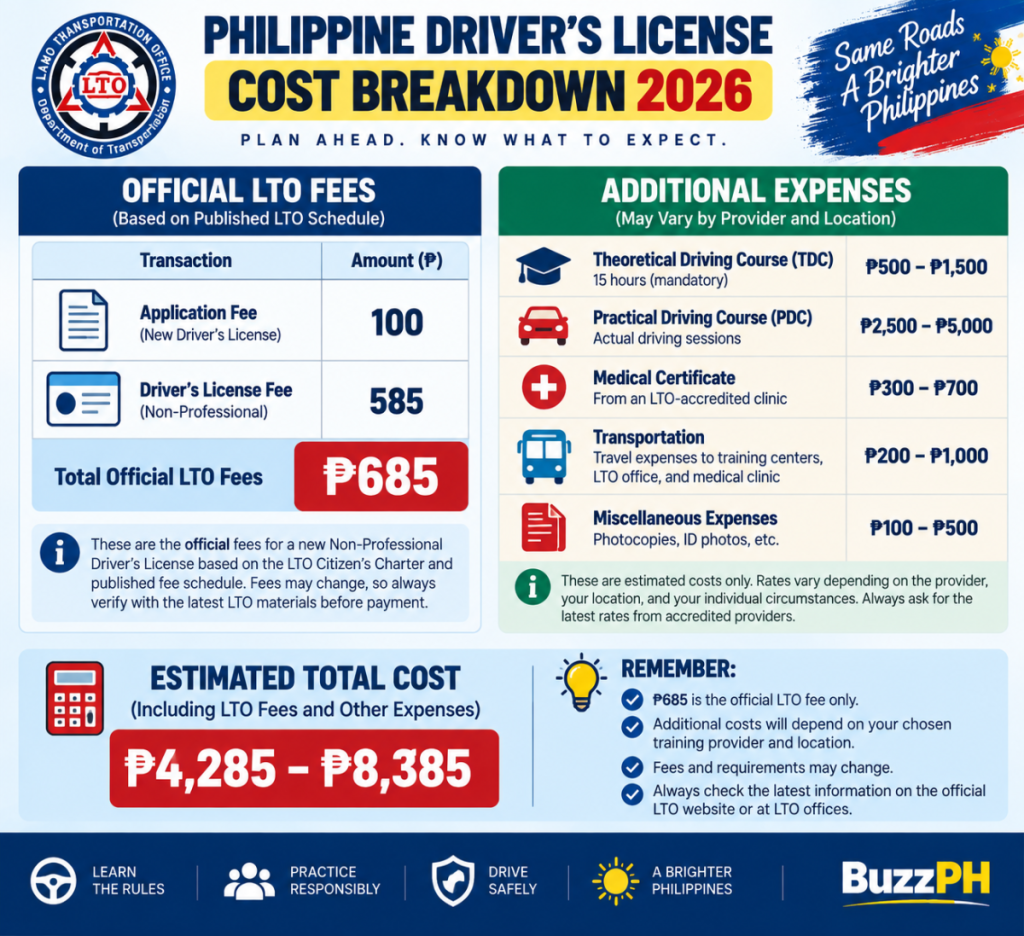
An LTO-published fee schedule lists the following charges for a new driver’s license:
| Published LTO charge | Amount |
|---|---|
| Application fee | ₱100 |
| License fee | ₱585 |
| Published total | ₱685 |
Official LTO Fees vs. Total Driver’s License Budget
The official LTO fees are only one part of the total amount a first-time applicant may spend to obtain a driver’s license. The published charges above total ₱685, but this amount does not include other expenses that may be required during the licensing process.
Applicants may also need to budget separately for the Theoretical Driving Course (TDC), Practical Driving Course (PDC), medical certification, transportation, and other incidental expenses. These costs can vary depending on the provider, location, and individual circumstances.
For this reason, the ₱685 figure should not be treated as the guaranteed all-in cost of getting a Philippine driver’s license. Applicants should verify the current LTO charges and ask their training and medical providers for their latest rates before starting the process.
Note: The ₱685 figure represents the listed LTO application and license charges. It does not include TDC, PDC, medical, transportation, or other personal expenses.
A Better Way to Budget for a Driver’s License
Instead of asking only how much the license itself costs, divide the budget into stages.
Education: TDC expenses, if applicable.
Student Permit: applicable government charges and incidental expenses.
Practical Training: PDC or driving-school costs.
Medical: medical assessment and certification.
License Application: applicable LTO application and licensing charges.
Transportation and miscellaneous: travel, photocopying, and other personal expenses.
This approach is more useful because TDC, PDC, medical, and transportation costs can vary by provider and location.
Step 10: Take the Theoretical Examination
The theoretical examination tests knowledge related to driving and road safety.
Study the official LTO materials first.
Important subjects include:
- Traffic signs
- Traffic signals
- Pavement markings
- Right-of-way
- Defensive driving
- Driver responsibilities
- Road courtesy
- Safe driving practices
- Traffic laws
- Vehicle safety
- Fines and penalties
Republic Act No. 10930 specifically requires theoretical and practical examinations designed to sufficiently measure driver competency.
The goal should therefore be understanding rather than memorizing random online answers.
Step 11: Take the Practical Driving Test
The practical examination assesses actual driving ability.
Before the test, practice:
- Seat and mirror adjustment
- Seat-belt use
- Starting and stopping
- Steering
- Turning
- Lane positioning
- Signaling
- Reversing
- Parking
- Observation
- Speed control
- Following instructions
A useful practice method is to ask your instructor to conduct a mock examination with minimal assistance.
That can reveal whether you can make safe driving decisions independently.
Step 12: Complete the Final Processing and License Issuance
After completing the required examination and processing stages, the applicant proceeds through the remaining LTO procedures, which can include biometric processing and license issuance.
Republic Act No. 10930 requires personal appearance before issuance and provides for the driver’s photograph and other license information.
Follow the instructions of the licensing office and retain your transaction documents.
How Much Should You Budget?
There is no single reliable nationwide “total cost” because several expenses depend on the applicant’s circumstances and service providers.
A useful budget framework is:
| Expense category | What it includes | Pricing approach |
|---|---|---|
| LTO application | Government transaction | Verify current LTO amount |
| Driver’s license | Government license fee | Verify current LTO amount |
| TDC | Theoretical training | Provider-dependent |
| PDC | Practical training | Provider/location-dependent |
| Medical | Medical assessment | Clinic-dependent |
| Transportation | Trips to providers/LTO | Personal expense |
| Miscellaneous | Copies and other requirements | Varies |
This is a more responsible way to present costs than claiming that every Filipino applicant will spend exactly the same amount.
How Long Does the Process Take?
There is no single number of days that applies to every applicant.
The overall timeline depends on:
- TDC availability
- Student Permit processing
- PDC scheduling
- The Student Permit holding period
- Medical appointment availability
- LTO appointment availability
- Queue volume
- Examination schedules
- Document completeness
A useful timeline is:
TDC → Student Permit → practical training → required holding period → medical/document preparation → LTO application → examinations → issuance
Think of the process as a sequence of stages rather than a one-day transaction.
Non-Professional vs. Professional Driver’s License
A Non-Professional Driver’s License and Professional Driver’s License are different classifications.
The appropriate classification depends on the type of driving the person intends to perform and the applicable LTO requirements.
LTO’s current Citizen’s Charter specifically lists separate transactions for changing classification from Non-Professional to Professional and for additional Driver’s License Codes.
Someone who intends to drive professionally should therefore not simply use the Non-Professional checklist.
The correct professional transaction should be checked with LTO based on the intended vehicle category and driving activity.
Understanding Driver’s License Codes
Driver’s License Codes identify the vehicle categories a license holder is authorized to operate.
For the Non-Professional transaction, LTO’s published materials identify DL Codes A, A1, B, B1, and B2.
The code matters because holding a driver’s license does not automatically mean that the holder is authorized to operate every type of motor vehicle.
Before applying, determine the type of vehicle you actually intend to operate and check the corresponding LTO code.
How Long Is a Philippine Driver’s License Valid?
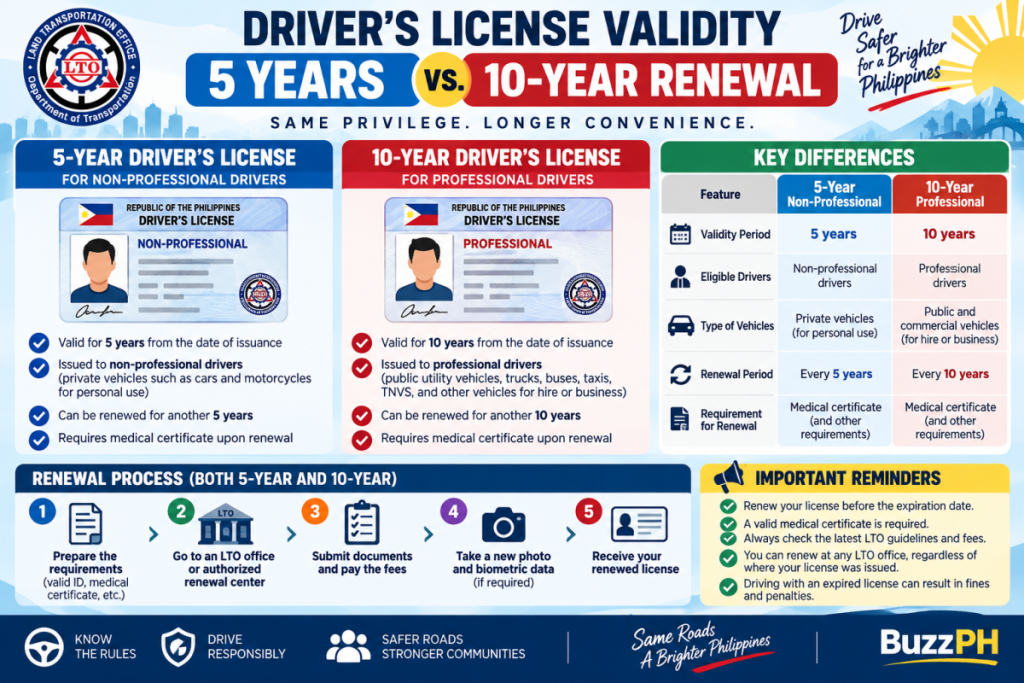
Republic Act No. 10930 provides the legal basis for driver’s-license validity.
Except for Student Permits, driver’s licenses are generally valid for five years, unless sooner revoked or suspended.
The law also provides that a professional or non-professional license holder who has not committed a violation of the relevant traffic laws during the five-year period is entitled to renewal for 10 years, subject to restrictions imposed by LTO.
This distinction is important.
A new driver should not assume that every newly issued license automatically has 10-year validity.
The 10-year provision concerns qualified renewal.
What Happens if You Have an Unsettled Traffic Violation?
LTO’s published qualification for a new Non-Professional Driver’s License states that the applicant must not have an unsettled traffic violation.
If you have an outstanding traffic matter, resolve it through the appropriate official process rather than assuming it will not affect your licensing transaction.
Why You Should Avoid Fixers
Applicants should complete the licensing process through legitimate LTO channels.
Republic Act No. 10930 establishes penalties for applicants who commit specified acts such as willful misrepresentation, connivance in irregular licensing procedures, falsification of documents, or cheating during examinations.
The law specifies a ₱20,000 fine for these specified acts and provides additional consequences, including license revocation and a period of disqualification in applicable cases.
The safest approach is to complete the required training, examinations, and documentation honestly.
Common Mistakes First-Time Applicants Should Avoid
Using an old requirements list
Government procedures can change. Check the current LTO checklist instead of relying on an old article.
Confusing TDC with PDC
The TDC covers theoretical knowledge, while the PDC covers practical driving skills.
Applying before satisfying the Student Permit period
The published LTO qualification requires a new Non-Professional applicant to have held the Student Permit for at least one month.
Using an unverified provider
Check that your training provider is properly recognized by LTO.
Assuming ₱685 is the complete 2026 cost
The ₱685 figure comes from a published LTO fee schedule and represents the listed application and license fees in that schedule. It does not include TDC, PDC, medical, transportation, or other expenses.
Studying only random online reviewers
Use official LTO educational material as the foundation of your preparation.
Ignoring traffic violations
An unsettled traffic violation can affect the licensing process.
Using unofficial intermediaries
Use official LTO and LTMS channels rather than people promising shortcuts.
How to Prepare for the Theoretical Examination
Begin with official LTO educational material.
Focus on understanding:
Traffic signs: Know what each sign requires the driver to do.
Road markings: Understand lane lines, arrows, pedestrian crossings, and other markings.
Right-of-way: Learn how to handle common intersection situations.
Defensive driving: Understand how to identify and reduce hazards.
Road courtesy: Recognize the responsibilities drivers have toward other road users.
Traffic laws: Understand the rules that govern everyday driving.
The LTO TDC curriculum itself includes traffic rules, road signs, road markings, right-of-way, hazard recognition, road courtesy, defensive driving, vehicle safety, and other related subjects.
How to Prepare for the Practical Driving Test
Practice basic skills until they become consistent.
Before the examination, make sure you can:
- Adjust the vehicle properly
- Use seat belts correctly
- Start and stop smoothly
- Signal before turning or changing position
- Maintain proper lane position
- Turn safely
- Reverse under control
- Park
- Observe pedestrians and other vehicles
- Follow signs
- Control speed
- Follow instructions calmly
Do not practice only the exact maneuver you expect to see.
A competent driver should be able to respond safely when the road situation changes.
A Practical First-Time Applicant Timeline
A useful planning sequence is:
Stage 1: Complete the TDC.
Stage 2: Apply for the Student-Driver’s Permit.
Stage 3: Complete practical driving training.
Stage 4: Satisfy the Student Permit holding period.
Stage 5: Obtain the required medical certificate.
Stage 6: Prepare the application documents.
Stage 7: Submit the LTO application and pay applicable fees.
Stage 8: Complete the theoretical examination.
Stage 9: Complete the practical driving test.
Stage 10: Complete final processing and license issuance.
The actual calendar time will vary according to appointments, training schedules, queues, and individual circumstances.
Final Checklist Before Going to LTO
Before your transaction, check:
☐ Student-Driver’s Permit
☐ TDC completion record
☐ PDC certificate
☐ LTO-accredited medical certificate
☐ Valid identification
☐ APL Form/application information
☐ Parental or guardian documents if applicable
☐ TIN information if applicable
☐ LTMS account/client information
☐ Current LTO transaction instructions
☐ Current applicable fees
☐ Transportation budget
☐ Additional documents required for your specific circumstances
Checking your documents before leaving home can prevent an unnecessary trip to an LTO office.
Frequently Asked Questions
Can I get a Non-Professional Driver’s License without a Student Permit?
For a new Non-Professional Driver’s License, LTO’s published qualification requires the applicant to have held a Student-Driver’s Permit for at least one month from issuance.
How old must I be?
For Filipino applicants, LTO’s published qualification states that a person must be at least 17 years old to apply for a new Non-Professional Driver’s License. Foreign applicants are subject to a different minimum age requirement.
Is the 15-hour TDC required?
Yes. LTO rules identify a mandatory 15-hour Theoretical Driving Course as a prerequisite for obtaining a Student-Driver’s Permit.
Do I need a Practical Driving Course?
Yes. The LTO’s published requirements for a new Non-Professional Driver’s License include completion and passing of the PDC through an appropriate LTO-recognized provider.
How much is the driver’s license?
The LTO’s published 2024 Citizen’s Charter lists ₱100 for the application and ₱585 for the license, totaling ₱685 for those listed charges.
Because this is a 2026 guide, applicants should verify the current amount applicable to their transaction before payment. The total personal cost can also be higher because of training, medical, transportation, and other expenses.
Is the driver’s license automatically valid for 10 years?
No.
Republic Act No. 10930 provides five-year validity for driver’s licenses, while qualified professional and non-professional license holders who meet the law’s clean-record condition may receive a renewal valid for 10 years, subject to LTO restrictions.
Can I apply online?
LTO’s current Citizen’s Charter lists both walk-in and portal transactions for driver’s licensing, including new Non-Professional Driver’s License services.
However, the exact online availability depends on the transaction. Follow the instructions shown in the official LTMS.
Can I use any driving school?
No. For the applicable TDC and PDC requirements, use an LTO-authorized or accredited provider specified by the current LTO rules.
What happens if I fail an examination?
Follow the current LTO procedure for the applicable examination and retake requirements. Do not use unofficial intermediaries to bypass the examination.
Can another person complete the entire application for me?
Not necessarily. Certain stages require the applicant’s personal participation, particularly examination, biometric, identification, and issuance-related procedures.
Republic Act No. 10930 specifically requires the applicant’s personal appearance before license issuance for the required photograph and licensing process.
Final Takeaway
Getting a Philippine driver’s license in 2026 is a process rather than a single transaction.
For a first-time Non-Professional applicant, the pathway generally begins with the 15-hour Theoretical Driving Course, followed by the Student-Driver’s Permit, practical driving training, the required Student Permit holding period, medical certification, LTO application, theoretical examination, practical driving test, and final issuance procedures.
The most important preparation is not simply knowing the license fee.
Applicants should understand the difference between the TDC and PDC, prepare the correct documents, use LTO-accredited providers, study official road-safety material, and verify the current requirements before visiting an LTO office.
The ₱685 figure frequently quoted online should also be understood correctly. It represents the application and license fees shown in the cited LTO fee schedule, not an all-in cost of becoming licensed and not necessarily a guaranteed 2026 amount. Applicants should confirm the current fee applicable to their transaction before payment.
For legal validity, Republic Act No. 10930 provides the five-year general driver’s-license validity and the possibility of a 10-year renewal for qualified holders who meet the law’s conditions.
Most importantly, a driver’s license is more than an identification card. It represents authorization to operate a motor vehicle subject to Philippine traffic laws and the responsibility to drive safely around pedestrians, cyclists, motorcyclists, passengers, and other motorists.
Official Sources and References
Land Transportation Office — 2025 Citizen’s Charter
The LTO’s 2025 Citizen’s Charter contains its current service procedures and licensing transactions.
Source: LTO Citizen’s Charter 2025
LTO — Driver’s Licensing Requirements and Services
Use the LTO’s official licensing materials for requirements and procedures relating to Student-Driver’s Permits and Non-Professional Driver’s Licenses.
Source: LTO official website
LTO — Theoretical Driving Course (TDC)
The LTO’s official memorandum specifies the 15-hour Theoretical Driving Course and its curriculum.
Source: LTO Theoretical Driving Course — 15 Hours
Republic Act No. 10930
This is the statutory basis for driver’s-license validity, examinations, personal appearance, and related licensing provisions.
Source: Republic Act No. 10930 — Lawphil
LTO — License Schedule of Fees and Charges
The LTO-published schedule lists ₱100 for the application and ₱585 for the license, totaling ₱685 for those listed charges. Because your article is for 2026, keep the warning that applicants should verify the amount applicable to their transaction before payment.
Source: LTO License Schedule of Fees and Charges
LTMS Official Portal
For online LTO services and account-related transactions, link readers directly to the official LTMS portal.
Source: Official LTMS Portal
Important Source Note for Readers
Government requirements and fees can change. When an older published fee schedule differs from a newer LTO instruction, the latest LTO-issued requirement or transaction instruction should take precedence.
For current transactions, use the official LTO website and LTMS portal rather than relying on unofficial fixers, social-media posts, or outdated checklists.




 Facebook
 Twitter