
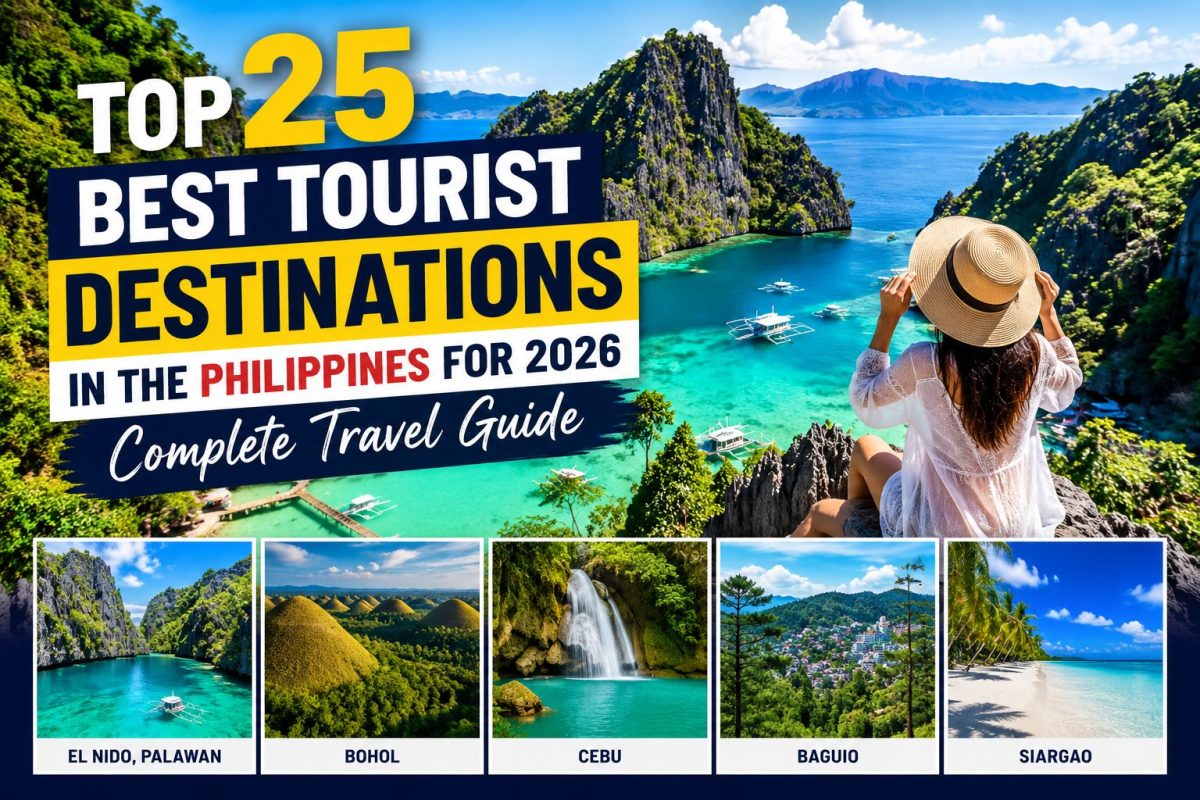
Philippines Travel Guide: 25 Destinations Worth Visiting Right Now
From pristine beaches and ancient rice terraces to vibrant cities and hidden waterfalls — here is your complete guide to the Philippines’ most rewarding travel destinations today.
⚡ Key Takeaways
- The Philippines is home to more than 7,600 islands, making it one of the world’s most geographically diverse travel destinations.
- Palawan, Siargao, Boracay, Batanes, and Cebu consistently rank among Asia’s most-visited and most-celebrated island destinations.
- The country offers a wide spectrum of travel experiences — from world-class surfing and diving to UNESCO-listed heritage sites and living cultural traditions.
- Budget-conscious travelers will find the Philippines accessible, while luxury seekers will discover world-class resorts and private island escapes.
- The best time to visit most regions is during the dry season, which runs roughly from November through May, though some areas have their own distinct weather patterns.
- Returning OFWs, first-time visitors, and seasoned travelers alike will find this guide useful for planning an itinerary across any budget or travel style.
Table of Contents
- Why the Philippines Remains One of Asia’s Great Travel Destinations
- Northern Luzon: Mountains, Heritage, and the Wind-Swept North
- Metro Manila and Nearby Provinces: Urban Culture and Accessible Escapes
- The Visayas: Island-Hopping Central
- Mindanao: The Underrated South
- Palawan: The Last Frontier
- All 25 Destinations at a Glance
- Destination Comparison Table
- Practical Travel Tips for Visiting the Philippines
- Budget Planning Guide
- Frequently Asked Questions
- Conclusion
Why the Philippines Remains One of Asia’s Great Travel Destinations
Few countries in the world can match the sheer variety of experiences that the Philippines offers within a single archipelago. Spanning over 7,600 islands across the western Pacific, the country presents a landscape of extraordinary contrasts — crystalline turquoise lagoons alongside centuries-old Spanish colonial churches, towering rice terraces carved by hand over 2,000 years ago within driving distance of modern, cosmopolitan cities, and volcanic peaks rising from seas so clear that divers can follow the reef down to 40 meters with full visibility. This variety is precisely what makes the Philippines such a compelling destination, not just for international visitors, but for Filipinos themselves, many of whom have barely scratched the surface of what their own country contains.
At present, the Department of Tourism continues to develop infrastructure across the archipelago, opening new flight routes, improving road networks in previously isolated provinces, and promoting lesser-known destinations that were once accessible only to the most determined adventurers. This means that travelers arriving today have access to a wider, more comfortable network of experiences than at any point in the country’s tourism history. Yet the fundamental character of the Philippines — warm, hospitable, genuinely welcoming — has remained unchanged. This combination of improving accessibility and enduring cultural warmth is what drives the country’s continued rise as a premier travel destination in Southeast Asia.
Travel conditions, visa requirements, and destination accessibility in the Philippines can change due to weather, local regulations, and infrastructure developments. Always verify current conditions with the Philippine Department of Tourism or your airline before finalizing itinerary plans. Some destinations require environmental fees, advance booking, or permits that must be arranged ahead of arrival.
Northern Luzon: Mountains, Heritage, and the Wind-Swept North
1. Batanes — The Windswept Islands at the Top of the Philippines
Batanes, Cagayan Valley
Batanes is unlike anywhere else in the Philippines. Situated at the northernmost tip of the archipelago, closer to Taiwan than to Manila, this group of islands is defined by rolling green hills that tumble directly into the Pacific Ocean, stone houses built by the Ivatan people to withstand typhoon-force winds, and a quietude that feels almost otherworldly by Philippine standards. The landscape is frequently compared to the Irish countryside or the Scottish Highlands, with its dramatic elevation changes, perpetual mist, and the sound of wind as a constant companion. Visitors come here to cycle along coastal cliffs, explore ancient Ivatan stone villages like Savidug and Chavayan, photograph the iconic Batan Island lighthouses, and simply breathe in the unhurried pace of island life at the country’s very edge. Batanes is best experienced slowly, with a minimum of four to five days to genuinely absorb its unique atmosphere.
2. Banaue Rice Terraces — A Living UNESCO Heritage Landscape
Banaue, Ifugao
The Banaue Rice Terraces are among the most extraordinary human-made landscapes in the world. Carved into the mountain slopes of Ifugao Province by the ancestors of the Ifugao people approximately 2,000 years ago using only hand tools, these terraces stretch across an estimated 10,360 square kilometers of mountainside and are inscribed on the UNESCO World Heritage List as a living cultural landscape. Unlike many heritage sites that exist primarily as museum pieces, the Banaue terraces are still actively farmed today, their intricate system of irrigation channels fed by ancient forest cover at the mountain summits. Travelers who venture here witness not just a historical monument but an ongoing tradition of rice cultivation that connects living Ifugao communities to their deepest ancestral roots. The viewpoints at Banaue Town and the villages of Batad and Bangaan offer perspectives that no photograph can fully prepare you for.
3. Vigan — The Best-Preserved Spanish Colonial City in Asia
Vigan, Ilocos Sur
Vigan is often described as a time capsule, and this description holds up remarkably well even in 2026. The city’s Calle Crisologo, a narrow cobblestone street flanked by two- and three-story stone-and-wood mansions built by wealthy Chinese-Filipino merchants during the Spanish colonial period, remains intact in a way that few Asian colonial streetscapes can claim. The absence of power lines, the horse-drawn carriages called kalesas that still ply the streets, and the distinct regional cuisine — longganisa de Vigan, bagnet, pinakbet — create an experience that is simultaneously historical and deeply alive. Vigan is also a UNESCO World Heritage Site, recognized for its exceptional synthesis of Filipino, Chinese, and Spanish architectural and cultural traditions. Visiting during the Viva Vigan Festival in May adds another layer of pageantry to an already richly textured experience.
When visiting Banaue, consider hiring a local Ifugao guide rather than navigating independently. These guides — many of them descended from the very communities that built and maintain the terraces — can offer context about rice cultivation cycles, traditional Ifugao spiritual practices, and the ongoing conservation challenges facing the terraces that no guidebook can replicate. Their fees directly support the local economy and the preservation of this irreplaceable cultural landscape.
4. Sagada — Hanging Coffins, Echo Valley, and Cloud-Kissed Mornings
Sagada, Mountain Province
Sagada has long held a particular mystique among Filipino travelers, and it continues to reward those willing to make the journey into the Cordillera mountains. The town is most famously associated with the Kankana-ey practice of placing the coffins of the deceased in caves and on cliff faces — a tradition that dates back centuries and that can be observed at Lumiang Cave and the cliffs above Echo Valley. But Sagada offers more than its famous funerary customs. The Sumaguing Cave system requires adventurous caving with rope descents through cathedral-sized chambers dripping with stalactites. Bomod-ok Falls, a multi-hour trek through rice paddies and pine forests, delivers a payoff in the form of one of the Cordillera’s most powerful waterfalls. And the town itself, wrapped in morning mist for much of the year, offers a collection of small cafes, bakeries, and weaving workshops that make extended stays genuinely pleasurable.
5. La Union — The Surfing Capital of Northern Luzon
San Juan, La Union
La Union — specifically the municipality of San Juan — has evolved from a quiet provincial surf spot into one of the most energetic beach communities in the Philippines. Located roughly five to six hours north of Manila by road, it has become the default weekend escape for Metro Manila residents seeking surf, fresh seafood, and the creative cafe and bar scene that has developed around the Urbiztondo beach area over the past decade. The waves here are consistent and beginner-friendly by Philippine standards, making San Juan the place where many Filipinos take their first surfing lessons. Currently, the strip along the beach road contains an impressive collection of independent restaurants, specialty coffee shops, local art galleries, and live music venues that keep the energy high even after the surfboards are racked for the night.
Metro Manila and Nearby Provinces: Urban Culture and Accessible Escapes
6. Intramuros, Manila — The Walled City
Intramuros, Manila
Intramuros — which translates from Spanish as “within the walls” — is the historic heart of Manila, a roughly 64-hectare fortified district built by Spanish colonial authorities beginning in 1571. Within its thick stone ramparts lie the Manila Cathedral, Fort Santiago (where national hero José Rizal spent his final days before execution), the San Agustin Church (a UNESCO World Heritage Site and the oldest stone church in the Philippines), and a network of colonial-era streets, plazas, and restored mansions. The transformation of Intramuros in recent years — from a neglected district into a genuinely engaging heritage destination with bamboo bike tours, Spanish-era casa museums, and open-air dining — has made it one of Manila’s most rewarding half-day or full-day experiences. A visit here provides essential context for understanding Philippine history, particularly the layers of indigenous, Chinese, Spanish, American, and Japanese influence that define Filipino identity.
7. Tagaytay and Taal Volcano — The Ridge Above the Lake
Tagaytay, Cavite
Tagaytay sits along a volcanic ridge overlooking Taal Lake, in the center of which sits Taal Volcano Island — a volcano within a lake within a larger volcanic caldera. This geological curiosity, combined with Tagaytay’s cooler highland temperatures (dramatically lower than Metro Manila) and its famous bulalo restaurants perched above the ridge, has made it the most popular day trip destination from Manila for decades. Taal Volcano’s 2020 eruption transformed the island significantly, and while the landscape has changed, guided hikes to the crater rim remain available through authorized operators in Talisay town. Tagaytay itself offers a collection of viewpoint restaurants, artisanal food producers, flower farms, and garden estates that make it pleasant for a full day or overnight visit.
8. Batangas — Diving, Beaches, and Local Culture
Batangas Province
Batangas province, located about two hours south of Manila, serves as the gateway to some of the most accessible marine environments near the capital. Anilao, a small fishing community in the municipality of Mabini, is internationally recognized as the “birthplace of scuba diving in the Philippines” and continues to attract underwater photographers and dive enthusiasts from around the world for its exceptional macro marine biodiversity — pygmy seahorses, nudibranchs, and rare invertebrates that make every dive a scientific discovery. Separate from the diving scene, Batangas offers several pleasant beach destinations including Laiya in San Juan, which provides clean, relatively uncrowded beaches accessible by a short drive from Batangas City. The province is also the jump-off point for ferries to Puerto Galera in Mindoro.
The Visayas: Island-Hopping Central
9. Boracay — The White Sand Icon
Boracay, Aklan
Boracay’s White Beach remains one of the most iconic stretches of shoreline in all of Asia — a four-kilometer arc of powdery, flour-fine white sand that faces a sea shifting from pale jade to deep cobalt depending on the time of day. Following a six-month government-mandated rehabilitation closure in 2018, Boracay returned as a cleaner, more regulated destination with stricter environmental standards, and those improvements have largely held in the years since. Today, the island offers a mature ecosystem of accommodation options ranging from budget guesthouses to the luxury Fairways & Bluewater and Discovery Shores resorts, a dining scene that spans beachside barbecue to international fine dining, and a water sports menu that includes kite surfing, parasailing, cliff diving, and island-hopping by traditional outrigger. The D’Mall shopping and dining complex gives the island an energetic commercial center without overwhelming the beach itself.
10. Cebu — History, Beaches, Whale Sharks, and Canyoneering
Cebu Province
Cebu is the Philippines’ second-largest metropolitan area and simultaneously one of the country’s most diverse travel destinations. Cebu City itself is the historic birthplace of Philippine Christianity — Ferdinand Magellan planted a cross here in 1521, and the Basilica Minore del Santo Niño houses the oldest Christian relic in the Philippines. Yet Cebu province extends far beyond the city. Oslob, in the south, offers the controversial but widely popular whale shark interaction experience where visitors can snorkel alongside the world’s largest fish in their natural habitat. Moalboal’s Panagsama Beach is a world-class dive site where a sardine run of millions of fish swirls in a constantly shifting, shimmering column. Kawasan Falls in Matutinao, at the end of a famous canyoneering route through cascading pools, delivers one of the archipelago’s most memorable adventure experiences.
11. Bohol — Chocolate Hills, Tarsiers, and Loboc River
Bohol Province
Bohol is a province of geological wonders and biological curiosities. The Chocolate Hills — more than 1,200 near-perfectly conical limestone mounds spread across 50 square kilometers of interior landscape — turn brown in the dry season, giving them the name that has caught the imagination of travelers worldwide since long before Instagram existed. The Philippine tarsier, one of the world’s smallest primates, is endemic to Bohol and can be observed at the Philippine Tarsier Foundation sanctuary near Corella in a setting that prioritizes the animals’ welfare over tourist spectacle. A lunch cruise along the Loboc River, floating through cathedral-arching bamboo and heritage trees, provides a gentle counterpoint to the island’s more active experiences. Panglao Island, connected to the Bohol mainland by bridge, offers white sand beaches and dive sites that rival anything in the Visayas.
12. Siargao — The Surf Capital of the Philippines
Siargao, Surigao del Norte
Siargao occupies a particular place in the Philippine travel imagination — equal parts surfing mecca, coconut paradise, and hip island retreat. Cloud 9, the wave that put Siargao on the global surf map, is a hollow, barreling right-hand break over a reef that draws professional surfers from around the world every September for the Siargao Cup. But Siargao’s appeal extends well beyond the surf break. The island’s interior is laced with coconut plantations and mangrove channels that feed into a network of lagoons, rock pools, and small islands — particularly around the Sugba Lagoon and the Sohoton Natural Biophysical Sanctuary — that reward exploration by kayak and island-hopping boat. The General Luna township has developed into one of the most thoughtfully curated small-town travel scenes in the country, with excellent independent cafes, restaurants, and accommodation that range from budget guesthouses to design-forward boutique properties.
13. Iloilo City and Guimaras — Heritage and Mango Country
Iloilo City and Guimaras Island
Iloilo City is one of the Philippines’ most underappreciated destinations — a gracious, walkable heritage city with a rich tradition of Ilonggo cuisine, spectacular late-Spanish-period church architecture in the surrounding municipalities of Molo, Jaro, and Pavia, and a growing creative scene centered around the Smallville entertainment district and the Casa Real historic precinct. A short ferry ride across the strait brings visitors to Guimaras Island, famous throughout the Philippines for producing what many regard as the sweetest mangoes in the world. Guimaras offers a very different pace from the urban energy of Iloilo — small island roads cycling past mango orchards, quiet beaches at Alubihod, and the heritage Trappist monastery whose monks produce jams, wines, and products from local fruit.
14. Coron, Palawan — Wreck Diving and Karst Lakes
Coron, Palawan
Coron sits at the northern end of Palawan province and is widely regarded as one of the world’s premier wreck diving destinations. The waters around Coron Bay contain more than a dozen Japanese warships sunk during a US Navy air attack in September 1944, now resting at depths between 10 and 40 meters and encrusted with decades of coral growth that have transformed them into artificial reefs of extraordinary richness. Above the surface, Coron presents a landscape of dramatic karst limestone formations rising from shallow turquoise seas, freshwater lakes (including the famous Kayangan Lake and Barracuda Lake) enclosed within volcanic rock, and white sand beaches accessible only by boat. Island-hopping tours around Coron Bay are among the most visually spectacular in the Philippines.
Mindanao: The Underrated South
Travel advisories for some areas of Mindanao remain active as of 2026. Travelers are strongly encouraged to check their government’s official travel advisory for the Philippines before planning any visit to Mindanao. Many popular Mindanao destinations — including Davao City, Camiguin, and Cagayan de Oro — are considered safe for tourism, but it is essential to verify current conditions for specific areas you plan to visit.
15. Davao City — Gateway to Mount Apo and Durian Country
Davao City, Davao del Sur
Davao City is Mindanao’s largest city and one of the largest cities by land area in the world, encompassing mountain, coastal, and agricultural zones within a single administrative boundary. The city itself is modern, well-organized, and known throughout the Philippines for its extraordinary fruit market culture — durian, pomelo, mangosteen, and marang are sold fresh at every turn. Outside the city, Mount Apo — the highest peak in the Philippines at 2,954 meters — draws trekkers from across the country, with multi-day ascents through forests that shelter Philippine eagles and rare orchid species. The Philippine Eagle Center near Calinan maintains a breeding program for the critically endangered national bird and remains one of the most important conservation institutions in the country as well as a meaningful visitor attraction.
16. Camiguin — The Island Born of Fire
Camiguin Island
Camiguin is a small, teardrop-shaped island off the northern coast of Mindanao with a geological history so intense that it has produced more volcanoes per square kilometer than any other island on Earth. This fiery past has given Camiguin a landscape of extraordinary diversity — hot and cold springs (including the famous Ardent Hot Spring), waterfalls dropping from volcanic slopes, a sunken cemetery visible from a glass-bottomed boat just offshore (submerged when the town of Bonbon sank into the sea following a 19th-century eruption), and black sand beaches that stand in striking contrast to the white sand found elsewhere in the Philippines. The island is small enough to circumnavigate by motorcycle in a single day, and its relative quietude compared to more famous destinations makes it a genuine hidden gem for travelers willing to venture further south.
17. Cagayan de Oro and Bukidnon — White Water and Highland Adventure
Cagayan de Oro, Misamis Oriental
Cagayan de Oro — commonly called CDO — has earned its reputation as the adventure sports capital of Mindanao, primarily on the strength of the Cagayan River’s white water rafting experience. The river’s Class III and IV rapids provide one of the Philippines’ most accessible and genuinely thrilling adventure experiences, attracting domestic tourists in large numbers throughout the year. Adjacent Bukidnon province, a vast highland plateau at elevations above 700 meters, offers a dramatically cooler climate, sweeping pastoral landscapes, and the 14-hectare pineapple plantations of Del Monte Philippines near Manolo Fortich. The Camp Philips plantation area and the Dahilayan Adventure Park — which claims to have one of the longest dual ziplines in Asia — round out the region’s adventure tourism profile.
Palawan: The Last Frontier
18. El Nido — Limestone Cliffs and Hidden Lagoons
El Nido, Palawan
El Nido is the destination that, perhaps more than any other, captures what most people picture when they imagine the Philippines. Towering karst limestone cliffs erupt from a sea of impossible turquoise, enclosing hidden lagoons, secret beaches accessible only through narrow rock passages, and snorkeling grounds teeming with reef fish that haven’t been overexposed to the point of depletion. The town of El Nido sits at the base of these formations on the northern tip of Palawan’s main island, and from here, organized island-hopping tours in outrigger boats fan out across the Bacuit Archipelago — a cluster of some 45 islands each with its own distinct character. Tour A visits the famous Big and Small Lagoons; Tour C reaches the stunning Shimizu Island and Helicopter Island. Accommodation in El Nido ranges from simple backpacker rooms to luxury ecolodges built into the jungle above the sea.
19. Puerto Princesa and the Underground River
Puerto Princesa, Palawan
Puerto Princesa is Palawan’s capital city and the main point of entry to the province by air. Beyond its function as a travel hub, the city has developed its own identity as one of the cleanest and most orderly cities in the Philippines — a reputation earned through strict environmental ordinances enforced consistently over many years. The Puerto Princesa Subterranean River National Park, a UNESCO World Heritage Site and one of the New Seven Wonders of Nature, lies about 80 kilometers north of the city and features a navigable underground river flowing for more than eight kilometers through a cave system decorated with massive stalactites and inhabited by millions of swiftlets and bats. The Honda Bay island-hopping circuit near the city provides a more accessible marine experience without the travel time required to reach El Nido or Coron.
20. San Vicente — The Long Beach of the Future
San Vicente, Palawan
San Vicente’s Long Beach stretches for an extraordinary 14.7 kilometers — making it the longest white sand beach in the Philippines, more than twice the length of Boracay’s famous strip. Currently, the beach remains largely undeveloped compared to Boracay and El Nido, with a smaller selection of resorts and guesthouses spread along its length and significant stretches that remain genuinely quiet. This combination of exceptional natural beauty and relative calm is precisely what draws the traveler who wants the Palawan experience without the full infrastructure of El Nido. An airport serving San Vicente from Manila opened in 2019 and has made the destination significantly more accessible. Development is gradually increasing, which means that visiting in the near term means catching one of the Philippines’ most spectacular beaches at a pivotal moment — before it becomes the next household name.
All 25 Destinations at a Glance
The five destinations below round out this guide’s full list of 25 places across the Philippine archipelago that are genuinely worth visiting today. Each merits consideration depending on your interests, travel style, and available time.
Dumaguete City and Apo Island, Negros Oriental
Dumaguete is a relaxed university city at the foot of Negros Oriental with a lively boulevard and a culinary tradition that includes excellent seafood and the beloved silvanas pastry. Just 30 minutes offshore, Apo Island is a community-managed marine sanctuary where sea turtles glide in numbers that would have seemed impossible before the community’s conservation efforts began in the 1980s. The success of Apo Island’s sanctuary is a celebrated case study in community-based conservation, and diving or snorkeling here offers an experience of marine abundance that is genuinely moving.
Antique Province, Panay Island
Antique remains one of the least-visited provinces in the Visayas despite offering trekking routes into Mount Madja-as, pristine coastal areas along the Sibuyan Sea, and cultural traditions centered on the Binirayan Festival. Travelers who make the effort to reach Antique are rewarded with an authentic Ilonggo experience and landscapes that have seen very little tourist infrastructure, making it an ideal destination for those who specifically seek out the road less traveled.
Siquijor Island
Siquijor has long carried a reputation for folk healing and mysticism in Philippine popular culture — a reputation that persists today alongside the island’s more straightforward attractions of clear water diving, beautiful beaches at Salagdoong and Paliton, and a circumnavigable road that rewards motorcycle touring. The island’s healers and herbalists, concentrated particularly in the mountain village of San Antonio, continue their practice and are genuinely open to respectful visitors. This combination of natural beauty and living cultural tradition gives Siquijor a character entirely its own.
Tawi-Tawi and the Turtle Islands, Sulu Archipelago
For the most intrepid travelers with specific interests in marine wildlife, the Turtle Islands in Tawi-Tawi province — the southernmost point of the Philippines, close to Malaysian Borneo — host the largest known sea turtle nesting colony in the Indo-Pacific. Access requires advance coordination with local authorities and is not a casual destination, but for researchers, conservationists, and serious wildlife enthusiasts, witnessing sea turtle nesting on these remote beaches is an experience without parallel in the Philippine archipelago.
Zamboanga City — The City of Flowers
Zamboanga City, at the southwestern tip of Mindanao, is one of the Philippines’ most culturally distinct cities — a place where Filipino, Spanish, and Chavacano (a Spanish-based creole language spoken nowhere else on Earth) traditions intersect in a living heritage that finds its most photogenic expression in the brightly painted vinta sailboats of the Rio Hondo waterfront settlement. Fort Pilar, a Spanish colonial fortification on the seafront, anchors the city’s historical identity. While Zamboanga requires careful attention to current travel advisories, visitors who make the journey to the appropriate areas of the city discover a place that rewards cultural curiosity in ways that few Philippine destinations can match.
Destination Comparison: Key Details at a Glance
| Destination | Region | Best For | Best Season | Budget Level | Nearest Airport |
|---|---|---|---|---|---|
| Batanes | Cagayan Valley | Scenery, Culture | Mar–May | Mid–High | Basco |
| Banaue | CAR | Heritage, Trekking | Nov–Apr | Low–Mid | Manila (bus) |
| Vigan | Ilocos Sur | Heritage, Food | Nov–Apr | Low–Mid | Laoag |
| Sagada | Mountain Province | Adventure, Nature | Nov–Mar | Low–Mid | Manila (bus) |
| La Union | Ilocos Region | Surfing, Cafes | Oct–Feb | Low–Mid | NAIA (drive) |
| Intramuros | NCR | History, Culture | Year-round | Low | NAIA |
| Tagaytay | Cavite | Day Trip, Volcano | Year-round | Low–Mid | NAIA (drive) |
| Boracay | Aklan | Beach, Nightlife | Nov–May | Mid–High | Caticlan |
| Cebu | Central Visayas | Diving, Adventure | Nov–May | Low–High | Mactan-Cebu |
| Bohol | Central Visayas | Nature, Culture | Nov–May | Low–Mid | Tagbilaran |
| Siargao | Caraga | Surfing, Island Hopping | Aug–Nov | Mid | Sayak |
| Coron | Palawan | Wreck Diving | Nov–May | Mid–High | Busuanga |
| El Nido | Palawan | Lagoons, Scenery | Nov–May | Mid–High | El Nido |
| Puerto Princesa | Palawan | Underground River | Nov–May | Low–Mid | Puerto Princesa |
| Davao | Davao Region | Trekking, Food | Year-round | Low–Mid | Francisco Bangoy |
| Camiguin | Northern Mindanao | Volcanoes, Diving | Dec–May | Low–Mid | Camiguin |
Practical Travel Tips for Visiting the Philippines
Getting Around the Archipelago
Domestic flights are the backbone of travel between major Philippine destinations, with Cebu Pacific, Philippine Airlines, and AirAsia Philippines offering competitive fares across a network of airports that has expanded significantly over the past decade. Budget travelers should book domestic flights at least four to six weeks in advance to secure the lowest fares, particularly for popular routes like Manila to El Nido, Manila to Siargao, and Cebu to Cagayan de Oro. RoRo (Roll-On, Roll-Off) ferries operated by 2GO Travel, Roble Shipping, and Montenegro Lines connect many islands not served by regular domestic flights, though travel times are significantly longer. Within destinations, habal-habal (motorcycle taxis), tricycles, jeepneys, and rented motorcycles are the standard modes of local transport.
When booking domestic flights in the Philippines, always check the baggage allowance carefully. Budget carriers typically include only a small carry-on allowance in the base fare, with checked baggage sold separately. Purchasing checked baggage at the time of booking is significantly cheaper than paying at the airport. Also note that many domestic airports have strict check-in cutoffs — arriving 90 minutes before departure for domestic flights is advisable.
Best Time to Visit
The Philippines is divided into climate zones that behave differently across the archipelago, which means that optimal travel timing varies by destination. As a general guide, the dry season across most of Luzon and the Visayas runs from November through May, with the peak of good weather falling between December and April. Palawan’s dry season is slightly longer, typically extending from October through June. Mindanao’s weather patterns are more complex — many areas receive rainfall year-round but with less seasonal extremes. The typhoon season, which runs from June through October, brings the most risk to northern and central Philippines, though the country’s eastern coasts can be affected outside this window as well. Siargao, notably, has its best surf from August to November — within the typhoon season — which requires flexibility and careful monitoring of weather systems.
Respecting Local Culture and Environment
The Philippines has implemented environmental fees at numerous destinations — Palawan’s El Nido charges tourism fees that fund island maintenance, Boracay limits the number of day visitors, and many dive sites require environmental permits. These fees are reasonable, often amounting to a few hundred pesos, and directly support the preservation of the environments that make these destinations worth visiting. Beyond fees, travelers should be aware of basic cultural courtesies: removing footwear before entering homes and many heritage sites, dressing modestly when visiting churches (which remain active places of worship), and asking permission before photographing indigenous communities or ceremonies. The Filipino value of pakikisama — a sense of social cohesion and getting along harmoniously — means that respectful, engaged visitors are almost always warmly received.
Budget Planning Guide
What to Expect at Each Budget Level
The Philippines accommodates a very wide range of travel budgets, from backpackers spending under ₱1,500 per day in budget guesthouses and local eateries to luxury travelers spending upwards of ₱25,000 per day in high-end resorts with private island transfers and fine dining. Understanding what each tier realistically provides helps in setting expectations and avoiding disappointment.
| Budget Level | Daily Spend | Accommodation | Food | Suitable Destinations |
|---|---|---|---|---|
| Budget | ₱800–₱1,500 | Dormitory / Fan Room | Carinderya / Local | Banaue, La Union, Vigan, Tagaytay |
| Mid-Range | ₱2,500–₱6,000 | AC Room / Small Resort | Mixed Local & Restaurant | Cebu, Bohol, Siargao, Davao |
| Comfort | ₱6,000–₱15,000 | Boutique Hotel | Full Restaurant Dining | Boracay, El Nido, Coron |
| Luxury | ₱15,000+ | Resort / Private Villa | Fine Dining / In-resort | El Nido Resorts, Amanpulo, Discovery Shores |
For OFWs returning home and looking to travel after years abroad, the Philippine peso’s current value means your foreign currency stretches remarkably well across most destinations. If you’re planning a homecoming trip that includes both family visits and island travel, consider booking domestic flights far in advance for seat sales, traveling mid-week to avoid weekend pricing premiums at popular beach resorts, and eating at local markets and roadside eateries where the food is often better than in tourist restaurants anyway. A well-planned 10-day trip covering Metro Manila, Cebu, and either Palawan or Bohol is achievable at a very reasonable total cost when flights are booked ahead.
Petty theft, scams targeting tourists, and overcharging are reported at busy tourist areas including popular Manila tourist traps, Boracay beach vendors, and some island tour operators. Always negotiate boat and tour prices before departure, confirm what is included, and book through accredited tour operators where possible. Keep copies of important documents separate from originals, and avoid displaying expensive cameras, jewelry, or large amounts of cash in crowded public areas.
Frequently Asked Questions
Citizens of most countries — including all European nations, the United States, Canada, Australia, Japan, South Korea, and most Southeast Asian countries — can enter the Philippines without a visa for stays of up to 30 days. This visa-free period can typically be extended at Bureau of Immigration offices for up to a maximum of 36 months. Citizens of a small number of countries are required to obtain a visa before travel. Always verify current visa requirements with the Philippine Bureau of Immigration or your country’s Philippine embassy before booking, as policies can change.
For most of the Philippines — including Metro Manila, the Visayas, and Palawan — the optimal travel window is from November to May, when rainfall is minimal and skies are reliably clear. December through February is generally considered the peak tourism season with the most favorable weather. June through October is the rainy season and typhoon season in the north and center of the country, though Mindanao and parts of Eastern Visayas are less affected. Siargao’s best surf is from August to November. Camiguin is generally pleasant year-round due to its southern location.
Domestic air travel is the fastest and most practical option for inter-island movement, with Cebu Pacific, Philippine Airlines, and AirAsia Philippines serving dozens of domestic routes daily. Ferries operated by companies like 2GO Travel and Starlite Ferries connect major port cities and offer an affordable if slower alternative. Fast craft services connect shorter routes — Cebu to Bohol takes 90 minutes by high-speed ferry, and Batangas Port to Puerto Galera is about 45 minutes. Within island groups like the Visayas, island-hopping by local outrigger is both economical and enjoyable.
The Philippines is generally safe for solo travelers in popular tourist areas, and Filipinos’ reputation for warmth and helpfulness toward visitors is well-earned and genuine. Standard precautions — avoiding poorly lit areas at night, not displaying valuables openly, using registered taxis or ride-hailing apps like Grab rather than unmarked vehicles — apply as in any country. Some areas of Mindanao and the Sulu Archipelago carry active travel advisories from multiple governments; travelers should check their national government’s advisory page and avoid areas specifically flagged. Popular destinations like Palawan, Boracay, Cebu, Bohol, and Batanes are frequently traveled by solo visitors without incident.
Philippine cuisine is one of Southeast Asia’s most distinctive and rewarding, blending Spanish, Chinese, Malay, and indigenous influences into a uniquely Filipino culinary tradition. Must-try dishes include lechon (whole-roasted pig, especially in Cebu), adobo (vinegar and soy-braised meat), sinigang (tamarind-soured soup), kare-kare (peanut-based oxtail stew), and crispy pata (deep-fried pork knuckle). Regional specialties are just as important — Ilocos’ bagnet and pinakbet, Batangas’ bulalo, Pampanga’s sisig and morcon, Cebu’s lechon and sutukil, and Davao’s fresh tropical fruits are all essential eating. Fresh seafood, particularly in coastal areas, is outstanding in quality and value throughout the archipelago.
A two-week trip covering two or three destinations can range widely depending on travel style. A budget-conscious traveler who books domestic flights in advance, stays in guesthouses, and eats primarily at local eateries can complete a two-week trip covering Metro Manila, Cebu, and Bohol for approximately ₱30,000 to ₱45,000 (roughly USD 550–800) excluding international airfare. Mid-range travelers adding a Palawan component, staying in comfortable resorts, and dining at a mix of local and tourist restaurants might spend ₱60,000 to ₱100,000 for two weeks. Luxury travel budgets for the same period at high-end Palawan resorts can exceed ₱200,000 easily.
Certification is required for independent scuba diving to significant depths, but many of the Philippines’ most spectacular marine environments are accessible without it. Snorkeling in Tubbataha Reef (aboard a live-aboard), Coron’s shallower reef areas, Moalboal’s sardine run, Apo Island, and El Nido’s lagoons requires only basic swimming ability and a mask and fins. Discover Scuba Diving (DSD) programs, which require no prior certification and provide a supervised introductory dive experience, are widely available at dive operators throughout the country for first-time divers who want to go deeper than snorkeling allows.
Yes, environmental and tourism fees are standard at most major Philippine destinations and should be factored into your budget planning. Examples include: El Nido Tourism Environmental Fee (₱200 for Filipinos, higher for foreigners), Boracay Tourist Pass (₱75/day as of recent years), Puerto Princesa Underground River entrance and permit fees (approximately ₱150–₱300 depending on package), Coron’s various lake entrance fees, and the Banaue municipality tourism fee. These fees are generally modest in value and go directly toward maintaining the natural and cultural environments that make these destinations worth visiting. Always check current fee schedules with the local tourism office or official destination website before arriving.
The Philippines offers numerous destinations well-suited to family travel. Tagaytay is an easy, child-friendly day trip from Metro Manila with the visual spectacle of Taal Volcano and the family-oriented Mushroom Burger restaurants and farm experiences. Cebu’s Moalboal sardine run and the Oslob whale shark experience (snorkeling only, with proper briefing) captivate younger visitors. Bohol’s Chocolate Hills and tarsier sanctuary are genuine child-pleasing attractions. Beach destinations like Laiya in Batangas offer calm, shallow waters suitable for young swimmers. El Nido and Coron, while requiring more logistics, reward adventurous families with landscapes that children tend to find genuinely magical.
Returning OFWs often face a welcome dilemma: so much of the Philippines has developed and changed that planning a homecoming trip can feel overwhelming. Prioritizing depends on how long you’ve been away and what you’ve missed most. If you haven’t seen your home region in years, starting there — with a few days dedicated to family time — is almost always the most emotionally meaningful choice before adding tourist destinations. For a travel itinerary proper, many returning OFWs find that combining a culturally resonant destination like Batanes or Vigan with a beach escape in Siargao or Palawan provides a balance of reconnecting with Philippine heritage and simply decompressing in extraordinary natural surroundings. Budget wisely for transportation, as domestic airfares to popular destinations spike significantly during peak holiday periods.
Conclusion: The Philippines Rewards Those Who Explore It
The 25 destinations covered in this guide represent only a fraction of what the Philippine archipelago has to offer — which is perhaps the most important point of all. This is a country where genuine discovery remains possible, where well-traveled visitors still stumble upon beaches that feel like they’ve never been written about, where cultural traditions are living and evolving rather than preserved under glass for tourist consumption.
Whether you are a returning OFW reconnecting with home after years abroad, a first-time international visitor drawn by the promise of Palawan’s turquoise lagoons, or a domestic traveler working methodically through the Philippines’ seemingly inexhaustible list of remarkable places, the country will deliver. The warmth of Filipino hospitality, the quality of the natural environment at its best-protected sites, and the genuine richness of Philippine history and culture combine to create a travel experience that is difficult to match anywhere else in Asia.
Plan carefully, respect the destinations you visit, travel with curiosity and openness, and the Philippines will reward you generously.







 Facebook
 Twitter