
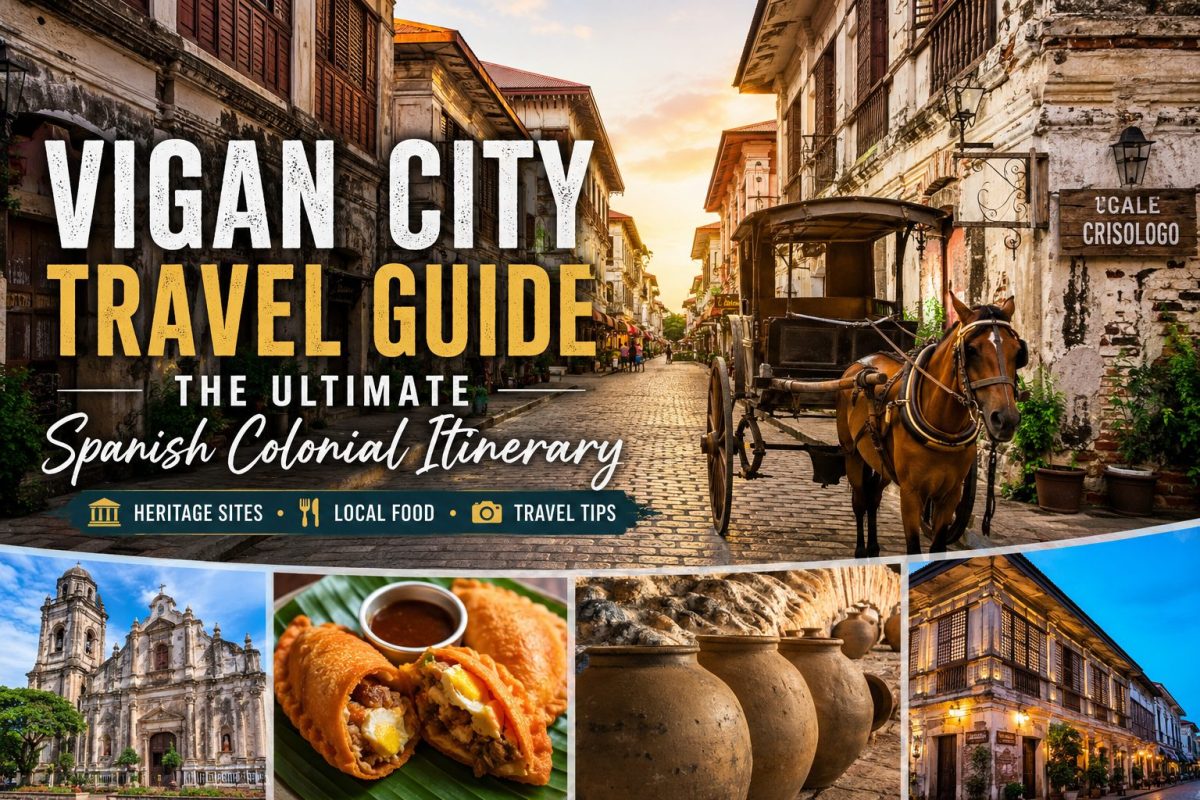
Calle Crisologo, Vigan City, Ilocos Sur

If there is a single street in the Philippines that encapsulates the entire weight and beauty of the country’s colonial heritage, it is Calle Crisologo. Named after Floro Crisologo, one of Ilocos Sur’s most powerful political dynasties of the 20th century, this 500-meter cobblestone thoroughfare cuts through the heart of Vigan’s Mestizo District—the ancient residential quarter of Chinese-Ilocano merchant families who accumulated tremendous wealth during the indigo, textile, and tobacco trading booms of the 17th, 18th, and 19th centuries. Flanking the street on both sides are rows of extraordinarily well-preserved Bahay na Bato—literally “houses of stone”—the distinctive hybrid architectural style that defines Vigan: thick, earthquake-resistant lower walls of volcanic stone and brick, topped by wide, airy upper floors of hardwood with capiz shell sliding windows and overhanging wooden balconies that provide shade to the street below. These are not museum reconstructions. They are real homes, many still owned by descendants of the original merchant families, where you might glimpse laundry drying on an upper-floor balcony or hear the muffled sound of a television through a centuries-old doorway. Vigan is the living version of what Batanes is to natural heritage—a place that has preserved its identity against enormous historical pressure.
The experience of walking Calle Crisologo changes dramatically depending on what time of day you visit, and understanding this rhythm is the key to getting the most out of the street. The absolute best time is the early morning—arrive by 5:30 AM when the street is completely empty of tourists, shrouded in a soft morning mist that rolls in from the adjacent Mestizo River, and lit only by the glow of heritage yellow lanterns mounted on iron brackets along the stone facades. In those early morning minutes, with the cobblestones still damp from the night, the sound of your footsteps echoing off 300-year-old walls, and not another soul in sight, the centuries genuinely collapse and the experience approaches the transcendent. By 8:00 AM the tour groups begin arriving, and by 10:00 AM the street is busy with visitors, kalesa horses, and souvenir vendors. The second-best time is after 7:00 PM when lanterns are fully lit, the heat of the day has broken, and the street takes on a warm, romantic amber glow that makes it one of the most photographically stunning urban scenes in all of Southeast Asia.
Vehicles are permanently banned from Calle Crisologo to protect both the cobblestone surface and the pedestrian heritage experience, making it a genuinely pleasant place to walk, linger, and explore at your own pace. The street is lined with a mix of souvenir shops, weaving workshops selling abel Ilocano textiles, antique dealers, small restaurants, and heritage accommodation options. Several of the ground-floor shops offer live demonstrations of abel weaving on traditional wooden looms—a craft that has been practiced in the Ilocos region for centuries using homegrown cotton and natural plant dyes. Watching a skilled weaver produce the intricate geometric patterns of abel cloth on a hand-operated wooden loom is one of the most compelling craft demonstrations available anywhere in the Philippines, and the weavers are generally happy to explain their work to curious visitors. Abel cloth products—table runners, blankets, bags, and clothing—make exceptional souvenirs that directly support local artisan livelihoods and cannot be found anywhere else in the country.
Access to Calle Crisologo is completely free, which makes it one of the greatest zero-cost heritage experiences available anywhere in the Philippines. The street is approximately a 10-minute walk from Vigan’s central plaza and bus drop-off points, or a short ₱50–₱80 trike ride from outlying areas of the city. Walking the full length of the street at a relaxed pace, pausing to look into shop windows and admire the architectural details of individual mansions, takes approximately 30 to 45 minutes. Returning multiple times—once at dawn, once in the afternoon, once at night—reveals a completely different aspect of the street each time and costs nothing beyond the small investment of your time and attention. For travelers who appreciate the combination of zero-cost sightseeing with maximum cultural depth, Calle Crisologo belongs alongside Samal Island’s natural wonders as one of the Philippines’ finest free experiences.
Vigan Cathedral (St. Paul Metropolitan Cathedral), Vigan City

Flanking the main Plaza Salcedo in the heart of Vigan City, the Saint Paul Metropolitan Cathedral—locally and universally known as the Vigan Cathedral—is among the oldest and most architecturally significant Catholic churches in the Philippines. Construction of the current structure was completed in 1800, though earlier versions of the church on this site date to the late 16th century, making the site of continuous Catholic worship in Vigan as old as the Spanish colonial presence itself. The cathedral is built in the earthquake baroque style—a distinctly Philippine architectural adaptation of the European baroque tradition in which the bell tower is detached from the main church building and positioned at a distance, a pragmatic design decision made after repeated catastrophic collapses of attached towers during major earthquakes flattened the church body below. This pragmatic ingenuity—adapting European grandeur to local geological reality—is one of the most fascinating architectural stories in Philippine history, and Vigan Cathedral is one of the finest examples of it. Visitors exploring Vigan’s heritage should also consider pairing the city’s history with the natural wonder of Siquijor for a complete Philippine cultural and natural experience.
The cathedral’s facade is a commanding expression of Spanish colonial religious authority: massive stone walls, a broad arched entryway flanked by twin pilasters, a high pediment decorated with religious reliefs, and a wide atrium forecourt paved in stone that creates a formal processional approach from the plaza. The free-standing bell tower, rising to approximately 30 meters, is positioned to the left of the main entrance and serves as an important visual anchor for the Plaza Salcedo ensemble—one of the most photographically complete colonial civic spaces surviving in the Philippines. Step inside the cathedral and the interior impresses with its scale: long barrel-vaulted nave, a richly carved main altar in gilded baroque style, ornate side chapels dedicated to various saints, and the characteristic heavy silence of a building designed to make its worshippers feel the weight of the divine. Morning Mass is celebrated daily, and attending a service in Vigan Cathedral—surrounded by centuries-old walls, with the sound of Ilocano hymns echoing through the nave—is a profoundly atmospheric experience that most secular travelers find unexpectedly moving.
Entry to the cathedral itself is free, as it remains an active parish church serving the local Catholic community. Modest dress is required—shoulders covered, no shorts—out of respect for an active place of worship. Photography is generally permitted inside the nave but should be avoided during active prayer or Mass. The plaza in front of the cathedral, Plaza Salcedo, serves as the social heart of Vigan—an open public square where locals gather in the evenings, where street food vendors set up carts after dark, and where the famous Vigan Heritage Village Lighted Fountain Show takes place nightly at 7:00 PM and 8:00 PM. The fountain show is free to watch and features synchronized water jets choreographed to music—a popular evening activity that provides a relaxed and budget-free way to end a day of heritage exploration in Vigan. Accommodation near Plaza Salcedo is extremely convenient for accessing both the cathedral and Calle Crisologo, with options ranging from ₱1,200 to ₱3,500 per night.
The combination of the Vigan Cathedral, its detached bell tower, and the Plaza Salcedo ensemble is best experienced across multiple times of day. Early morning when the plaza is quiet and the cathedral doors open for the first Mass is the most serene time to visit. Midday reveals the full play of tropical light on the stone facade—ideal for architectural photography with dramatic shadow and texture. Evening at the plaza, after the heat of the day has broken, when families gather on benches around the central fountain and the cathedral’s floodlit facade glows against the darkening sky, provides the most atmospheric and communal experience of Vigan’s living heritage. The bell tower is accessible to visitors during certain hours for a small fee of approximately ₱30–₱50, and the view from its upper levels over the red-tiled rooftops of the Mestizo District and surrounding Vigan streets is one of the best elevated perspectives available in the city.
Syquia Mansion Museum, Vigan City, Ilocos Sur

If Calle Crisologo shows you the exterior face of Vigan’s colonial wealth, the Syquia Mansion shows you its interior life—and the contrast is extraordinary. This beautifully preserved ancestral home served as the residence of Doña Alicia Syquia Quirino, wife of Elpidio Quirino, the sixth President of the Philippines who served from 1948 to 1953. Built by the wealthy Syquia family in the classic Vigan Bahay na Bato style of the late 19th century, the mansion is a three-story structure of volcanic stone on the lower level and fine Philippine hardwood on the upper floors, with the characteristic wide capiz shell windows, interior courtyard, and ground-floor storage and commercial spaces that define the Vigan merchant home typology. Today operated as a museum by the National Historical Commission of the Philippines, the Syquia Mansion gives visitors an extraordinarily intimate view of how upper-class colonial Filipino families lived, entertained, and expressed their social status through architecture, furnishings, and daily objects.
The mansion’s interior is a treasure trove of colonial-era material culture displayed in its original domestic context rather than in a detached museum setting. Massive hardwood floors of molave and narra planks, polished to a deep brown luster by generations of household activity, run throughout the upper-floor living areas. The formal sala (living room) is furnished with 19th-century European-style wooden chairs upholstered in local weaving, antique Chinese porcelain jars on carved wooden stands, ornate gilt-framed mirrors imported from Spain, and a large central table surrounded by the kind of formal seating arrangement that speaks of an era when receiving guests was a carefully choreographed social performance. The dining room retains its original sideboard, imported European dinner service, crystal glassware, and a long mahogany table that would have seated the extended Syquia family and their distinguished guests. The bedrooms are intimate and fascinating—personal items including hairbrushes, prayer books, hand-embroidered pillowcases, and a cradle used for the Quirino children remain in place, creating an uncanny sense of a family that stepped out for the afternoon and simply never came back.
Admission to the Syquia Mansion Museum is ₱100 for adults and ₱80 for seniors and students—one of the best-value paid museum experiences in the Philippines given the quality and completeness of what is on display. The museum is closed on Tuesdays, so planning your visit for any other day of the week is essential. Guided tours of the mansion are available and highly recommended—the mansion’s museum staff are knowledgeable and passionate guides who bring the objects and spaces to life with family histories, historical anecdotes, and contextual information about colonial-era Vigan society that no amount of label-reading can replicate. A guided tour typically takes 45 minutes to an hour. Photography is permitted in most areas of the mansion. The mansion is located on Quirino Boulevard, a short walk from Calle Crisologo and Plaza Salcedo, making it easily combinable with a morning walking tour of the heritage district.
The Syquia Mansion is most rewarding when visited in the context of Vigan’s broader social history. The Syquia family represented the Chinese-mestizo merchant elite that flourished under Spanish colonial rule, accumulating land, capital, and political influence through trade in indigo, tobacco, and textile goods. Understanding this social context makes the objects in the mansion—the imported European furniture, the Chinese porcelain, the Ilocano handwoven textiles, the presidential memorabilia—far more than decorative period pieces: they become material evidence of how a specific class of people navigated the intersection of Chinese, Ilocano, Spanish, and eventually American colonial cultural influences to construct a distinctly Filipino elite identity. For travelers who want to understand the Philippines more deeply rather than simply photograph it, the Syquia Mansion delivers that understanding with exceptional economy of means for ₱100. If the intersection of heritage and natural beauty appeals to you, the budget island hopping experience in Palawan offers a similarly layered Philippine travel experience in a completely different register.
Pagburnayan Pottery Pits (Burnay Potteries), Vigan City

On the southern outskirts of Vigan’s city proper, along the banks of the Mestizo River, lies one of the most remarkable living craft traditions in the Philippines: the Pagburnayan pottery workshops where artisans continue to produce burnay—the heavy, unglazed earthenware jars introduced to Ilocos by Chinese immigrants centuries ago—using production methods that have changed remarkably little since their introduction. The word pagburnayan derives from the Ilocano root for pottery-making, and this district has been the center of Vigan’s ceramic production since at least the Spanish colonial period. What makes Vigan’s pottery tradition genuinely distinctive from other Philippine ceramic crafts is the combination of its ancient Chinese origins, its continuous unbroken production over centuries, its use of water-buffalo clay preparation, and above all, the extraordinary dragon kilns—brick-lined firing tunnels stretching up to 50 meters in length that have been in continuous use for generations and that produce the characteristic dense, dark, unglazed surface of authentic burnay ware.
The production process of burnay pottery is worth understanding in detail because watching it unfold is the central experience of visiting Pagburnayan. The clay itself is sourced from the riverbanks of the Mestizo River and prepared in a laboriously physical way: it is mixed with water and then kneaded and trodden by carabaos (water buffalo), whose weight and steady circular walking action breaks down clay lumps and achieves a homogeneous consistency that cannot be replicated by machine at the same scale. Watching a carabao patiently circle a clay pit while a potter guides it and monitors the clay consistency is a scene of agricultural pre-industrial production that belongs to a different era—and the fact that it continues here in Vigan in 2026 is a small miracle of cultural persistence. The kneaded clay is then worked on hand-operated pottery wheels by master potters who produce the characteristic spherical and conical forms of burnay jars with practiced efficiency; visitors are welcome to step up to the wheel and attempt a piece under guidance. Do not expect competence on your first try—the clay has its own will, and the gap between the master’s effortless shaping and your fumbling attempts is a humbling and deeply entertaining experience.
The finished and dried clay pieces are loaded into the dragon kilns for firing—the massive brick tunnel kilns are loaded from the front, fired over several days with wood fuel fed through side openings, and then allowed to cool before opening. The firing process produces the characteristic dense, dark, slightly rough-textured surface of genuine burnay ware that distinguishes it from commercially produced ceramic goods. Visiting the Pagburnayan area is completely free in the sense that no formal entrance fee is charged—the workshops are working production facilities that welcome visitors informally. A small honorarium or purchase of a burnay piece is the customary and appropriate acknowledgment of the artisans’ time. Small burnay items—cups, small bowls, decorative pieces—are available from ₱50 to ₱200. The large traditional storage jars that most travelers recognize from photographs range from ₱500 to ₱3,000 depending on size, but transporting these home in checked luggage requires creative packing in bubble wrap and clothing.
The Pagburnayan district is located approximately 15 to 20 minutes by trike from the Vigan heritage core (Calle Crisologo and Plaza Salcedo), making it a convenient half-day add-on to a morning walking tour of the Mestizo District. Trike fare from the central plaza to Pagburnayan is approximately ₱50–₱80 each way. The best time to visit is morning (9:00 AM to 12:00 PM) when production activity at the workshops is at its most active and the quality of light for photography is good. The workshops are typically closed or minimally active on Sundays and Philippine public holidays. The Pagburnayan experience is one of the clearest demonstrations of why Vigan rewards travelers who go beyond the obvious photogenic landmarks of Calle Crisologo and engage with the working heritage of the city—a philosophy equally applicable to destinations like Batanes, where the daily life of Ivatan communities offers equal depth to the scenic landscapes.
Plaza Burgos & The Vigan Street Food Scene, Vigan City

Plaza Burgos is Vigan’s food plaza—the epicenter of the city’s street food culture and the place where locals and tourists alike converge after dark for cheap, delicious, authentically Ilocano eating. Located adjacent to the Vigan City Hall and a short walk from Calle Crisologo, Plaza Burgos comes alive in the early evening when dozens of food stalls set up their grills, woks, and frying vats across the plaza’s open space, filling the air with the smell of garlic, vinegar, and sizzling pork fat in a way that is immediately and overwhelmingly appetizing. The plaza is the undisputed home of the Vigan empanada—arguably the Philippines’ finest street food creation and a dish that has no true equivalent elsewhere in the country. Every serious Filipino food traveler has a Plaza Burgos empanada on their bucket list, and with good reason: watching the vendors stretch the orange achuete-colored rice flour wrapper over a mound of shredded green papaya, raw egg, and savory local sausage, then fold and seal it with practiced speed before dropping it into a bubbling vat of oil, is as much theater as it is food preparation.
The Vigan empanada is a genuinely unique culinary object that bears almost no resemblance to its Spanish namesake. The wrapper is made from rice flour rather than wheat, colored with achuete (annatto) to its characteristic vivid orange, and fried rather than baked—producing a shatteringly crispy exterior with a texture closer to a thin, crackling shell than a pastry. The filling of shredded unripe green papaya provides a slightly tangy, crunchy texture body; the raw egg cooks inside the wrapper as it fries, becoming a runny or set yolk depending on timing; and the local longganisa sausage adds a hit of garlicky, vinegary savory intensity that ties the whole thing together. The mandatory accompaniment is Sukang Iloko—the local sugarcane vinegar, dark and sharp and completely unlike the mild white vinegar used elsewhere in Filipino cooking—into which you dip the empanada aggressively and repeatedly. One empanada costs ₱25–₱40 at Plaza Burgos stalls and represents approximately the best ₱35 you can spend on food in the Philippines. Eating two is entirely appropriate and highly recommended.
Beyond empanada, Plaza Burgos stalls offer a broad range of Ilocano street food and light meals including okoy (shrimp and sweet potato fritters), tupig (grilled sticky rice in banana leaf), bibingka (rice cake cooked in clay pot), grilled corn, fresh buko (young coconut), basi wine shots, and various barbecued pork and chicken skewers. A fully satisfying Plaza Burgos street food dinner covering three to four different items with drinks costs approximately ₱150–₱250 per person—making it not only the most atmospheric dining option in Vigan but also by far the most economical. Seating is informal—plastic stools and small tables around each vendor, or simply eating standing up as the locals do while watching the evening crowd circulate. The plaza is typically at its most lively between 6:00 PM and 9:00 PM.
Plaza Burgos should be experienced on every evening of your stay in Vigan—not because you need to eat there every night, but because the social atmosphere of the plaza changes night by night, and the pleasure of wandering between stalls, trying a different item each visit, and watching the city’s evening life unfold around you is one of the great free pleasures of Vigan travel. The plaza is also where you will encounter Vigan’s most authentic street-level social scene: families on evening walks, teenagers on phones, elderly couples on bench seats, tour groups following guides, and solo travelers like yourself discovering that the best part of any city is almost always the square where its people gather to eat, talk, and simply be together. For travelers who love finding great street food scenes, our guide to the top 20 budget-friendly destinations in the Philippines for 2026 highlights many more exceptional eating destinations across the archipelago.
Crisologo Museum & The Mestizo Heritage District, Vigan City

Calle Crisologo is the most famous street in Vigan’s Mestizo District, but it is far from the only one worth exploring in depth. The entire Mestizo District—the UNESCO World Heritage-designated core of Vigan City—is a grid of cobblestone and stone-paved streets lined with heritage structures of varying states of preservation and use, forming one of the most complete surviving examples of a Spanish colonial Asian trading town urban fabric anywhere in the world. Walking the Mestizo District beyond Calle Crisologo—turning down side streets, peering through the heavy wooden doors of ancestral homes left ajar in the heat, watching elderly women fan themselves on second-floor balconies, and discovering small courtyards and chapels tucked behind the main street frontages—rewards patient exploration with an intimacy of heritage experience that the main thoroughfare, busy with tourists and vendors, cannot fully provide. The Crisologo Museum, housed within the former residence and political stronghold of the powerful Crisologo family, offers the deepest formal interpretation of this political and social history available in Vigan.
The Crisologo Museum is dedicated to the memory of Floro Crisologo—the flamboyant, controversial, and ultimately assassinated Ilocano political patriarch who dominated Ilocos Sur politics for decades before his dramatic murder inside the Vigan Cathedral in 1970—and his family. The museum occupies the family’s ancestral Bahay na Bato home on Quirino Boulevard and preserves the personal effects, official regalia, campaign materials, family photographs, and political memorabilia of one of the most powerful and complex figures in 20th-century Philippine provincial politics. The collection includes Crisologo’s personal firearms—a pointed reminder of the era’s violent political culture—alongside ceremonial sashes, official portraits, and the kind of domestic objects that make a political history tangible and human rather than abstract. Admission is approximately ₱50–₱80 per person and the museum is open daily except Tuesdays.
Beyond the museum, a self-guided walking tour of the broader Mestizo District is one of the most rewarding free activities in Vigan. The district’s street grid was laid out in the 16th century following Spanish colonial urban planning principles, with the main commercial streets oriented toward the plaza and river, and residential lanes running perpendicular. Walking this grid today, the logic of the original plan is still clearly legible in the arrangement of lots, the orientation of building facades, and the relationship of public spaces to private courtyards. Heritage enthusiasts will find multiple hours of material in the architectural variations between individual mansion facades—variations in the design of capiz windows, wooden balcony railings, stone gateway arches, roof pitch and material, and facade paint colors that together constitute a record of individual family taste, wealth, and social aspiration across three centuries of Vigan history. The Mestizo District walking tour is best done in the early morning between 6:00 AM and 9:00 AM when the light is soft, the streets are cool, and the neighborhood is at its most quietly authentic.
Accommodation within the Mestizo District itself is one of the most compelling options for heritage-minded travelers visiting Vigan. Several ancestral Bahay na Bato mansions have been converted into guesthouses and boutique hotels that allow guests to sleep within the original colonial architecture—waking up to creaking hardwood floors, the filtered morning light through capiz windows, and the sound of kalesa horses on the cobblestones outside. Prices for Mestizo District heritage accommodation range from ₱1,500 per night for a simple family guesthouse to ₱4,000–₱6,000 per night for premium boutique colonial hotels. Staying within the heritage core eliminates trike fares entirely for most sightseeing, allowing you to walk to every major attraction from your doorstep. For travelers interested in comparing Vigan’s colonial heritage with the Philippines’ most dramatic natural heritage, our best solo travel destinations guide for 2026 provides equally detailed coverage across the archipelago.
Ilocos Sur Day Trips: Bantay Bell Tower & Beyond, Ilocos Sur

Vigan City is the gravitational center of Ilocos Sur’s heritage tourism, but the surrounding province rewards travelers who venture beyond the city limits with a series of equally remarkable and far less visited heritage destinations reachable on easy half-day or full-day excursions. The most accessible and compelling of these is Bantay—a municipality immediately adjacent to Vigan that contains one of the most distinctive Spanish colonial monuments in the Philippines: the Bantay Bell Tower. Unlike most Philippine church bell towers, which are attached to or positioned immediately beside their parent church buildings, the Bantay Bell Tower stands entirely alone on a small hillock approximately 150 meters from the Bantay Church—an arrangement that reflects its dual purpose as both a sacred bell tower and a military watchtower used to spot approaching enemy ships, pirates, and raiding parties along the Ilocos coast. Climbing the tower’s interior staircase (a small fee applies, approximately ₱20–₱30) delivers elevated views over the surrounding lowlands, the rooftops of Bantay, and on clear days the coastal lowlands stretching toward the West Philippine Sea.
The Bantay Church itself—officially the Saint Augustine Parish Church of Bantay—dates to 1591, making it one of the oldest continuously active churches in the Philippines. Its massive stone walls, low-slung earthquake-resistant profile, and relatively plain facade compared to more elaborate colonial churches elsewhere in the country convey an air of military solidity that reflects its frontier-period origins. The combination of the church and its detached watchtower is one of the most evocative colonial heritage ensembles in Ilocos and is genuinely undervisited by travelers who focus exclusively on Vigan City’s UNESCO core. Bantay is reachable from Vigan by trike in approximately 10 to 15 minutes for ₱50–₱80 each way, making it an extremely economical add-on to a Vigan itinerary that adds meaningful heritage depth without significant cost or time investment.
Further afield, the municipality of Santa Maria in Ilocos Sur—approximately 30 kilometers north of Vigan—is home to another UNESCO World Heritage component: the Santa Maria Church, a Baroque church perched dramatically on a hilltop above the town and approached by a grand ceremonial staircase of 85 steps. The church’s hilltop position, designed for defensive as well as liturgical purposes, gives it a commanding visual presence over the surrounding agricultural valley that is unmatched by any other colonial church in the Ilocos region. Santa Maria Church is one of the four Baroque Churches of the Philippines designated as a UNESCO World Heritage Site in 1993, alongside San Agustin in Manila, Paoay Church in Ilocos Norte, and Miagao Church in Iloilo. Visiting Santa Maria on a day trip from Vigan—by hired vehicle or by catching a northbound bus on the national highway for approximately ₱50–₱80—adds one of the Philippines’ most spectacular colonial monuments to your Vigan itinerary for minimal additional cost.
For travelers with an appetite for extending their Ilocos heritage circuit further, a full-day excursion northward through Ilocos Norte to Laoag City and the Paoay Church, the iconic Paoay Lake, and the windmill farms of Bangui offers another exceptional day of heritage and natural scenery. Laoag is approximately 90 kilometers north of Vigan by road (1.5 to 2 hours by bus or hired vehicle) and can be combined with a return flight to Manila from Laoag International Airport for travelers who prefer not to retrace the overland route to Manila. The Ilocos heritage circuit is one of the most rewarding in the Philippines for travelers who appreciate layered cultural and historical experiences—a philosophy shared by destinations as diverse as Siquijor with its mystical heritage or the island environments of Palawan with its ancient Tabon Cave civilization.
Ilocano Food & Cultural Experiences, Vigan City

Ilocano cuisine is one of the Philippines’ most distinctive and least commercially diluted regional food traditions, and eating well in Vigan demands a willingness to engage with flavors that are aggressive, unapologetic, and deeply characteristic of a culture shaped by frugality, self-reliance, and centuries of agricultural and maritime life. Ilocano cooking is defined by three flavor pillars: intense garlic, sharp vinegar, and deeply savory local salts and fermented condiments. Unlike the sweeter profiles of Tagalog cuisine or the rich coconut-milk-based dishes of Bicolano cooking, Ilocano food is dry, concentrated, vinegary, and fundamentally honest—every dish tastes exactly like what it is, with no embellishment. This directness is a reflection of the Ilocano cultural character, which Ilocanos themselves describe as kugian (industriousness), nainsiriban (frugality and practicality), and an aversion to ostentatious display that paradoxically coexists with the creation of some of the most architecturally grand ancestral homes in the Philippines. Exploring the richness of Ilocano food culture is as important a part of the Vigan travel experience as walking Calle Crisologo—and for food travelers, it may ultimately be the most memorable part. For travelers who enjoy combining culinary exploration with natural wonder, Samal Island offers excellent fresh seafood alongside its famous beach and cave experiences.
Bagnet is the dish that most food travelers seek out in Vigan, and it deserves every bit of its legend. A large slab of pork belly is first slowly boiled in water seasoned with salt, garlic, and bay leaves until the meat is fully cooked and the skin softens. It is then dried and rested before being submerged in very hot oil for a first fry that cooks the exterior without crisping it fully. After resting again and cooling completely, the pork undergoes a second fry at higher temperature—this double-frying process causes the skin to puff and blister into a crackling network of air-filled bubbles that shatter with a sound audible across the dining table at first bite, revealing the tender slow-cooked meat beneath. The contrast between the translucent, tissue-thin crispy skin and the yielding interior pork fat and muscle is one of the great textural achievements of Philippine cooking. Bagnet is served with a side dish of pinakbet (bitter melon, eggplant, okra, and squash sautéed with shrimp paste) and, always, a small dish of Sukang Iloko for dipping. A full bagnet plate at a Vigan restaurant costs ₱280–₱450 depending on the size of the cut.
Vigan Longganisa deserves equal attention. Unlike the sweet, sugar-glazed longganisa of Tagalog provinces or the banana-ketchup-laced variants from Pampanga, Vigan’s longganisa is small, plump, and aggressively seasoned with local garlic, salt, and Sukang Iloko that permeates the ground pork filling during curing. The flavor is simultaneously garlicky, tangy, salty, and savory in a way that is genuinely unlike any other Philippine sausage—addictively good with garlic rice and fried egg as a breakfast at any of Vigan’s local eateries (₱80–₱150 for a longganisa silog). Taking home vacuum-packed Vigan longganisa (available from ₱150–₱250 per pack at the public market or at specialty shops on Calle Crisologo) is one of the most universally appreciated edible souvenirs from northern Luzon. Pinakbet—the quintessential Ilocano vegetable stew of bitter melon, eggplant, squash, okra, and string beans sautéed with bagoong fermented shrimp paste—and dinengdeng—a light, clear broth of vegetables and grilled fish flavored with bagoong—round out the essential Ilocano culinary vocabulary that every Vigan visitor should explore.
Beyond eating, Vigan’s cultural experiences extend to its living craft traditions. The abel weaving workshops along Calle Crisologo produce traditional Ilocano textiles on hand-operated wooden looms using geometric patterns and color combinations that encode centuries of design tradition. The Pagburnayan pottery district preserves the ancient Chinese-derived burnay ceramic tradition. Basi—the traditional Ilocano sugarcane wine fermented in burnay jars and flavored with tree bark and leaves—is a living beverage tradition that predates the Spanish colonial period and remains in production at family-run distilleries accessible from Vigan. Taking the time to seek out these living traditions—watching a weaver, trying to throw a clay pot, sipping basi at a plaza stall—transforms a Vigan visit from a sightseeing exercise into a genuine cultural encounter. This depth of cultural engagement is exactly what our Ultimate 2026 Philippines Travel Guide encourages for every destination across the archipelago.
💰 6 Essential Money-Saving Tips for Visiting Vigan in 2026
Vigan is already one of the most affordable UNESCO World Heritage destinations in Southeast Asia, but smart planning reduces costs even further without sacrificing the quality of your experience. Here are the six most effective money-saving strategies for traveling Vigan in 2026.
The overnight bus from Manila (Cubao or Pasay) to Vigan costs ₱900–₱1,300 per way for a sleeper or deluxe seat—dramatically cheaper than any flight option when you factor in the absence of airport taxes, transport to the airport, and luggage fees. More importantly, the 8-to-10-hour journey happens while you sleep, meaning you save the cost of one night’s accommodation and arrive in Vigan at dawn with a full day ahead of you. Book Partas, Aniceto, or Viron Transit tickets in advance through their company websites or at the terminal to secure preferred seats. Taking the same night bus back to Manila on your last evening squeezes maximum sightseeing into your trip and saves another accommodation night, potentially reducing total trip accommodation costs to just two or three nights instead of four.
Vigan’s heritage core is genuinely compact and walkable: Calle Crisologo, the Syquia Mansion, the Crisologo Museum, Plaza Salcedo, the Vigan Cathedral, and Plaza Burgos are all within a 10-to-15-minute walking radius of each other. Resisting the default trike habit for all movements within this zone saves ₱50–₱100 per trip—multiply that by 6 trips per day over 3 days and you save ₱900–₱1,800 that is better spent on bagnet, longganisa, and abel weaving products. Several Vigan shops rent bicycles for ₱200–₱300 per day, which covers the entire city including Pagburnayan and Bantay for a flat rate. Reserve trike spending for Pagburnayan visits and longer out-of-center trips only.
The single most effective food cost reduction in Vigan is eating breakfast at a local carenderia rather than at a guesthouse dining room or tourist-oriented cafe. A longganisa silog (Vigan sausage, garlic rice, and fried egg) at a local eatery costs ₱80–₱120 compared to ₱250–₱350 at a heritage hotel dining room for equivalent quality. The Vigan public market is open from approximately 5:00 AM and has stalls selling fresh pandesal, coffee, and rice meals for under ₱100 total. Eating all dinners at Plaza Burgos street stalls (₱150–₱250 per person for a full spread) rather than restaurants reduces your per-person daily food spend from ₱800–₱1,200 to ₱400–₱600 while delivering superior local flavor.
Virtually every family-run guesthouse and heritage homestay in Vigan maintains an active Facebook page and responds to direct messages for booking inquiries. Booking directly via Facebook rather than through Booking.com, Agoda, or Airbnb eliminates the 12–18% platform service fees that are either added to your bill or built into the displayed rate. On a ₱1,500/night heritage guesthouse over three nights, direct booking saves ₱540–₱810 compared to the same booking via a platform. Many Vigan guesthouses also offer minor discounts or complimentary local tips to guests who book direct as a gesture of appreciation for bypassing platform commissions. Message the guesthouse at least a week before arrival to confirm availability and negotiate directly.
The majority of Vigan’s most memorable experiences are completely free: walking Calle Crisologo at dawn (free), the Plaza Salcedo fountain show (free), Vigan Cathedral interior (free), Mestizo District street exploration (free), Abel weaving workshop viewing (free), and most plaza and public space cultural observation (free). Paid attractions in Vigan are few and inexpensive—Syquia Mansion at ₱100, Crisologo Museum at ₱50–₱80, Bantay Bell Tower at ₱20–₱30—and collectively cost under ₱250 for all three. By spending your first full day on entirely free activities and holding paid museum visits for your second day, you psychologically reduce the cost pressure of the trip and often discover that the free experiences are more rewarding than the paid ones.
The souvenir and craft shops lining Calle Crisologo apply tourist-area markups of 30–100% over the production cost of the same items available directly from public market vendors, Pagburnayan pottery workshops, and abel weaving studios located off the main tourist street. Vacuum-packed Vigan longganisa costs ₱150–₱200 per pack at the public market and ₱250–₱350 at Calle Crisologo shops. Small burnay pottery pieces cost ₱50 at Pagburnayan and ₱150 at street-front souvenir stores. Abel cloth table runners cost ₱150–₱250 directly from a weaving studio and ₱350–₱500 at the packaged souvenir level. Buying direct from producers at the public market and craft workshops is both cheaper and more ethically satisfying, as a greater share of the purchase price reaches the hands of the artisan or farmer who made it.
❓ Frequently Asked Questions About Visiting Vigan City
🇵🇭 Vigan Is Waiting—Walk Its Cobblestones, Taste Its Vinegar, and Let History Speak
This guide has given you the complete blueprint for a Vigan City visit in 2026: the overnight bus logistics that make the journey economical and efficient, the full range of Calle Crisologo experiences from dawn mist to evening lantern glow, the colonial interiors of the Syquia Mansion and Crisologo Museum, the living craft traditions of Pagburnayan pottery and abel weaving, the extraordinary street food culture of Plaza Burgos, the heritage depth of the Mestizo District’s side streets, the worthwhile day trips to Bantay and Santa Maria Church, and the essential flavors of bagnet, longganisa, pinakbet, and basi that constitute one of the Philippines’ most distinctive regional cuisines. For travelers building a broader Philippine itinerary, Vigan combines naturally with a swing northward through Ilocos Norte or southward toward Manila with stops at Siquijor’s mystical island or the islands of Palawan for a complete Philippine cultural and natural journey.
The key message of this guide is one that Vigan itself communicates more eloquently than any travel writer can: the Philippines is not only its beaches. The country’s history is layered, complex, beautiful, and heartbreaking in equal measure—the product of Chinese merchants, Ilocano farmers, Spanish priests, American administrators, and Filipino families who have lived and died and built and survived on this extraordinary archipelago for thousands of years. Vigan is where all of that history is most visible, most walkable, and most alive. It is a city that rewards slowness, curiosity, and genuine engagement with the people and places you encounter. Book the night bus, bring enough cash, wear comfortable walking shoes, and set your alarm for 5:15 AM on your first morning. The cobblestones of Calle Crisologo at dawn will do the rest. For more inspiration on the Philippines’ finest destinations—from the wild northern landscapes of Batanes to the southern idyll of Samal Island—explore the full collection at BuzzPH.
The kalesa is waiting at the corner. The empanada oil is hot at Plaza Burgos. The capiz windows of a 300-year-old mansion are filtering the morning light into patterns on a hardwood floor that has been walked by six generations of the same family. Vigan is one of the great travel gifts of Southeast Asia—accessible, affordable, deeply beautiful, and entirely, irreducibly itself. Check our guide to the Top 25 Best Tourist Destinations in the Philippines for 2026 to plan your next Philippine adventure after Vigan. Mabuhay ang Vigan. Mabuhay ang Pilipinas!







 Facebook
 Twitter