
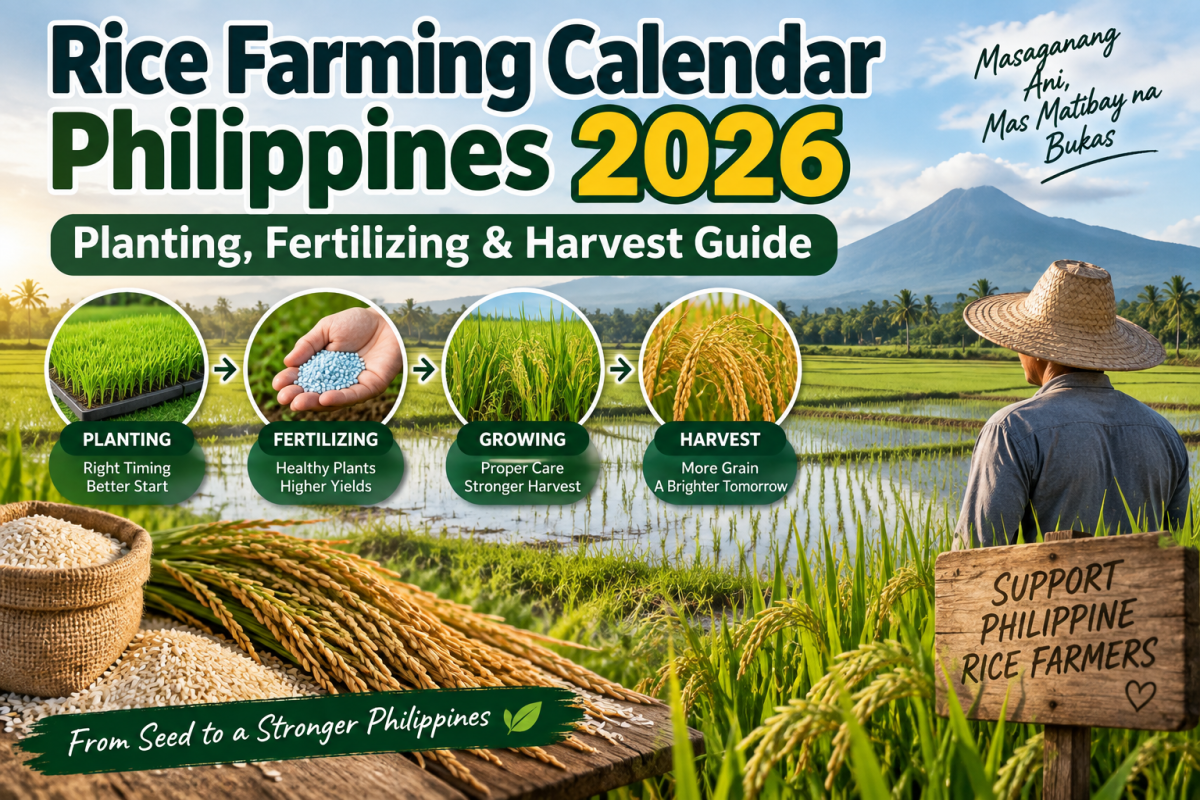
A Rice Farming Calendar Philippines 2026 should be more than a list of months for planting and harvesting. Rice production schedules vary across the country depending on location, rainfall, irrigation, rice variety, planting method, soil condition and weather.
A practical calendar helps farmers organize the crop from pre-planting preparation through establishment, nutrient management, crop monitoring and harvest. It can also help with planning seed purchases, fertilizer, labor, machinery, irrigation and post-harvest activities.
The Philippines has both irrigated and rainfed rice ecosystems, and the appropriate schedule for one farm may not be suitable for another. DA-PhilRice’s rice-management resources and tools emphasize farm-specific decision-making, including nutrient recommendations based on crop and field conditions. The International Rice Research Institute (IRRI) likewise recommends crop calendars that account for planting date, variety duration and the timing of major farm operations.
This 2026 guide provides a practical framework for planning rice production in the Philippines. It combines current Philippine agricultural data with established rice-production guidance and clearly identifies BuzzPH’s sample calculations and planning examples.
Important: This guide is an educational planning resource. Planting dates, fertilizer rates, water requirements and harvest timing should be adjusted to the farm’s location, rice variety, ecosystem and actual field conditions. Farmers should verify technical recommendations with their local agriculture office, irrigation authority or DA-PhilRice resources.
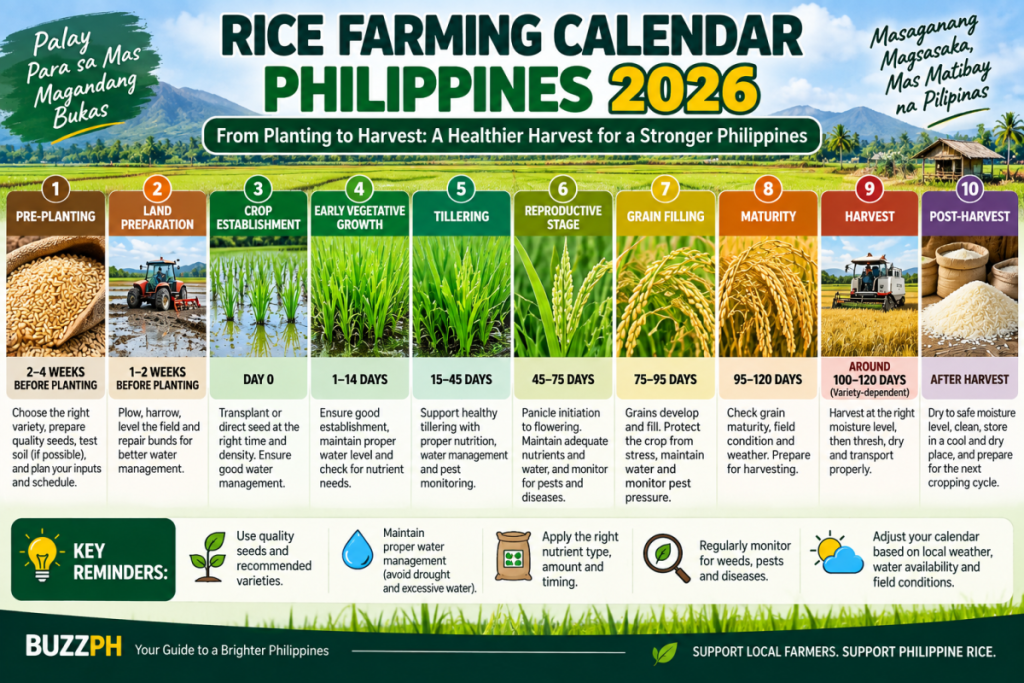
Quick Rice Farming Calendar Philippines 2026
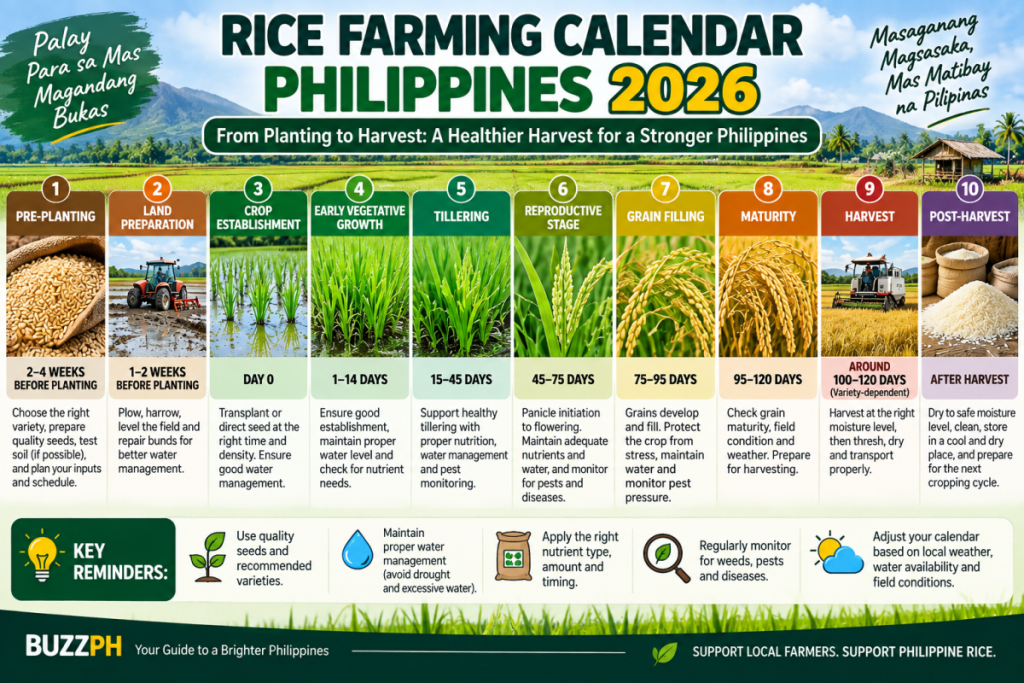
A typical rice crop can be organized into the following stages:
| Farming stage | Typical timing | Main activities |
|---|---|---|
| Pre-planting | Before crop establishment | Select variety, prepare seed, assess soil and plan inputs |
| Land preparation | Before planting | Plowing, harrowing, leveling and field preparation |
| Crop establishment | Planting window | Transplanting or direct seeding |
| Early vegetative growth | Early crop | Establishment, weed, water and nutrient management |
| Tillering | Vegetative stage | Nutrient management and pest monitoring |
| Reproductive stage | Mid-to-late crop | Panicle development, flowering and crop protection |
| Grain filling | After flowering | Water, nutrient and pest management |
| Maturity | Final stage | Monitor grain development and harvest readiness |
| Harvest | Near maturity | Harvest, threshing, drying and transport |
| Post-harvest | After harvest | Storage, marketing and next-crop planning |
The exact duration depends heavily on the rice variety. IRRI’s crop-calendar guidance notes that short-duration varieties can commonly take about 100–120 days, medium-duration varieties around 120–140 days, while longer-duration varieties may require substantially more time.
Therefore, the calendar should be built around the actual variety being planted, rather than assuming that every rice crop takes exactly four months.
Why Rice Planting Dates Differ Across the Philippines
There is no single planting date that works for every Philippine rice farm.
PAGASA’s general climate information identifies June to November as the country’s broad rainy season and December to May as the broad dry season, but rainfall patterns differ across climate types and geographic areas.
For rice farmers, the practical question is not simply whether it is officially the rainy or dry season.
The more important questions are:
- Is irrigation available?
- When does reliable rainfall normally begin?
- What variety will be planted?
- How long does the variety take to mature?
- What is the expected harvest window?
- Is the field vulnerable to flooding or drought?
- Are labor and harvesting services available when needed?
An irrigated farm may have considerably more flexibility than a rainfed farm. Conversely, a rainfed farmer may need to wait for sufficient rainfall before establishing a crop.
2026 Philippine Rice Production Context
Current 2026 production data provide useful context for understanding the country’s rice sector.
The Philippine Statistics Authority reported that palay production from April to June 2026 reached 4.63 million metric tons, with harvested area of approximately 1.04 million hectares and average yield of about 4.47 metric tons per hectare.
Cagayan Valley was the largest contributor during the quarter at approximately 1.20 million metric tons, followed by Central Luzon at around 1.10 million metric tons. Bicol Region was another major contributor.
These statistics demonstrate why a Philippine rice calendar should recognize regional differences.
However, national and regional averages should not be interpreted as guarantees for individual farms. Actual yields depend on variety, soil, water, weather, management practices and other conditions.
Regional Rice Farming Calendar Framework
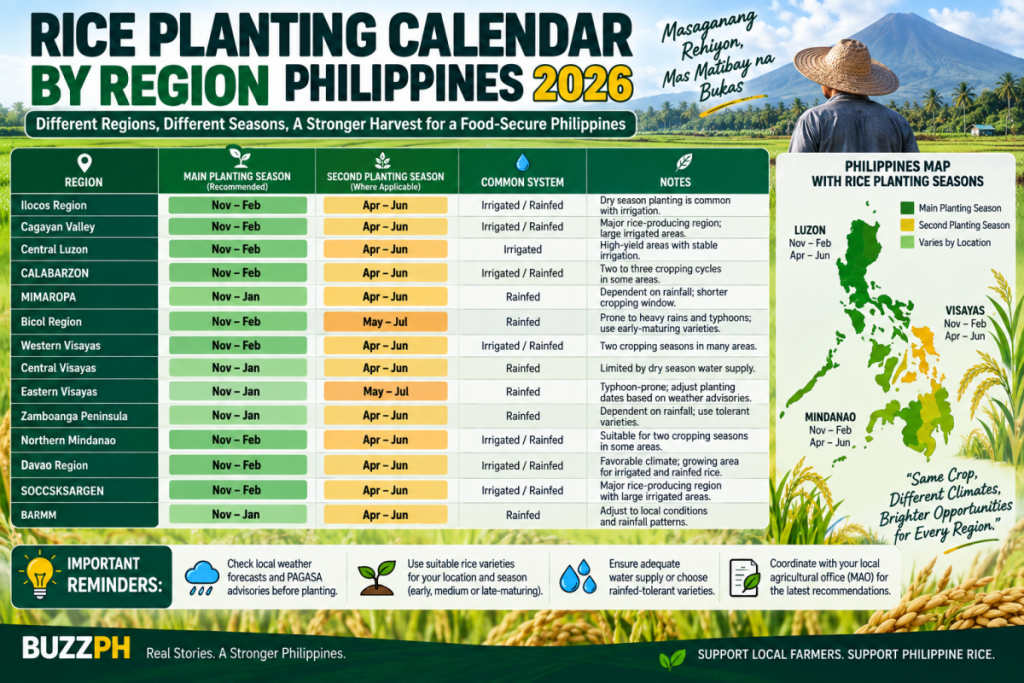
Instead of assigning an exact planting date to every province, farmers should use a regional planning framework.
| Major rice-growing area | Key calendar considerations |
|---|---|
| Cagayan Valley | Coordinate planting with local rainfall and irrigation conditions; account for variety duration |
| Central Luzon | Irrigation availability and mechanized field operations can strongly influence scheduling |
| Ilocos Region | Consider local rainfall, water availability and crop duration |
| Western Visayas | Local rainfall and irrigation conditions should guide crop establishment |
| Bicol Region | Heavy rainfall and wet-field conditions can affect land preparation and harvest |
| Northern Mindanao | Local rainfall, irrigation and cropping patterns should be considered |
| Davao Region | Use local rainfall information and farm-specific water conditions rather than a northern-Luzon calendar |
| SOCCSKSARGEN | Coordinate planting with irrigation, rainfall and local cropping schedules |
This approach deliberately avoids inventing one rigid set of dates for every location.
A farmer in one municipality may have reliable irrigation while another nearby farm may depend primarily on rainfall. Even farms within the same province can therefore have different practical planting windows.
How to Determine Your Local Planting Window
A farmer can make the calendar more accurate by checking five things before planting.
First, determine the water source.
Is the field irrigated, partially irrigated or entirely rainfed?
Second, identify the variety.
Check the expected maturity period and recommended growing environment.
Third, check recent and forecast weather.
PAGASA information can help with broader weather and climate planning, while local observations remain important.
Fourth, consider the next crop or harvest deadline.
If the farm follows multiple cropping cycles, the current crop must fit into the broader annual schedule.
Fifth, consult local agricultural personnel.
Municipal and provincial agriculture offices can provide location-specific information that a national article cannot accurately replace.
Wet-Season Rice Farming
Wet-season rice generally benefits from increased rainfall, particularly on rainfed farms.
However, abundant rainfall can also create problems.
Farmers may face:
- Flooding
- Waterlogging
- Nutrient losses
- Difficult field access
- Increased disease pressure
- Delayed harvesting
- Grain-quality problems
PAGASA’s national climate information identifies June to November as the broad rainy period, but local rainfall distribution varies.
The best planting window therefore depends on when adequate water becomes available without creating excessive risk during the later crop stages.
Dry-Season Rice Farming
Dry-season rice can be productive when reliable irrigation is available.
The advantage is greater control over water compared with a purely rainfed system.
However, dry-season production requires careful attention to:
- Irrigation supply
- Water scheduling
- High temperatures
- Nutrient management
- Pest pressure
- Soil moisture
PhilRice’s nutrient-management resources also recognize that crop nutrient requirements can vary between seasons because environmental conditions affect crop growth.
A dry-season calendar should therefore be based on the actual irrigation system and farm conditions.
Selecting a Rice Variety
The rice variety should be selected before finalizing the crop calendar.
Important characteristics include:
- Maturity duration
- Suitability for the local ecosystem
- Seed quality
- Disease considerations
- Expected yield characteristics
- Recommended planting method
- Local market preference
PhilRice’s PalayCheck approach includes using quality seed of a recommended variety as an important rice-management practice.
Once the variety is selected, its expected maturity period becomes the foundation for calculating the approximate harvest window.
Land Preparation
Land preparation should be scheduled backward from the intended crop-establishment date.
Typical activities include:
- Field clearing
- Plowing
- Harrowing
- Leveling
- Bund repair
- Irrigation preparation
- Drainage preparation
Field leveling is particularly important because uneven fields can result in uneven water distribution.
PalayCheck identifies proper field leveling as one of its important rice-management practices.
The number and timing of land-preparation operations will depend on soil condition, previous crop, machinery availability and the chosen planting system.
Rice Crop Establishment
Rice can be established through different methods, with transplanting and direct seeding among the common approaches.
For transplanted rice, the calendar needs to include:
- Seed preparation
- Nursery establishment
- Seedling management
- Land preparation
- Transplanting
- Early establishment
Direct-seeded rice follows a different sequence because there is no transplanting stage.
IRRI recommends considering crop duration and major farm activities when creating a crop calendar.
This means farmers should not simply copy a transplanting schedule when using direct seeding.
Early Crop Management
After establishment, farmers should regularly check whether the crop has developed a healthy and reasonably uniform stand.
Important observations include:
- Plant establishment
- Weed pressure
- Water availability
- Nutrient condition
- Insect activity
- Disease symptoms
Early problems can become more expensive to correct later.
For that reason, field inspection should be treated as a regular activity in the calendar rather than something done only when visible damage becomes severe.
Tillering Stage
Tillering is an important vegetative stage because rice plants develop additional shoots that can contribute to productive panicles.
During this period, farmers should pay close attention to:
- Nitrogen status
- Water management
- Weed competition
- Pest activity
- Overall crop vigor
PhilRice nutrient-management guidance emphasizes providing appropriate nutrients during important crop stages, including tillering and reproductive development.
The objective is not to maximize fertilizer application.
The objective is to provide the crop with the nutrients it needs at the appropriate time.
Fertilizer Management
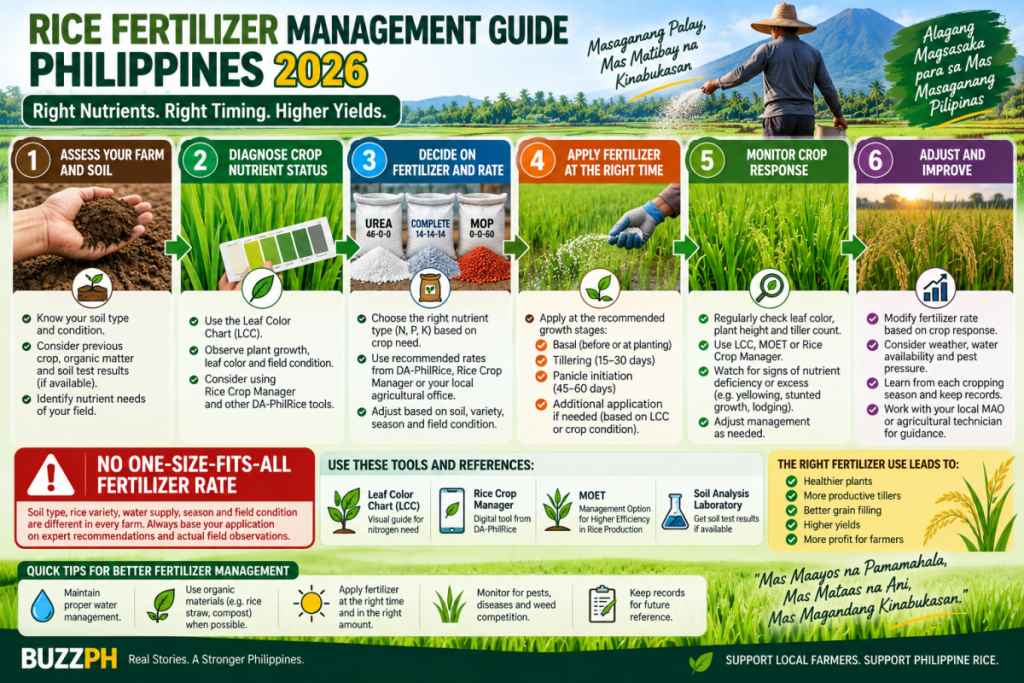
Fertilizer management is one of the areas where a generic nationwide schedule can become misleading.
A fertilizer program can vary according to:
- Soil fertility
- Variety
- Season
- Planting method
- Previous crop
- Water management
- Crop condition
- Expected yield
PhilRice recommends nutrient-management approaches and diagnostic tools including the Leaf Color Chart (LCC), Minus-One Element Technique (MOET), and Rice Crop Manager.
Important: Do not treat a fertilizer rate published for one production condition as a universal recommendation for every rice farm.
For example, PhilRice has published a fertilizer recommendation for particular wet-season transplanted-rice conditions involving 14-14-14 and urea applications. That recommendation is an example of a production-specific program, not a universal prescription.
Farmers should use soil information, crop observations and appropriate local recommendations before deciding the exact fertilizer product and rate.
Using the Leaf Color Chart
The Leaf Color Chart can help farmers assess the nitrogen status of rice plants.
PhilRice explains that the tool uses leaf color as an indicator related to nitrogen status and can help guide nitrogen-management decisions.
The advantage is that fertilizer decisions can incorporate actual crop condition rather than relying exclusively on a fixed number of days after planting.
PhilRice also provides digital diagnostic tools related to nutrient management.
Using MOET and Soil Information
The Minus-One Element Technique can help identify nutrient limitations affecting rice growth.
PhilRice describes MOET as a low-cost diagnostic technique that can help identify deficiencies in important nutrients.
This reinforces an important principle:
Two rice fields in the same municipality may not require the same fertilizer program.
Soil characteristics and previous crop history can change nutrient requirements significantly.
Practical Fertilizer Timeline
Instead of publishing one universal fertilizer recipe, farmers can use the following framework:
| Crop stage | Management focus |
|---|---|
| Before planting | Assess soil and nutrient requirements |
| Establishment | Consider appropriate basal nutrition |
| Early tillering | Monitor crop growth and nutrient status |
| Tillering | Evaluate nitrogen requirement |
| Panicle initiation | Monitor critical nutrient needs |
| Flowering | Maintain appropriate crop nutrition |
| Grain filling | Avoid unnecessary late applications |
The specific fertilizer product, quantity and timing should come from an appropriate recommendation for the farm.
Water Management
Water should be included in the calendar from the beginning.
The objective is to provide sufficient moisture while avoiding unnecessary or prolonged excessive water conditions.
Farmers should monitor:
- Irrigation availability
- Field water level
- Drainage
- Rainfall
- Drought conditions
- Flooding risk
PhilRice’s rice-management resources emphasize avoiding both excessive water and drought stress.
Water management becomes particularly important when weather conditions differ significantly from normal expectations.
Weed Management
Weeds compete with rice for resources such as:
- Water
- Nutrients
- Light
- Growing space
Weed management should therefore be planned early.
Farmers should identify the weeds present in their fields and use appropriate management methods.
PhilRice provides diagnostic resources for identifying Philippine weed species and obtaining relevant management information.
Pest and Disease Monitoring
Rice fields should be inspected regularly for signs of pest and disease problems.
Potential concerns include:
- Rats
- Rice bugs
- Stem borers
- Brown planthoppers
- Defoliating insects
- Fungal diseases
- Bacterial diseases
The appropriate response depends on the pest, crop stage and severity of the problem.
Current regional data also demonstrate that pest and water problems can affect actual production. In Quirino, for example, the PSA reported lower second-quarter 2026 palay production and cited insufficient irrigation and rainfall together with pest problems among factors affecting output.
This is an example of why farmers should monitor their own fields instead of assuming that a national calendar predicts exactly what will happen.
Flowering and Grain Filling
The reproductive stage is another critical part of the calendar.
Farmers should monitor:
- Panicle development
- Flowering
- Water availability
- Nutrient status
- Pests
- Diseases
- Weather
- Lodging
The objective is to protect the crop through flowering and grain filling until it reaches maturity.
Stress during reproductive development can affect final grain production, so the calendar should not treat flowering as a period when field management can simply stop.
How Long Does Rice Take to Harvest?
Rice maturity depends on variety and growing conditions.
IRRI’s crop-calendar guidance gives broad maturity ranges of approximately:
- 100–120 days: short-duration varieties
- 120–140 days: medium-duration varieties
- 160 days or more: longer-duration varieties
These are broad categories rather than guaranteed harvest dates.
Temperature, water, sunlight, soil conditions and crop management can influence development.
Farmers should therefore use the variety’s production guide and actual crop development to determine harvest readiness.
How to Recognize Harvest Readiness
Harvest should be based on crop maturity rather than simply counting days.
Farmers should monitor:
- Grain development
- Panicle appearance
- Grain color
- Crop uniformity
- Moisture condition
- Risk of lodging or shattering
Harvesting too early can result in immature grain and lower quality.
Delaying harvest can increase exposure to:
- Birds
- Rats
- Shattering
- Lodging
- Rain
- Other field losses
The appropriate harvest timing should be confirmed using the variety’s recommendations and local technical guidance.
Example: 120-Day Rice Crop Calendar
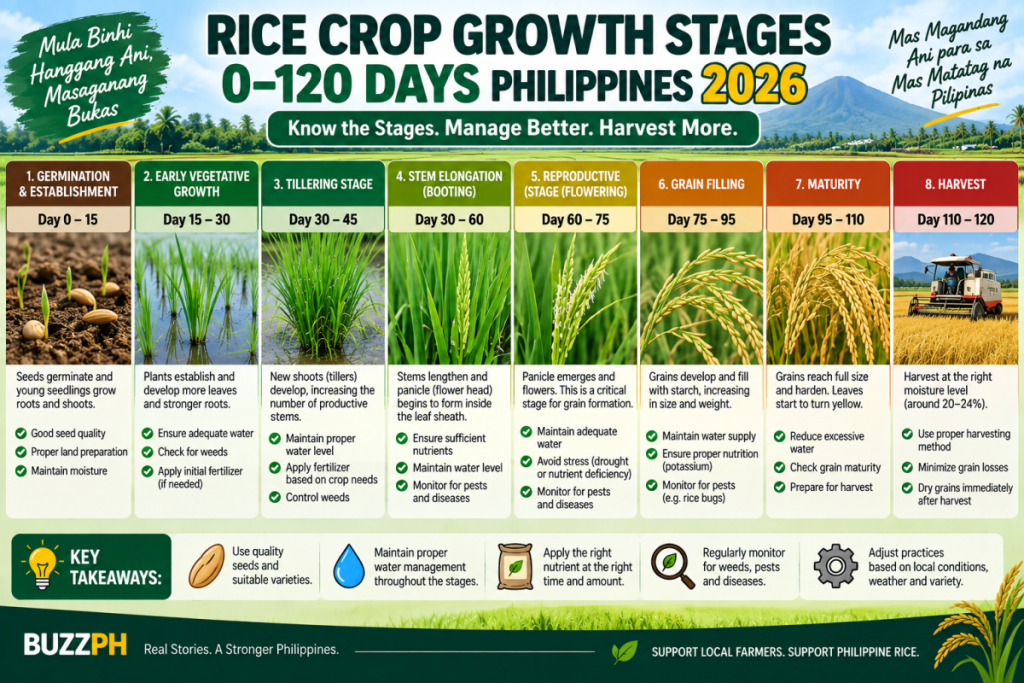
The following is a BuzzPH planning example for illustrating how a farmer can organize a 120-day crop.
It is not an official national rice-production schedule.
| Approximate crop period | Main planning activity |
|---|---|
| Before Day 0 | Variety selection, soil assessment and input planning |
| Days -30 to -15 | Seed and farm preparation |
| Days -15 to -7 | Land preparation |
| Days -7 to 0 | Final field preparation |
| Day 0 | Planting or transplanting |
| Days 1–14 | Crop establishment |
| Days 15–30 | Weed, water and nutrient monitoring |
| Days 30–45 | Tillering and nutrient management |
| Days 45–60 | Reproductive development |
| Days 60–75 | Panicle development/flowering |
| Days 75–95 | Grain filling |
| Days 95–110 | Maturity monitoring |
| Days 110–120 | Harvest planning and harvesting |
Actual timing can shift according to variety, planting method, weather and field conditions.
Example: Turning a Planting Date Into a Calendar
Suppose a farmer establishes a crop on June 15, 2026, using a variety with an expected duration of approximately 120 days.
A simplified planning framework would be:
June 15: Crop establishment
Late June: Establishment and early monitoring
July: Vegetative growth and tillering
Late July to August: Reproductive development and flowering
August to September: Grain filling and maturity monitoring
Around October: Harvest planning or harvesting, depending on the actual variety and crop development
This is an example of how the farmer can convert the expected crop duration into a working calendar.
It should not be interpreted as a guaranteed harvest date.
How to Build Your Own Rice Farming Calendar
The most useful approach is to build the calendar from the farm’s actual conditions.
| Step | What to determine |
|---|---|
| 1 | Identify the farm’s province and municipality |
| 2 | Determine whether the farm is irrigated or rainfed |
| 3 | Select the rice variety |
| 4 | Check expected maturity duration |
| 5 | Review local weather and rainfall information |
| 6 | Determine the practical planting window |
| 7 | Schedule land preparation |
| 8 | Arrange seed, fertilizer and other inputs |
| 9 | Plan labor and machinery |
| 10 | Monitor crop development and adjust operations |
| 11 | Schedule harvesting, threshing and drying |
| 12 | Record results for the next crop |
This approach is more reliable than using a fixed national month-by-month schedule.
Working Backward From Harvest
Another useful method is to start with the intended harvest window.
The planning sequence becomes:
Desired harvest window → crop duration → planting date → land preparation → input purchases
IRRI specifically identifies crop calendars as useful tools for planning inputs, labor, financing, contractors and harvesting operations.
For commercial farmers, this approach can help avoid situations where harvesting arrives but labor, machinery, drying capacity or transportation has not been arranged.
Rice Farming Calendar and Farm Expenses
A crop calendar is also a financial-planning tool.
Farmers should estimate the timing of:
- Seeds
- Fertilizer
- Crop-protection inputs
- Land preparation
- Labor
- Irrigation
- Machinery
- Harvesting
- Threshing
- Drying
- Transportation
Some costs occur before planting, while others arrive several months later.
Putting expenses beside the farming calendar can help farmers understand when cash will be needed.
One-Hectare Rice Farm Planning Example
The following is a BuzzPH planning framework, not an official production-cost estimate.
For a one-hectare farm, the farmer can organize costs into:
| Expense | What determines the actual cost |
|---|---|
| Seed | Variety and establishment method |
| Land preparation | Machinery, labor and soil condition |
| Fertilizer | Soil and crop nutrient requirements |
| Weed management | Weed species and control method |
| Pest management | Field history and pest pressure |
| Irrigation | Local water system and usage |
| Labor | Local rates and operation requirements |
| Harvesting | Mechanization and contractor rates |
| Drying | Grain moisture and service cost |
| Transport | Distance and harvest volume |
There is no responsible single peso amount that applies to every one-hectare rice farm in the Philippines.
A highly mechanized irrigated farm can have a very different cost structure from a smaller rainfed operation relying heavily on family labor.
Rice Yield and Farmgate Price Context
Production planning should also consider yield and market conditions.
PSA reported an average national palay yield of approximately 4.47 metric tons per hectare during April–June 2026. Central Luzon recorded approximately 5.94 metric tons per hectare during the same quarter, while Cagayan Valley reached around 5.02 metric tons.
These are regional and national statistical averages.
They should not be used as guaranteed yield targets for an individual farm.
PSA also reported a seasonally adjusted average farmgate price of approximately ₱22.14 per kilogram for palay during April–June 2026.
Actual prices received by farmers can vary according to:
- Location
- Variety
- Grain quality
- Moisture
- Buyer
- Market conditions
- Transportation
- Harvest timing
Therefore, farmers should use local buying prices rather than national averages when preparing an actual farm-income projection.
Why Irrigated and Rainfed Calendars Are Different
The difference can be summarized simply:
Irrigated farm: greater control over water availability.
Rainfed farm: greater dependence on rainfall timing and distribution.
A rainfed farmer should pay particular attention to the onset and reliability of rainfall.
An irrigated farmer still needs to monitor water availability because irrigation systems can experience shortages, maintenance problems or scheduling constraints.
The calendar should therefore include a water-risk assessment, not just a planting date.
When to Adjust the Rice Calendar
A farming calendar should be flexible.
Consider adjusting the plan when:
- Rainfall arrives later than expected
- Irrigation is interrupted
- Flooding occurs
- Drought conditions develop
- Land preparation is delayed
- Seedlings develop differently than expected
- Pest pressure increases
- Harvest machinery becomes unavailable
- Drying capacity is limited
A calendar is a decision-making tool.
It should help farmers respond to changing conditions rather than force them to continue an unsuitable schedule.
Common Rice Farming Calendar Mistakes
Planting because the month says it is time
A month on a calendar cannot guarantee suitable rainfall or field conditions.
Using the same schedule for every variety
Different varieties have different maturity periods.
Applying one fertilizer recipe to every field
Nutrient requirements vary.
Ignoring irrigation
Dry-season production requires reliable water planning.
Waiting until harvest to arrange machinery
Harvesting services can be difficult to secure during busy periods.
Ignoring post-harvest operations
Threshing, drying, storage and transportation need advance planning.
Using national statistics as personal farm targets
National and regional averages are useful benchmarks, but they are not individual farm guarantees.
Ignoring local agricultural advice
Local technicians can account for conditions that a nationwide online guide cannot.
DA-PhilRice Digital Tools for Rice Farmers
Farmers looking for more customized management information can use tools provided by DA-PhilRice.
Rice Crop Manager Advisory Service provides recommendations based on farm and crop information and can support more site-specific nutrient management.
PalayCheck App can generate a crop calendar based on information such as rice variety and planting method and provides management reminders.
PhilRice also provides diagnostic tools related to nutrient management and crop problems.
These resources are especially useful because they move farmers away from a generic one-size-fits-all approach.
2026 Rice Farming Checklist
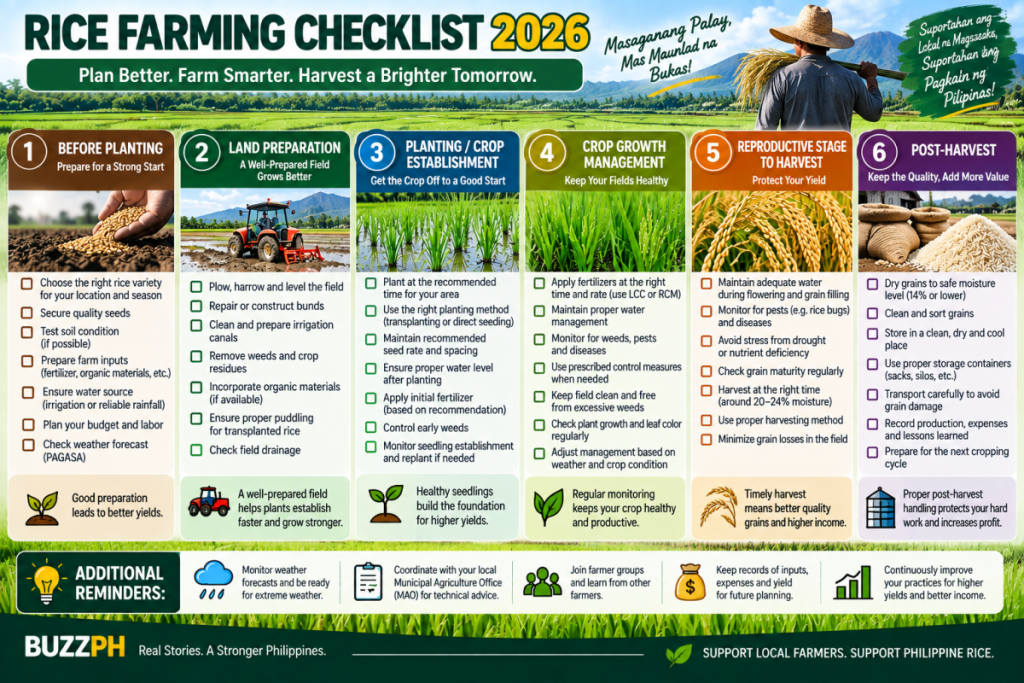
Before planting
☐ Identify the rice variety
☐ Check maturity duration
☐ Determine whether the farm is irrigated or rainfed
☐ Check local weather conditions
☐ Assess soil and nutrient requirements
☐ Prepare seed
☐ Schedule land preparation
☐ Plan fertilizer requirements
☐ Arrange labor and machinery
☐ Confirm water availability
During establishment
☐ Monitor plant establishment
☐ Check water conditions
☐ Monitor weeds
☐ Observe nutrient status
☐ Inspect for pests and diseases
During vegetative growth
☐ Monitor tillering
☐ Evaluate nutrient requirements
☐ Manage weeds
☐ Check irrigation
☐ Continue pest monitoring
During reproductive development
☐ Monitor panicle development
☐ Maintain appropriate water conditions
☐ Monitor pests and diseases
☐ Check crop nutrition
Before harvest
☐ Check grain maturity
☐ Schedule harvesting equipment
☐ Arrange labor
☐ Arrange drying
☐ Plan transportation
☐ Confirm buyer or marketing arrangements
Frequently Asked Questions
What is the best month to plant rice in the Philippines?
There is no single best month nationwide. Planting depends on location, rainfall, irrigation, rice variety and farming system. PAGASA identifies June to November as the broad rainy season and December to May as the broad dry season, but local rainfall patterns differ.
How many days does rice take to harvest?
It depends on the variety. IRRI broadly classifies short-duration rice at around 100–120 days, medium-duration varieties at around 120–140 days and longer-duration varieties at 160 days or more.
Is a four-month rice calendar always accurate?
No. Four months can be a useful approximation for some varieties, but farmers should use the expected maturity of the actual variety being planted and monitor crop development.
What is the difference between wet-season and dry-season rice?
Wet-season rice generally has greater access to rainfall but may face flooding and excessive moisture. Dry-season rice can benefit from favorable growing conditions but requires reliable water management, especially on irrigated farms.
Should fertilizer be applied according to a fixed schedule?
Not necessarily. Fertilizer requirements depend on soil, variety, season, crop establishment and crop condition. DA-PhilRice recommends tools such as Rice Crop Manager, LCC and MOET to support better nutrient-management decisions.
Can farmers use the same rice calendar throughout Luzon, Visayas and Mindanao?
No. Climate, rainfall, irrigation, varieties and local cropping systems vary. A nationwide calendar should be used as a framework and adjusted using local information.
What is the PalayCheck system?
PalayCheck is a rice crop-management system developed by PhilRice that organizes recommended rice-management practices into key checks, including seed quality, field preparation and nutrient management.
What is Rice Crop Manager?
Rice Crop Manager is a decision-support service from DA-PhilRice that provides more customized crop and nutrient-management recommendations based on information about the farm and crop.
Can farmers create their own rice calendar?
Yes. Start with the farm location, water source, rice variety and expected crop duration. Then work backward from the intended harvest window to determine planting and land-preparation dates. Adjust the plan as weather and crop conditions change.
Why is irrigation important when planning a rice crop?
Irrigation affects the farmer’s ability to establish and maintain a crop, particularly during periods of limited rainfall. It can provide greater control over water availability, but farmers still need to consider actual irrigation schedules and possible water shortages.
What should farmers do if planting is delayed?
Recalculate the expected harvest window and check whether the selected variety remains suitable for the revised schedule. Farmers should also reassess rainfall, irrigation, labor and machinery availability before proceeding.
Final Thoughts
A useful Rice Farming Calendar Philippines 2026 should not tell every farmer to plant, fertilize and harvest on exactly the same dates.
The Philippines has diverse rice-growing environments, and successful crop planning depends on matching the farming schedule with the location, water source, variety, weather, soil and production system.
Current PSA data show that Philippine rice production remains highly regional. From April to June 2026, the country produced approximately 4.63 million metric tons of palay, with Cagayan Valley and Central Luzon among the largest contributors.
For an individual farmer, however, national statistics are only background information.
The practical process is:
Choose the appropriate variety → assess the farm → determine water availability → identify a suitable planting window → prepare the field → establish the crop → manage nutrients and water → monitor pests and diseases → track crop development → harvest at appropriate maturity → manage post-harvest operations.
For nutrient management, farmers should avoid relying on a universal fertilizer formula. DA-PhilRice’s Rice Crop Manager, Leaf Color Chart, MOET and PalayCheck resources provide more appropriate frameworks for making crop-management decisions.
The most important lesson is simple: a calendar should guide farm decisions, not replace them.
Farmers should verify local recommendations with their municipal or provincial agriculture office, irrigation authority, accredited agricultural professionals or DA-PhilRice resources before making significant production decisions.
Research and Source Note
This BuzzPH article is a research-based agricultural planning guide. It does not claim that the BuzzPH editorial team personally operates a rice farm, and no fictional firsthand experience has been added.
The article’s technical and statistical information was developed using primary or authoritative agricultural sources, particularly DA-PhilRice, the Philippine Statistics Authority (PSA), PAGASA and the International Rice Research Institute (IRRI).
The 2026 production figures and price information are based on PSA reports. These figures are presented as national or regional statistics and are not represented as guaranteed individual-farm results.
The fertilizer discussion uses DA-PhilRice material and deliberately distinguishes published examples from universal recommendations. Fertilizer requirements can vary substantially depending on soil, variety, season, water management and crop conditions.
The crop-calendar examples, planning tables and one-hectare organizational framework are BuzzPH editorial analysis and planning examples. They are intended to help readers understand how to construct a farm calendar and should not be interpreted as official government production schedules.
Primary Sources and Verification
Philippine Rice Research Institute (DA-PhilRice) — Rice Crop Manager, PalayCheck, nutrient management and diagnostic tools.
Philippine Statistics Authority (PSA) — 2026 palay production, harvested area, yield and farmgate-price statistics.
PAGASA — Philippine climate patterns, rainfall and seasonal information.
International Rice Research Institute (IRRI) — rice crop duration and crop-calendar planning principles.
Important: Agricultural recommendations can change according to variety, location, season, soil, water availability and weather. Farmers should verify current local recommendations before applying fertilizer, pesticides or other farm inputs.
Editorial Quality and Originality Statement
This article intentionally avoids presenting a fabricated “personal farming experience.” Instead, its expertise is demonstrated through primary-source research, current 2026 Philippine statistics, transparent methodology, regional analysis, practical planning frameworks and clearly identified editorial estimates.
The article also avoids treating one planting date, fertilizer rate or yield as universally applicable to Philippine rice farms. That distinction is important because agricultural decisions are inherently site-specific.




 Facebook
 Twitter