

Rice farming in the Philippines can be a viable small-scale agricultural business when the farm is planned around suitable land, reliable water, quality seed, efficient production, and realistic financial expectations. For beginners, however, starting a rice farm involves much more than planting and harvesting. Land preparation, fertilizer, labor, machinery, irrigation, postharvest handling, palay prices, and unexpected crop risks can all affect the final return. This practical 2026 guide explains what new farmers should consider before investing, from choosing a suitable farm site to calculating production costs, potential revenue, break-even prices, and estimated returns.
For beginners, the biggest mistake is often looking only at the possible sales from a harvest. Rice farming should instead be treated as a complete production cycle where every peso spent on land preparation, seeds, fertilizer, labor, irrigation, harvesting, hauling, drying, and other activities is recorded and compared with the actual value of the palay sold.
This guide explains how to start a small rice farm in the Philippines in 2026, including the land you need, estimated costs, production practices, government assistance, and a practical way to calculate whether a rice-farming project can make money.
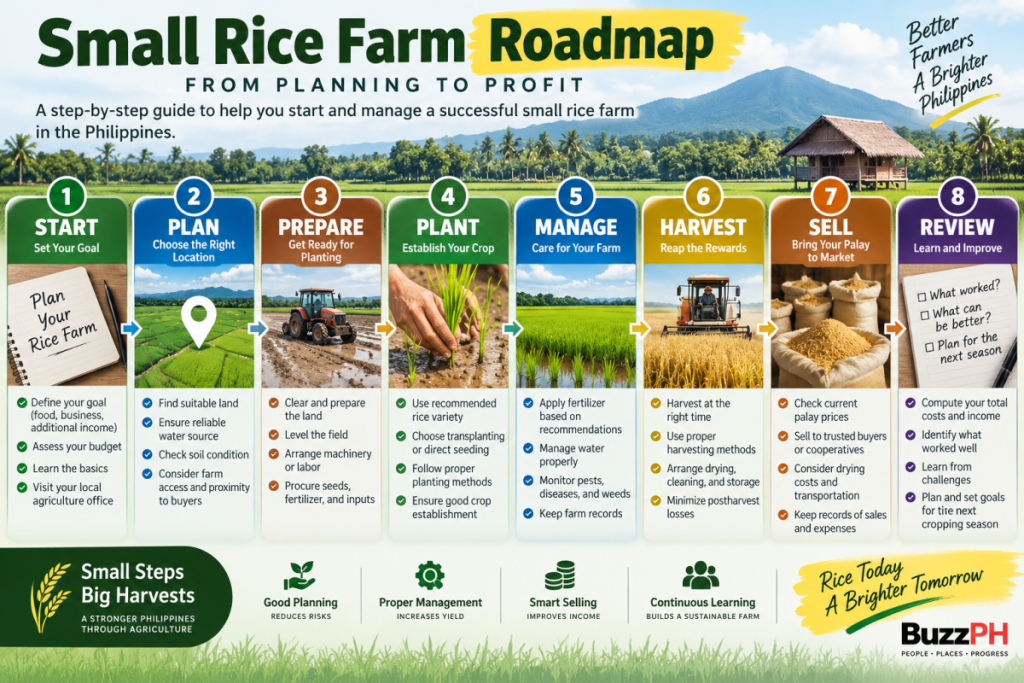
The figures used in this guide are based on Philippine government agricultural data and are intended as planning references rather than guaranteed farm results. Actual costs and income can vary significantly by province, season, farm size, irrigation, variety, weather, labor rates, machinery availability, and palay prices.
Start With the Right Farm, Not Just the Right Seeds
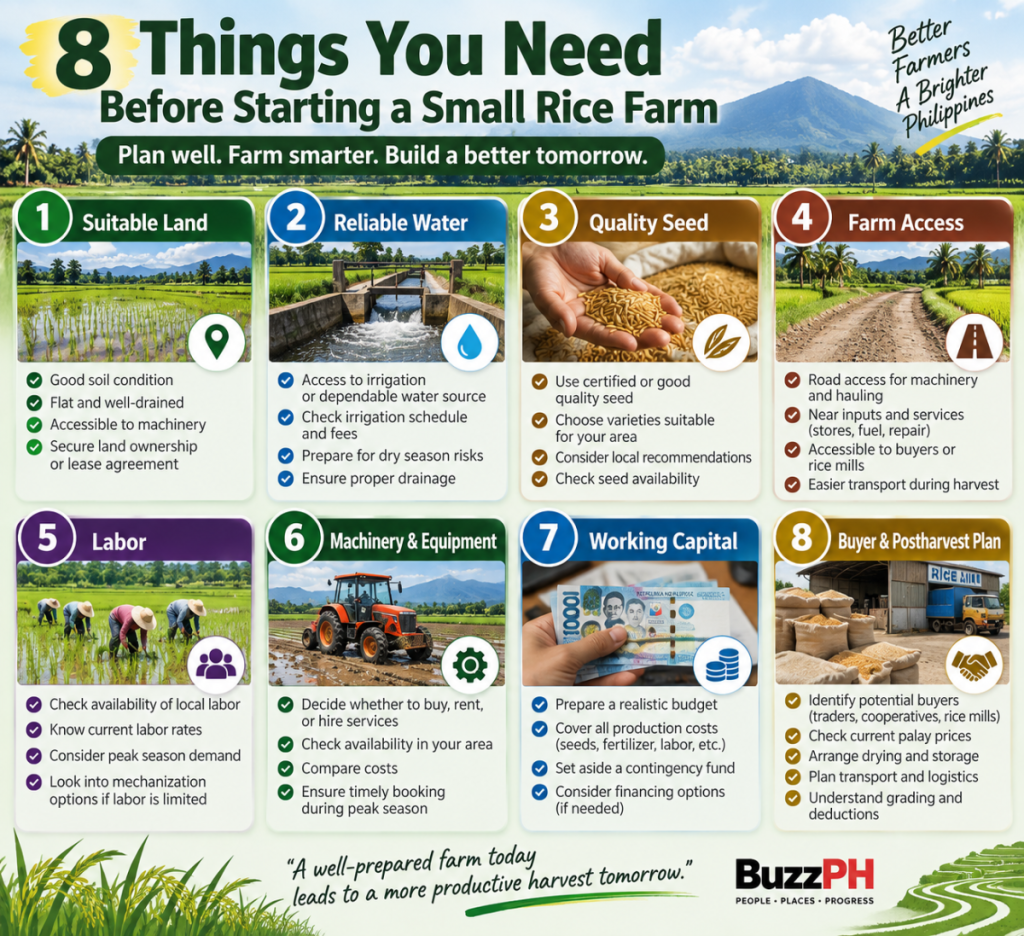
Before purchasing anything, evaluate the land.
Rice can be grown in different environments, but a beginner should be particularly careful about water availability and field conditions. A farm with good soil but unreliable water can be more difficult to manage than a slightly smaller farm with dependable irrigation.
Look at the following before committing money:
- Is the land suitable for rice production?
- Is there reliable irrigation or another dependable water source?
- Does the field drain properly?
- Can machinery or farm equipment reach the property?
- Is the road accessible during harvest?
- Is the property legally available for farming?
- Is the land owned or leased?
- Are there nearby rice farmers or farmer organizations?
- Is there a rice mill, trader, or buying station within practical hauling distance?
The location also affects the economics of the operation. A farm far from roads, machinery providers, laborers, dryers, or buyers may have higher logistical costs even when the field itself is productive.
If you are leasing land, calculate the lease payment as part of your farming cost. Do not treat it as a separate expense simply because you do not own the property.
How Much Land Do You Need?
You do not necessarily need several hectares to start.
A beginner could start with a smaller area, such as 0.5 hectare, particularly if the objective is to learn rice production before expanding. A 1-hectare farm, however, provides a much easier basis for planning because many Philippine agricultural statistics and farm-cost estimates are expressed on a per-hectare basis.
Starting small can reduce your financial exposure while allowing you to learn:
- how your local soil behaves;
- how much water the farm actually requires;
- which varieties perform well in your area;
- how much labor is available;
- which pests and diseases are common;
- how local traders price palay; and
- which farming activities are worth mechanizing.
Do not assume that a larger farm automatically means larger profit. If production costs rise faster than yield or selling price, expanding can simply multiply losses.
Check Your Local Agriculture Office Before Planting
One of the most practical steps for a first-time farmer is to visit the Municipal or City Agriculture Office where the farm is located.
This is particularly important because rice recommendations can be location-specific. Local agricultural technicians may know the varieties commonly planted in the area, pest problems, planting schedules, irrigation conditions, available government programs, and farmer organizations.
You should also ask whether the farm is eligible for available government programs.
The Department of Agriculture’s Rice Competitiveness Enhancement Fund (RCEF) currently includes seed, mechanization, extension, and credit-related support.
The Agricultural Training Institute also identifies RCEF-related training and support for rice farmers.
Do not assume that every farmer automatically receives every benefit. Eligibility, registration, program schedules, and distribution arrangements can change, so verify current requirements with the appropriate local agricultural office.
Register and Keep Farm Records
A serious small farm should be managed with records from the beginning.
Record:
- land size;
- land ownership or lease cost;
- seed variety;
- seed quantity;
- fertilizer purchases;
- pesticide purchases;
- land preparation;
- planting labor;
- weeding;
- irrigation expenses;
- harvesting;
- threshing;
- drying;
- hauling;
- other farm expenses;
- harvest weight;
- selling price; and
- total sales.
DA-PhilRice’s PalayCheck App is specifically designed to help farmers create crop calendars, monitor farm activities, record expenses, and calculate total costs and net income.
This is an important distinction between farming as a hobby and farming as a business.
If you do not know how much you spent, you cannot accurately determine whether your farm made money.
Choose a Suitable Rice Variety
Do not choose a rice variety simply because another farmer obtained a good harvest from it.
A variety’s performance depends on location, season, soil, water conditions, management, disease pressure, and other factors.
Use certified or otherwise appropriate quality seed and ask your local agricultural technician or DA-PhilRice resources about varieties recommended for your area.
PhilRice’s PalayCheck system identifies the use of high-quality seed of a recommended variety as one of its key crop-management checks. High-quality seed can support better germination and crop establishment.
DA-PhilRice also provides a Binhing Palay application that allows users to review characteristics of rice varieties when choosing what to plant.
For a beginner, the goal should not necessarily be to find the variety with the highest theoretical yield. A better question is:
Which recommended variety is appropriate for my location and farming conditions, and can I obtain quality seed for it?
Prepare the Land Properly
Land preparation establishes the foundation for the crop.
Depending on the production system and local conditions, activities may include:
- Clearing or managing crop residues.
- Initial tillage.
- Secondary tillage.
- Leveling.
- Preparing the field for crop establishment.
Proper leveling is particularly important in irrigated rice because uneven fields can create areas that receive too much or too little water.
PhilRice’s PalayCheck system includes proper land preparation and field leveling among its crop-management priorities. Its approach treats rice production as an integrated system rather than a collection of unrelated activities.
For a small farm, you generally do not need to buy a tractor or combine harvester.
Instead, compare the cost of hiring machinery or contracting farm operations against owning equipment.
For most beginners, purchasing expensive machinery for a single small farm can tie up too much capital. Equipment ownership becomes more attractive when you have enough land, multiple farming cycles, or a business opportunity to provide services to neighboring farms.
Decide Between Transplanting and Direct Seeding
Rice can be established using different methods, including transplanting and direct seeding.
The appropriate method depends on your farm conditions, available labor, machinery, water management, and local practices.
Transplanting can involve additional labor for nursery establishment and planting, while direct seeding can reduce certain labor requirements but requires appropriate field preparation and management.
There is no universal method that is automatically best for every Philippine rice farm.
PhilRice’s current rice research and integrated crop-management work covers both transplanted and direct-seeded rice systems and emphasizes location-specific and best-fit technologies.
For a beginner, it is sensible to observe successful farms in the same area and discuss the advantages and disadvantages with the local agriculture office before choosing a system.
Manage Fertilizer Based on the Crop and Site
Fertilizer is one of the areas where inexperienced farmers can spend too much money.
More fertilizer does not automatically mean more rice.
The right nutrient management program depends on soil conditions, crop establishment, variety, expected yield, and other factors.
PhilRice promotes tools such as the Minus-One Element Technique (MOET) and Rice Crop Manager-related services to help improve fertilizer recommendations. Its available rice applications include tools for determining fertilizer requirements and crop-management recommendations.
Rather than copying another farmer’s fertilizer schedule exactly, obtain advice appropriate for your field.
Keep a record of every fertilizer application, including:
- product;
- quantity;
- application date;
- cost; and
- reason for application.
This information becomes extremely useful when comparing one cropping season with another.
Manage Water Carefully
Water management is one of the most important parts of rice farming.
Having access to water is not enough. You also need to manage it appropriately throughout crop development.
Poor water management can increase costs, affect crop growth, encourage certain problems, and reduce productivity.
PhilRice’s PalayCheck system includes water management as a major component of integrated rice crop management.
If the farm relies on irrigation, find out:
- who manages the irrigation system;
- how irrigation schedules are determined;
- what fees apply;
- whether water is dependable during critical periods; and
- what happens during drought or excessive rainfall.
For rainfed farms, the risk assessment needs to be even more conservative because rainfall can significantly affect production.
Do Not Spray Pesticides on a Calendar Without a Reason
Pest management should be based on actual crop conditions rather than automatically spraying because a certain number of days has passed.
PhilRice’s integrated approach includes pest management as one of the major areas of rice crop management. Its resources emphasize observing pest populations and protecting beneficial organisms rather than relying blindly on routine spraying.
Monitor the field regularly.
Look for:
- unusual leaf damage;
- discoloration;
- dead or damaged tillers;
- insects;
- weeds;
- disease symptoms; and
- unusual crop growth.
If you are unsure about a pest or disease, seek assistance from a qualified agricultural technician rather than guessing which pesticide to use.
Always follow the product label and applicable agricultural safety requirements.
Keep Planting and Farm Activities Organized
Timing matters.
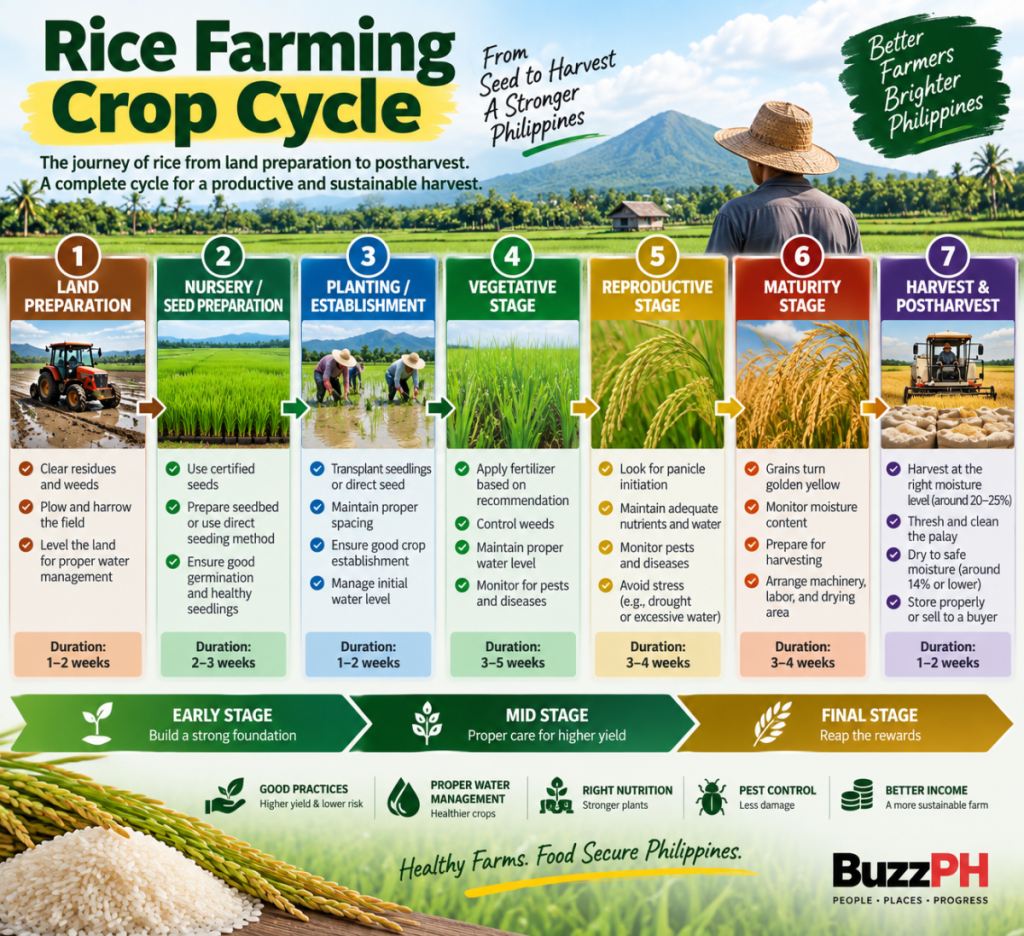
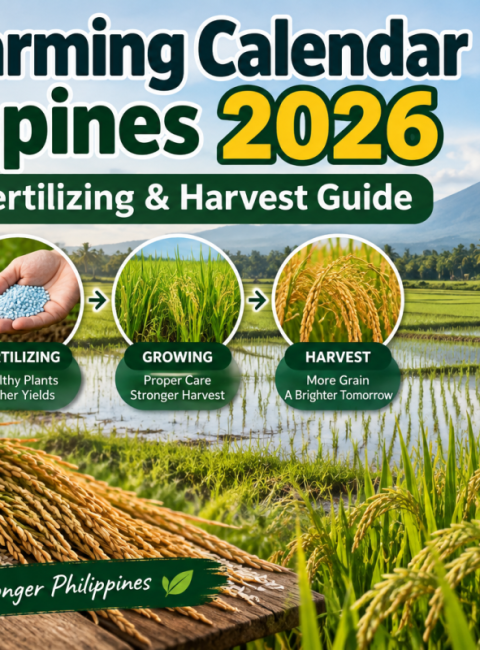
A farmer should maintain a crop calendar covering major activities from land preparation through harvest.
DA-PhilRice’s PalayCheck App provides crop calendars based on the selected rice variety and production method and provides reminders related to crop management, pests, diseases, water, and fertilization.
A simple farm calendar might include:
Pre-planting: land assessment, seed selection, machinery booking and field preparation.
Establishment: nursery or direct seeding, depending on the selected method.
Early crop stage: weed monitoring, water management, and crop establishment checks.
Vegetative stage: nutrient management, pest monitoring, and water management.
Reproductive stage: continued crop monitoring and appropriate nutrient and water management.
Maturity: prepare harvesting equipment, labor, transportation, and drying arrangements.
Postharvest: threshing, drying, cleaning, storage or immediate sale.
The exact schedule should be based on the variety, production system, local recommendations, and crop condition.
Plan Your Harvest Before the Rice Is Ready
One mistake that can cost a farmer money is waiting until the crop is already ready before arranging harvesting and postharvest services.
Before harvest, confirm:
- who will harvest;
- what machinery will be used;
- when it will be available;
- where the palay will be dried;
- who will transport it;
- where it will be sold;
- how the buyer determines price; and
- what deductions may apply.
This is especially important during periods when many farms in the same area mature at roughly the same time.
Mechanized harvesting can reduce dependence on manual labor, but availability can become a constraint during peak periods.
Government investment in rice mechanization has continued. In July 2026, DA reported that PhilMech had delivered 1,731 units of machinery under the RCEF mechanization program as of June 30, including tractors, combine harvesters, dryers, and precision seeders.
That does not mean an individual farmer will automatically have access to a machine. However, it reinforces the importance of checking local farmer cooperatives, associations, machinery service providers, and government-supported equipment programs.
Drying and Postharvest Handling Matter
Harvesting is not the end of the business cycle.
Poor postharvest handling can reduce the value and quality of your rice.
PhilRice’s PalayCheck system includes postharvest management as a key area, covering activities such as drying, cleaning, and storage.
Before harvest, know where the palay will go.
If you harvest without having a practical drying and transport plan, you may be forced to sell under less favorable conditions simply because you need to move the grain quickly.
For a small farm, compare the cost and practicality of:
- selling immediately after harvest;
- paying for drying;
- storing temporarily; or
- selling through a cooperative or other buyer.
The best option depends on your local prices, drying costs, storage facilities, cash requirements, and market conditions.
How Much Does It Cost to Start a Small Rice Farm?
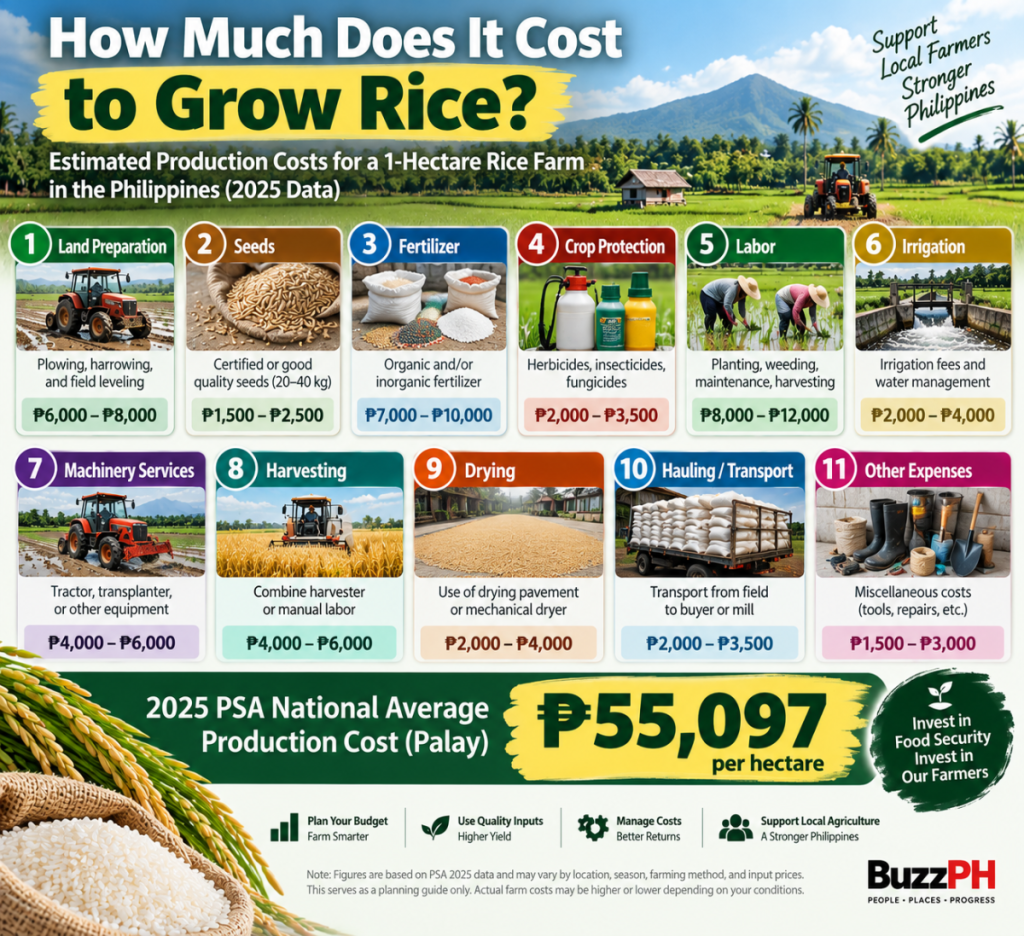
There is no single startup figure that applies to every Philippine rice farm.
The cost depends heavily on whether you already own the land, whether the field is irrigated, whether you lease it, whether machinery is available locally, and how much labor you need.
The most useful national benchmark currently available comes from the Philippine Statistics Authority.
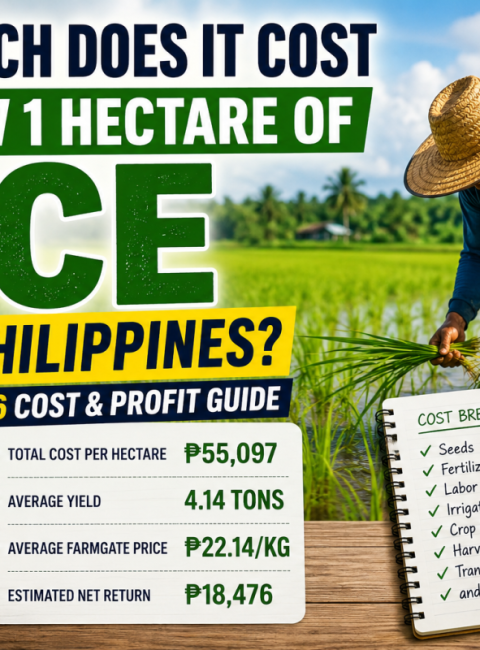
According to PSA’s 2025 Costs and Returns of Palay Production, the average cost of palay production was ₱13.26 per kilogram nationally, equivalent to an average production cost of ₱55,097 per hectare. The reported regional average ranged from ₱43,536 per hectare in Caraga to ₱66,261 per hectare in Cagayan Valley.
These figures are extremely useful for planning, but they should not be treated as a quotation for your own farm.
Your actual cost could be higher or lower.
For example, a small farm that requires expensive land preparation, hired labor, transportation, and irrigation may have substantially different costs from the national benchmark.
Also remember that the PSA production-cost figure is a production benchmark. If you are purchasing land, constructing irrigation infrastructure, building storage facilities, or buying machinery, those are additional capital investments.
A Practical 1-Hectare Budget
For a beginner, it is more useful to think in terms of a working farm budget rather than one claimed “startup cost.”
For example, suppose you are planning one hectare and estimate your production costs at around ₱55,000 per cropping season.
That is close to the PSA’s 2025 national average of ₱55,097 per hectare.
Your own budget could be organized like this:
| Expense | Planning approach |
|---|---|
| Land preparation | Get local contractor quotation |
| Seeds | Use actual local price |
| Fertilizer | Calculate based on recommendation |
| Crop protection | Budget based on actual needs |
| Planting/establishment | Local labor or machinery rate |
| Irrigation | Actual fees and pumping cost |
| Weeding | Local labor/machinery cost |
| Harvesting | Current contractor/machine rate |
| Threshing | Current local rate |
| Drying | Actual drying cost |
| Hauling | Actual transportation cost |
| Miscellaneous | Add contingency |
| Total | Your actual farm budget |
This is more reliable than taking an internet article’s estimated cost and assuming it applies to your province.
How Much Can a Small Rice Farm Earn?
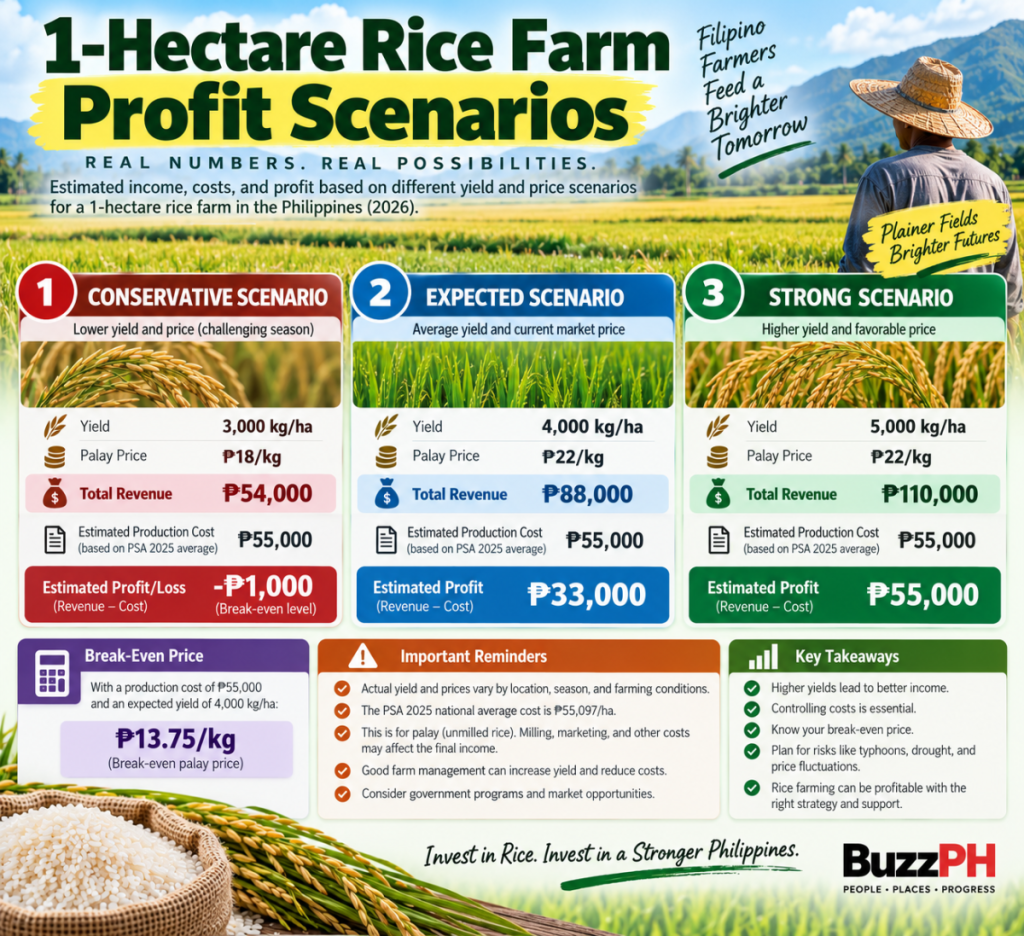
This is where farmers need to be particularly careful.
Rice farming does not have a guaranteed profit.
The Philippine Statistics Authority reported that the national average net return from palay production in 2025 was ₱18,476 per hectare. However, regional results varied considerably. Northern Mindanao recorded an average net return of ₱32,436 per hectare, while Davao Region recorded ₱29,860 per hectare.
Those figures demonstrate why using one “rice farming profit” number for the entire Philippines can be misleading.
Your farm’s result could be very different.
For example, suppose a hypothetical farm produces 4,000 kilograms of palay and sells it for ₱22 per kilogram.
Gross sales would be:
4,000 kg × ₱22 = ₱88,000
If the farm’s total production cost were ₱55,000:
₱88,000 − ₱55,000 = ₱33,000 estimated net return
But this is only a scenario, not a promised result.
If yield falls to 3,000 kilograms at the same price:
3,000 × ₱22 = ₱66,000
With ₱55,000 in costs:
₱66,000 − ₱55,000 = ₱11,000
And if the selling price drops or production costs rise, the result could be even lower.
This is why yield alone should not determine whether you expand.
Use Current Palay Prices When Planning
Palay prices can change substantially.
PSA reported a seasonally adjusted average farmgate price of ₱22.14 per kilogram during April–June 2026, up from ₱21.25 during January–March 2026.
PSA also publishes monthly farmgate price data. Its definition of farmgate price refers to the price received by farmers at the first point of sale, net of the marketing costs paid by farmers.
That distinction matters.
Do not build a five-year farm plan around today’s palay price.
Instead, calculate your farm using at least three scenarios:
Conservative: lower yield + lower selling price.
Expected: realistic yield + realistic local price.
Strong: better yield + favorable selling price.
If the farm only makes money under the strongest scenario, you should reconsider the investment.
Calculate Your Break-Even Price
One of the most useful calculations for a beginning farmer is the break-even selling price.
The formula is:
Total production cost ÷ total kilograms harvested = break-even price per kilogram
Suppose your total cost is ₱55,000 and you harvest 4,000 kilograms.
₱55,000 ÷ 4,000 = ₱13.75/kg
That means you need to receive more than ₱13.75 per kilogram to generate a positive return under this simplified calculation.
If your harvest is only 3,000 kilograms:
₱55,000 ÷ 3,000 = ₱18.33/kg
Your break-even price is now much higher because the same production expense is spread over fewer kilograms.
This illustrates a critical principle in rice farming:
Yield and cost control work together.
A high yield with uncontrolled costs may still produce disappointing profit, while a moderate yield with efficient production costs may generate a better return.
Should You Buy Land for Rice Farming?
For someone completely new to agriculture, buying farmland specifically for rice production deserves careful consideration.
The land itself may cost far more than one cropping season’s operating expenses.
If you purchase expensive property, your business calculation needs to include the capital invested in the land. If you borrow money to purchase it, financing costs also matter.
A lower-risk approach for some beginners may be to:
- start with family-owned farmland;
- lease suitable agricultural land;
- partner with an existing farmer; or
- begin with a small test area.
The appropriate choice depends on your capital, location, land availability, and long-term plans.
Do not buy agricultural property simply because someone says rice farming is profitable.
First determine whether the farm operation itself makes financial sense.
Government Support Can Reduce Some Barriers
The Philippine government has several programs intended to improve rice farmers’ competitiveness.
The RCEF framework includes support for:
- rice seeds;
- farm mechanization;
- extension and training;
- credit; and other forms of rice-farming assistance.
The 2024 amendment to the Rice Tariffication Law extended RCEF through 2031 and increased the annual allocation to ₱30 billion, with funding directed toward areas including high-quality seeds, mechanization, extension and training, credit, soil improvement, pest and disease management, and water management.
For a beginner, the important lesson is not to assume that government assistance will pay for the farm.
Instead, treat available programs as potential support that can improve your economics after you verify eligibility.
Ask your local agriculture office about current:
- seed distribution;
- farmer registration;
- training schedules;
- machinery services;
- cooperative programs;
- credit programs; and
- other rice-related assistance.
Use Technology to Track the Farm
You do not need an expensive farm-management system to start.
A smartphone and spreadsheet can already make a major difference.
At minimum, record every expense.
DA-PhilRice’s PalayCheck App provides a more specialized option. It allows farmers to record farm activities and expenses and calculate total expenses and net income.
PhilRice also maintains other rice-related applications, including tools for identifying weeds, choosing varieties, fertilizer recommendations, and rice crop management.
For a beginner, this data can become extremely valuable after several seasons.
You can compare:
- yield per hectare;
- fertilizer spending;
- pest-control expenses;
- labor costs;
- machinery costs;
- selling price;
- total revenue; and
- net return.
That turns each harvest into a source of information for improving the next one.
Common Mistakes New Rice Farmers Should Avoid
The first mistake is starting without checking water availability.
The second is copying another farmer’s fertilizer program without understanding why it works on that farm.
The third is buying machinery too early.
The fourth is ignoring postharvest costs.
The fifth is assuming a good harvest automatically means a good profit.
The sixth is not recording expenses.
The seventh is using outdated price information when calculating expected income.
The eighth is choosing a rice variety based solely on its advertised yield potential.
The ninth is waiting until harvest to find a buyer, dryer, transporter, or harvesting service.
The tenth is expanding before proving that the first production cycle is financially sustainable.
These mistakes are avoidable with careful planning.
A Better Way to Start Your First Rice Farm
If you are completely new to rice farming, consider treating your first season as both a production cycle and a learning cycle.
Before planting, spend time with experienced farmers in the same area.
Ask them:
- What varieties perform well here?
- When do most farmers plant?
- What are the common pests?
- How much does land preparation cost?
- How much does harvesting cost?
- Where do farmers sell?
- What are the usual farmgate prices?
- Is irrigation reliable?
- Which expenses surprise beginners?
- Which machines are difficult to book during peak season?
Then compare those answers with official agricultural information.
The objective is not to copy another farmer’s farm exactly. It is to understand the local operating environment.
This combination of local observation + official agricultural guidance + your own farm records is much more useful than relying on a generic online article.
A Simple 30-Day Preparation Checklist
Before spending money, complete these steps:
Week 1: Inspect the land, confirm ownership or lease arrangements, and verify water availability.
Week 2: Visit the Municipal/City Agriculture Office and identify appropriate rice varieties, training opportunities, farmer groups, and available government programs.
Week 3: Obtain actual local quotations for land preparation, seeds, fertilizer, labor, irrigation, harvesting, drying, and hauling.
Week 4: Build a complete farm budget, identify your expected selling channel, reserve enough working capital, and schedule machinery and postharvest services before planting.
Do not plant simply because the land is available.
Plant when the land, water, inputs, labor, budget, crop plan, and postharvest arrangements are ready.
Is Small Rice Farming Worth It in the Philippines?
It can be—but it should be approached as a business with agricultural risks rather than as guaranteed passive income.
Official Philippine data show that rice production remains economically significant, but profitability varies between farms and regions. In 2025, PSA estimated the national average production cost at ₱55,097 per hectare and the average net return at ₱18,476 per hectare. Regional differences were substantial.
That means the question should not simply be:
“How much can one hectare of rice earn?”
A better question is:
“Can I produce a kilogram of palay at a competitive cost, achieve a reasonable yield, and sell it at a price that leaves enough margin after all expenses?”
That is the mindset that can make small-scale rice farming more sustainable.
Starting with 0.5 to 1 hectare can give a beginner an opportunity to learn the production cycle without immediately committing a large amount of capital. Once you have actual records from your own farm, you can determine whether expanding makes financial sense.
The most valuable asset you build during your first season may not be the harvest itself. It may be the farm data that tells you exactly where your money went, how much palay you produced, what worked, what failed, and what needs to change.
For 2026, the strongest approach is therefore not to chase a promised “high-profit rice farm.” It is to build a farm around appropriate land, reliable water, quality seed, science-based crop management, efficient labor and machinery use, careful postharvest planning, and accurate financial records.
With that foundation, a small rice farm can become a practical agricultural enterprise—and, if the numbers consistently work, a foundation for gradual expansion.
Sources and research used
This guide was researched using Philippine government and government-agriculture sources rather than relying on a single existing farming article. Key references include the Philippine Statistics Authority (PSA) for 2025 production costs, net returns, and 2026 palay prices; DA-PhilRice for the PalayCheck integrated rice-management system and farm-management tools; the Department of Agriculture for current RCEF programs; and the Agricultural Training Institute for RCEF-related training and farmer support.
Important: The budget and profit examples in this article are original calculations based on clearly stated assumptions. They are not guarantees of income. Farmers should obtain current local quotations and agricultural advice before investing.



 Facebook
 Twitter