

Durian farming is one of the most promising long-term fruit-growing opportunities in Mindanao, particularly in the Davao Region. But establishing a productive durian orchard requires much more than planting seedlings and waiting for fruit.
The biggest decisions are made before the first commercial harvest: choosing suitable land, obtaining reliable planting material, designing proper drainage, establishing a practical fertilizer program, managing the canopy, preventing pests and diseases, and understanding where the harvested fruit will be sold.
Current government statistics show why durian deserves attention in Mindanao. The Philippine Statistics Authority reported that Davao Region produced 64,621.28 metric tons of durian in 2024, making it the region’s second-largest fruit crop by production volume. Durian production increased by 7.1% in 2024 and 2.9% in 2023.
The latest available 2026 price data also show how market conditions can change. PSA’s first-quarter 2026 report recorded a 33.4% year-on-year growth in Davao Region’s average durian farmgate price. PSA defines a farmgate price as the price received by farmers at the farm location, before transport and other marketing costs.
That distinction is important. A higher farmgate price does not automatically mean a farmer’s profit increased by the same percentage because production costs, transportation, labor, crop losses, and other expenses also affect the final return.
This guide explains how to grow durian in Mindanao using Philippine agricultural references, current government statistics, and practical orchard-management principles.
How This Guide Was Researched
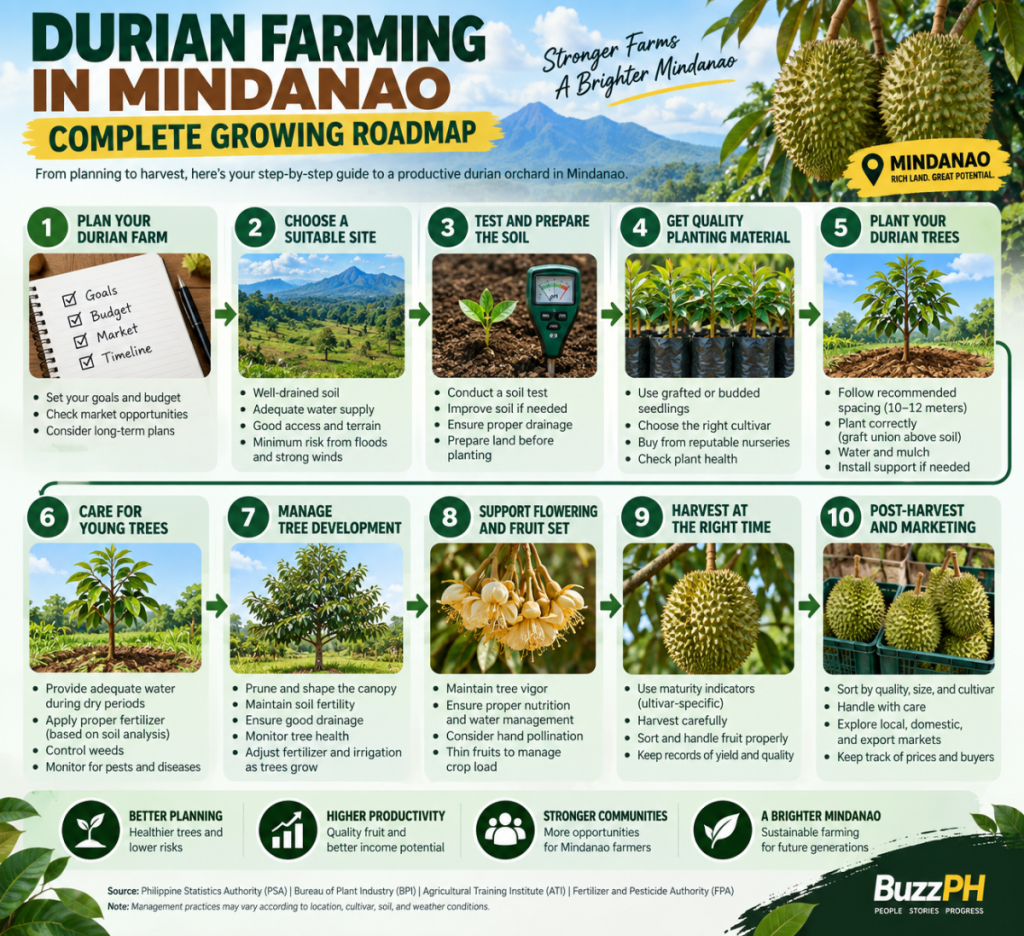
This guide was developed primarily from Philippine government agricultural and statistical sources, including the Philippine Statistics Authority, Bureau of Plant Industry, Agricultural Training Institute, and Fertilizer and Pesticide Authority.
The BPI durian production guide was particularly useful for technical information covering fertilizer application, irrigation, pruning, mulching, pollination, and fruit thinning. BPI’s guidance states that periodic fertilizer application should be based on soil or plant-tissue analysis rather than relying on one fixed program for every orchard.
Current fertilizer-regulation information was checked against the Fertilizer and Pesticide Authority’s registered-product database, which lists active fertilizer products and their guaranteed analyses, target crops, registration numbers, and expiry dates.
Current production and price figures were checked against PSA releases rather than older farming articles.
This distinction is important because agricultural practices can remain relevant for years while prices, production statistics, product registrations, and market conditions can change quickly.
Why Mindanao Is Suitable for Durian
Mindanao has an established tropical fruit industry and several areas where durian production has developed commercially.
Davao Region is particularly important. The Bureau of Plant Industry’s Davao National Crop Research, Development and Production Support Center supports tropical fruit production through research, planting materials, technical assistance, training, and pest and disease diagnostic services.
However, the word Mindanao covers a large and geographically diverse area.
A farm in Davao City may have different rainfall patterns, soil characteristics, elevation, drainage, and market access from a farm in Bukidnon, South Cotabato, Agusan del Sur, Zamboanga, or another province.
Therefore, farmers should evaluate the actual farm rather than assuming that any property in Mindanao is automatically suitable for durian.
Major Durian-Growing Areas in Mindanao
Davao Region is the country’s best-established durian production center, but durian production and technical development extend beyond Davao.
Farmers and agricultural programs in other Mindanao regions are also developing production capacity.
Potential durian-growing areas include parts of:
- Davao Region
- SOCCSKSARGEN
- Northern Mindanao
- Zamboanga Peninsula
- CARAGA
The presence of durian production in an area is a useful starting point, but it is not a substitute for a site assessment.
The most important questions are:
- Does the soil drain well?
- Is there enough water during dry periods?
- Is the site exposed to damaging winds?
- Can farm vehicles reach the orchard?
- Is the soil suitable?
- Is planting material available?
- Is there a realistic market nearby?
What Current Davao Durian Data Tell Farmers
PSA’s 2024 annual data provide useful context. Davao Region produced 64,621.28 metric tons of durian, equivalent to 1.9% of the region’s total fruit-crop production. Durian ranked second among the region’s fruit crops by production volume.
The figure also increased 7.1% in 2024, following 2.9% growth in 2023.
However, farmers should not assume that regional production growth means every individual farm will automatically become profitable.
Regional production is influenced by many farms, tree ages, weather, harvested area, yields, and other factors.
The same principle applies to prices.
PSA’s first-quarter 2026 data show a 33.4% year-on-year increase in the average durian farmgate price. But farmgate price is not the same as net income because transport, labor, fertilizer, harvesting, sorting, and other marketing costs are excluded from the farmgate figure.
This is why a farm business plan should use actual local costs and several price scenarios rather than assuming that the latest regional price will continue indefinitely.
Choose Quality Durian Planting Material
One of the most important decisions in establishing an orchard is selecting planting material.
A durian tree grown from an unknown seed may not reproduce the desirable characteristics of the parent fruit.
For a commercial orchard, farmers generally have a stronger reason to use properly identified vegetatively propagated planting materials.
When purchasing seedlings, ask:
- What cultivar is it?
- Is it grafted or budded?
- Where did the scion or budwood originate?
- Is the nursery recognized or accredited where applicable?
- How old is the plant?
- Is the root system healthy?
- Is the graft union healthy?
- Are there signs of disease or insect damage?
The BPI Davao center provides high-quality planting materials and technical support for tropical fruit production.
For a large commercial planting, it is worth spending time verifying the nursery and cultivar before purchasing hundreds of seedlings.
Durian Varieties for Mindanao
The Philippine durian industry includes several recognized cultivars and selections, including Puyat, Duyaya, Lacson Uno, Arancillo, UPLB Gold, Chanee, Monthong, and others.
The Philippine National Standard for durian provides specifications and information concerning Philippine durian varieties and product characteristics.
There is no single cultivar that can automatically be called the best for every Mindanao farm.
Consider:
- local climate;
- elevation;
- soil;
- disease pressure;
- market demand;
- fruit characteristics;
- availability of genuine planting material;
- expected harvest period;
- farm-management capacity.
For commercial production, discuss cultivar selection with a reputable nursery, agricultural technician, municipal or city agriculturist, DA personnel, or BPI specialist.
Choose the Farm Site Carefully
A good durian orchard begins with good land.
Look for:
- well-drained soil;
- adequate water availability;
- sufficient sunlight;
- manageable terrain;
- good road access;
- protection from severe winds where practical;
- enough space for orchard infrastructure.
Avoid sites where water regularly remains around the root zone.
Durian needs moisture, but prolonged waterlogging can create serious root and disease problems.
Check the Farm After Heavy Rain
One of the simplest site-assessment techniques is to inspect the property after a significant rainfall.
Look for:
- standing water;
- muddy areas that remain wet;
- blocked drainage;
- water flowing toward planting holes;
- erosion;
- compacted areas;
- low sections of the farm.
A property that looks excellent during a dry visit may reveal serious drainage problems after heavy rain.
Correcting drainage before planting is much easier than trying to redesign the orchard after hundreds of trees have been established.
Test the Soil Before Planting
A soil test should be part of serious orchard planning.
Testing can provide information about:
- soil pH;
- nutrient availability;
- organic matter;
- possible nutrient deficiencies;
- soil-management requirements.
The result can help determine whether amendments are necessary and can prevent farmers from applying fertilizer based solely on habit.
Keep the laboratory results.
Future soil tests can then be compared with the original baseline.
Prepare the Land
Land preparation should be completed before seedlings arrive.
Depending on the property, preparation may include:
- clearing;
- drainage construction;
- erosion control;
- access roads;
- planting-line establishment;
- irrigation infrastructure.
Do not remove every piece of vegetation simply because the area is being converted into an orchard. Ground cover and appropriate vegetation can contribute to erosion control, provided they do not compete excessively with the trees or interfere with farm operations.
Durian Planting Distance
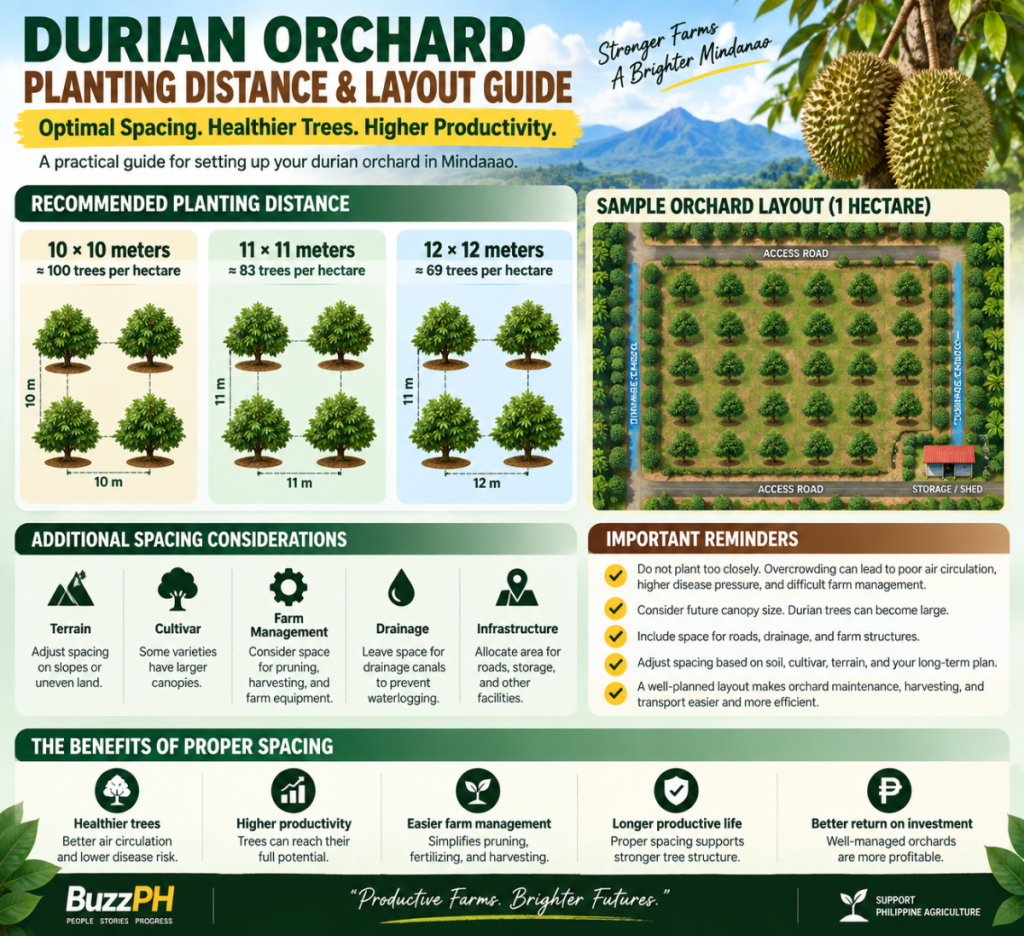
A Philippine agricultural training reference commonly uses approximately 10–12 meters as a general planting distance for durian.
The final spacing should depend on:
- cultivar;
- terrain;
- soil;
- expected canopy size;
- pruning system;
- farm machinery;
- drainage;
- long-term orchard design.
Theoretical tree populations are:
| Spacing | Approximate trees per hectare |
|---|---|
| 10 × 10 m | 100 |
| 11 × 11 m | 83 |
| 12 × 12 m | 69 |
These numbers do not account for roads, drainage channels, buildings, waterways, irregular boundaries, and other infrastructure.
Do not automatically choose the closest spacing simply because it gives the highest number of trees.
An overcrowded mature orchard can become difficult to prune, spray, inspect, harvest, and maintain.
How to Plant a Durian Seedling
A practical planting sequence is:
- Mark the final planting position.
- Prepare the planting hole.
- Improve the soil according to soil-test recommendations.
- Handle the seedling carefully.
- Place the root ball without unnecessary root damage.
- Keep the graft union above the soil.
- Firm the soil gently.
- Water after planting.
- Stake the plant if needed.
- Apply suitable mulch around the root zone.
Do not bury the graft union.
Avoid placing fresh manure directly against the roots or trunk.
Water Management
Water management is about balance.
Young trees require sufficient moisture while establishing their roots, especially during prolonged dry periods.
Mature trees also need water, but excess moisture around the root zone can contribute to disease problems.
BPI’s production guide recommends irrigation during dry periods and also discusses mulching as a way of helping conserve moisture.
Monitor:
- rainfall;
- soil moisture;
- irrigation;
- tree age;
- soil type;
- canopy size;
- signs of water stress.
Irrigation should be adjusted when weather conditions change rather than being treated as a completely fixed calendar activity.
Mulching
Suitable organic mulch can help:
- reduce evaporation;
- suppress weeds;
- moderate soil conditions;
- contribute organic material.
BPI’s durian production guide specifically mentions materials such as rice straw, dried leaves, cut grasses, and coconut husk for mulching during dry periods.
Keep mulch away from direct contact with the trunk.
A constantly wet pile against the trunk can create an unfavorable environment for disease and bark problems.
Durian Fertilizer Program: What Farmers Should Actually Do
Fertilizer management was one of the weakest areas of the earlier version of this article, so this section is intentionally more practical.
The most important principle is:
Use a stage-based fertilizer plan, but adjust the actual rate according to soil or plant-tissue analysis.
BPI’s production guide gives a specific starting recommendation for newly planted trees: 50 grams of complete fertilizer at 14-14-14 as basal fertilizer, or according to soil analysis. It then recommends that periodic fertilizer applications be based on soil or plant-tissue analysis.
That gives farmers a useful starting reference while avoiding the mistake of presenting one fixed fertilizer rate as appropriate for every farm.
Fertilizer Framework for Young Durian Trees
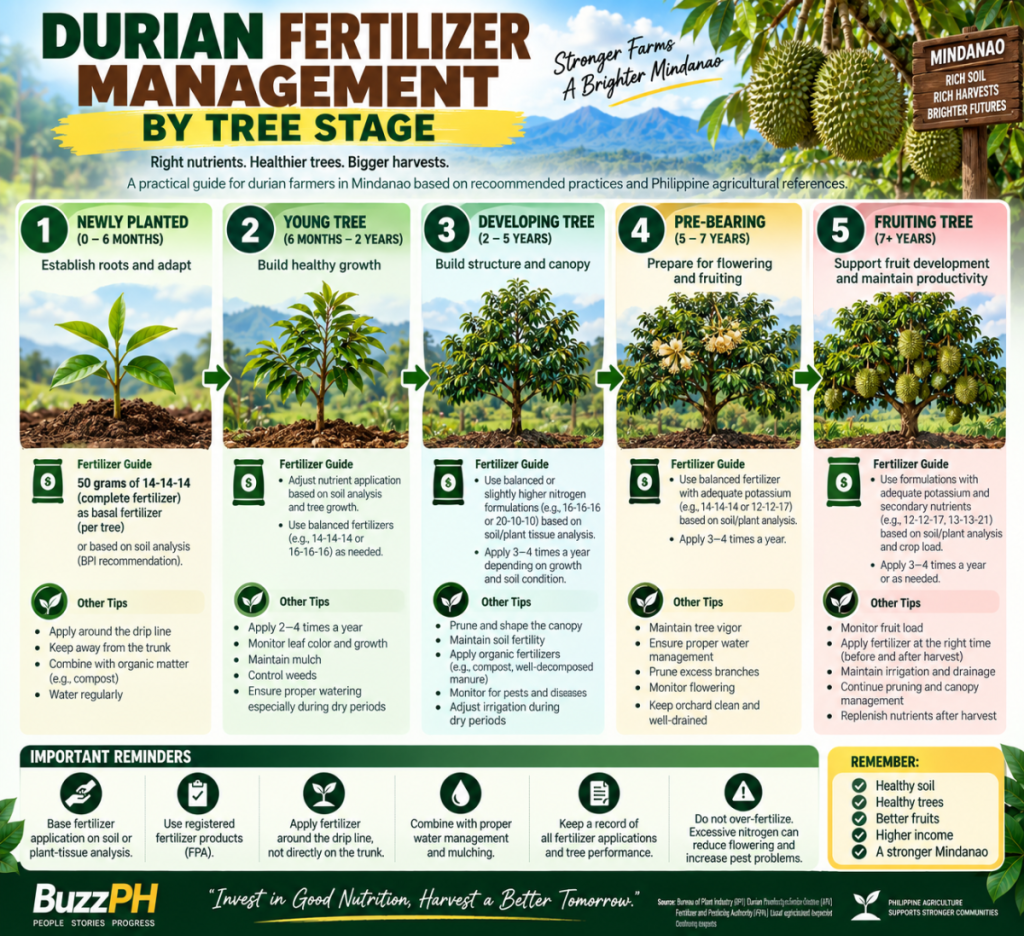
| Tree stage | Main objective | Fertilizer approach |
|---|---|---|
| Newly planted | Establish roots | Follow soil analysis; BPI guide gives 50 g of 14-14-14 as a basal reference |
| Young tree | Build healthy canopy | Regular assessment of growth and soil nutrients |
| Developing tree | Build structure | Adjust nutrition as canopy and root system expand |
| Pre-bearing | Prepare for production | Monitor tree vigor and nutrient status |
| Fruiting tree | Support crop and tree | Base nutrient management on soil/plant analysis and crop load |
The table is a management framework, not a universal prescription.
Newly Planted Trees
For newly planted trees, BPI’s production guide gives 50 grams of complete 14-14-14 fertilizer as a basal reference, with soil analysis used to adjust the recommendation.
The purpose at this stage is not to force rapid growth.
The goal is to help the young plant establish a healthy root system and begin developing its canopy.
Young and Developing Trees
As the tree grows, the fertilizer program should be adjusted.
A larger tree has a larger root system and greater nutrient demand than a newly planted seedling.
Instead of automatically increasing fertilizer every few months, monitor:
- new shoot growth;
- leaf color;
- canopy development;
- soil-test results;
- previous fertilizer applications;
- rainfall;
- tree health.
If growth is poor, determine the cause before simply increasing fertilizer.
Poor growth can also result from:
- waterlogging;
- drought;
- root damage;
- disease;
- poor planting material;
- weed competition;
- inadequate sunlight.
Mature Fruiting Trees
Mature trees require a different management approach because nutrients are supporting both vegetative growth and fruit production.
Monitor:
- flowering;
- fruit set;
- crop load;
- leaf condition;
- soil nutrient levels;
- previous fertilizer applications.
Do not assume that applying more nitrogen will automatically produce more durian.
Likewise, do not apply large quantities of potassium or micronutrients simply because another farmer uses them.
The correct rate depends on the farm’s actual nutrient status.
Use Registered Fertilizer Products
The Fertilizer and Pesticide Authority maintains a current database of registered fertilizer products. As of August 31, 2026, its database includes products with different nutrient formulations and specified target crops.
When purchasing fertilizer:
- Check the product label.
- Check its registration status.
- Confirm the nutrient analysis.
- Check whether the crop/use is appropriate.
- Follow the application instructions.
- Keep purchase and application records.
This is particularly important when using specialized fertilizers, foliar products, biostimulants, or micronutrient products.
Keep a Fertilizer Record
For every application, record:
- date;
- product name;
- formulation;
- amount;
- number of trees;
- tree age;
- weather;
- reason for application;
- observed response.
Over time, these records become one of the farm’s most valuable sources of original information.
They allow farmers to compare fertilizer decisions with actual tree growth, flowering, fruit production, and costs.
Durian Farm Management Calendar
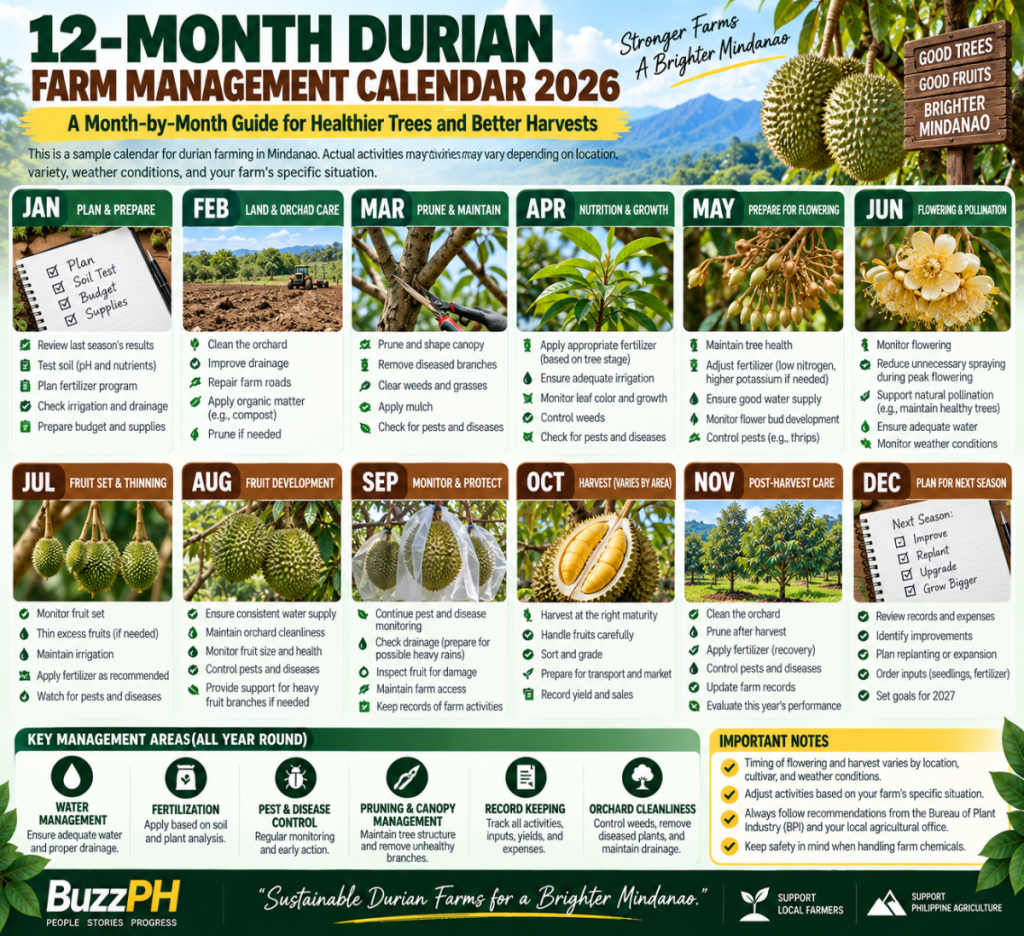
A farm calendar should be treated as a management framework rather than a universal flowering or harvesting schedule.
Weather, cultivar, farm elevation, irrigation, and tree age can shift the timing of activities.
| Period | Main activities |
|---|---|
| January–March | Inspect orchard, review soil and fertilizer records, prune where appropriate, maintain drainage |
| April–June | Closely monitor water availability, irrigation, weeds, pests, and disease |
| July–September | Monitor heavy-rain impacts, drainage, disease pressure, canopy condition, and developing fruit |
| October–December | Harvest and postharvest operations where applicable, evaluate crop results, maintain sanitation and plan the next production cycle |
This calendar is deliberately broad.
It should be adjusted according to the farm’s actual flowering, fruiting, rainfall, and harvest records.
Build a Farm-Specific Calendar
A better long-term approach is to create a calendar from actual farm observations.
Record:
- flowering date;
- fruit-set date;
- major pest outbreaks;
- disease observations;
- fertilizer applications;
- irrigation;
- harvest date;
- yield;
- selling price.
After several seasons, the farmer can develop a much more accurate farm-specific calendar than a generic internet schedule.
Pruning and Canopy Management
Pruning helps maintain tree structure and improve orchard management.
BPI’s production guide notes that pruning can improve air circulation and reduce relative humidity, while removal of low branches can reduce splash-related pathogen movement. It also recommends removing dead, broken, diseased branches and water shoots to help shape the canopy and support fruit production.
Focus on:
- dead branches;
- diseased branches;
- broken branches;
- poorly positioned growth;
- excessive water shoots;
- low branches that interfere with orchard sanitation.
Avoid excessive pruning.
The objective is a healthy, manageable canopy rather than the removal of as much foliage as possible.
Pest Monitoring
Durian can be affected by various insects, including fruit borers, shoot and twig borers, psyllids, and mealybugs.
Inspect regularly for:
- holes;
- frass;
- damaged shoots;
- distorted leaves;
- insect colonies;
- fruit damage;
- premature fruit drop.
Do not automatically treat every insect as a pest.
Identify the organism and determine whether it is causing economically important damage before selecting a control measure.
Phytophthora and Disease Prevention
Phytophthora is an important disease concern in durian production.
The most effective strategy is not waiting until an orchard is heavily infected.
Focus on:
- drainage;
- sanitation;
- appropriate spacing;
- healthy planting material;
- canopy management;
- avoiding unnecessary root and trunk damage.
If an unfamiliar disease symptom appears, obtain a proper diagnosis before beginning a chemical treatment program.
BPI Davao provides pest and disease diagnostic services and technical assistance.
Flowering and Pollination
Flowering should be viewed as the result of long-term orchard management.
Healthy trees with appropriate nutrition, water management, canopy development, and disease control are better positioned to produce flowers and support fruit development.
BPI’s durian production guide notes that durian has a high degree of self-incompatibility and recommends hand pollination to achieve a higher fruit-setting percentage.
For commercial farms, pollination practices should be adapted to cultivar, flowering behavior, orchard design, and local experience.
Fruit Thinning
Fruit thinning can help manage crop load.
BPI’s production guide recommends fruit thinning and notes that it is normally performed several weeks after flower opening.
The exact approach should consider:
- tree age;
- tree vigor;
- branch strength;
- cultivar;
- number of developing fruits;
- target fruit size;
- market requirements.
The goal is not to maximize fruit count.
The goal is to produce a manageable crop while protecting the long-term health and productivity of the tree.
Harvesting Durian
Harvest timing should be based on maturity indicators rather than a single calendar date.
Monitor:
- fruit development;
- aroma;
- stem characteristics;
- husk changes;
- cultivar-specific maturity indicators.
BPI’s durian maturity material provides guidance on practical maturity indicators that can help farmers determine when fruit is ready for harvest.
Keep harvest records by cultivar.
Over several seasons, the farm can develop a more reliable relationship between flowering, fruit set, maturity indicators, and harvest date.
Post-Harvest Handling
The work does not end when the fruit is removed from the tree.
Handle harvested fruit carefully during:
- sorting;
- packing;
- loading;
- transportation;
- storage.
Separate fruit by:
- cultivar;
- size;
- maturity;
- quality;
- intended market.
For higher-value markets, consistent quality and careful handling become increasingly important.
Durian and the Developing Market
Mindanao’s durian industry is not limited to traditional farm-gate transactions.
The Philippines has been developing opportunities in processed and export-oriented durian products.
For farmers, this means that production quality, traceability, agricultural practices, and postharvest handling can become increasingly important.
However, an export opportunity should not be interpreted as a guarantee that an individual farmer will receive an export price.
Most farmers should first establish:
- reliable production;
- consistent quality;
- appropriate postharvest handling;
- dependable buyer relationships.
Durian Farm Cost Planning for 2026
There is no single “cost per hectare” that accurately applies to every Mindanao durian farm.
A farm established on cleared, accessible land with existing irrigation will have a very different cost structure from a farm requiring:
- land clearing;
- drainage;
- roads;
- fencing;
- irrigation;
- soil improvement;
- extensive labor.
A realistic budget should include:
| Cost category | Examples |
|---|---|
| Land preparation | Clearing, drainage, cultivation |
| Planting materials | Grafted/budded seedlings |
| Planting | Labor, stakes, planting supplies |
| Fertilizer | Soil amendments and fertilizers |
| Irrigation | Pump, pipes, tanks |
| Weed management | Labor and equipment |
| Pest management | Monitoring and registered products |
| Pruning | Labor and tools |
| Infrastructure | Roads, fencing, storage |
| Harvest | Labor and containers |
| Transport | Farm-to-market logistics |
About the Cost and Income Numbers
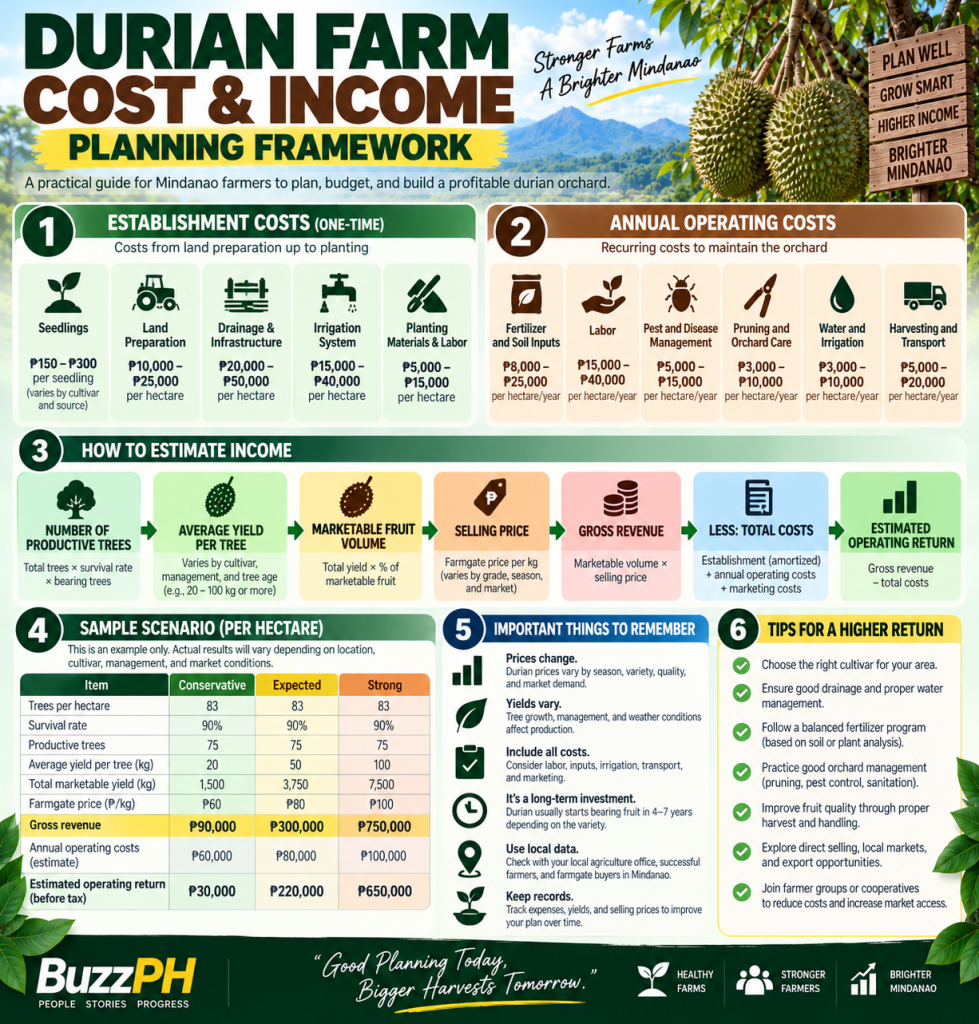
Important: Any durian farming cost or income estimate should be treated as a planning scenario, not a guaranteed result.
Costs vary by municipality, farm condition, labor rate, seedling source, planting density, irrigation requirements, fertilizer prices, and infrastructure needs.
Income also varies according to:
- tree age;
- number of productive trees;
- yield;
- fruit quality;
- rejected fruit;
- market channel;
- cultivar;
- season;
- farmgate price;
- transport costs.
PSA’s 2026 farmgate-price data illustrate why price assumptions need to be updated regularly. The reported durian farmgate price changed 33.4% year-on-year in the first quarter of 2026, and the PSA specifically notes that farmgate prices exclude transportation and other marketing costs.
Therefore, do not use a single online price to calculate your expected lifetime farm income.
Before investing, obtain current quotations from local nurseries, fertilizer suppliers, laborers, irrigation contractors, and potential buyers.
How to Build a Durian Income Model
Use:
Gross revenue = marketable fruit volume × actual selling price
Then calculate:
Operating return = gross revenue − annual operating costs
Finally, account for the original orchard-establishment investment and other business costs.
Build at least three scenarios:
| Scenario | Assumption |
|---|---|
| Conservative | Lower yield + lower selling price |
| Expected | Realistic yield + typical selling price |
| Strong | Higher yield + favorable selling price |
This is much safer than using a maximum yield and premium price to advertise potential income.
Keep Farm Records
Farm records can eventually become a form of original farm research.
Record:
- cultivar;
- seedling source;
- planting date;
- tree location;
- fertilizer;
- irrigation;
- pruning;
- pest observations;
- disease incidents;
- flowering;
- fruit set;
- thinning;
- harvest date;
- fruit weight;
- rejected fruit;
- selling price;
- buyer.
After several seasons, the farmer can answer questions such as:
Which cultivar performs best on this farm?
When does flowering normally occur?
How long does fruit take to reach harvest maturity?
Which months have the greatest disease pressure?
How much fertilizer is actually being used?
Which buyer provides the best return after transport costs?
That information can be more valuable than a generic farming formula because it is based on the actual orchard.
Common Durian Farming Mistakes
Planting Before Checking Drainage
Water problems are much easier to solve before planting.
Buying Seedlings Only Because They Are Cheap
Planting material determines the foundation of the orchard.
Planting Too Closely
High tree density can create long-term canopy and disease-management challenges.
Applying Fertilizer Without Soil Information
More fertilizer does not necessarily mean better growth or more fruit.
Copying Another Farm’s Fertilizer Program
Two farms can have very different soil, rainfall, tree age, and nutrient requirements.
Spraying Without Diagnosis
Identify the pest or disease before selecting a control strategy.
Ignoring Farm Records
Without records, it becomes difficult to improve management from one season to the next.
Planning Only for Production
Harvesting, transport, sorting, buyers, and postharvest handling should be considered before the first commercial crop.
Practical Durian Orchard Checklist
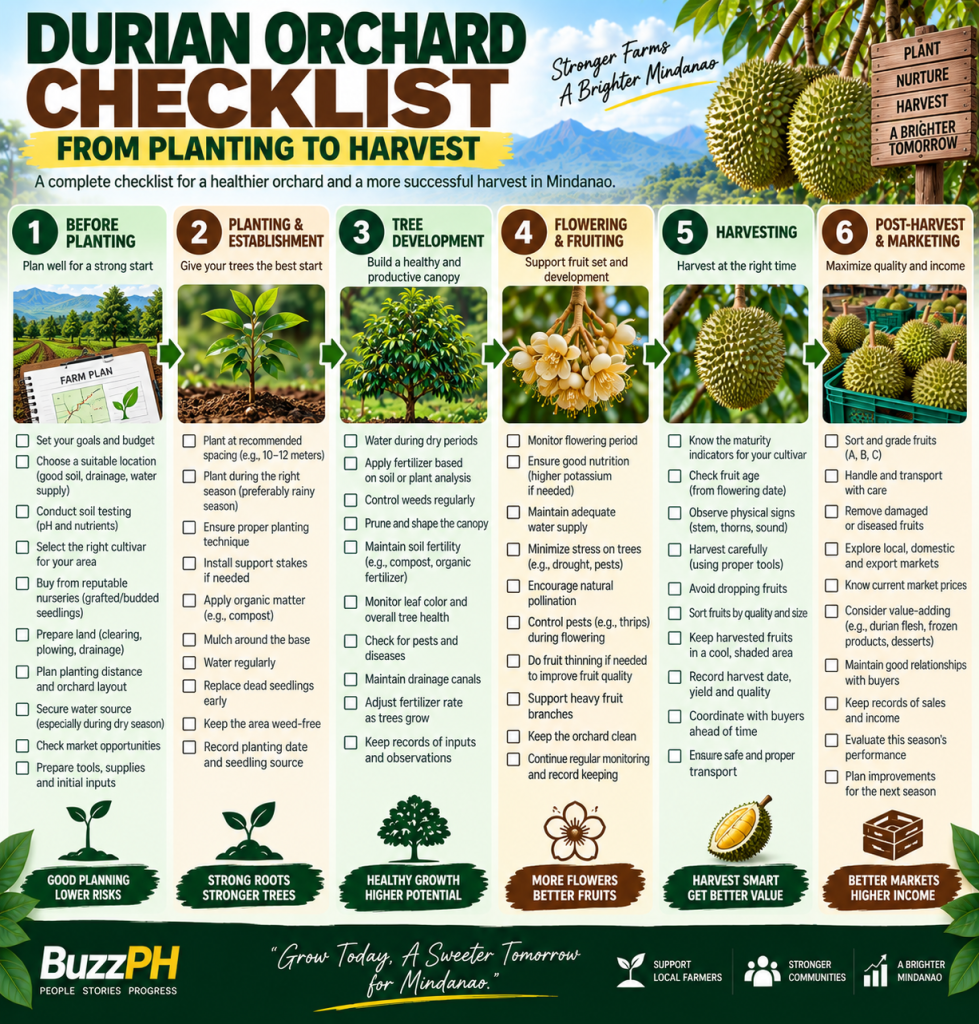
Before planting
☐ Soil tested
☐ Drainage evaluated
☐ Water source identified
☐ Land access checked
☐ Cultivar selected
☐ Nursery verified
☐ Planting material inspected
☐ Spacing planned
☐ Farm budget prepared
☐ Target market identified
During establishment
☐ Seedlings planted correctly
☐ Graft unions kept above soil
☐ Irrigation available
☐ Drainage maintained
☐ Mulch managed properly
☐ Weeds controlled
☐ Pest monitoring started
☐ Fertilizer records maintained
During orchard development
☐ Canopy monitored
☐ Pruning performed appropriately
☐ Soil fertility monitored
☐ Pest observations recorded
☐ Disease symptoms recorded
☐ Irrigation adjusted
☐ Farm records updated
During fruit production
☐ Flowering recorded
☐ Pollination managed
☐ Fruit set monitored
☐ Crop load assessed
☐ Fruit pests monitored
☐ Maturity checked
☐ Harvest organized
☐ Fruit sorted and handled carefully
Final Takeaway
Durian farming in Mindanao is a long-term investment that rewards careful planning more than shortcuts.
Davao Region’s production data demonstrate the crop’s importance to the regional fruit industry. In 2024, Davao produced 64,621.28 metric tons of durian, while current 2026 statistics show continued movement in both production and farmgate prices.
But those statistics should not be interpreted as a promise of profitability for every farmer.
A successful orchard starts with:
the right land → reliable planting material → proper drainage → appropriate nutrition → disciplined orchard management → good harvesting → a realistic market plan.
For fertilizer, the most important lesson is not to memorize one recipe. BPI’s own production guidance combines a specific basal reference for newly planted trees with soil- and plant-analysis-based periodic applications.
For farm scheduling, a generic calendar can provide structure, but the farmer’s own records should eventually become the most useful calendar.
For finances, use current local quotations and several production and price scenarios rather than assuming that today’s farmgate price will continue for years.
And for long-term improvement, keep records.
A durian farm should not simply produce fruit.
It should produce information about what works on that particular farm.
That is how a new orchard can gradually move from guesswork toward a more precise and sustainable production system.
Frequently Asked Questions
What is the best place to grow durian in Mindanao?
Davao Region is the Philippines’ most established durian-producing area, but suitable farms can exist elsewhere in Mindanao. The actual site should be evaluated for soil, drainage, water, climate, terrain, access, and market conditions.
What is the recommended spacing for durian trees?
A general Philippine reference uses approximately 10–12 meters, but final spacing should account for cultivar, terrain, canopy management, drainage, and long-term orchard design.
Can I grow durian from seed?
Yes, but seed-grown trees can vary considerably in fruit characteristics. For a commercial orchard, farmers should investigate reliable grafted or vegetatively propagated planting materials.
How long does durian take to produce fruit?
The timeframe depends on cultivar, propagation method, site, tree health, nutrition, water management, and orchard practices. There is no universal guaranteed fruiting age.
How much fertilizer should I give a durian tree?
For newly planted trees, the BPI production guide gives 50 grams of 14-14-14 complete fertilizer as a basal reference, with adjustment according to soil analysis. Periodic applications should be based on soil or plant-tissue analysis rather than a fixed formula for every farm.
Does durian need irrigation in Mindanao?
It can, particularly during dry periods. Water requirements depend on rainfall, soil, tree age, canopy size, and farm conditions. Irrigation should be combined with good drainage.
What is one of the biggest risks in durian farming?
Poor drainage is an important risk because prolonged wet conditions can contribute to root and disease problems. Phytophthora is among the important disease concerns in durian production.
When should durian be harvested?
Harvest according to cultivar-specific maturity indicators rather than relying solely on a calendar date. Aroma, stem condition, fruit appearance, and other maturity indicators can be used together.
Can durian farming be profitable?
It can be commercially viable, but profitability varies substantially according to tree age, yield, fruit quality, market price, labor, fertilizer, irrigation, transport, and other costs. A farm-specific financial model is more useful than a generic income promise.
Where can farmers get technical assistance?
Farmers can contact their city or municipal agriculture office, DA programs, ATI, and BPI. The BPI Davao center provides technical services related to tropical fruit production, including planting materials and pest and disease support.
Sources and References
Philippine Statistics Authority — 2024 Fruit Crops Situationer, Davao Region
Used for annual Davao durian production and regional fruit-crop context.
Philippine Statistics Authority — Q1 2026 Average Farmgate Prices, Davao Region
Used for the current durian farmgate-price comparison and explanation of what the farmgate price represents.
Bureau of Plant Industry — Durian Production Guide
Used for technical information on fertilizer, irrigation, mulching, pruning, pollination, and fruit thinning.
Bureau of Plant Industry — Davao National Crop Research, Development and Production Support Center
Used for information concerning technical assistance, planting materials, and tropical fruit production support.
Agricultural Training Institute — Davao
Used for practical agricultural-training context concerning durian production, orchard management, postharvest handling, and market development.
Fertilizer and Pesticide Authority — Registered Products
Used to verify the current status and availability of registered fertilizer products and their guaranteed analyses.
Important Accuracy Note
Agricultural recommendations can vary according to cultivar, soil, rainfall, elevation, tree age, planting material, and farm-management system.
The fertilizer figures in this guide should therefore be treated as documented reference points, not a substitute for soil testing or site-specific agricultural advice.
Farmers establishing a commercial durian orchard should consult a qualified agriculturist, local agriculture office, DA/ATI program, or BPI technical specialist when making site-specific fertilizer, crop-protection, and orchard-management decisions.
Prices and product registrations can also change. Always verify current supplier quotations, product labels, and FPA registration status before purchasing agricultural inputs.


 Facebook
 Twitter