
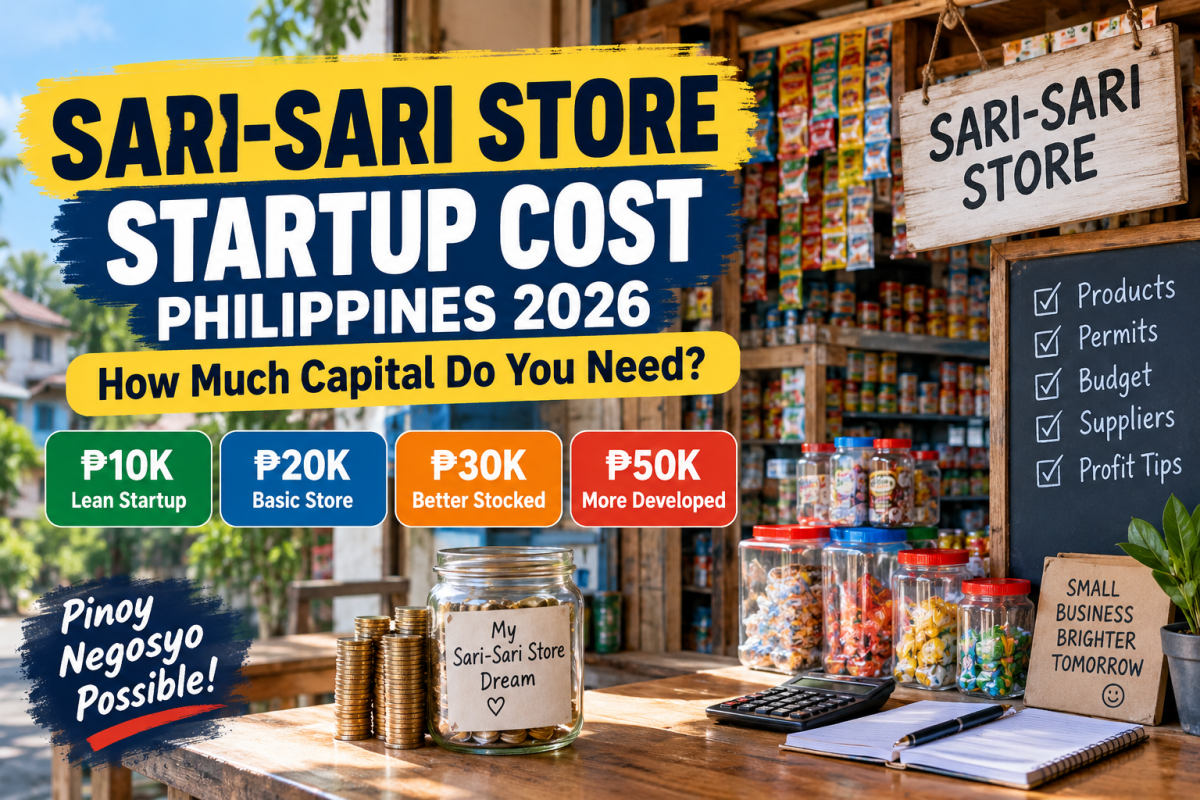
Sari-sari store startup cost Philippines entrepreneurs should consider more than just the money needed to fill the shelves. A realistic 2026 budget should account for initial inventory, store equipment, registration and permit-related expenses, cash for daily operations, and a reserve for restocking. Depending on the location and size of the business, a small home-based store may start with around ₱10,000 to ₱20,000, while a more developed setup can require ₱30,000 to ₱50,000 or more.
Starting a sari-sari store is one of the most accessible ways to enter small-scale retail in the Philippines. A business can operate from a small space at home, serve nearby households, and begin with a relatively modest amount of capital compared with many other businesses.
But how much money is actually enough?
For 2026, a very small home-based sari-sari store may be planned around ₱10,000 to ₱20,000, while a better-stocked operation may require ₱30,000 to ₱50,000 or more. The amount depends on whether you already have a suitable space, how much inventory you want to carry, what equipment you need, local registration requirements, supplier prices, and whether you need to pay rent.
There is no government-mandated nationwide startup capital amount for a sari-sari store. The figures in this guide are planning scenarios, not official capital requirements.
The more important question is not simply, “How much capital do I need?”
It is:
How much should I spend on inventory, how much should I reserve for working capital, and what expenses will I need to cover before the store becomes self-sustaining?
How Much Is the Sari-Sari Store Startup Cost in the Philippines?
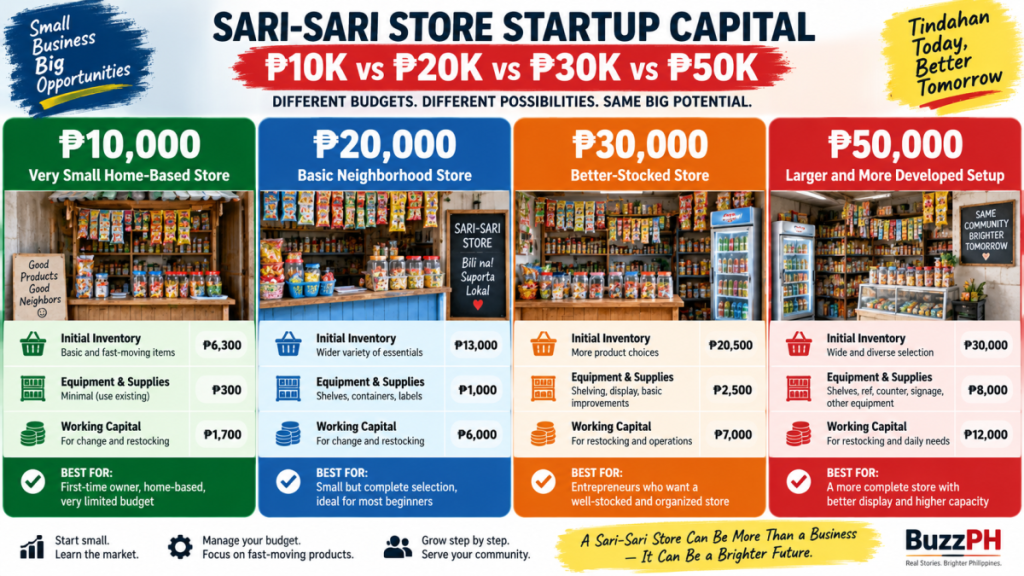
A reasonable planning range is:
| Starting Capital | Possible Setup |
|---|---|
| ₱10,000 | Very small home-based store |
| ₱20,000 | Basic neighborhood store |
| ₱30,000 | Better-stocked home-based store |
| ₱50,000 | Larger inventory and more developed setup |
These amounts assume that the entrepreneur already has, or can access, a suitable location.
If you need to rent a commercial space, renovate the store, purchase a refrigerator, install security equipment, or make other substantial improvements, the required capital can increase significantly.
What the ₱10,000 Budget Looks Like
A ₱10,000 budget is possible for a very lean home-based store, especially when the owner already has a table, shelves, lighting, storage containers, and a suitable selling area.
At this level, the objective should be to stock products that customers are likely to purchase regularly rather than trying to offer hundreds of different items.
An illustrative allocation is:
| Category | Sample Allocation |
|---|---|
| Basic food and grocery items | ₱3,500 |
| Snacks and biscuits | ₱1,500 |
| Coffee, noodles and canned goods | ₱1,300 |
| Beverages | ₱1,000 |
| Personal and household sachets | ₱700 |
| Store supplies | ₱300 |
| Cash/restocking reserve | ₱1,700 |
| Total | ₱10,000 |
The numbers above are planning allocations rather than supplier quotations.
At this capital level, inventory discipline matters more than product variety.
If ₱10,000 is available, spending all ₱10,000 on merchandise may appear attractive because the store will look fully stocked. However, that can create a cash-flow problem immediately after opening.
A better approach is to retain some cash so you can replace fast-moving products and respond to actual customer demand.
What the ₱20,000 Budget Looks Like
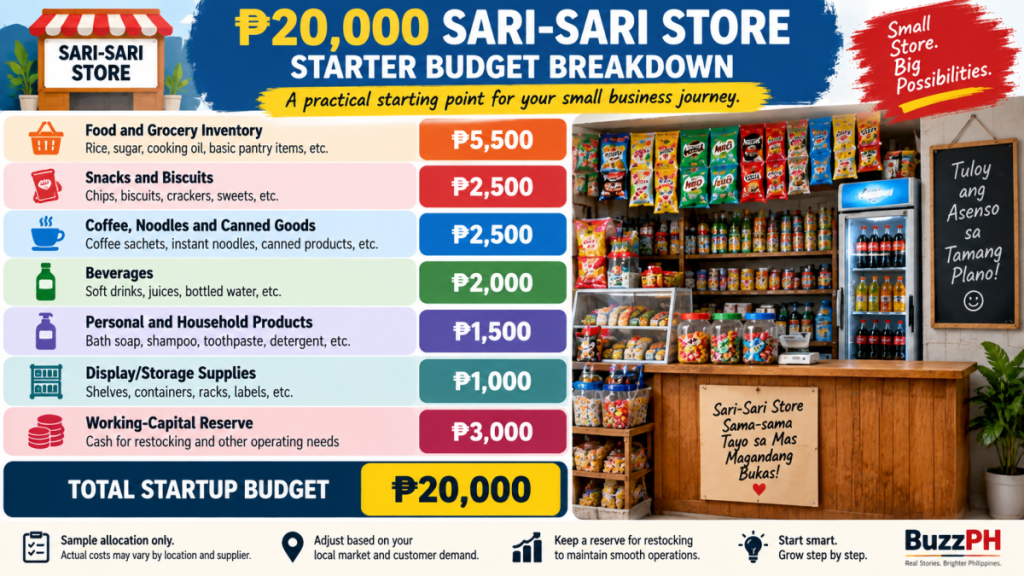
A ₱20,000 starting budget gives a new store considerably more flexibility.
A sample framework is:
| Category | Sample Allocation |
|---|---|
| Food and grocery inventory | ₱5,500 |
| Snacks and biscuits | ₱2,500 |
| Coffee, noodles and canned goods | ₱2,500 |
| Beverages | ₱2,000 |
| Personal and household products | ₱1,500 |
| Display/storage supplies | ₱1,000 |
| Working-capital reserve | ₱3,000 |
| Total | ₱20,000 |
The ₱3,000 reserve is important.
It gives the owner room to buy additional stock after identifying what customers actually want.
For example, if a particular coffee sachet, snack, canned product or beverage sells much faster than expected, the owner can use the reserve to restock it instead of waiting until the store has accumulated enough sales cash.
What the ₱30,000 Budget Looks Like
With ₱30,000, the owner can build a broader product mix while keeping a meaningful amount of working capital.
One possible allocation is:
| Category | Sample Allocation |
|---|---|
| Food and grocery products | ₱8,000 |
| Snacks and confectionery | ₱3,500 |
| Beverages | ₱3,000 |
| Household and personal products | ₱3,000 |
| Shelving/display/storage | ₱3,000 |
| Basic store improvements | ₱2,000 |
| Working-capital reserve | ₱7,500 |
| Total | ₱30,000 |
The large reserve is intentional.
A new business does not yet know its exact inventory turnover. Keeping cash available allows the owner to adjust the product mix based on real sales instead of guessing.
What the ₱50,000 Budget Looks Like
A ₱50,000 budget can support a more developed sari-sari store, particularly if the owner already has a location.
A sample planning framework:
| Category | Sample Allocation |
|---|---|
| Initial merchandise | ₱20,000 |
| Additional fast-moving inventory | ₱5,000 |
| Shelving/display/storage | ₱4,000 |
| Equipment allowance | ₱5,000 |
| Store improvements/signage | ₱3,000 |
| Registration/compliance allowance | ₱3,000 |
| Working-capital reserve | ₱10,000 |
| Total | ₱50,000 |
The equipment allowance is not a claim that a refrigerator or other equipment will cost ₱5,000.
Equipment prices vary considerably depending on whether you purchase new or used equipment, already own the equipment, or obtain products through a supplier arrangement.
If you already have shelves, a refrigerator, a counter or other usable equipment, the money can instead be directed toward inventory and working capital.
How We Built These 2026 Startup Budgets
The numbers in this article are designed as planning models rather than a nationwide price list.
That distinction is important.
A sari-sari store in Davao City can have different supplier, transport, rent and customer-demand conditions from one in a rural municipality, another city, or a different island.
Product prices can also change over time.
For this reason, the budgets use categories and allocation ranges instead of claiming that every store will pay exactly the same amount.
The methodology is based on five principles:
First, prioritize essential and fast-moving merchandise.
A beginning store should learn what the neighborhood actually purchases.
Second, separate inventory from working capital.
Not every peso should become merchandise.
Third, treat equipment as optional where possible.
Existing household equipment can reduce startup costs.
Fourth, separate official government fees from estimated business expenses.
DTI business-name registration fees are official, while store renovations, inventory and equipment depend on actual circumstances.
Fifth, treat profit calculations as illustrations.
A sample margin is not a guarantee of what a real store will earn.
This distinction makes the financial model more transparent and easier for readers to adapt to their own situation.
How to Research Actual 2026 Product Prices
Before spending your capital, create your own local price sheet.
Compare prices from:
- Wholesale distributors
- Authorized suppliers
- Public markets where appropriate
- Local grocery wholesalers
- Cash-and-carry stores
- Manufacturer or distributor programs
- Legitimate online wholesale channels
For products covered by the Department of Trade and Industry’s Basic Necessities and Prime Commodities monitoring system, the latest DTI SRP bulletin can be used as a reference point.
However, an SRP is not the same thing as your wholesale acquisition cost.
Your business plan should ultimately use the actual price offered by your supplier, including delivery costs where applicable.
Example: Building a ₱20,000 Starter Inventory
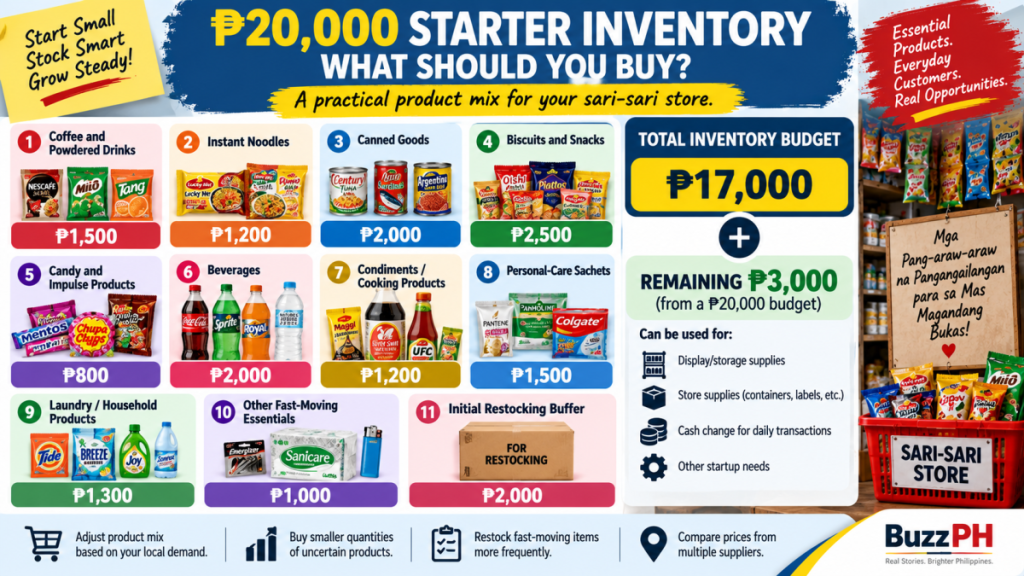
Instead of simply saying “spend ₱13,000 on groceries,” you can divide the inventory into specific product groups.
A sample framework:
| Product Group | Planning Allocation |
|---|---|
| Coffee and powdered drinks | ₱1,500 |
| Instant noodles | ₱1,200 |
| Canned goods | ₱2,000 |
| Biscuits and snacks | ₱2,500 |
| Candy and impulse products | ₱800 |
| Beverages | ₱2,000 |
| Condiments/cooking products | ₱1,200 |
| Personal-care sachets | ₱1,500 |
| Laundry/household products | ₱1,300 |
| Other fast-moving essentials | ₱1,000 |
| Initial restocking buffer | ₱2,000 |
| Total | ₱17,000 |
This leaves ₱3,000 from a ₱20,000 budget for display/storage, supplies, cash change and other startup needs.
The exact products and quantities should be changed according to local demand.
The important principle is to buy smaller quantities of uncertain products and larger quantities of products with demonstrated demand.
What Should Be in Your First Inventory?
Potential product categories include:
- Instant noodles
- Coffee sachets
- Biscuits
- Chips and snacks
- Candy
- Canned goods
- Condiments
- Sugar and cooking essentials
- Packaged beverages
- Personal-care sachets
- Laundry products
- Dishwashing products
- Basic household products
- School and convenience items
The correct mix depends on the location.
A sari-sari store near a school may have stronger demand for snacks and beverages.
A residential store may see more demand for cooking ingredients and household products.
A store near a transport route may have different customer behavior again.
This is why copying another store’s inventory is not necessarily a good strategy.
How to Conduct Your Own Local Market Research
Before purchasing inventory, spend several days observing your intended market.
Look at:
- Number of competing stores
- Product categories competitors carry
- Approximate customer traffic
- Busy hours
- Nearby schools
- Offices
- Transport stops
- Residential density
- Products customers frequently ask for
- Products competitors frequently run out of
You can also ask prospective customers simple questions:
What do you usually buy from a sari-sari store?
Which products are difficult to find nearby?
Do you usually buy sachets, individual pieces, or larger packages?
What time do you normally shop?
This is a simple form of original market research.
It may not produce a formal statistical survey, but it can provide information specific to the neighborhood where the business will actually operate.
Fast-Moving vs. Slow-Moving Inventory
Inventory should be divided into three practical groups.
Fast-moving products are items customers purchase repeatedly.
These deserve more attention during restocking.
Moderate-moving products sell regularly but do not require large quantities.
Test products are items where demand is uncertain.
Purchase test products in smaller quantities.
If they sell quickly, increase the next order.
If they remain on the shelf, do not keep tying up capital simply to maintain variety.
The goal is not to have the largest selection.
The goal is to have a selection that turns over efficiently.
How Much Working Capital Should You Keep?
A practical planning range is to reserve approximately 10% to 20% of starting capital for working capital and cash needs.
For illustration:
| Starting Capital | Possible Reserve |
|---|---|
| ₱10,000 | ₱1,000–₱2,000 |
| ₱20,000 | ₱2,000–₱4,000 |
| ₱30,000 | ₱3,000–₱6,000 |
| ₱50,000 | ₱5,000–₱10,000 |
This is not a formal financial rule.
The appropriate amount depends on supplier delivery schedules, product turnover, daily sales, payment methods, and operating expenses.
The principle is simply:
Do not let inventory consume all of your cash.
What Equipment Does a Sari-Sari Store Need?
A small store does not necessarily need expensive equipment.
Potential equipment includes:
- Shelves
- Counter
- Product racks
- Storage containers
- Cash box
- Calculator
- Price labels
- Lighting
- Refrigerator or cooler
- Mobile phone
- Security equipment
- Notebook or spreadsheet for records
Before buying anything, check what you already have.
A household table can potentially serve as a counter.
Existing shelves may be usable.
An existing refrigerator may reduce startup requirements.
Every piece of equipment you do not need to purchase leaves more capital available for inventory and working capital.
Home-Based vs. Rented Store
Location can significantly change the startup budget.
| Factor | Home-Based Store | Rented Store |
|---|---|---|
| Rent | Potentially none | Recurring cost |
| Deposit/advance | Usually none | May apply |
| Renovation | Often limited | Potentially higher |
| Foot traffic | Neighborhood dependent | Location dependent |
| Startup capital | Potentially lower | Potentially higher |
| Fixed monthly costs | Usually lower | Usually higher |
If you operate from home, you may be able to start with ₱10,000–₱20,000.
If you need to rent and renovate a commercial space, that same amount may be insufficient before you even purchase inventory.
Why the Philippine Statistics Authority Classification Matters
The Philippine Statistics Authority (PSA) officially classifies “Retail selling in sari-sari stores” under PSIC subclass 47113 in the Philippine Standard Industrial Classification (PSIC) Revision 5. The PSIC is the country’s official framework for classifying establishments and enterprises according to their primary economic activity.
This classification places sari-sari stores within the country’s formal retail sector and provides an official reference for describing the type of business covered by this guide.
For prospective store owners, however, the PSIC classification should not be interpreted as a statement about startup capital, expected profit, or registration requirements. Those factors depend on the specific business, location and applicable government rules.
What Registrations Should You Consider?
A sari-sari store should be planned as a legitimate retail business.
If you operate using a business name other than your true name, the Department of Trade and Industry (DTI) states that the business name must be registered. DTI also explains that business-name registration gives the business a legal identity, but a Business/Mayor’s Permit is still required to actually operate the business.
DTI’s current Business Name Registration System lists registration fees according to territorial scope:
| Territorial Scope | Registration Fee |
|---|---|
| Barangay | ₱200 |
| City/Municipality | ₱500 |
| Regional | ₱1,000 |
| National | ₱2,000 |
DTI also states that these registration fees are subject to an additional ₱30 Documentary Stamp Tax.
These amounts refer specifically to DTI business-name registration. They should not be presented as the total cost of obtaining every permit or registration required to operate a sari-sari store.
Local permits, taxes and other requirements should be confirmed with the appropriate local government office and the Bureau of Internal Revenue.
How Much Should You Budget for Registration and Permits?
Instead of assuming one nationwide permit cost, create a registration/compliance allowance in your financial plan.
For example, you could create a line called:
Registration and compliance — verify actual cost locally
Then contact your:
- DTI office or Negosyo Center
- Barangay
- City or municipal government
- BIR Revenue District Office
This approach is more accurate because local permit costs and requirements can differ.
What About BIR Registration?
The Bureau of Internal Revenue (BIR) publishes a Taxpayer’s Guide on Business Registration covering the registration process for business taxpayers. The BIR guide is an appropriate official reference when determining the applicable registration process and documentation for a new business.
BIR procedures can change, so prospective business owners should verify the latest requirements directly with the BIR before completing registration.
Do not rely solely on an old social-media post, outdated blog article or business checklist when dealing with tax registration.
How Much Can a Sari-Sari Store Earn?
There is no universal monthly income figure for sari-sari stores.
Sales depend on:
- Location
- Foot traffic
- Product selection
- Product margins
- Competition
- Store hours
- Local purchasing power
- Supplier pricing
- Inventory turnover
- Credit sales
- Seasonal demand
Most importantly:
Sales are not profit.
If your store sells ₱1,500 worth of merchandise in one day, that does not mean you earned ₱1,500.
The merchandise itself has a cost.
Example: ₱1,500 Daily Sales
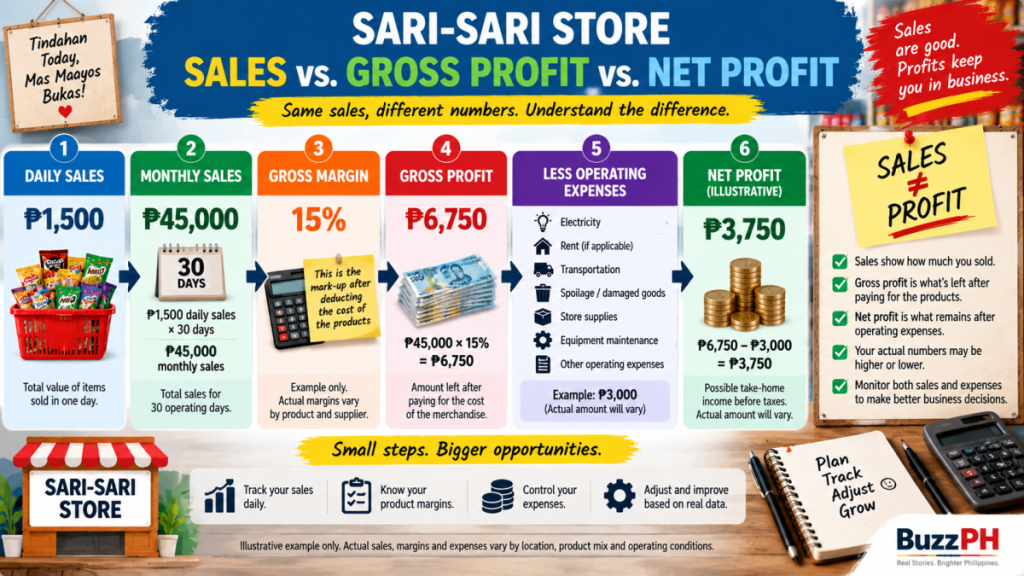
Suppose a hypothetical store generates:
₱1,500 daily sales × 30 days = ₱45,000 monthly sales
Now assume, purely for illustration, an average gross margin of 15%.
The calculation would be:
₱45,000 × 15% = ₱6,750 gross profit
The ₱6,750 is still not necessarily the owner’s take-home income.
The business may have expenses such as:
- Electricity
- Rent
- Transportation
- Spoilage
- Damaged goods
- Store supplies
- Equipment maintenance
- Payment-related costs
- Other operating expenses
The 15% margin is an illustrative assumption, not a claim that every sari-sari store earns 15%.
Three Illustrative Sales Scenarios
To understand the relationship between sales and gross profit, consider three hypothetical examples.
| Daily Sales | Monthly Sales | Gross Profit at 15% |
|---|---|---|
| ₱800 | ₱24,000 | ₱3,600 |
| ₱1,500 | ₱45,000 | ₱6,750 |
| ₱2,500 | ₱75,000 | ₱11,250 |
These examples assume 30 operating days and a hypothetical 15% average gross margin.
Actual profit can be substantially higher or lower depending on product margins, sales volume, operating expenses, spoilage, credit sales and location.
The purpose of the table is to teach the calculation—not to promise a specific income.
How to Calculate Break-Even Sales
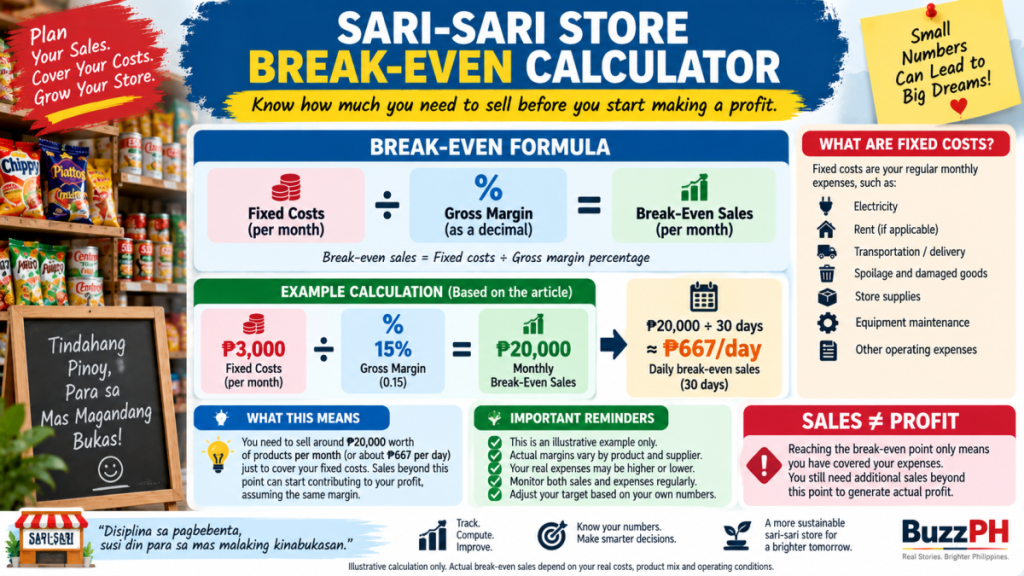
Break-even analysis asks:
How much does the store need to sell before it covers its operating expenses?
A simplified formula is:
Break-even sales = Fixed costs ÷ Gross margin percentage
Suppose a hypothetical store has:
Monthly fixed costs = ₱3,000
and:
Average gross margin = 15%
Then:
₱3,000 ÷ 0.15 = ₱20,000 monthly sales
If the store operates 30 days:
₱20,000 ÷ 30 = approximately ₱667 daily sales
This means the store would need approximately ₱667 in daily sales under these simplified assumptions to generate enough gross profit to cover ₱3,000 of fixed costs.
This is only an educational example.
A real business should calculate its actual product-level margins and expenses.
Why Gross Margin Matters More Than Sales Alone
Imagine two stores each generating ₱50,000 in monthly sales.
Store A has a 10% average gross margin.
Store B has a 20% average gross margin.
Their illustrative gross profits would be:
Store A: ₱50,000 × 10% = ₱5,000
Store B: ₱50,000 × 20% = ₱10,000
Both stores have identical sales revenue, but the gross profit is different.
That is why a sari-sari store owner should monitor not only how much is sold, but also what products are being sold and what margin they generate.
Should You Allow Customers to Buy on Credit?
“Lista” can be common in neighborhood retail, but it can also create serious cash-flow problems.
Suppose customers owe the store ₱3,000.
That amount may represent completed sales, but it is not ₱3,000 of cash available for restocking.
For a small store, too much unpaid credit can make it difficult to replenish inventory.
If you offer credit:
- Set a credit limit.
- Record every transaction.
- Set payment dates.
- Monitor overdue accounts.
- Avoid unlimited credit.
- Keep business credit separate from personal lending.
The owner should know exactly how much money is actually available in cash and how much remains outstanding as receivables.
How to Track Inventory Without Expensive Software
You can start with a notebook or spreadsheet.
Track:
Date → Product → Quantity Purchased → Purchase Cost → Quantity Sold → Selling Price → Remaining Stock
At the end of each day, record:
- Cash sales
- Digital payments
- Credit sales
- Purchases
- Expenses
- Cash remaining
- Products requiring restocking
After several weeks, this information becomes extremely valuable.
You may discover that five products generate a large percentage of your sales while twenty other products barely move.
That is your own store-specific market data.
How DTI’s Sari-Sari Store Programs Support Better Operations
The Department of Trade and Industry has specifically developed initiatives supporting sari-sari store owners.
Its “Tindahan Mo, e-Level Up Mo!” program included modules addressing digitalization, cashless payments, capital management, product selection and operations. DTI described the program as an initiative to help sari-sari store owners improve efficiency and competitiveness through digital tools and sustainable business practices.
This reinforces an important point for new entrepreneurs:
Running a sari-sari store is not only about purchasing products and selling them.
Basic financial management, inventory management and digital tools can also become part of the business.
The First 30 Days: Learn Before Expanding
During the first month, focus on collecting information.
Record:
- Daily sales
- Best-selling products
- Slow-moving products
- Customer requests
- Supplier prices
- Expenses
- Credit balances
- Stock shortages
Do not make major expansion decisions simply because the store looks empty.
An empty shelf can mean strong sales—or it can mean the wrong products were purchased.
The sales records will tell you which explanation is more likely.
Days 31 to 60: Adjust Your Inventory
After the first month, start changing your purchasing strategy.
Increase inventory for products that:
- Sell repeatedly
- Have acceptable margins
- Are easy to restock
- Have reliable customer demand
Reduce inventory for products that:
- Remain unsold
- Expire quickly
- Require too much capital
- Generate little demand
This is where the store begins moving from guesswork to data-based inventory management.
Days 61 to 90: Optimize the Business
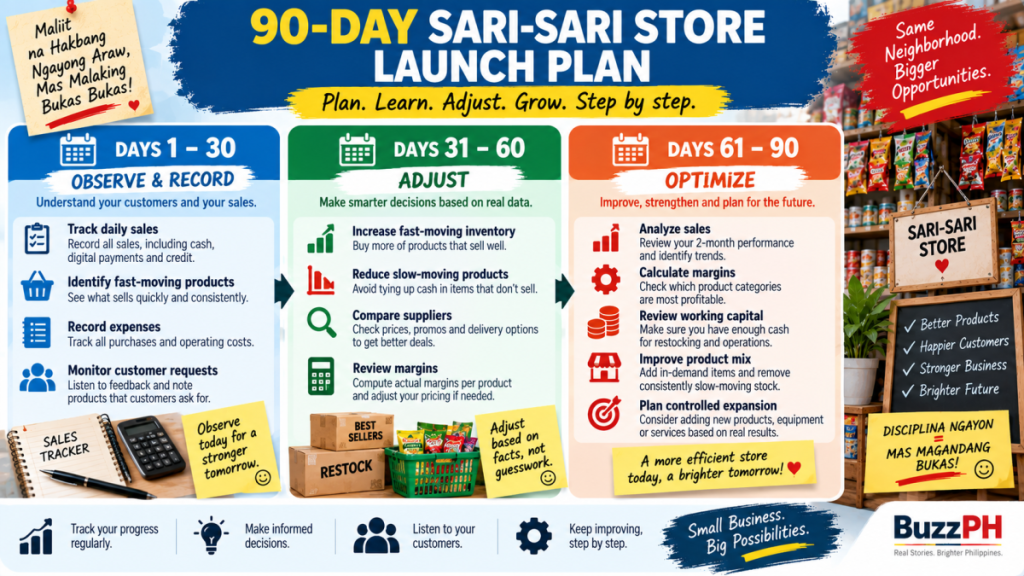
By the third month, you should have enough information to evaluate:
- Average daily sales
- Monthly sales
- Gross margin by category
- Best-selling products
- Slow-moving products
- Monthly expenses
- Credit outstanding
- Inventory turnover
- Available working capital
Only after understanding these numbers should you consider significant expansion.
Common Sari-Sari Store Startup Mistakes
Spending all capital on inventory
A store can be fully stocked but financially short of cash.
Buying too many products at once
Variety does not automatically create sales.
Copying another store
Your customers may have different needs.
Giving too much credit
Unpaid balances can reduce your working capital.
Mixing personal and business money
This makes profitability difficult to measure.
Ignoring product expiry
Slow-moving products can turn into losses.
Competing only through low prices
Low prices can reduce margins without necessarily producing enough additional sales.
Expanding too quickly
More inventory should be based on actual demand.
Practical ₱20,000 Startup Plan
For someone starting a home-based store with ₱20,000, one balanced approach is:
₱13,000 — Initial inventory
Focus on essential and fast-moving products.
₱1,000 — Display and storage
Use existing furniture whenever possible.
₱1,000 — Store supplies
Price labels, containers, packaging and recordkeeping materials.
₱2,000 — Cash/change reserve
Maintain liquidity for daily transactions.
₱3,000 — Restocking reserve
Keep this available until sales data shows where the money should be invested.
This is not the only correct allocation.
It is an example of how to avoid turning the entire startup capital into inventory.
Practical ₱50,000 Startup Plan
A larger budget should still be managed carefully.
A possible framework is:
₱25,000 — Initial inventory
Broaden the product assortment.
₱7,000 — Shelving/display/equipment
Prioritize equipment that improves operations.
₱3,000 — Store improvements
Basic signage, organization, lighting or security.
₱5,000 — Registration and miscellaneous allowance
Verify actual local requirements before spending.
₱10,000 — Working capital
Keep available for restocking and operating needs.
The objective is not to spend all ₱50,000.
The objective is to deploy the capital where it produces useful business activity while retaining enough liquidity to keep the store operating.
2026 Sari-Sari Store Startup Checklist
Before opening, review the following:
Business planning
- Determine your total available capital.
- Decide whether the store will be home-based or rented.
- Study nearby competitors.
- Identify your target customers.
- Estimate conservative daily sales.
Market research
- Observe customer traffic.
- Identify popular product categories.
- Compare competitor prices.
- Talk to potential customers.
- Identify products that nearby stores do not consistently carry.
Inventory
- Start with fast-moving products.
- Buy uncertain products in small quantities.
- Compare supplier prices.
- Record every purchase.
- Monitor expiry dates.
Registration
- Check DTI requirements.
- Confirm local business-permit requirements.
- Check BIR registration requirements.
- Verify barangay and other applicable requirements.
Financial management
- Separate personal and business money.
- Record daily sales.
- Track purchases.
- Track credit sales.
- Maintain working capital.
- Calculate gross margins.
- Review monthly expenses.
Final Thoughts: How Much Capital Should You Prepare?
A very small home-based sari-sari store can potentially begin with around ₱10,000, provided the owner already has a suitable location and basic equipment.
A ₱20,000 to ₱30,000 budget provides greater flexibility for inventory and working capital.
A ₱50,000 budget can support a larger product assortment and better store setup, but the owner should still avoid spending the entire amount immediately.
The right amount depends on your actual circumstances.
Before opening, calculate:
Inventory + equipment + registration/compliance + store improvements + working capital + emergency reserve
Then compare that amount with your available capital.
Most importantly, remember that startup capital is not the same thing as inventory budget.
A successful small store needs products, but it also needs cash to restock, make change, handle unexpected expenses and respond to customer demand.
Start with a manageable inventory, monitor what actually sells, maintain accurate records and expand only when your sales data supports the decision.
Sources and References
Philippine Statistics Authority — Philippine Standard Industrial Classification (PSIC)
The PSA’s official PSIC Revision 5 provides the country’s framework for classifying economic activities. It specifically lists “Retail selling in sari-sari stores” as subclass 47113.
Department of Trade and Industry — Business Name Registration System (BNRS)
DTI’s official BNRS provides information about business-name registration, territorial-scope fees and the distinction between business-name registration and the Business/Mayor’s Permit required to operate.
Department of Trade and Industry — Suggested Retail Prices (SRP)
DTI’s Fair Trade Enforcement Bureau provides information about Suggested Retail Prices for Basic Necessities and Prime Commodities and directs consumers to the latest SRP information.
Bureau of Internal Revenue — Taxpayer’s Guide on Business Registration
The BIR’s official guide provides information about business registration procedures and documentation for taxpayers.
Department of Trade and Industry — Tindahan Mo, e-Level Up Mo!
DTI’s program supports sari-sari store owners through digitalization and business-improvement initiatives, including digital services, cashless payments and operational skills.
Important: Startup budgets, inventory allocations, gross-margin examples and break-even calculations in this article are illustrative planning examples. They are not guaranteed costs, sales levels or profits. Actual figures vary by location, supplier, product mix, equipment, rent, operating expenses and applicable government requirements.






 Facebook
 Twitter