

You do not need ₱100,000 to start learning how to invest.
For many Filipinos, the hardest part of investing is not finding a large amount of money. It is knowing where to begin, understanding which financial products are appropriate, recognizing the risks, and avoiding opportunities that sound too good to be true.
In 2026, a starting amount of ₱1,000 can be enough to begin building an investment habit, depending on the product you choose. Some government securities, for example, have been made accessible at relatively low minimum amounts. The Bureau of the Treasury’s information on GBonds states that Treasury Bills can start at ₱500, while longer-term Retail Treasury Bonds have a ₱5,000 minimum in the cited program.
But having ₱1,000 does not mean you should automatically put it into stocks.
Your first decision should depend on whether you already have emergency savings, whether you have expensive debt, when you will need the money, and how much investment risk you can tolerate.
The Bangko Sentral ng Pilipinas (BSP) advises investors to understand what they are investing in, invest only money they can afford to lose, consider the risk-return relationship, invest with an appropriate time horizon, and diversify.
This guide explains how Filipinos can approach their first ₱1,000 investment in 2026, what options are available, how to compare them, how much regular contributions can accomplish, and how to protect yourself from investment scams.
Important: This article is for general educational purposes. It is not personalized financial, investment, tax, or legal advice. Investment returns are not guaranteed, and some investments can lose money.
Can You Really Start Investing With ₱1,000?
Yes, but not every investment product has the same minimum.
A ₱1,000 budget may be enough for some products and insufficient for others.
The amount you need can depend on:
- The financial product
- The provider
- The current minimum investment
- Brokerage or transaction fees
- The price of the security
- The investment platform
- Eligibility requirements
- The particular government offering, if applicable
This is why the better question is not simply:
“Can I invest ₱1,000?”
A better question is:
“What can I responsibly do with ₱1,000 based on my financial situation?”
That distinction prevents a common beginner mistake: choosing an investment first and asking whether it is appropriate afterward.
What Should Your First ₱1,000 Actually Do?
Your first ₱1,000 does not need to generate a spectacular return.
In fact, trying to turn a small amount into a large amount as quickly as possible can encourage excessive risk.
Your first ₱1,000 can instead help you:
- Develop the habit of setting money aside
- Learn how an investment works
- Understand fees
- Experience market fluctuations with a small amount
- Learn how to monitor an account
- Begin building a long-term financial plan
Imagine two beginners.
One invests ₱1,000 once and never contributes again.
The other starts with ₱1,000 and then invests another ₱1,000 whenever their monthly budget allows.
The second person has created a repeatable financial habit.
That habit may ultimately matter more than finding an investment that happens to perform exceptionally well for a short period.
Should You Invest Your ₱1,000 or Save It?
Sometimes the best decision is not to invest it yet.
If the ₱1,000 is your only available cash and you might need it for food, transportation, medicine, rent, utilities, or an emergency, keeping it accessible may be more appropriate.
The BSP’s financial education materials specifically encourage investors to keep investment money separate from emergency or goal-specific savings and emphasize that returns are not guaranteed.
This gives beginners a useful rule:
Money you may need soon should generally prioritize liquidity.
Money intended for long-term growth can be considered for investing.
Why an Emergency Fund Matters Before Investing
An emergency fund protects you from having to sell investments at an inconvenient time.
Suppose you invest your ₱1,000 in the stock market.
A few months later, your phone breaks, you have an unexpected medical bill, or your motorcycle needs an expensive repair.
If you have no cash reserve, you may be forced to sell the investment while its value is down.
The problem isn’t necessarily that the investment was bad.
The problem was that money needed for emergencies was placed in an asset that can fluctuate.
Your emergency-fund target depends on your income stability, monthly expenses, debt, dependents, and other financial circumstances.
There is no single number that works for everyone.
Savings and Investments Are Not the Same Thing
This distinction is essential for beginners.
A bank deposit and a market investment are different financial products.
Eligible deposits at PDIC member banks are covered by deposit insurance subject to PDIC rules. The current maximum deposit insurance coverage is ₱1 million per depositor per bank. PDIC confirms that this maximum coverage has been in effect since March 15, 2025.
However, deposit insurance should not be confused with protection against losses in investment products.
A financial app can offer several different products, such as:
- Bank deposits
- Money market funds
- Bond funds
- Equity funds
- Stocks
- Government securities
- Insurance products
- Other investments
The fact that you access a product through an app does not automatically make that product a bank deposit.
Always identify exactly what you are buying.
What Can You Actually Do With ₱1,000 in 2026?
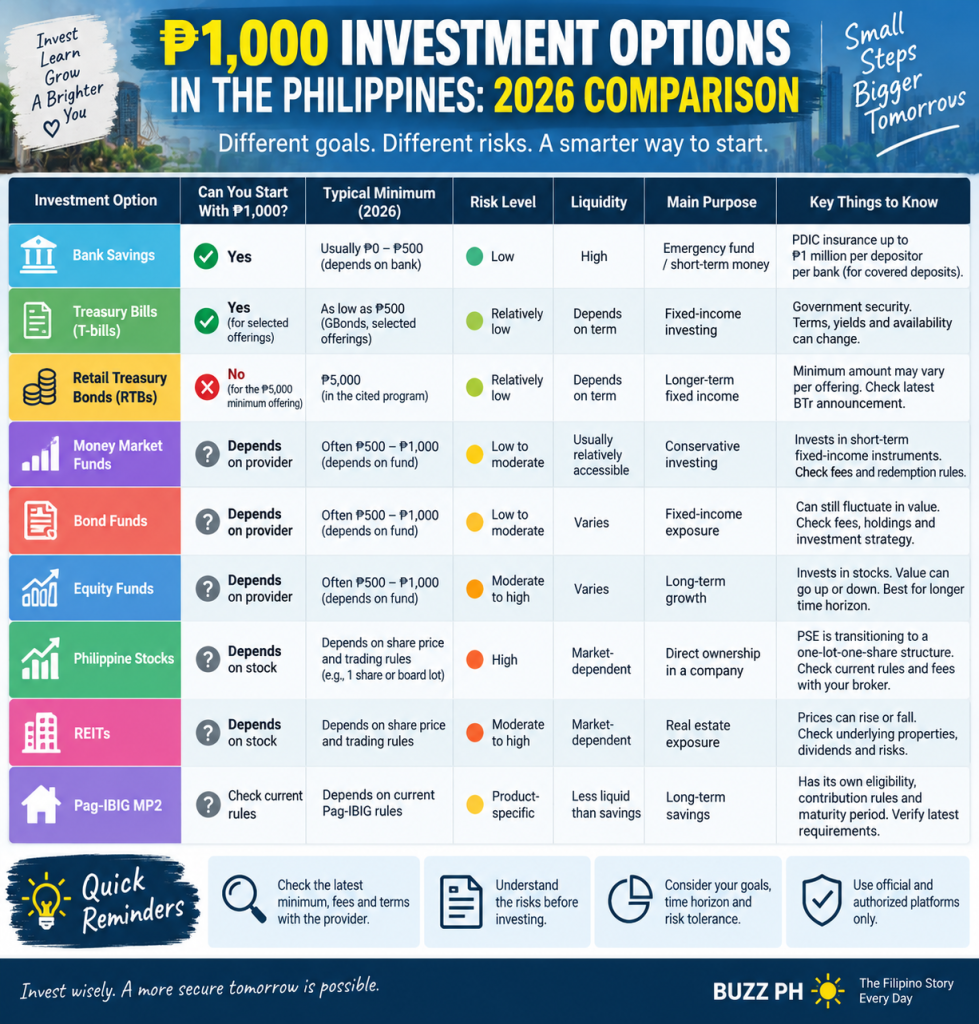
The following comparison provides a practical starting framework.
| Option | Is ₱1,000 Potentially Enough? | Risk | Liquidity | Main Purpose |
|---|---|---|---|---|
| Bank savings | Often | Low | High | Emergency/short-term money |
| Treasury Bills | Yes for selected offerings | Relatively low | Depends on terms | Fixed-income investing |
| Retail Treasury Bonds | Not for the cited ₱5,000 minimum offering | Relatively low | Depends on terms | Longer-term fixed income |
| Money market fund | Provider-dependent | Low to moderate | Usually relatively accessible | Conservative investing |
| Bond fund | Provider-dependent | Low to moderate | Varies | Fixed-income exposure |
| Equity fund | Provider-dependent | Moderate to high | Varies | Long-term growth |
| Philippine stocks | Depends on current trading rules and stock price | High | Market-dependent | Direct equity ownership |
| REITs | Depends on current trading rules and price | Moderate to high | Market-dependent | Real-estate exposure |
| Pag-IBIG MP2 | Check current Pag-IBIG rules | Product-specific | Less liquid than ordinary savings | Long-term savings |
This table is deliberately presented as a research framework rather than a list of recommendations.
Minimum amounts, rates, fees, eligibility, tax treatment, and availability can change. Verify the current terms with the relevant institution before transferring money.
Option 1: Bank Savings
A savings account may not technically be an investment, but it can be the most appropriate destination for a beginner’s first ₱1,000 if that money is needed for financial security.
Its biggest advantage is accessibility.
If the money is intended for an emergency, having it available can be more valuable than chasing a higher potential return.
PDIC currently provides maximum deposit insurance coverage of ₱1 million per depositor per bank for covered deposits.
However, remember that PDIC insurance applies to covered deposits, not ordinary market investments.
Best suited for: Emergency savings and short-term financial needs.
Option 2: Treasury Bills
Government securities are one of the clearest examples of why beginners should research actual products instead of assuming investing means buying stocks.
The Bureau of the Treasury’s information on GBonds states that Treasury Bills can be accessed with a minimum of ₱500, making selected T-bill investments potentially accessible to someone with ₱1,000. The same BTr material states that Retail Treasury Bonds have a ₱5,000 minimum in the cited program.
This does not mean every Treasury Bill or future offering will have identical terms.
The maturity, yield, purchasing channel, fees, and other conditions can vary.
The important lesson is that government securities can provide an alternative to simply keeping all your money in cash or taking stock-market risk.
Option 3: Retail Treasury Bonds
Retail Treasury Bonds, or RTBs, are longer-term government securities intended for retail investors.
However, the minimum amount matters.
The BTr’s cited GBonds information lists a ₱5,000 minimum for longer-term investments such as RTBs, meaning a person with exactly ₱1,000 would not meet that particular minimum.
This is an excellent example of why a quality investing article should not simply tell readers:
“You can invest ₱1,000 in government bonds.”
The specific security and offering matter.
Always check the current Bureau of the Treasury announcement.
Option 4: Money Market Funds
Money market funds generally invest in short-term fixed-income instruments.
They are often considered more conservative than equity investments, but they are still investment products.
That means they should not automatically be treated as equivalent to a bank savings account.
Before investing, examine:
- Minimum investment
- Management fees
- Redemption rules
- Underlying assets
- Historical performance
- Risks
- Tax treatment
- Provider information
A lower-risk investment is not the same thing as a risk-free investment.
Option 5: Bond Funds
Bond funds pool investors’ money and invest in bonds or other fixed-income securities.
They can provide diversification because the fund may hold several securities instead of one.
However, a bond fund can still fluctuate in value.
Interest-rate movements, credit conditions, maturity structure, and the securities held by the fund can affect performance.
Do not interpret the word “bond” as a guarantee that your investment cannot decline.
Option 6: Equity Funds
Equity funds primarily invest in stocks.
They can provide diversification because your money may be spread across multiple companies rather than concentrated in one.
That diversification does not eliminate market risk.
If the overall market declines, an equity fund can decline too.
The BSP’s investor education guidance recommends understanding risk appetite, investing over an appropriate time horizon, and diversifying across investments with different risk-return profiles.
Best suited for: Investors with a long-term horizon who can tolerate significant fluctuations.
Option 7: Philippine Stocks
Buying individual stocks means buying ownership in specific publicly listed companies.
The Philippine Stock Exchange explains that its traditional board-lot system has historically meant the minimum number of shares depends on the stock’s price range and applicable lot size.
However, PSE has also announced a transition toward a one-lot-one-share structure as part of its new trading engine, which is scheduled for implementation in 2026. This is intended to make the market more accessible by allowing investors to trade a single share regardless of market price.
Because trading rules and implementation details can change, beginners should check the current broker and PSE rules before assuming exactly how much cash is required.
More importantly, do not choose a stock simply because its share price is low.
A ₱5 stock is not automatically cheaper or better than a ₱100 stock.
Before buying an individual company, look at:
- Revenue
- Profitability
- Debt
- Cash flow
- Business model
- Competitive position
- Valuation
- Dividend history, if relevant
- Industry risks
Option 8: REITs
Real Estate Investment Trusts, commonly called REITs, provide investors with exposure to income-producing real estate through publicly traded securities.
They can be interesting for beginners who want exposure to real estate without buying an entire physical property.
But REITs are still market investments.
Their prices can rise and fall.
Distributions can also vary.
Before buying a REIT, look beyond the dividend yield.
Consider the properties, tenants, occupancy, debt, distribution history, growth prospects, and valuation.
Option 9: Pag-IBIG MP2
Pag-IBIG MP2 is a popular long-term savings option for eligible Filipinos.
However, it should not simply be described as a stock-market investment.
It has its own eligibility requirements, contribution rules, maturity period, and dividend mechanism.
If you are considering MP2, verify the latest rules directly with Pag-IBIG Fund before contributing.
The key question is whether you can leave the money according to the product’s intended time horizon.
Which ₱1,000 Option Is Best for You?
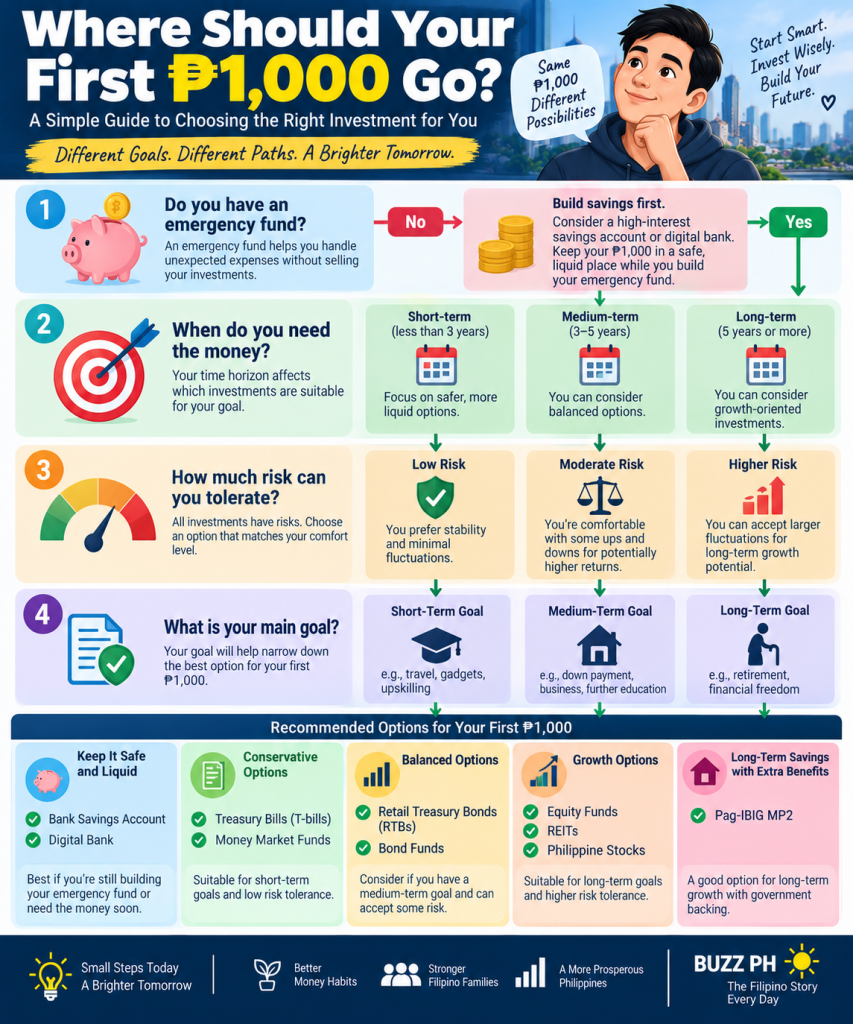
There is no universal answer.
Instead, use your circumstances to narrow the choices.
| Your Situation | More Appropriate Starting Direction |
|---|---|
| No emergency savings | Build liquid savings |
| Need the money soon | Savings or suitable short-term product |
| Conservative risk tolerance | Conservative/fixed-income options |
| Long-term growth goal | Diversified equity exposure |
| Interested in real estate | REITs |
| Interested in researching companies | Individual stocks |
| Want government securities | T-bills or other suitable government securities |
| Eligible for long-term savings products | Compare products such as MP2 |
This is an educational framework, not an individualized investment recommendation.
The Seven Things to Compare Before Investing ₱1,000
Instead of choosing an investment based solely on its advertised return, compare seven factors.
1. Minimum investment
Can you actually access the product with ₱1,000?
2. Fees
How much will you pay to buy, manage, sell, or withdraw?
3. Risk
What could cause your investment to lose value?
4. Liquidity
How quickly can you access your money?
5. Time horizon
How long should the money remain invested?
6. Diversification
Are you depending on one company, one asset, or one market?
7. Regulation and provider legitimacy
Who operates the product, and what regulator or legal framework applies?
This framework is more useful than simply asking:
“Which investment has the highest return?”
Why Fees Matter So Much With a ₱1,000 Investment
Small fees can represent a large percentage of a small portfolio.
For example:
₱50 fee ÷ ₱1,000 investment = 5%
A ₱100 cost represents:
₱100 ÷ ₱1,000 = 10%
That is why beginners should not focus only on advertised returns.
Depending on the product, costs can include:
- Brokerage commissions
- Management fees
- Sales charges
- Transaction fees
- Withdrawal fees
- Taxes
- Foreign-exchange costs
- Other administrative charges
The actual fees depend on the provider and product.
Always check the provider’s current fee schedule before investing.
How to Start Investing With Your First ₱1,000
Step 1: Decide whether the money is truly investable
If you need the ₱1,000 for essential expenses, keep it available.
Step 2: Identify your goal
Are you investing for:
- Retirement?
- A home?
- Education?
- Wealth building?
- A long-term financial goal?
Your goal affects your time horizon.
Step 3: Determine when you need the money
Money needed next month should not be treated the same as money intended for a 10-year goal.
Step 4: Assess your risk tolerance
Imagine your ₱1,000 temporarily falling to ₱800.
Would you panic?
If yes, you may need to begin with a less volatile product while learning.
Step 5: Research the provider
Use official regulator and provider information.
The SEC specifically advises investors to request and read relevant documents such as prospectuses, offering circulars, and financial information before committing money.
Step 6: Verify the investment
Do not rely solely on a TikTok video, Facebook post, Messenger group, or friend’s recommendation.
Step 7: Understand the fees
Know what you are paying before you invest.
Step 8: Make the investment
Only proceed when you understand the product and accept its risks.
Step 9: Keep your records
Save confirmations, statements, receipts, and relevant documents.
Step 10: Decide whether you can contribute regularly
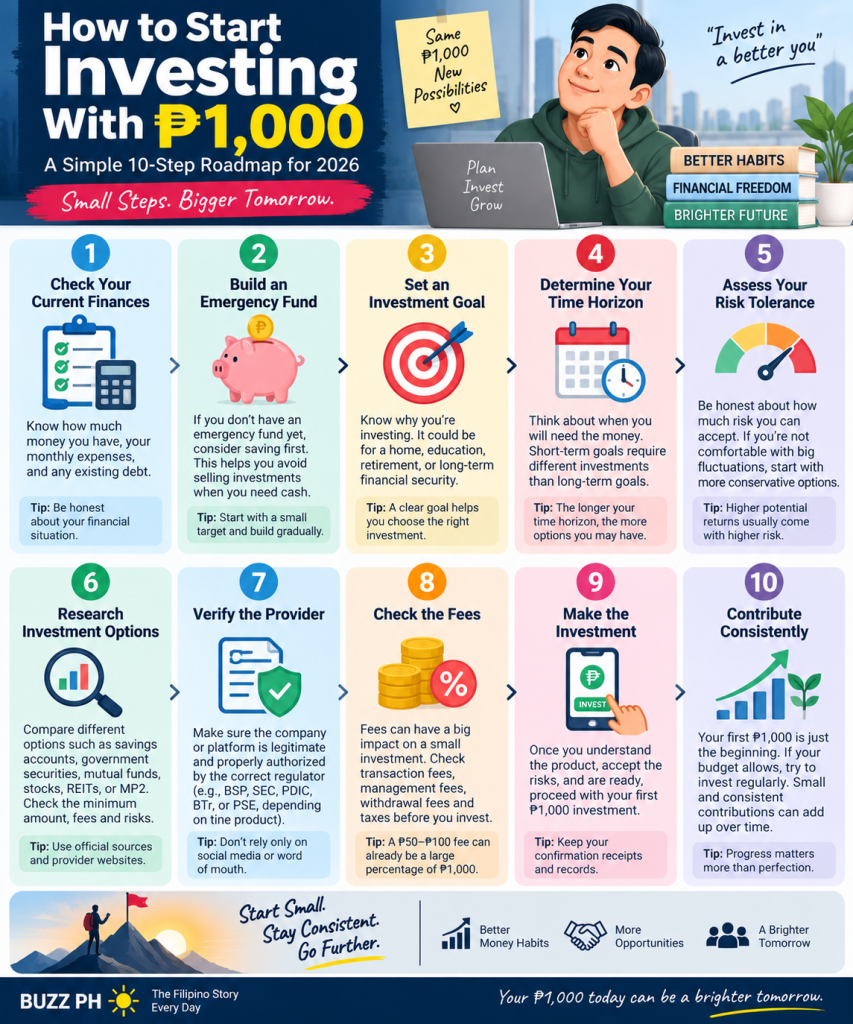
Your first ₱1,000 is more powerful when it becomes part of a sustainable investing habit.
Three Example ₱1,000 Starting Strategies
These are illustrations rather than recommendations.
Strategy A: Build the Financial Foundation
₱1,000 → savings
This may be appropriate for someone who has no emergency fund.
The objective is financial stability rather than investment growth.
Strategy B: Conservative Investing
₱1,000 → appropriate conservative/fixed-income product
This may suit someone who already has some emergency savings and wants to learn about investing without immediately taking substantial stock-market risk.
The specific product should be evaluated for its minimum, fees, liquidity, and risks.
Strategy C: Long-Term Growth
₱1,000 → diversified equity-oriented investment
This can be considered by someone who has stable finances, emergency savings, and a long investment horizon.
The investor must accept that the investment can decline in value.
None of these strategies is automatically best.
What Happens If You Invest ₱1,000 Every Month?
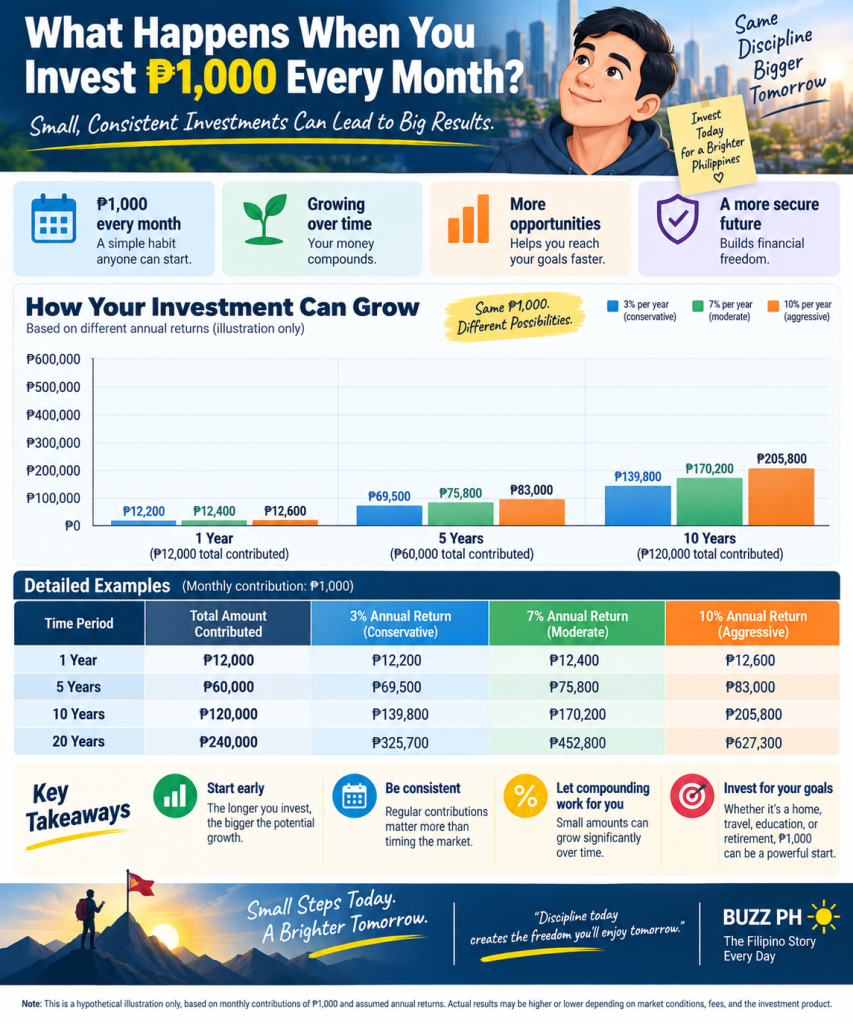
The most important part of the ₱1,000 strategy is what happens after the initial investment.
Suppose you start with ₱1,000 and then contribute ₱1,000 every month.
Your personal contributions would total:
After 1 year: ₱13,000
After 5 years: ₱61,000
After 10 years: ₱121,000
These figures do not assume any investment return.
They simply show how consistent contributions can build capital.
If your investments generate returns, the final value could be higher.
If investments perform poorly, it could be lower.
A Hypothetical Compounding Example
Consider a purely mathematical example using a hypothetical 6% average annual return.
This is not a forecast or guarantee.
If ₱1,000 were invested once and compounded at 6% annually for 10 years, it would mathematically grow to approximately ₱1,791.
But if you continue contributing ₱1,000 every month, your contributions become the dominant force driving the portfolio’s growth.
This demonstrates an important lesson:
The amount you consistently contribute can matter more than trying to find a “secret” investment with extraordinary returns.
Actual investment performance will vary.
Why You Should Not Chase Investments That Promise Fast Profits
The desire to double ₱1,000 quickly is exactly what scammers can exploit.
The SEC warns investors to be cautious of:
- Quick-profit schemes
- Unexpected investment offers
- “Inside information”
- Hot tips and rumors
- High-pressure sales tactics
- Recruitment-focused schemes
- Guaranteed-return claims
The SEC also advises investors to ask for relevant documents and carefully read the terms before committing money.
If someone tells you:
“Invest now or you will miss your chance.”
stop.
If someone says:
“Guaranteed 20% every month.”
stop.
If someone says:
“You only make money if you recruit more people.”
investigate extremely carefully.
You do not have to invest immediately.
How to Verify an Investment Opportunity
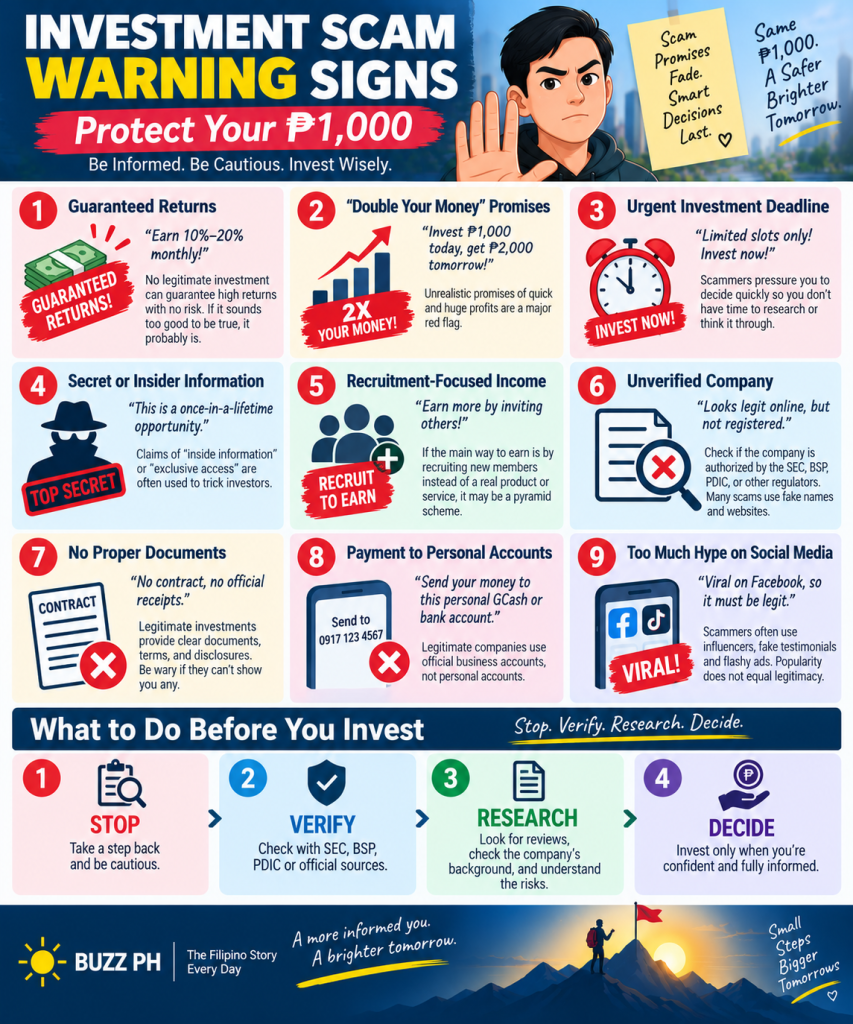
Before sending your ₱1,000, perform a basic verification.
Find the legal entity
Determine the actual company or organization behind the offer.
Identify the product
Is it a deposit, stock, bond, fund, insurance product, investment contract, or something else?
Check the appropriate regulator
Corporate registration by itself does not automatically authorize a company to conduct every type of financial or investment activity. The SEC explicitly warns investors about this distinction.
Find the official documents
Ask for appropriate offering documents, prospectuses, financial statements, or other official materials.
Examine the return claim
The higher and more certain the promised return, the more carefully you should investigate.
Check where the money is going
Be cautious when you are asked to transfer money to unexplained personal accounts or intermediaries.
Look for pressure tactics
A legitimate investment decision should not require you to panic.
Do Not Confuse Low Price With Good Value
A stock priced at ₱5 is not automatically cheaper than one priced at ₱100.
Share price alone tells you very little about whether a company is expensive or cheap.
A company’s valuation depends on factors such as:
- Number of shares
- Earnings
- Revenue
- Assets
- Debt
- Cash flow
- Growth expectations
- Market valuation
Beginners should therefore avoid choosing stocks simply because the price per share looks affordable.
Common Mistakes Beginners Make
Investing emergency money
This can force you to sell at the wrong time.
Putting everything into one company
One company’s problems can severely affect your portfolio.
Following social-media investment tips blindly
Someone else’s financial circumstances may be completely different from yours.
Ignoring fees
A small fee can have a large impact on a ₱1,000 portfolio.
Expecting instant profits
Investing is generally a long-term activity.
Trading constantly
Frequent transactions can increase costs and encourage emotional decisions.
Borrowing money to invest
Borrowing introduces additional financial pressure and can magnify losses.
Investing in products you do not understand
The BSP’s investor education guidance emphasizes investigating before investing and only investing in products you understand.
How to Grow From ₱1,000 to ₱10,000
You do not necessarily need a higher-risk investment to grow your portfolio.
You can increase your contributions.
A simple progression could be:
₱1,000: Learn and start.
₱2,500: Continue contributing.
₱5,000: Review diversification.
₱10,000: Establish a more deliberate investment allocation.
₱25,000: Reassess your goals and risk tolerance.
₱50,000+: Consider whether additional diversification is appropriate.
The timeline can be slow.
There is no need to rush.
A Simple Monthly ₱1,000 Investing System
If your budget allows it, make investing a repeatable process.
Payday
↓
Set aside ₱1,000
↓
Transfer to your chosen savings or investment account
↓
Record the transaction
↓
Review your finances
↓
Repeat next month
When your income increases, you can consider increasing your contribution.
For example:
₱1,000 → ₱1,500 → ₱2,000 → ₱3,000 per month
The objective is sustainability.
Do not invest so aggressively that you cannot afford your normal living expenses.
What If You Can Only Start With ₱500?
That is still a beginning.
The Bureau of the Treasury’s GBonds information shows why investors should investigate individual products instead of assuming investing always requires thousands of pesos: selected Treasury Bills have been offered with a ₱500 minimum.
The principle is simple:
Invest according to what your financial situation can safely support.
Do not borrow money simply so you can say that you have started investing.
What If You Have ₱10,000 Instead?
Having ₱10,000 gives you more flexibility, but the basic principles remain unchanged.
You still need to consider:
- Emergency savings
- Debt
- Risk
- Diversification
- Fees
- Liquidity
- Investment horizon
- Provider legitimacy
More money gives you more choices.
It does not eliminate the need for research.
How Long Should You Keep Your Money Invested?
There is no universal answer.
The correct period depends on the investment and your financial goal.
If you need the money next month, a volatile market investment may be inappropriate.
If the goal is retirement decades away, short-term price fluctuations may matter less.
The BSP encourages investors to consider the medium to long term, understand risk appetite, and diversify investments.
Before investing, ask:
“When will I need this money?”
That question should come before:
“How much can this investment make?”
Your ₱1,000 Investment Checklist
Before investing, make sure you can answer these questions:
☐ I know exactly what I am buying.
☐ I know who provides the product.
☐ I checked the relevant official source.
☐ I understand the major risks.
☐ I know the minimum investment.
☐ I checked the fees.
☐ I understand the liquidity.
☐ I know the intended investment horizon.
☐ I am not using emergency money.
☐ I am not borrowing to invest.
☐ I am not relying on guaranteed-return promises.
☐ I have saved my transaction records.
☐ I know where to obtain help if something goes wrong.
If several answers are “no,” do more research before investing.
Frequently Asked Questions
Is ₱1,000 enough to start investing in the Philippines?
Yes. Some products can be accessed with ₱1,000 or less, while others require more. For example, BTr information on GBonds states that selected Treasury Bills can start at ₱500, while the cited Retail Treasury Bond minimum is ₱5,000.
What is the best investment for ₱1,000?
There is no universally best investment. The appropriate choice depends on your financial situation, emergency savings, risk tolerance, time horizon, fees, liquidity needs, and the actual product available to you.
Can ₱1,000 make me rich?
Not by itself. The more realistic opportunity is using ₱1,000 to begin a consistent savings and investing habit and gradually increasing your contributions.
Can I double my ₱1,000 investment?
An investment can potentially double over time, but nobody can reliably guarantee when that will happen. Be extremely cautious about anyone promising quick or guaranteed doubling.
Is investing ₱1,000 in stocks safe?
Stocks involve risk and can lose value. Individual stocks also expose you to company-specific risk. Beginners should understand volatility and diversification before investing.
Is a money market fund the same as a bank deposit?
No. A money market fund is an investment product. It should not automatically be treated as a PDIC-insured bank deposit.
Are bank deposits insured in the Philippines?
Covered deposits at PDIC member banks are insured up to the maximum deposit insurance coverage, currently ₱1 million per depositor per bank.
Can I invest ₱1,000 every month?
Yes, if your budget allows it. Regular contributions can turn a small initial investment into a larger portfolio over time.
Should I invest before building an emergency fund?
Not necessarily. If you have no financial reserve and may need the money soon, building liquid savings may be more appropriate.
Are government securities risk-free?
They should not simply be described as “risk-free.” Government securities have specific terms, maturities, market conditions, and risks. Read the applicable offering information before investing.
How can I avoid investment scams?
Verify the company and product, check the appropriate regulator, understand where your money is going, read official documents, and avoid high-pressure offers, guaranteed-return claims, suspicious recruitment schemes, and supposed insider tips. These are among the warnings provided by the SEC.
What should I do after making my first investment?
Keep your records, understand how the investment behaves, continue learning, and determine whether regular contributions fit your budget. Avoid making decisions based solely on short-term market movements.
The Bottom Line: Your First ₱1,000 Is a Starting Point
Your first ₱1,000 will not make you wealthy overnight.
It does not need to.
The real value of starting small is that it gives you an opportunity to learn how money can be saved, invested, monitored, and grown over time.
Before investing, make sure the money is genuinely available for that purpose.
Understand what you are buying.
Understand the risk.
Check the fees.
Verify the provider.
Use primary sources instead of relying entirely on social-media recommendations.
And never let the fear of missing out pressure you into an investment you do not understand.
If ₱1,000 is all you can comfortably start with, that is enough to begin building the habit.
Your next goal does not have to be turning ₱1,000 into ₱10,000 as quickly as possible.
It can simply be making another sensible contribution next month.
Over years, that consistency can become much more important than trying to predict the next hot investment.
How Buzz PH Researched This Guide
This guide was researched using primary Philippine sources rather than relying primarily on investment blogs or affiliate websites.
The research prioritizes:
- Bangko Sentral ng Pilipinas (BSP) for financial education, investment risk, risk-return principles, diversification, and investor guidance.
- Securities and Exchange Commission (SEC Philippines) for investor protection, investment-scam warnings, and guidance on evaluating investment offers.
- Philippine Deposit Insurance Corporation (PDIC) for deposit insurance coverage.
- Bureau of the Treasury (BTr) for government-security access and minimum investment information.
- Philippine Stock Exchange (PSE) for stock-market mechanics and board-lot information.
When discussing a current minimum, fee, rate, eligibility requirement, or other time-sensitive detail, readers should verify the latest information directly with the relevant provider or government agency before investing.
This methodology is important because financial products and market rules can change. A number that was correct in a previous year should not automatically be treated as current in 2026.
Editorial Disclosure
Written by: Buzz PH Editorial Team
Last updated: September 14, 2026
Research standard: Primary Philippine government and financial-market sources were prioritized for regulatory, investor-protection, deposit-insurance, government-security, and market-structure information.
Financial disclosure: This article provides general educational information and does not constitute personalized financial, investment, tax, or legal advice. Buzz PH does not guarantee investment returns. Readers should independently verify current product terms and consider their own financial circumstances before investing.
Editorial policy: Buzz PH does not treat investment products as universally suitable for every reader. Where products or investment categories are discussed, the article focuses on their characteristics, risks, accessibility, and appropriate considerations rather than promising specific returns.
Official Sources and References
Bangko Sentral ng Pilipinas — Financial Education
The BSP’s financial education program covers financial planning, saving, investing, debt management, financial consumer protection, and responsible use of financial services.
Bangko Sentral ng Pilipinas — Investing Guidance
BSP educational materials emphasize investigating investments, investing only money that can be afforded to lose, understanding risk-return relationships, investing over an appropriate time horizon, and diversification.
Securities and Exchange Commission Philippines — Investment 101
The SEC’s investor guidance covers quick-profit schemes, high-pressure investment offers, supposed insider information, recruitment-based schemes, official documents, and the distinction between SEC registration and authority to conduct specific activities.
Philippine Deposit Insurance Corporation — Deposit Insurance
PDIC currently provides maximum deposit insurance coverage of ₱1 million per depositor per bank for covered deposits.
Bureau of the Treasury — GBonds
BTr information states that GBonds provides access to selected government securities, including Treasury Bills with a ₱500 minimum and longer-term investments such as RTBs with a ₱5,000 minimum in the cited program.
Philippine Stock Exchange — Investing at PSE
PSE provides information about brokerage, transaction costs, and its board-lot system.
Philippine Stock Exchange — Board-Lot Reform
PSE documentation regarding its new trading engine describes a planned one-lot-one-share structure designed to reduce minimum investment barriers.




 Facebook
 Twitter