

Durian farming startup cost is an important consideration for anyone planning to establish an orchard in the Philippines, especially in major producing areas such as Davao. A practical 2026 planning model puts the initial establishment cost for a 1-hectare farm at about ₱200,000 to ₱500,000, excluding land acquisition and major infrastructure. The actual amount can vary significantly depending on site preparation, water access, seedlings, labor, irrigation, fertilizer, drainage, equipment, and other farm requirements.
Starting a durian farm in the Philippines can require a significant amount of capital, but there is no single startup figure that applies to every farm.
For a new 1-hectare durian orchard on land that is already owned and reasonably suitable for production, a practical 2026 planning model can fall in the ₱200,000 to ₱500,000 range for initial orchard establishment, before land acquisition and major infrastructure such as large farm buildings, extensive road construction or deep-well development.
A moderate planning example in this guide comes to approximately ₱340,000, excluding the purchase of land.
That figure is not an official government cost estimate. It is an original budgeting model that organizes the major expenses a new grower should expect: land preparation, seedlings, planting labor, soil amendments, irrigation, tools, crop protection, drainage, minor infrastructure and contingency.
The actual amount can be considerably lower or higher depending on the property.
A farmer who already has a cleared farm, water supply, fencing, equipment and family labor may spend less. Someone developing a sloping property with limited road access and no water infrastructure may spend substantially more.
Durian remains an important agricultural commodity in Mindanao, particularly in the Davao Region. The Philippine Statistics Authority reported that Davao Region produced 4,658.10 metric tons of durian in the first quarter of 2026, 1.0% higher than the 4,611.62 metric tons recorded during the same quarter of 2025.
The industry is also continuing to develop its domestic and export market. In August 2026, the Department of Agriculture reported a trial shipment of 1.08 metric tons of fresh Davao durian to Oman, valued at about US$3,000, while the DA has continued promoting durian as one of the country’s priority high-value export crops.
For anyone considering entering the business, the important question is therefore not simply, “How much does one hectare cost?”
The better question is:
How much capital will this specific property require to establish a healthy orchard, maintain it before commercial production, and survive unexpected costs?
This guide breaks down that question step by step.
Quick Answer: 2026 Durian Farm Startup Cost
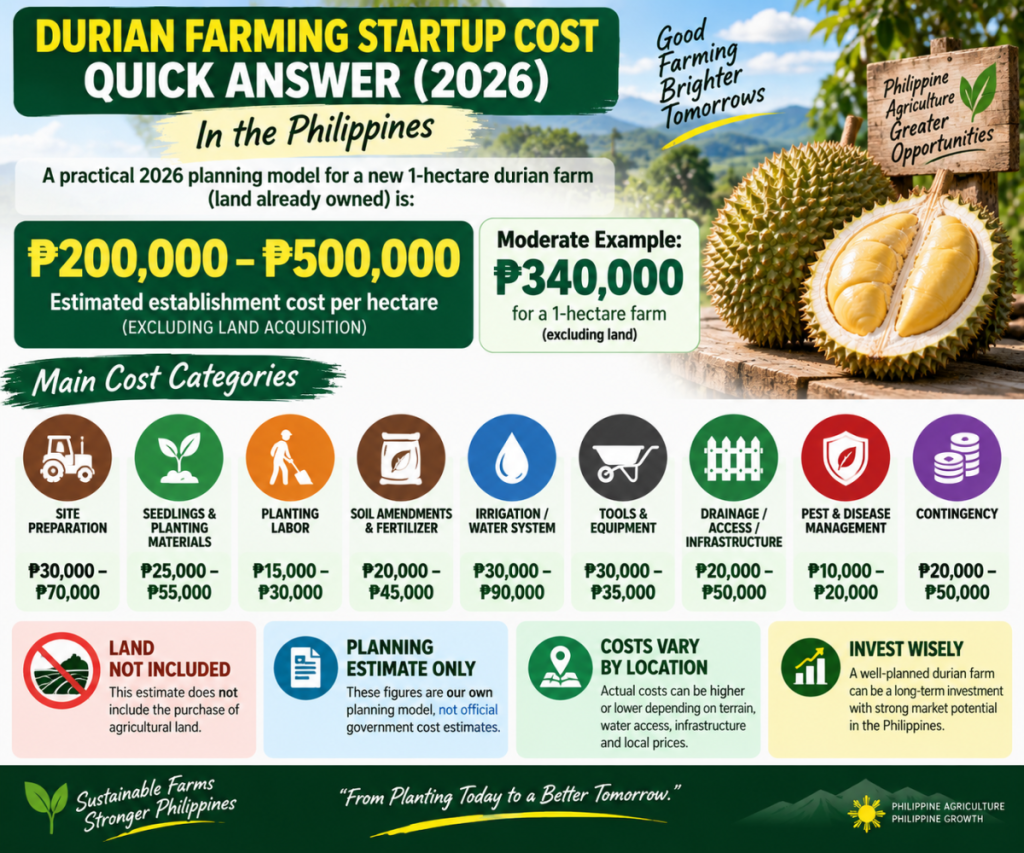
For a 1-hectare orchard where the farmer already owns suitable agricultural land, this guide uses the following planning range:
| Expense | Illustrative planning range |
|---|---|
| Site preparation | ₱30,000–₱70,000 |
| Seedlings and planting materials | ₱25,000–₱55,000 |
| Initial planting labor | ₱15,000–₱30,000 |
| Soil amendments and fertilizer | ₱20,000–₱45,000 |
| Irrigation/water system | ₱30,000–₱90,000 |
| Tools and small equipment | ₱15,000–₱35,000 |
| Drainage/access/minor infrastructure | ₱20,000–₱50,000 |
| Initial pest and disease management | ₱10,000–₱20,000 |
| Contingency | ₱20,000–₱50,000 |
| Illustrative establishment range | ₱185,000–₱445,000 |
For a conservative planning exercise, it is reasonable to round the overall planning envelope to approximately ₱200,000–₱500,000 per hectare, excluding land acquisition.
These figures are not official PSA, DA or BPI prices.
They are an original cost-planning framework intended to help a prospective farmer identify the categories that need actual local quotations.
Important: Official Data vs. Our Cost Estimates
This distinction is important for anyone using this article to make a financial decision.
The Philippine Statistics Authority provides official statistics on agricultural production and farmgate prices. The Bureau of Plant Industry and Department of Agriculture provide technical production information. Those sources should be used when discussing crop production, official statistics and agricultural practices.
However, there is no single government-published number that can accurately represent the startup cost of every 1-hectare durian farm in the Philippines.
Therefore, the ₱200,000–₱500,000 startup range in this article is our planning estimate, not an official government benchmark.
The model was constructed by identifying the major cost categories involved in establishing an orchard and assigning practical budgeting ranges to each category.
Before investing, the farmer should replace those assumptions with:
- Local nursery quotations
- Local labor rates
- Irrigation quotations
- Equipment rental prices
- Fertilizer quotations
- Land-development estimates
- Actual transport costs
- Property-specific engineering or drainage requirements
This approach is more reliable than treating one generic internet figure as the “true” cost of durian farming.
How We Built the 2026 Cost Model
The cost model uses a simple principle:
Total establishment cost = site preparation + planting materials + planting labor + soil inputs + irrigation + tools + infrastructure + crop protection + contingency
We then separate that figure from working capital, because the money required to plant the orchard is not the same as the money required to maintain it while the trees are still young.
The model assumes:
- Approximately 1 hectare of agricultural land
- Land is already owned or otherwise available
- The property is potentially suitable for durian
- No major land purchase cost
- No large commercial building
- No large tractor purchase
- No major post-harvest facility
- No deep-well construction included in the base case
- Moderate rather than luxury infrastructure
- A new orchard rather than an already established plantation
These assumptions make the model useful for comparison without pretending that every Philippine farm has identical conditions.
Infographic #1 — Durian Farm Startup Cost at a Glance
Placement: Immediately after the quick-answer section.
Infographic content:
1-HECTARE DURIAN FARM — 2026 PLANNING MODEL
₱200K–₱500K
Estimated establishment capital
Breakdown:
- Land preparation
- Seedlings
- Labor
- Fertilizer
- Irrigation
- Tools
- Infrastructure
- Crop protection
- Contingency
Important: Land purchase and major infrastructure are excluded.
The graphic should clearly label the figures as “Illustrative Planning Estimates — Not Official Government Costs.”
What Current 2026 Data Tell Us About Davao Durian
Davao remains one of the most important places to study when evaluating Philippine durian farming.
According to the PSA’s first-quarter 2026 Davao Region fruit-crop situationer, the region produced 4,658.10 metric tons of durian, up 1.0% from the same quarter of 2025.
That figure should not be confused with annual production. It represents the specific quarterly reference period used by the PSA.
The latest available PSA data also demonstrate why farmers should avoid using a single quarter as a long-term production forecast.
For example, the PSA reported 37,433.48 metric tons of durian in Davao Region during the third quarter of 2025, substantially higher than the first-quarter 2026 figure.
This illustrates the seasonal nature of agricultural production.
For a business plan, it is therefore better to work with several production scenarios rather than extrapolating one quarterly number across an entire year.
Davao’s Durian Industry Is Still Developing
The current industry environment also provides evidence that durian is receiving continued attention from government agencies and market participants.
In May 2026, the Bureau of Plant Industry’s Davao National Crop Research, Development and Production Support Center held a durian stakeholders meeting in Davao City involving growers, researchers, BPI experts and other industry stakeholders. Discussions covered production challenges, market opportunities and industry development.
The Agricultural Training Institute’s Davao office also conducted a five-day durian production, postharvest handling and marketing training in Panabo City in 2025 for agricultural extension workers and farmers from across the region.
For a new farmer, this matters because technical support and local knowledge can be more valuable than relying solely on generic online farming information.
Current Market Development: Export Opportunities Are Real, But Not Guaranteed
There are also recent examples of Philippine durian entering additional international markets.
In August 2026, the Department of Agriculture reported the first trial shipment of fresh Davao durian to Oman. The shipment consisted of 56 boxes weighing approximately 1.08 metric tons and was valued at about US$3,000.
The DA also reported in 2026 that Philippine durian was being promoted at international trade events, including efforts to develop markets in Europe and other destinations.
However, an export opportunity should not be interpreted as a guarantee that a small farm will receive export prices.
Export markets can involve:
- Quality requirements
- Traceability
- Food-safety requirements
- Packaging standards
- Volume requirements
- Buyer specifications
- Cold-chain logistics
- Certification
- Export documentation
A new farmer should therefore build a financial model around realistic farmgate or buyer prices rather than assuming that every harvest will qualify for premium export pricing.
Land Preparation Can Determine Your Starting Budget
Land preparation is one of the first expenses that can separate a low-cost orchard from a high-cost project.
A relatively level property that has previously been cultivated may require:
- Clearing
- Weed removal
- Basic soil preparation
- Staking
- Hole preparation
- Drainage work
- Access preparation
A difficult property can require considerably more.
For planning purposes, this guide allocates approximately ₱30,000–₱70,000 for basic site preparation.
That is not a fixed market rate.
The final cost should be based on an actual inspection.
A property covered in thick vegetation or located far from a usable road may require machinery and additional hauling. A previously maintained farm may require considerably less.
Land Price Is a Separate Investment
Land acquisition should not be hidden inside an orchard-establishment estimate.
The cost of agricultural land varies enormously according to:
- Municipality
- Road access
- Soil
- Water
- Terrain
- Title status
- Proximity to urban areas
- Existing structures
- Agricultural productivity
- Local land demand
For this reason, this guide does not provide a nationwide land price.
A farmer considering a specific property should obtain current local market information and verify the property’s legal and agricultural status.
Soil Testing Should Come Before a Large Fertilizer Purchase
Soil condition is one of the variables that can influence both productivity and cost.
Before establishing an orchard, the farmer should investigate:
- Soil pH
- Nutrient levels
- Organic matter
- Drainage
- Soil depth
- Compaction
- Water-holding capacity
The Bureau of Plant Industry maintains a Durian Production Guide among its crop production resources.
Testing the soil before buying large amounts of fertilizer can help avoid unnecessary input costs.
This is a good example of where spending a small amount on information can potentially prevent a much larger expense later.
Seedlings Are a Long-Term Investment
The quality of planting material matters because the farmer will be managing those trees for many years.
A new grower should investigate:
- Cultivar
- Propagation method
- Nursery reputation
- Plant health
- Root condition
- Uniformity
- Source
- Age and size
- Availability of replacement plants
For the cost model, this guide uses approximately ₱25,000–₱55,000 for seedlings and planting materials.
Again, this is a planning allowance rather than an official national price.
The correct number of trees also depends on orchard design and spacing.
The objective should not be to purchase the maximum number of seedlings possible. Long-term tree growth, orchard access, pruning, harvesting and disease management must be considered.
Planting Labor Adds More Than the Cost of Digging Holes
Establishing an orchard requires more labor than simply putting seedlings into the ground.
Initial activities can include:
- Measuring and staking
- Preparing planting holes
- Moving seedlings
- Planting
- Staking
- Mulching
- Initial watering
- Weed control
- Replacing damaged plants
A preliminary allocation of ₱15,000–₱30,000 is used in this model.
Actual labor should be calculated using the prevailing rate in the municipality where the farm will operate.
Irrigation May Be One of the Biggest Infrastructure Expenses
Water availability should be evaluated before purchasing the property.
A basic irrigation system may involve:
- Pump
- Pipes
- Hoses
- Storage tank
- Filters
- Valves
- Drip or other delivery equipment
- Installation labor
- Electricity or fuel
This guide uses ₱30,000–₱90,000 as a planning range for a basic-to-moderate irrigation system.
The range is deliberately broad because the actual requirement can vary dramatically.
A farm with a nearby reliable water source may need only a simple distribution system.
Another property may require substantial infrastructure before irrigation is practical.
This is one reason water availability should be treated as a land-selection issue, not merely an irrigation-budget issue.
Fertilizer and Soil Amendments Are Recurring Costs
The first fertilizer budget should not be treated as the orchard’s lifetime fertilizer requirement.
Young trees require continuing management, and fertilizer requirements can change as the orchard develops.
The model allocates ₱20,000–₱45,000 for initial soil amendments and fertilizer.
Possible inputs can include:
- Organic matter
- Compost
- Fertilizer
- Soil amendments
- Micronutrients where appropriate
The actual program should be based on crop requirements and soil conditions rather than blindly applying a universal schedule.
Tools and Small Equipment
A one-hectare farm does not necessarily require a tractor.
Basic equipment may include:
- Pruning shears
- Pruning saw
- Grass cutter
- Hoe
- Shovel
- Spade
- Wheelbarrow
- Sprayer
- Hoses
- Personal protective equipment
The model allocates approximately ₱15,000–₱35,000.
Specialized machinery can often be rented or contracted when needed.
For a small orchard, buying an expensive machine that is used only occasionally can tie up capital that could otherwise be used for irrigation or working capital.
Drainage and Farm Access
Drainage and access are often overlooked during the initial budgeting stage.
Potential expenses include:
- Drainage channels
- Culverts
- Gravel
- Small bridges
- Farm roads
- Footpaths
- Loading areas
The planning model allocates ₱20,000–₱50,000 for minor access and infrastructure.
This is not intended to cover major road construction.
If the property requires substantial engineering work, that should be budgeted separately before the land is purchased.
Pest and Disease Management
Durian production requires regular monitoring for pests and diseases.
The BPI Durian Production Guide discusses several pest and disease concerns, including fruit-borer problems associated with particular durian cultivars.
For initial budgeting, this guide allocates ₱10,000–₱20,000 for crop-protection and monitoring expenses.
This category may cover:
- Monitoring
- Sanitation
- Cultural control
- Approved crop-protection products
- Spraying labor
- Protective equipment
Chemical products should be used according to their labels and applicable Philippine requirements.
Infographic #2 — 1-Hectare Durian Farm Cost Breakdown
Placement: After the detailed cost sections.
Show a large 1-hectare orchard illustration divided into:
- Site preparation
- Seedlings
- Labor
- Fertilizer
- Irrigation
- Tools
- Infrastructure
- Crop protection
- Contingency
Include:
Illustrative moderate setup: approximately ₱340,000
Small footer:
“Planning model — actual costs vary by farm location and conditions.”
Our Moderate 1-Hectare Budget Example
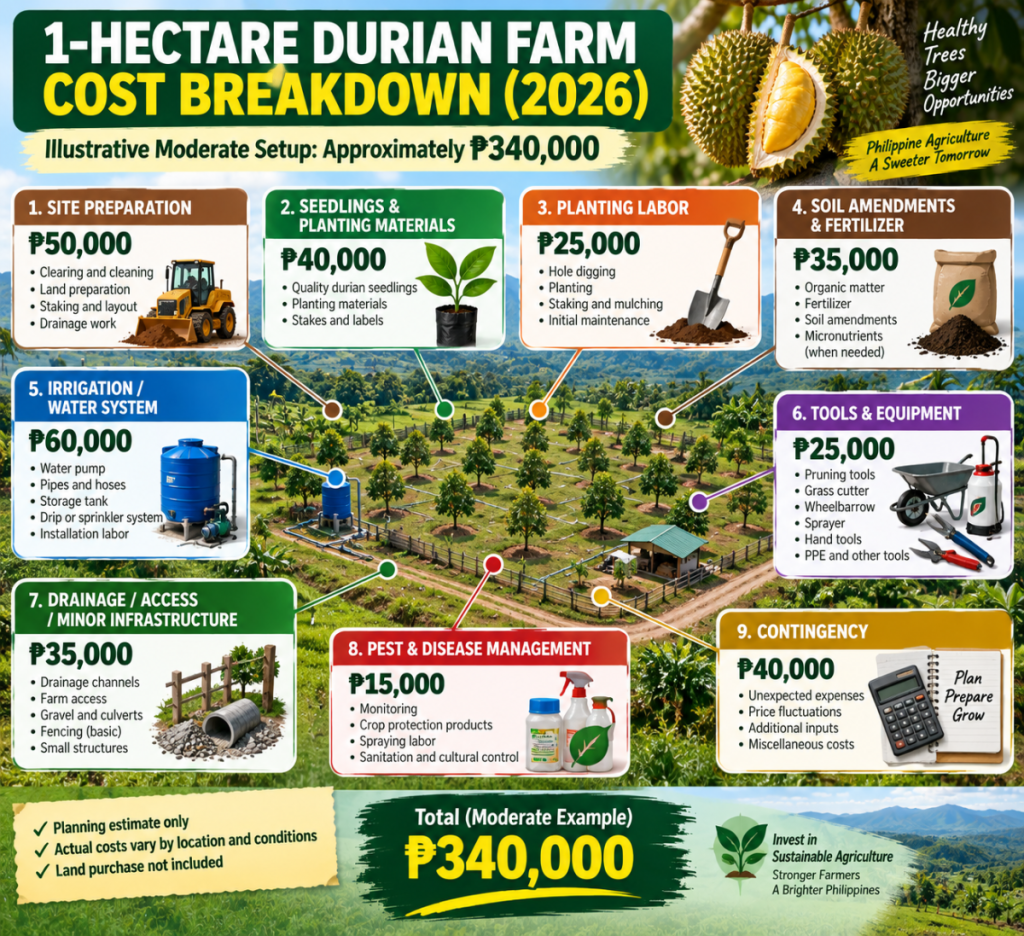
Using the assumptions above, a moderate planning scenario can look like this:
| Category | Example allocation |
|---|---|
| Site preparation | ₱50,000 |
| Seedlings/planting materials | ₱40,000 |
| Initial planting labor | ₱25,000 |
| Soil amendments/fertilizer | ₱35,000 |
| Irrigation | ₱60,000 |
| Tools/small equipment | ₱25,000 |
| Drainage/access/minor infrastructure | ₱35,000 |
| Pest/disease management | ₱15,000 |
| Miscellaneous establishment expenses | ₱15,000 |
| Contingency | ₱40,000 |
| Total | ₱340,000 |
The ₱340,000 figure should be viewed as a worked example, not a quotation.
It demonstrates how a farmer can build a budget rather than claiming that every hectare costs ₱340,000.
What Is Not Included in the ₱340,000 Example?
This is an important limitation.
The moderate example does not include:
- Purchase of land
- Major land clearing
- Major farm-road construction
- Deep-well construction
- Large water-storage infrastructure
- Tractor purchase
- Farmhouse
- Warehouse
- Large post-harvest facility
- Financing interest
- Major storm damage
- Land registration costs
- Major electrical infrastructure
- Large-scale security systems
If any of these are required, they should be added separately.
Three Startup Scenarios for 2026
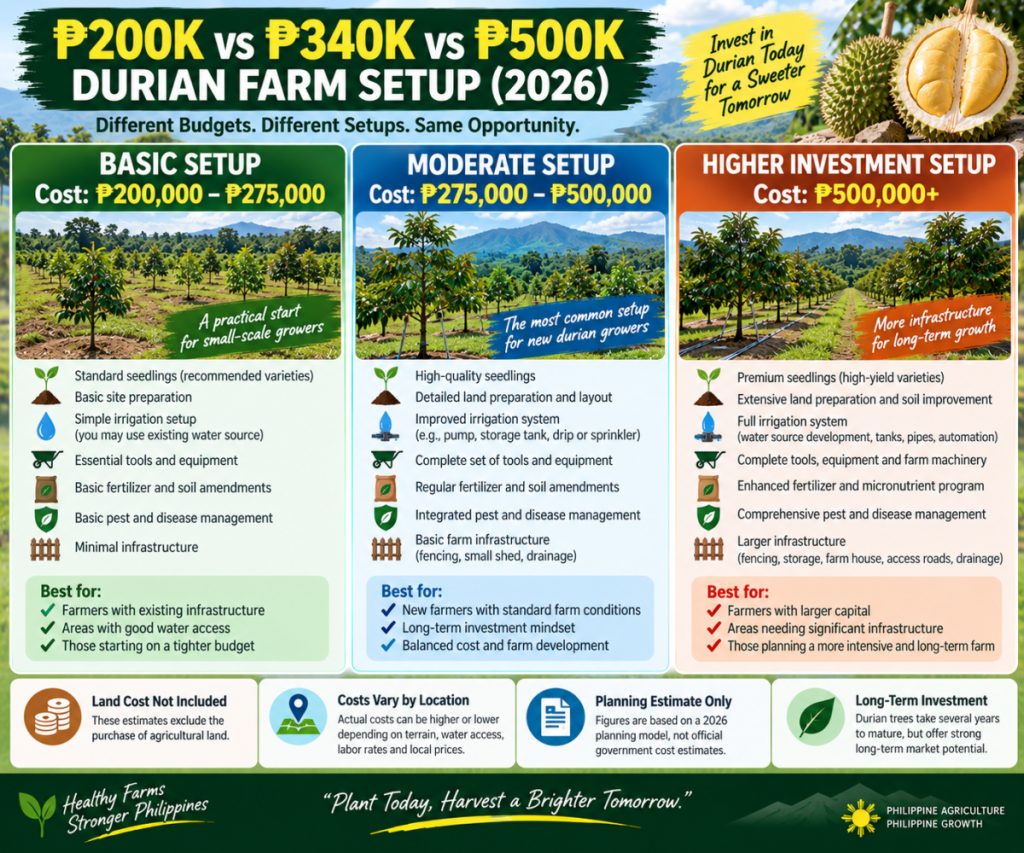
A useful way to plan is to compare three different starting positions.
Basic setup: approximately ₱200,000–₱275,000
This may be possible when the farmer already has:
- Suitable land
- Existing road access
- Water source
- Basic tools
- Some fencing
- Available family labor
Moderate setup: approximately ₱275,000–₱500,000
This assumes the farmer must purchase most of the basic establishment inputs and install a reasonable irrigation system.
Higher-investment setup: ₱500,000 and above
This can occur when the project includes:
- Difficult land development
- Extensive irrigation
- New farm roads
- Fencing
- Electrical infrastructure
- Buildings
- Specialized equipment
- Larger planting programs
The higher budget does not automatically produce higher returns. Infrastructure should be matched to the farm’s actual requirements.
Infographic #3 — ₱200K vs. ₱340K vs. ₱500K Farm Setup
Placement: Immediately after the three startup scenarios.
Create three vertical columns:
₱200K BASIC
- Existing water
- Existing access
- Basic tools
- Smaller infrastructure budget
₱340K MODERATE
- New irrigation
- Standard orchard establishment
- Tools
- Drainage
- Contingency
₱500K+ HIGHER INVESTMENT
- Larger infrastructure
- Improved irrigation
- Access improvements
- Fencing/equipment
- Larger contingency
Clearly label all three as planning scenarios.
Working Capital Is Separate From Startup Capital
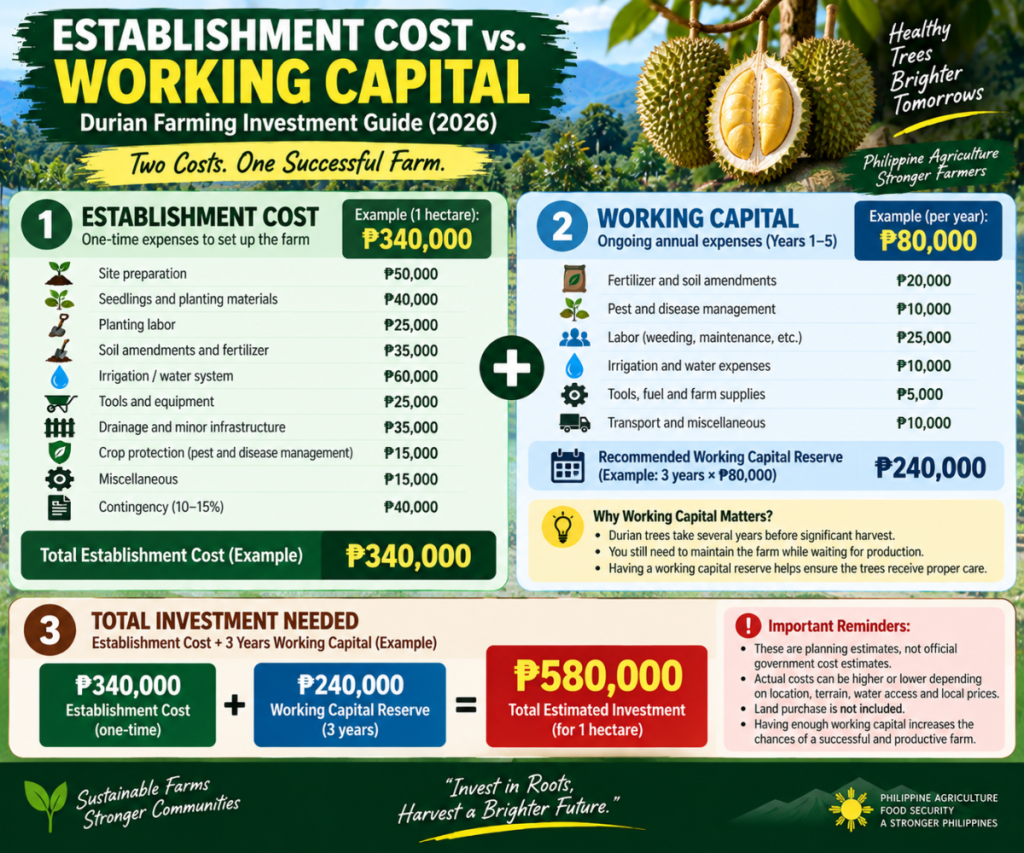
This is one of the most important changes from the earlier version of this article.
A farmer should not spend every peso on planting.
The orchard will continue to require money after the trees are planted.
Working capital is the reserve used for ongoing farm expenses before the orchard generates enough income to support itself.
Potential expenses include:
- Fertilizer
- Labor
- Irrigation
- Weed control
- Pest management
- Repairs
- Fuel
- Transportation
- Replacement seedlings
- Farm security
How Much Working Capital Should You Prepare?
There is no single official working-capital requirement for every durian farm.
For planning purposes, a new grower can create a reserve using this formula:
Working capital reserve = estimated annual operating expenses × number of years to be funded
For example, if a farmer estimates that the young orchard requires ₱80,000 per year in operating expenses and wants to maintain a three-year reserve:
₱80,000 × 3 = ₱240,000
If the farmer wants a four-year reserve:
₱80,000 × 4 = ₱320,000
These are examples, not claims about the actual operating cost of every orchard.
The important lesson is that a farm requiring ₱340,000 to establish could potentially require another substantial amount of cash over the following years.
Why a Multi-Year Cash Plan Matters
The BPI Durian Production Guide states that well-cared-for durian trees can begin bearing as early as approximately five years old. It also provides age-based examples of fruit numbers per tree as trees mature.
Early fruiting should not be interpreted as immediate full commercial production.
A useful planning sequence is:
Establishment → tree development → first fruiting → increasing production → mature orchard
The exact timeline depends on planting material, management, environmental conditions and other factors.
Year-by-Year Financial Planning
A simplified planning framework can look like this:
| Period | Primary financial focus |
|---|---|
| Year 1 | Land preparation and orchard establishment |
| Year 2 | Tree maintenance and infrastructure |
| Year 3 | Canopy development and continuing inputs |
| Year 4 | Continued maintenance and possible early fruiting |
| Year 5+ | Increasing production, harvesting and marketing |
This is not a guaranteed production schedule.
It is a financial-planning framework designed to remind growers that commercial income may lag behind initial investment by several years.
Should You Intercrop While Durian Trees Are Young?
Potentially.
DA durian production guidance has discussed the use of cash crops between durian rows before the trees reach productive size.
Intercropping can potentially help use otherwise underutilized space during the orchard’s early years.
However, the selected crop should not interfere with:
- Durian nutrition
- Irrigation
- Disease control
- Orchard access
- Tree growth
- Weed management
The right intercrop will depend on the specific location, climate, soil, market and labor availability.
It should therefore be treated as a farm-design decision, not guaranteed additional income.
Current Davao Farmgate Prices Need to Be Used Carefully
Farmgate price is particularly important when estimating future revenue.
The PSA publishes agricultural farmgate-price statistics for Davao Region.
Its first-quarter 2026 fruit-price release reported a 33.4% year-on-year growth rate in the average farmgate price of durian for the region.
The significance of this figure is not that farmers should assume prices will continue rising at 33.4%.
Instead, it demonstrates why a business plan should use multiple price scenarios.
Agricultural prices move according to supply, demand, seasonality, quality and market conditions.
Farmgate Price Is Not Retail Price
A farmer should never calculate orchard profitability using a supermarket or roadside retail price without adjusting for the supply chain.
Farmgate revenue is closer to:
Harvested kilograms × actual farmgate selling price
rather than:
Harvested kilograms × retail price
The difference can include:
- Transport
- Sorting
- Packaging
- Trader margins
- Wholesale margins
- Retail margins
- Market fees
- Spoilage
- Handling
This distinction can materially change the profitability calculation.
Build Three Revenue Scenarios
A more responsible financial model uses at least three scenarios:
Conservative
Lower production + lower selling price
Base case
Moderate production + realistic selling price
Strong case
Higher production + favorable selling price
For example:
Gross revenue = saleable kilograms × actual selling price
Then:
Net farm income = gross revenue − operating expenses
The calculation should not begin with a desired profit and work backward.
A Simple Example of Revenue Modeling
Suppose an established orchard eventually sells:
5,000 kg × ₱100/kg = ₱500,000 gross sales
That does not mean ₱500,000 profit.
The farmer would still subtract:
- Fertilizer
- Labor
- Irrigation
- Pest management
- Harvesting
- Packaging
- Transportation
- Repairs
- Other operating expenses
The ₱100/kg figure in this example is hypothetical.
When preparing an actual business plan, replace it with current quotations or verified farmgate-price data appropriate to the location, cultivar, quality and selling channel.
Infographic #4 — Where Your Durian Farm Capital Goes
Placement: After the revenue and expense explanation.
Visual flow:
STARTUP CAPITAL
↓
Land preparation
↓
Seedlings
↓
Irrigation
↓
Labor
↓
Fertilizer
↓
Farm infrastructure
↓
Crop protection
↓
Working capital
↓
Future production
Add a warning:
“Startup capital is not the same as total cash required before the orchard becomes commercially productive.”
Davao and Mindanao Offer an Established Agricultural Ecosystem
For new growers in Mindanao, the advantage is not simply that durian grows in the region.
There is an existing network involving:
- Farmers
- Nurseries
- Agricultural extension workers
- Researchers
- Traders
- Processors
- Exporters
- Government agencies
ATI Davao has conducted formal training covering production, postharvest handling and marketing.
BPI Davao has also continued industry coordination, including the 2026 stakeholders meeting.
This makes local agricultural networking an important part of the startup process.
A first-time farmer should consider speaking with the municipal or city agriculture office and nearby established growers before finalizing a planting plan.
Good Agricultural Practices Can Become a Business Asset
Philippine durian farms in Davao are also participating in PhilGAP certification.
For example, BPI records show PhilGAP certificates issued in 2026 to durian farms in Davao City and Davao del Sur.
Good agricultural practices can help farmers improve systems for:
- Farm records
- Input management
- Worker safety
- Traceability
- Food safety
- Environmental management
Certification is not a substitute for good farming, but building good recordkeeping and farm-management habits early can make future market requirements easier to address.
Why Recordkeeping Matters
A serious farm should track every major expense.
Record:
- Date
- Input
- Quantity
- Price
- Supplier
- Labor
- Application
- Tree/plot affected
- Harvest quantity
- Selling price
- Buyer
- Transport cost
This information eventually allows the farmer to calculate the actual cost per kilogram.
Without records, a farmer may know the total amount of money spent but still not know whether the orchard is becoming more efficient.
Common Mistakes That Increase Durian Farm Costs
Buying land before checking water
A cheap property can become expensive if irrigation requires major infrastructure.
Choosing seedlings only because they are cheap
The planting material is a long-term investment.
Planting before soil testing
Unnecessary inputs can increase expenses.
Ignoring drainage
Poor drainage can create long-term management problems.
Buying machinery too early
Equipment ownership brings maintenance and depreciation costs.
Using retail prices to forecast farm income
Retail prices are not equivalent to farmgate prices.
Assuming export prices apply to all fruit
Export markets can require specific quality, volume and compliance standards.
Spending all available cash on establishment
The farm still needs money after planting.
Assuming first fruiting means full production
Young trees do not necessarily produce like mature orchards.
How to Reduce Startup Costs Without Reducing Quality
Cost reduction should focus on eliminating unnecessary expenses rather than buying inferior inputs.
Useful approaches include:
Start with one hectare
A smaller initial project allows the farmer to learn before committing additional capital.
Use existing infrastructure
An existing water source or farm road can dramatically reduce establishment costs.
Compare nursery suppliers
Request multiple quotations while checking plant quality and source.
Rent specialized machinery
For occasional use, contracting may be cheaper than ownership.
Conduct soil testing
This can help avoid unnecessary fertilizer spending.
Build infrastructure in stages
Not every facility needs to be constructed on the first day.
Maintain a contingency reserve
Unexpected expenses are part of farming.
Infographic #5 — Year 1–5 Durian Farm Expense Timeline
Placement: Before the conclusion.
Show:
YEAR 1
- Land preparation
- Seedlings
- Irrigation
- Planting
- Initial inputs
YEAR 2
- Fertilizer
- Labor
- Weed management
- Irrigation
- Pest monitoring
YEAR 3
- Tree maintenance
- Fertilizer
- Canopy management
- Infrastructure maintenance
YEAR 4
- Continuing orchard costs
- Possible early fruiting
- Harvest-related preparation
YEAR 5+
- Increasing production
- Harvesting
- Marketing
- Postharvest costs
- Continued orchard maintenance
Footer:
“Production timing varies by cultivar, planting material and farm conditions.”
Is ₱100,000 Enough to Start a Durian Farm?
For a new 1-hectare commercial orchard, ₱100,000 would generally be a very limited starting budget if the farmer must establish infrastructure, purchase seedlings and finance the initial operation.
It may be more realistic for a smaller planting project or for land where major infrastructure already exists.
The more useful question is:
How much orchard can I establish without exhausting my working capital?
Starting smaller with sufficient reserves can be financially safer than planting a full hectare and having no money left for maintenance.
Is ₱300,000 Enough?
₱300,000 can be a workable planning figure for a one-hectare orchard under favorable conditions, particularly if the property already has some infrastructure.
However, the farmer should compare the actual site-development and irrigation quotations before committing.
A difficult property could consume much of that amount before planting is completed.
Is ₱500,000 Enough?
₱500,000 provides a larger planning envelope for a one-hectare establishment project when suitable land is already owned.
It can potentially cover a stronger irrigation system, better infrastructure and a larger contingency.
But it still may not cover land purchase, major road construction, deep wells, farm buildings or other large capital projects.
Is Durian Farming a Long-Term Investment?
Durian should generally be approached as a long-term orchard investment.
The BPI guide indicates that well-cared-for trees can begin bearing as early as five years, but production continues to develop as the orchard matures.
This means the farmer needs patience and sufficient capital.
The risks include:
- Weather
- Pests
- Disease
- Input costs
- Labor availability
- Market prices
- Fruit quality
- Logistics
- Buyer requirements
- Production variability
A farm business plan should therefore contain both conservative and optimistic scenarios.
What Makes a Durian Farm Financially Sustainable?
A sustainable orchard is not simply one that produces a lot of fruit.
It needs to produce fruit while controlling:
- Cost per tree
- Cost per kilogram
- Labor requirements
- Input waste
- Crop losses
- Transport costs
- Postharvest losses
- Financing costs
The long-term objective should be to understand the farm’s actual cost of production per kilogram.
Once those numbers are available, the farmer can make more informed decisions about expansion, selling channels and reinvestment.
Infographic #6 — Durian Farm Startup Checklist
Placement: Immediately before the conclusion.
BEFORE PLANTING, CHECK:
☐ Land ownership/use rights
☐ Soil test
☐ Water source
☐ Drainage
☐ Road access
☐ Terrain
☐ Seedling supplier
☐ Cultivar selection
☐ Orchard layout
☐ Irrigation plan
☐ Fertilizer plan
☐ Pest-management plan
☐ Labor availability
☐ Buyer/market plan
☐ Working-capital reserve
☐ Emergency fund
☐ Farm records system
Bottom:
“Do not buy seedlings until the site and budget are ready.”
Practical 2026 Pre-Planting Checklist
Before spending significant capital, a prospective grower should be able to answer these questions:
- Is the land legally available for the intended agricultural use?
- Is there reliable water?
- Does the property have adequate drainage?
- Can workers and vehicles reach the farm?
- Has the soil been tested?
- Which cultivar will be planted?
- Where will the seedlings come from?
- What is the actual seedling quotation?
- What will labor cost locally?
- How much will irrigation cost?
- Who will maintain the orchard?
- Where will harvested fruit be sold?
- What price assumptions are being used?
- How many years of working capital are available?
- What happens if production or prices are lower than expected?
If several of these questions remain unanswered, the project needs more planning before planting begins.
A Better Formula for Your Own Durian Farm Budget
Every property should eventually have its own spreadsheet.
Start with:
Initial establishment cost
= site preparation
- seedlings
- planting labor
- soil amendments
- irrigation
- tools
- drainage/access
- crop protection
- contingency
Then calculate:
Annual operating cost
= fertilizer
- labor
- irrigation
- pest management
- weed control
- repairs
- transport
- other recurring expenses
Then:
Gross revenue
= saleable kilograms × actual selling price
And finally:
Net farm income
= gross revenue − operating costs − other applicable expenses
For investment decisions, also include the original establishment cost and financing costs where applicable.
Final 2026 Durian Farming Startup Cost Estimate
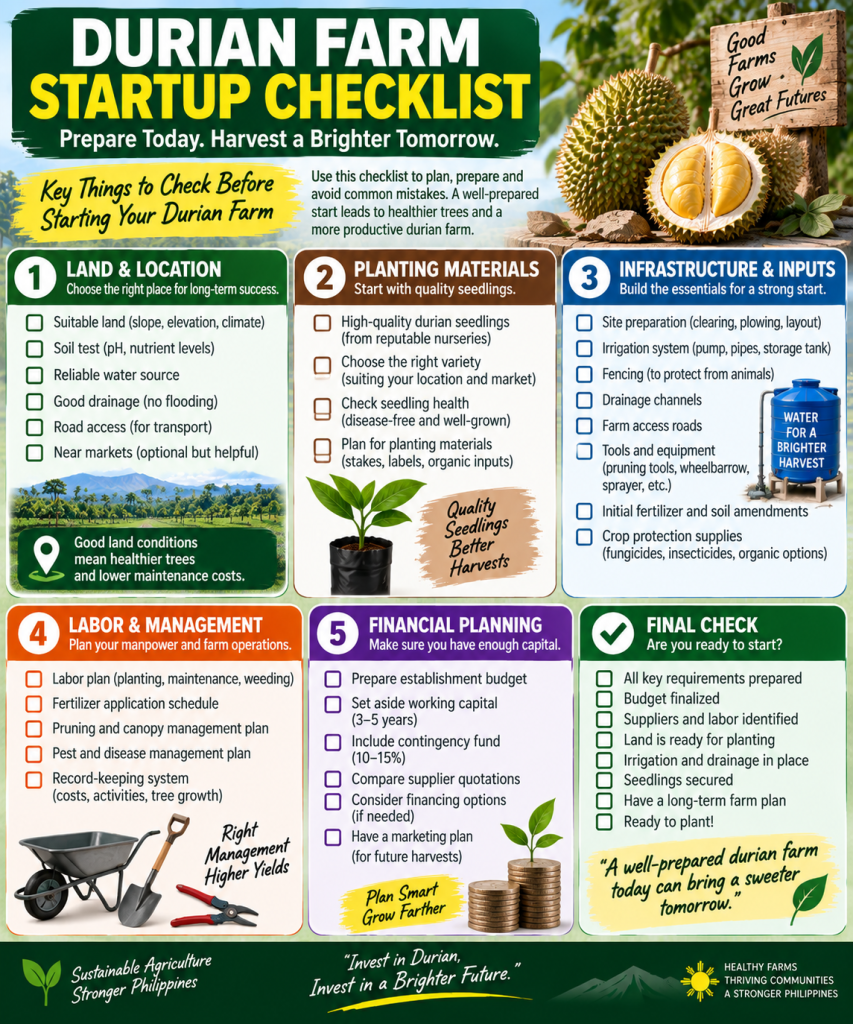
For a farmer who already owns suitable land, a reasonable 2026 planning range for establishing one hectare of durian is approximately ₱200,000–₱500,000, excluding the purchase of land and major infrastructure.
A moderate worked example in this guide comes to approximately ₱340,000.
But the most important point is that these numbers are planning estimates, not official government cost figures.
The actual investment should be based on the farmer’s specific property and current local quotations.
Davao’s current agricultural data confirm that durian remains a significant regional crop. The PSA recorded 4,658.10 metric tons of durian production in Davao Region during the first quarter of 2026, while recent government activities show continued investment in technical support, industry coordination and market development.
At the same time, current market developments should not be interpreted as guaranteed profits. Farmgate prices can change, export markets have requirements, and an orchard requires years of management before reaching mature production.
The strongest approach for a new farmer is therefore to treat durian as a long-term agricultural investment, prepare adequate working capital, verify the property before planting and build the financial model around actual local costs.
The first investment should not be the seedlings.
It should be the farm plan.
Frequently Asked Questions About Durian Farming Startup Cost
How much does it cost to start a 1-hectare durian farm in the Philippines in 2026?
A practical planning range is approximately ₱200,000–₱500,000 excluding land acquisition, depending on site preparation, irrigation, seedlings, labor, infrastructure and other requirements. This is a planning estimate rather than an official government cost.
Does the estimate include the land?
No. Land acquisition is excluded because agricultural land prices vary considerably by municipality, access, title, terrain and other factors.
How much should I budget for seedlings?
This guide uses approximately ₱25,000–₱55,000 as a planning allowance for one hectare. Actual nursery prices should be obtained locally because cultivar, plant size, propagation method and supplier can affect the price.
How long before durian trees produce fruit?
The BPI Durian Production Guide states that well-cared-for trees can begin bearing as early as approximately five years old, although actual timing varies.
Is Davao a major durian-producing area?
Yes. Davao has a significant durian industry, and PSA data continue to record substantial regional production. Davao Region produced 4,658.10 metric tons in the first quarter of 2026.
Can I start a durian farm with ₱100,000?
A full one-hectare commercial establishment would be difficult if substantial infrastructure is required. A smaller planting area or a property with existing water, access and tools may make a smaller budget more practical.
Do I need a tractor for one hectare?
Not necessarily. Renting equipment or hiring machinery services can sometimes be more practical for a small orchard than purchasing and maintaining specialized machinery.
Can I grow other crops between young durian trees?
Potentially. Philippine agricultural guidance has discussed intercropping before durian trees reach productive size. However, the selected crop should not interfere with irrigation, nutrition, tree growth or farm access.
Should I calculate profit using retail durian prices?
No. Use the actual price received by the farmer or an appropriate farmgate-price assumption. Retail prices include costs and margins that do not go directly to the grower.
Are the ₱200,000–₱500,000 figures official government estimates?
No. They are an original planning model created for this article. Official government data are used separately for production, agricultural information and market statistics.
How much working capital should I keep?
Calculate your expected annual operating expenses and multiply them by the number of years you want to fund before relying on significant orchard income. For example, ₱80,000 in estimated annual operating expenses multiplied by three years equals a ₱240,000 working-capital reserve.
Research Sources and References
This guide combines official Philippine government statistics, agricultural production guidance, regional industry information, and current 2026 developments. The durian farm cost figures in this article are our own planning estimates, not official government cost estimates.
Philippine Statistics Authority — Davao Region: 1st Quarter 2026 Fruit Crops Situationer
The PSA’s Q1 2026 release reports that Davao Region produced 4,658.10 metric tons of durian, an increase of 1.0% from 4,611.62 metric tons during the same quarter of 2025. The release is based on the PSA Crops Production Survey.
PSA Davao Region — Q1 2026 Fruit Farmgate Prices
This PSA publication provides the regional fruit farmgate-price data used when discussing recent durian price movements. The figures should be interpreted as historical/current statistical information rather than a forecast of future farmgate prices.
Bureau of Plant Industry — Durian Production Guide
The BPI Durian Production Guide provides technical information on durian production, including orchard establishment, cultivation, pest and disease management, harvesting and other production considerations.
Bureau of Plant Industry — Official Production Guides
BPI’s official production-guide library includes the Durian Production Guide among its agricultural production resources.
BPI Davao — 2026 Durian Stakeholders Meeting
This May 2026 BPI-Davao activity brought together growers, agricultural researchers, BPI experts and other stakeholders to discuss production challenges, market opportunities and development of the local durian industry.
ATI Davao documented a five-day training program conducted in March 2025 covering durian production, postharvest handling and marketing. The training included practical activities involving orchard layout, planting, fertilizer application, pruning and disease management.
Department of Agriculture — Davao Durian Export Development
The Department of Agriculture reported the 2026 trial shipment of fresh Davao durian to Oman and discussed continuing efforts to develop international markets for Philippine durian.
Important Note About the Cost Estimates
The ₱200,000–₱500,000 per-hectare startup range presented in this article is an original planning model, not a published PSA, DA or BPI cost benchmark.
The estimate was developed by breaking the startup budget into major categories such as:
- Site preparation
- Seedlings and planting materials
- Planting labor
- Soil amendments and fertilizer
- Irrigation
- Tools and equipment
- Drainage and farm access
- Crop protection
- Contingency
Actual costs can vary significantly depending on the farm’s location, terrain, water availability, existing infrastructure, labor rates, nursery prices and other site-specific conditions.
For an actual investment decision, readers should replace the planning assumptions with current quotations from local suppliers, nurseries, irrigation contractors and agricultural service providers.
Final Note for Prospective Growers
The figures in this guide should be used as a starting framework rather than a substitute for a farm-specific feasibility study.
Before investing, obtain current quotations from nurseries, agricultural suppliers, irrigation contractors and local labor providers. Check the property, test the soil, verify water availability and speak with the municipal or city agriculture office.
Most importantly, keep establishment capital and working capital separate.
A farm can have enough money to plant trees but not enough money to maintain them.
A successful durian investment therefore begins not with the number of seedlings that can be purchased, but with whether the farmer has enough land, water, technical knowledge, working capital and market access to manage the orchard over the long term.


 Facebook
 Twitter