
Flying fox migration is helping researchers better understand how large fruit bats move across landscapes in search of food, suitable habitats, and safe roosting areas. Scientists from the University of the Philippines are tracking these movements to gather information that could support future conservation efforts for flying fox species in the Philippines and beyond.
Flying foxes are sizable fruit-consuming bats belonging to the genus Pteropus and the family of megabats. Their name is derived from their elongated snouts, prominent eyes, and pointed ears, which resemble those of a small fox. These bats inhabit warm climates throughout Asia, Australia, Africa, and various tropical islands.
Flying foxes are recognized as the largest bats globally, with some species boasting a wingspan of up to 1.5 meters (5 feet). In contrast to smaller insectivorous bats, they do not utilize echolocation. Instead, they depend on their keen eyesight and acute sense of smell. Their diet consists of fruits, flower nectar, and pollen.
During the day, they rest in large trees within groups known as camps, which can accommodate thousands of bats. They primarily feed on fruits and flowers. As they forage and travel, they play a crucial role in seed dispersal and pollination.
The Philippines is home to approximately 9 to 10 recognized species of flying foxes, which are large fruit bats. About half of these species are endemic, indicating that they are not found anywhere else in the world. Among the most prevalent and significant species in the country are the golden-crowned flying fox (scientific name: Acerodon jubatos) and the large flying fox (Pteropus vampyrus).
The golden-crowned flying fox is classified as critically endangered and is distinguished by its golden fur crown, making it one of the largest bat species in the world. In contrast, the large flying fox is a widespread and substantial fruit bat that inhabits various regions across Southeast Asia, including areas protected by the Department of Environment and Natural Resources.
Certain species of bats have been documented flying over 20 kilometers from their roosting sites in a single night to search for food, effortlessly traversing islands and even crossing international borders. Throughout a year, flying foxes can cover distances exceeding 6,000 kilometers, positioning them as some of the most widely ranging bats globally.
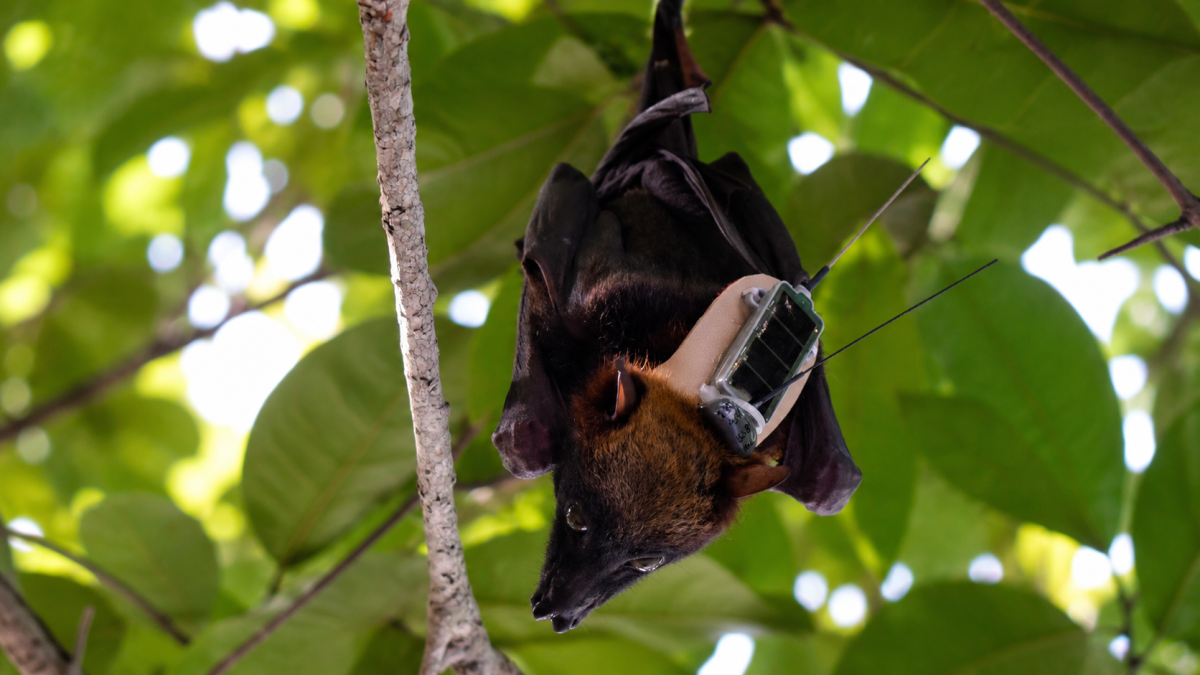
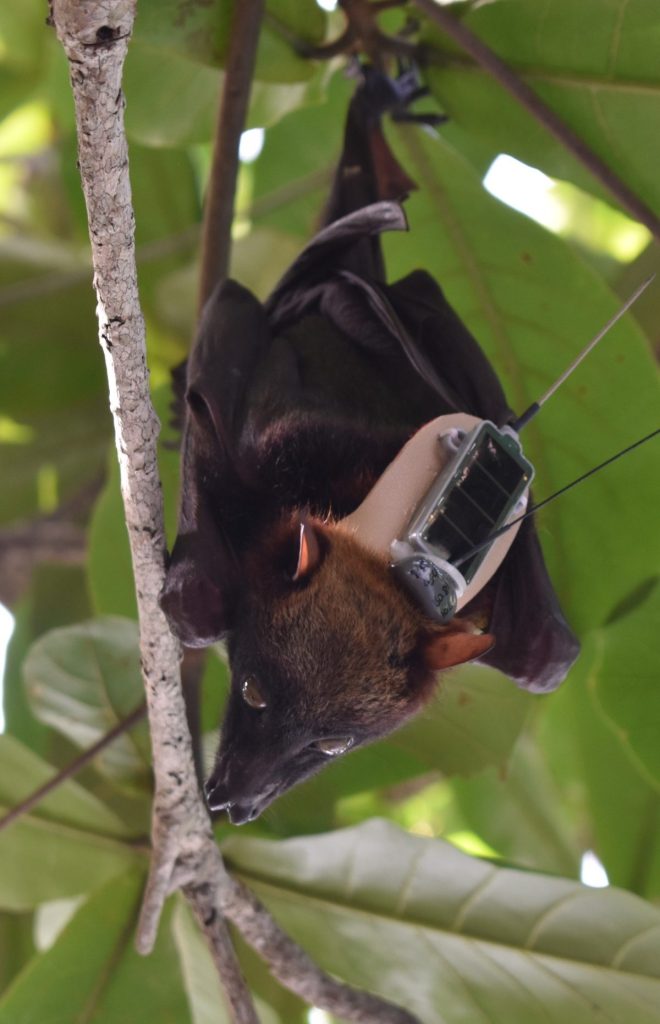
Their flight patterns often exceed the speed and distance that humans can effectively monitor. To gain a deeper insight into the movement and habitat utilization of flying foxes, biologists from the University of the Philippines – Diliman College of Science’s Institute of Biology (UPD-CS IB), in collaboration with other researchers, captured nine flying foxes from three different species and equipped them with lightweight GPS collars to monitor their movements.
The researchers wanted to find out the movement patterns of the golden-crowned flying fox, the large flying fox and the small flying fox (Pteropus hypomelanus).
“There’s just not a lot of data about flying fox movements in the Philippines,” said Rio Renato Constantino, one of the main researchers. “There have only been two studies about it so far, and both for the same two species (referring to golden-crowned flying fox and large flying fox) and in the same place (Subic), which forms a fraction of these species’ range,”
Currently, no studies have been conducted on the small flying fox anywhere, according to Constantino.
While the flying foxes were resting, the researchers approached them quietly with handheld antennas to retrieve the GPS movement data from their collars. Although the small sample size limits the ability to generalize the findings to the broader population, the data indicate that both the golden-crowned flying fox and the large flying fox may travel greater distances than the small flying fox.
The studied bats exhibit differences in their consistency of returning to the same roosts, frequently revisit their feeding locations, and utilize a diverse array of habitats, including urban areas and farmlands significantly altered by human activity.
Constantino considers the movement patterns of these elusive flying foxes to be a captivating subject for research. “By learning where they go, we learn more about their habitat use, what kinds of places they like to frequent. Do they stay in forests? Do they visit cities often?” he said. “At sunset they fly out of the roost and disappear into the night. Where do they go? That’s what we wanted to answer.”
Understanding the movement of flying foxes in various environments is crucial for their conservation and management. “They serve a number of important ecological functions, among them seed dispersal. After a flying fox eats fruit, it poops out the seed, often a considerable distance away from the tree where it obtained its meal. In this way, flying foxes help maintain fruiting tree populations and help forest regeneration,” Constantino explained.
It is essential to safeguard known flying fox roosts and reduce disturbances whenever feasible. “If you don’t disturb them, they won’t go away; and if you know where they are, you can avoid them,” Constantino said.
The findings of this study can guide land-use planning and conservation efforts that protect both biodiversity and public health.
The research titled, “Movement patterns of three species of flying foxes across human-modified landscapes in the Philippines,{ was published in Mammalia, an international, multidisciplinary journal that is published bimonthly and focuses on the inventory, analysis, and interpretation of mammalian diversity.—###
Photo caption: Researchers captured nine flying foxes from three species and fitted them with lightweight GPS collars to track their movements.











 Facebook
 Twitter