

Whale Shark Interaction at Barangay Tan-awan, Oslob, Cebu
The whale shark briefing center in Barangay Tan-awan sits along the Cebu coastal highway, approximately 5 kilometers north of Oslob town proper. Every morning, before the sun has fully risen above the mountains behind the coastline, wooden paddleboats begin sliding into the water and small shrimp are scattered across the surface. The whale sharks—locally called butanding—have learned to associate this stretch of reef with food, and they glide in from the open sea with a kind of unhurried predictability that makes them feel almost tame. They are not. These are wild animals that simply tolerate human presence, and that distinction matters enormously when you are floating two meters away from a ten-meter fish.
What makes this experience budget-friendly is that the entire operation is managed by the local government, not a private conglomerate. The fees are posted on a public board at the registration gate, the staff are trained local fishermen and marine wardens, and the equipment—life jackets, snorkel masks, and the paddleboats themselves—is included in your entry fee. You do not need to rent gear separately, you do not need to tip a private guide to access the water, and you do not need to book in advance. You simply turn up, pay at the counter, sit through a five-minute briefing, and wait for your boat number to be called. The whole queue process from registration to hitting the water typically takes between thirty and fifty minutes on a normal weekday morning.
The in-water experience itself lasts thirty minutes per batch. Your boat rows out to where the sharks are feeding, and you slide into the water alongside the outrigger’s bamboo arms. The sharks move slowly, opening their enormous mouths to filter the shrimp. They are largely indifferent to swimmers as long as you maintain the mandated four-meter distance and keep your movements calm. Most first-time visitors describe the experience as surreal—the sheer scale of the animals against the clarity of the water is something that photographs simply cannot capture accurately. Bring a waterproof camera or phone case if you want footage; GoPro videos tend to come out far better than standard mobile underwater shots. Local boatmen are surprisingly skilled at capturing photos for solo travelers and are generally happy to help without expecting additional payment beyond their regular role.
Getting here from Cebu City requires an early start. Buses depart from the Cebu South Bus Terminal (CSBT) along N. Bacalso Avenue. Look for the Ceres Liner marked “Bato via Oslob”—this is the critical detail, as the bus labeled “Bato via Barili” takes a completely different route down the west coast and will leave you stranded on the wrong side of the island. Aim to board by 3:00 AM to arrive at Tan-awan by 6:30 AM and secure a slot well before the peak crowd arrives after 8:00 AM. The best months to visit are November through May when Cebu’s weather is dry and the morning sea is calm. For more on planning a smooth Philippines trip in general, our ultimate 2026 Philippines travel guide is worth reading before you finalize your itinerary.
Tumalog Falls, Oslob, Cebu
After your whale sharks swim wraps up and your heart rate has settled back to something resembling normal, do not make the mistake of walking straight back to the highway and catching a bus home. Tumalog Falls is located just a ten-minute motorcycle ride inland from the Tan-awan briefing center, and it is one of the most visually distinctive waterfalls in the entire Visayas region. Unlike the thundering, dramatic cascades found in places like Aliwagwag or Tinago, Tumalog is defined by its extraordinary gentleness. The water does not plunge—it flows, spreading across an enormous moss-covered rock face in dozens of thin, transparent curtains that catch the morning light and refract it into something genuinely beautiful. The pool at the base is cool, milky-turquoise, and shallow enough for non-swimmers to enjoy.
The trek from the highway drop-off to the falls takes about five minutes along a short forest path. Vendors near the entrance sell cold coconuts and snacks, which is a sensible purchase after a salty morning in the sea. The falls area has a designated swimming zone with roped-off sections to prevent people from wandering directly under the heavier water flow. Most visitors spend between forty-five minutes and ninety minutes here, alternating between swimming in the pool, standing under the lighter sections of the cascade, and photographing the green-and-white wall of water from different angles. Early morning (before 9:00 AM) is the best time to visit because the forest is quiet, the light filters through the canopy at a low golden angle, and most tour groups have not yet arrived. You will practically have the falls to yourself.
Getting to Tumalog without a private tour is straightforward, but the road itself is steep enough that walking is not recommended. Exit the whale shark briefing area and walk to the shoulder of the main coastal highway. You will immediately spot habal-habal drivers (motorcycle taxis) waiting near the gate. The officially standardized round-trip fare is ₱100 per passenger. This includes the driver waiting for you at the drop-off point near the entrance trail for up to one hour and then returning you to the highway. Do not pay more than ₱100. If a driver quotes you ₱150 or ₱200, politely refuse and move to the next one—there are always plenty available on busy mornings. The entry fee at the falls itself is ₱50, collected at a small booth near the trailhead by local community staff.
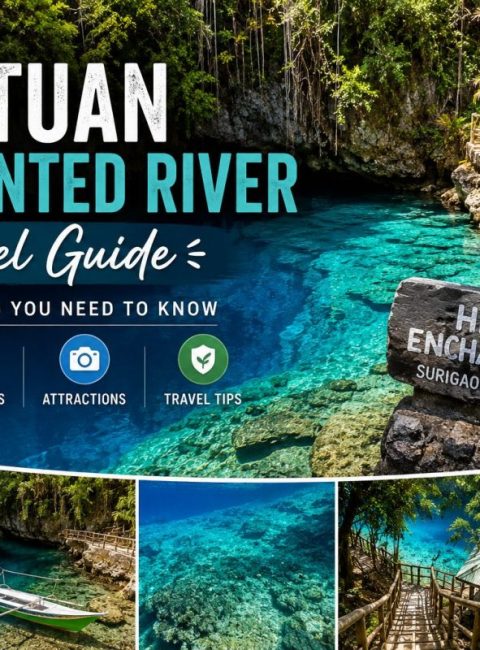
Pack a change of dry clothes in a waterproof bag before you leave Cebu City in the morning. You will almost certainly swim here, and climbing back onto a motorcycle while dripping wet is uncomfortable and can leave you quite cold on the shaded mountain road back down. Bring reef-safe or mineral sunscreen for this stop since there are no sunscreen restrictions at Tumalog—or continue wearing your rash guard if you brought one for the whale sharks. The falls are open daily, and there is no “bad” month to visit, though water flow is heaviest during the rainy season from June to October. For a look at other stunning natural swimming spots in the Philippines, see our guide to Hinatuan Enchanted River—another jaw-dropping waterway worth putting on your list.
Sumilon Island Sandbar, Oslob, Cebu
Sumilon Island sits roughly 1.5 kilometers off the coast of Oslob, a compact island with a private resort at its center and a famous sandbar curving off one end like a crescent of pure white sugar. The sandbar is the main reason people make the crossing—it is a narrow, blindingly white strip of sand surrounded by water so clear you can see the seafloor at two meters depth. Depending on the tide direction and the season, the sandbar’s orientation and length change constantly. Some mornings it curves north; other mornings it tilts south. Occasional king tides temporarily submerge it completely, making it look as though you are standing in the middle of the open sea. It is photogenic beyond description, and it is fully accessible to budget travelers without paying premium resort rates.
The island itself is home to the Bluewater Sumilon Island Resort, which caters primarily to upscale day-trip packages and overnight guests. However, the sandbar is a public area, and the island is accessible by public pump boat. Independent visitors are welcome to set up on the sandbar and enjoy the water without purchasing any resort package. The resort itself offers a day-use option with pool access and dining, but this is entirely optional. Budget travelers who pack their own sandwiches and snacks, wear their swimwear under their clothes, and carry a dry bag have everything they need without spending a single centavo at the resort counter.
To reach Sumilon on a budget, head south from the whale shark briefing center along the highway by walking or taking a short tricycle ride to Bancogon Port, which is the public departure point for boats to the island. At the port you will find a small ticketing booth where public boat seats are sold on a per-head basis at approximately ₱250 round-trip. The key is patience—the public boat waits until enough passengers have gathered to justify the crossing, usually between six and ten people. Peak hours (between 9:00 AM and 11:00 AM) are the easiest times to fill a boat quickly. If you arrive at Bancogon after your Tumalog Falls visit around 10:00 AM, you should have no trouble finding fellow travelers also waiting for the boat.
Plan to spend two to three hours on the sandbar. The crossing itself takes about fifteen minutes on a good sea day. Bring your own drinking water, sunscreen (apply before boarding—there are no restrictions here), and a dry bag or waterproof pouch for your phone and valuables since you will be wading through shallow water to reach the sandbar from the boat drop-off. There is no permanent shade on the sandbar itself, so a hat and UV rash guard are genuinely practical here. After your visit, the return boat runs on demand when enough passengers are ready to head back to the port. Budget travelers combining all three spots—whale sharks, Tumalog, and Sumilon—can realistically complete the full itinerary by 1:00 PM and catch an afternoon Ceres bus back to Cebu City with time to spare. If island adventures are your thing, our budget island hopping guide to Palawan is a natural next chapter.
💰 6 Proven Money-Saving Tips for Your Oslob DIY Trip
These tips come directly from the ground-level experience of independent travelers who have done Oslob the DIY way multiple times. Follow them and you will finish the day having spent ₱1,500 or less while experiencing every major attraction South Cebu has to offer.
The single most effective cost-saving move you can make is catching the early-morning Ceres Liner from CSBT instead of booking into a shared van service. The bus fare is ₱200 each way versus ₱700–₱1,200 for van seats. Over a round trip, this saves you ₱1,000–₱2,000 per person. The AC bus is comfortable, safe, and drops you off precisely where you need to be. Bring a jacket because the air conditioning will run at full blast for the entire 4-hour journey.
Chemical sunscreen is banned at the whale shark center, and arriving with it already applied means you must shower it off completely before entering a boat—adding time to your morning and potentially bumping you to a later queue batch. A long-sleeved UV rash guard and swim leggings eliminate this problem entirely while providing better sun protection for the rest of the day at Tumalog and Sumilon. A basic rash guard costs ₱250–₱400 at Divisoria or online and pays for itself in saved queue time and stress on the first use.
The restaurants directly adjacent to the whale shark briefing center charge tourist-inflated prices for ordinary Filipino food. Walk five to ten minutes north or south along the coastal highway and you will find traditional open-air carinderias where a plate of rice and a generous serving of meat or fish costs ₱80–₱120. Ask the locals where they eat—they will point you to the right spot immediately. Tinowang isda (sour fish soup) and ginisang gulay (sautéed vegetables) are always available, always fresh, and always cheap at these spots.
Private boat charters to Sumilon Island from tour operators can cost ₱1,500–₱3,000 for the vessel, regardless of how many people are on board. The shared public pump boat from Bancogon Port costs ₱250 per head and goes to exactly the same sandbar. The only difference is that you may need to wait 15–30 minutes for enough passengers to join. Use that waiting time to eat a quick snack, refill your water bottle at a nearby sari-sari store, or simply enjoy the coastal view. Patience is the budget traveler’s most valuable currency at Bancogon Port.
Cash is the only payment method accepted everywhere in Oslob, and small bills make every transaction faster and friction-free. Prepare a set of small denominations before you leave Cebu City: ₱50s for the bus conductor and entry fees, ₱100s for the habal-habal driver and boat ticket, and a ₱200–₱500 reserve for food. ATM machines exist in Oslob town proper, but they can be unreliable and frequently run out of cash during peak season. Withdraw from a Cebu City ATM the night before your trip and carry everything you need.
The return Ceres bus passes directly through Carcar City, which is famous throughout the Philippines for its authentic Cebuano lechon. The bus stops briefly at the Carcar market area, and vendors selling packaged portions of roasted pig walk along the highway. A generous serving of Carcar lechon wrapped in banana leaves costs around ₱80–₱120 and serves as the perfect bus-ride dinner on the way back to the city. It transforms the return journey from a boring commute into a genuine culinary experience—and it is far cheaper than any restaurant meal you would find in Cebu City.
❓ Frequently Asked Questions
🇵🇭 Oslob Is Waiting—And You Don’t Need to Empty Your Wallet to See It
This guide has walked you through every detail of a complete, fully independent DIY trip to South Cebu: the exact bus to take from CSBT and why you must double-check the destination sign, the real cost breakdown at the whale shark gate for both Filipino and international visitors, how to reach Tumalog Falls by habal-habal without overpaying, how to access the Sumilon sandbar without booking a private resort package, what to eat and where to find it along the highway, and the ethical context every responsible traveler deserves to know before stepping into the water. Whether you incorporate all three attractions or focus on just the whale sharks, the information here gives you everything needed to do it on your own terms and on your own budget.
The Philippines is one of the most naturally extraordinary places on earth, and Oslob is proof that its most spectacular experiences do not require a tour package, a resort booking, or a travel agent. The ocean here belongs to everyone. The public buses run reliably. The local fisherfolk are welcoming and the marine wardens take their conservation role seriously. All you need to bring is an early alarm, a handful of small bills, a waterproof bag, and the willingness to commute the way locals do. If this guide inspires you to explore further, our roundup of the top 25 best tourist destinations in the Philippines for 2026 is a natural next read.
Pack light, start early, keep your distance from the sharks, and let South Cebu remind you why the Philippines earned its reputation as one of the greatest travel destinations in all of Southeast Asia. The butanding are waiting in the blue water of Tan-awan, gliding slow and unbothered through the morning shrimp, and they are worth every kilometer of that four-hour bus ride. Mabuhay!







 Facebook
 Twitter