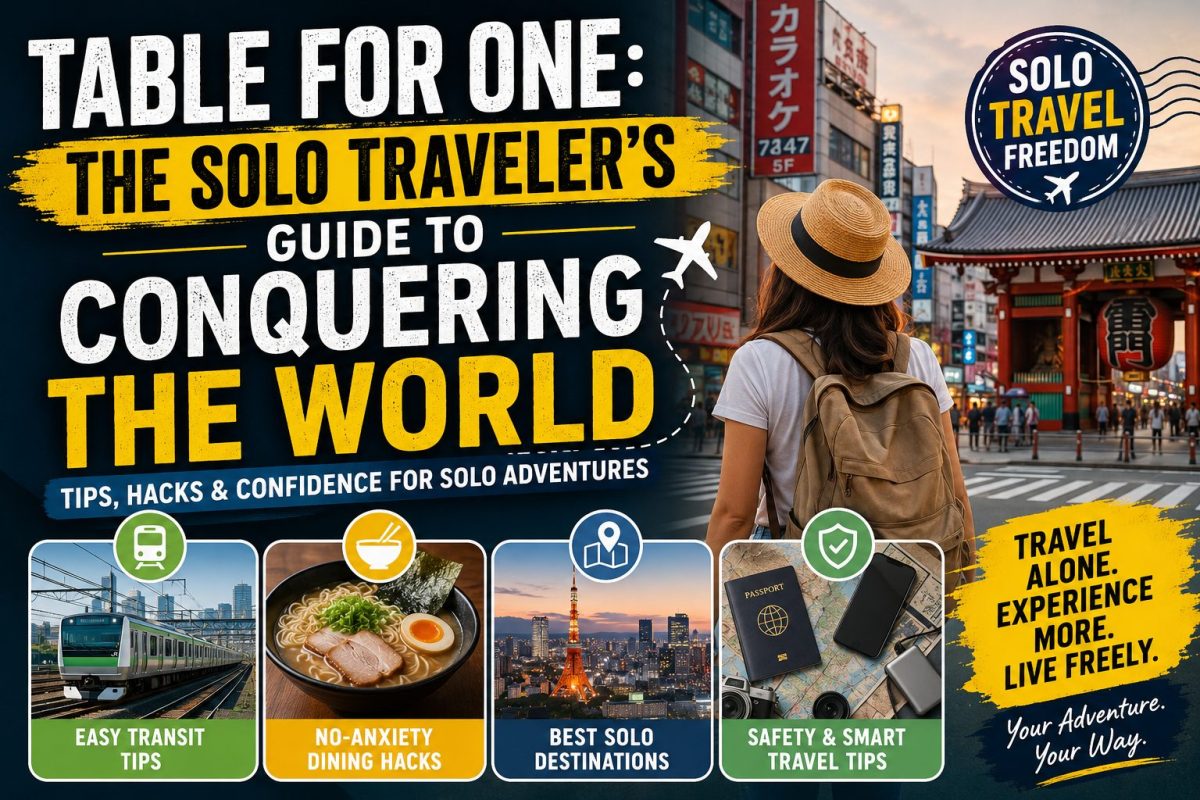
Table for One: The Solo Traveler’s Guide to Conquering the World

by Angela P. Villanueva
0 comments 35 minutes read
A solo traveler exploring Tokyo, Japan, featured in a comprehensive Solo Travel Guide for independent travelers.

L

🇵🇭 2026 Travel Guide
Solo Travel Guide: How to Explore Tokyo, Japan with Total Confidence in 2026

There’s a specific kind of anxiety that hits when you walk into a foreign restaurant alone for the first time and say those three words: “Just one, please.” You feel the whole room watching. You wonder if people are whispering. And then — nothing. Nobody cares. That moment of realizing you’re completely invisible to everyone else? That’s the exact moment solo travel starts to click. And once it does, it never un-clicks. You’ll spend the rest of your trip waking up at whatever hour you want, changing your plans on a whim, and moving through a foreign city entirely on your own terms — with zero compromises.

This solo travel guide covers everything you need to go from nervous first-timer to confident independent traveler — using Tokyo, Japan as the master template. Why Tokyo? Because it’s the single best city on earth for learning how to travel alone. It’s safe, it’s logical, it practically bends over backwards to accommodate people who prefer doing things solo, and it has a dining culture that was literally engineered for one person. If you can navigate Tokyo by yourself, you can navigate anywhere.

This guide is for first-time solo travelers who are excited but a little scared. It’s for people who’ve always traveled with friends or partners and want to try going it alone. And it’s for the experienced solo traveler who wants a field-tested Tokyo blueprint with real numbers, not the vague “it’s affordable!” filler you’ll find on other travel blogs. Every cost in this guide is real. Every hack has been tested. Every mistake mentioned was made by a real traveler.

You’ll learn how to get from the airport to your accommodation without getting ripped off, how to eat incredibly well without speaking a word of Japanese, how to budget your days down to the last yen, which neighborhoods actually reward solo exploration, and the three universal rules that separate smart solo travelers from stressed-out ones. By the time you finish reading this, you’ll have a complete plan — and a lot less anxiety about using it.

💡 Solo Travel Budget Range: A solo trip to Tokyo runs roughly ₱3,100–₱6,800 per day (approximately 8,300–18,100 JPY), covering accommodation, three meals, and metro transport — with the lower end achievable in capsule hotels and ramen shops, and the mid-range giving you a private hotel room and sit-down dinners.
1
Getting to Tokyo: Airport to City Without the Rip-Off

Most international flights into Tokyo land at one of two airports: Narita International Airport (NRT) or Haneda Airport (HND). Here’s what most travel blogs won’t tell you — that choice matters a lot more than you’d think. Narita is the bigger of the two and handles the majority of long-haul international routes, but it sits about 60 kilometers outside the city center. Haneda, on the other hand, is practically inside Tokyo. If your airline gives you a choice of airports, choose Haneda every single time. You’ll save at least 45 minutes of transit time and a significant chunk of money on the way in.

From Haneda, the fastest and cheapest option is the Tokyo Monorail, which runs directly to Hamamatsucho Station for just 500 JPY — that’s roughly ₱165 at current exchange rates. From Narita, the Narita Express (N’EX) train gets you to Shinjuku or Shibuya in about 90 minutes and costs around 3,070 JPY (₱1,010). Whatever you do, skip the taxis. An airport cab from Narita can cost upward of 15,000 JPY (₱4,950), and there is absolutely no reason to spend that money when train options are this good. The trains are fast, clean, perfectly on time, and clearly signed in English.

Once you’re in the city, your best friend is the IC card system — specifically Suica or Pasmo. Don’t bother buying individual paper tickets for each journey; the machines at station ticket booths are confusing even for regulars. Instead, add a digital Suica card directly to your Apple Wallet or Google Wallet before you even leave the airport. Load it with 3,000 JPY (₱990) for your first two days, and just tap your phone at the turnstile every time you board or exit. The system automatically deducts the correct fare. For navigation, Google Maps is completely reliable in Tokyo — it even tells you which specific train car to board for the fastest transfer at your connecting station. It’s a level of detail that genuinely surprised me the first time I used it.

Here’s a real mistake I watched a fellow traveler make at Shinjuku Station — the busiest train station in the world — on my second visit to Tokyo. She was using a digital Suica card on her phone, but her battery died right at the turnstile. The gate locked. A line built up behind her in seconds. She had to scramble to find a station employee while her face turned the color of a fire hydrant. Tokyo’s heavy reliance on Google Maps for navigation will drain your phone battery by early afternoon. Always carry a compact power bank in your daypack. Specifically, a MagSafe or USB-C power bank that can charge while you walk. This is not optional — it’s as essential as your passport.

✈ Top Highlights — Airport to City Transit
  • Haneda Airport (HND) — Closest airport to central Tokyo; strongly preferred for solo arrivals
  • Tokyo Monorail from Haneda — 500 JPY (~₱165) to Hamamatsucho Station; takes 13 minutes
  • Narita Express (N’EX) — 3,070 JPY (~₱1,010) from Narita to central Tokyo; ~90 minutes
  • Digital Suica / Pasmo card — Add to Apple/Google Wallet at the airport before anything else
  • Google Maps navigation — Flawless in Tokyo; download offline maps before you land
  • Power bank in daypack — Non-negotiable; map usage drains phones by 2 PM
🏠 Accommodation: ₱1,485–₱3,465/night 🍽 Meals: ₱230–₱750/meal
🚌 Transport: ₱165–₱1,010 per airport trip 💰 Daily Transit Budget: ₱265/day (metro)
📅 Best Time to Arrive: Any season; avoid Golden Week (late April–early May) when stations get extremely crowded
💡
Budget Tip: If you’re flying from Manila or Cebu, check AirAsia and Cebu Pacific for direct routes to Narita; roundtrip prices often drop to ₱8,000–₱14,000 during off-peak months (September through November). Book at least 6 weeks out. Add eSIM data from Airalo for about ₱450 for 7 days — it activates the moment you land and saves you from hunting for a SIM counter while jet-lagged and lost.
2
Real Daily Budget Breakdown for Solo Travelers

One of the biggest lies in travel writing is the phrase “Tokyo is expensive.” Honestly, compared to cities like London, Paris, or Sydney, Tokyo is genuinely competitive — especially when you know where to eat and how to sleep. The mistake most first-timers make is paying for things that locals never pay for: tourist restaurants with English menus near major attractions, hotel concierge-booked day tours, and airport taxis. Cut those three things out of your budget and you’ll find Tokyo can be done comfortably on ₱3,100–₱3,800 per day on the budget tier.

The budget tier means sleeping in a boutique capsule hotel at around 4,500 JPY (₱1,485) per night. Don’t let the word “capsule” put you off — modern Tokyo capsule hotels are nothing like the cramped pods of the 1980s. Many now come with reading lights, climate control, USB charging ports, a personal curtain for privacy, and genuinely excellent communal shower facilities. You get a locker for your luggage, a common lounge, and sometimes even a rooftop area. Brands like Nine Hours and First Cabin have elevated the format completely.

For meals, budget tier spending runs about 3,000 JPY (₱990) per day total — that’s across breakfast, lunch, and dinner. A convenience store breakfast from 7-Eleven or FamilyMart costs 400–600 JPY (₱132–₱198) and is genuinely good: onigiri, hot coffee, and tamagoyaki egg rolls. Lunch at a standing soba counter is 600–900 JPY (₱198–₱297). Dinner at an Ichiran Ramen booth runs about 1,100 JPY (₱363). For metro transit, budget 800 JPY (₱264) per day for typical sightseeing movement across 4–6 train journeys.

A traveler I met at a hostel in Shimokitazawa — a nurse from Davao City on her first solo trip — had set herself a daily budget of ₱4,000. By day three she messaged me saying she hadn’t gone over ₱3,200 on any single day. “The convenience stores alone are an event,” she said. “I had better food from FamilyMart than I’ve had at some restaurants back home.” That’s Tokyo in a nutshell: quality is everywhere, and it doesn’t always come with a hefty price tag.

💰 Top Highlights — Budget Breakdown
  • Capsule hotel (budget) — 4,500 JPY (~₱1,485) per night; clean, modern, great for solos
  • Business hotel (mid-range) — 10,500 JPY (~₱3,465) per night; private room, en-suite bathroom
  • Convenience store meals — 400–600 JPY (~₱132–₱198) per meal; surprisingly excellent quality
  • Ramen dinner (Ichiran) — ~1,100 JPY (~₱363); the gold standard solo dining experience
  • Daily metro fares — ~800 JPY (~₱264) for typical sightseeing; pay with digital Suica
  • Total daily spend (budget tier) — 8,300 JPY (~₱2,739) per day all-in
🏠 Accommodation: ₱1,485–₱3,465/night 🍽 Meals: ₱132–₱495/meal
🚌 Transport: ₱264/day on metro 💰 Daily Budget: ₱2,739–₱5,940
📅 Best Time to Visit: March–April (cherry blossoms) or October–November (cool weather, fewer tourists)
💡
Budget Tip: Load your Suica card with exactly 5,000 JPY (₱1,650) at the start of each 3-day stretch. This comfortably covers all metro rides with a small buffer. Never leave the card below 500 JPY — some station exits charge a slightly higher fare than expected based on your entry point, and a card that hits zero locks you at the gate. Top up at any convenience store or station kiosk in under 60 seconds.

3
Best Solo-Friendly Neighborhoods to Explore in Tokyo

Tokyo is enormous — roughly 2,194 square kilometers and home to over 13 million people. For a solo traveler stepping off the train for the first time, this can feel overwhelming. The truth is, you don’t need to see all of it. You need three or four excellent neighborhoods that reward slow, independent exploration, and Tokyo has more of those per square kilometer than almost any city on earth. The neighborhoods below aren’t picked for Instagram fame — they’re picked because they’re genuinely great for someone moving at their own pace.

Shimokitazawa is the best neighborhood in Tokyo for solo wandering, full stop. It’s the vintage thrift capital of the city — narrow, walk-friendly alleys packed with record shops, indie coffee bars, second-hand clothing stores, and tiny live music venues. Nobody looks at you twice if you’re sitting alone at a wooden table with a book and an iced matcha latte. The atmosphere is relaxed, creative, and completely free of the sensory overload you get in Shinjuku or Shibuya. Expect to spend a full afternoon here without spending more than ₱500 on coffee and snacks.

Shinjuku Gyoen National Garden is the perfect midday reset when city noise gets to be too much. Entry is 500 JPY (₱165) and the park covers 58 hectares of manicured lawns, forested paths, and greenhouse gardens right in the middle of one of Tokyo’s busiest districts. Solo travelers love it because it’s enormous enough that you can genuinely find a quiet corner and stay there for hours. Bring a convenience store bento, find a bench under a cypress tree, and decompress. Alcohol is banned inside the park, which keeps the crowds calm and family-friendly. TeamLab Planets in Toyosu is a must-do for any solo visitor — it’s an immersive digital art space where you walk barefoot through knee-deep water and enter infinity mirror rooms. Because the experience is inherently personal and doesn’t require conversation with anyone, it’s completely natural to go alone. Tickets cost 3,200 JPY (₱1,056) and must be booked online weeks in advance — it sells out regularly.

A solo traveler from Iloilo City told me she almost skipped Yanaka because a friend told her “there’s not much to do there.” That friend was wrong. Yanaka is one of the few districts in Tokyo that survived the WWII air raids largely intact, meaning it still has the narrow streets, wooden shopfronts, and old temple architecture that the rest of the city lost decades ago. It’s quiet, historically rich, and completely walkable. The Yanaka Cemetery — which sounds grim but is actually a lush, peaceful garden cemetery with hundreds of cherry trees — is one of the best free afternoon walks in the entire city. Give Yanaka a full morning, bring a light jacket, and wander without an agenda.

📍 Top Highlights — Solo-Friendly Neighborhoods
  • Shimokitazawa — Vintage shops, indie cafes, zero tourist pressure; perfect for slow solo days
  • Shinjuku Gyoen Garden — 500 JPY (~₱165) entry; 58 hectares of calm inside the city
  • TeamLab Planets, Toyosu — 3,200 JPY (~₱1,056); book weeks ahead; ideal solo art experience
  • Yanaka district — Free to explore; preserved old Tokyo streets and historic temples
  • Akihabara — Electronics, anime, and gaming paradise; entirely navigable alone at any hour
  • Asakusa — Historic temple district; best visited at 7 AM before tour groups arrive
🏠 Accommodation: ₱1,485–₱3,465/night 🍽 Meals: ₱132–₱495/meal
🚌 Transport: ₱264/day (metro between neighborhoods) 💰 Daily Budget: ₱2,739–₱4,950 including one paid attraction
📅 Best Time to Visit: October–November for mild weather and manageable crowd levels
💡
Budget Tip: Visit Asakusa’s Senso-ji Temple at 7:00 AM before the tour groups arrive — entry is free, the grounds are peaceful, and the surrounding Nakamise shopping street vendors start setting up around 8:00 AM with fresh ningyo-yaki (small filled pastries) for around 200 JPY (~₱66) per bag. You’ll have the temple largely to yourself for a full hour. By 10:00 AM, that same temple is shoulder-to-shoulder with crowds and far less enjoyable.
4
No-Anxiety Dining: How to Eat Incredibly Well Alone in Tokyo

Japan practically invented low-interaction dining. The country has a long, proud tradition of eating alone — they even have a word for it, “Ohitorisama,” which translates roughly to “party of one” and carries zero social stigma. Solo dining in Tokyo doesn’t mean sitting at a cramped counter feeling awkward while you wait for your food. It means sitting at a beautifully designed private booth with a wooden panel on either side of you, a personal call button for the server, and your own fully customized bowl of noodles arriving through a sliding bamboo shutter. It’s genuinely one of the most pleasant dining experiences in the world.

Ichiran Ramen is the gold standard for solo dining in Tokyo — and honestly, anywhere. You walk in, approach a vending machine near the entrance, and punch in your order for tonkotsu (pork bone broth) ramen. You pay the machine: about 1,100 JPY (₱363). You’re then handed a paper slip where you mark your preferences — broth richness, noodle firmness, green onion quantity, garlic level, spice, and extra toppings. You hand the slip to an employee and are seated at a single private booth with wooden dividers on both sides. A bamboo shutter in front of you rises, a pair of hands places your bowl through the gap, and the shutter closes. You eat in total peace. Nobody checks on you. Nobody makes small talk. When you’re done, you press a button if you want extra noodles (kaedama, 200 JPY / ₱66). It’s extraordinary.

The Depachika strategy is the second great solo dining hack. “Depachika” refers to the basement floors of Tokyo’s major department stores — places like Isetan in Shinjuku or Tokyu Food Show in Shibuya. These basement food halls are overwhelming in the best possible way: dozens of stalls selling fresh sushi, wagyu beef croquettes, premium bento boxes, taiyaki (fish-shaped cakes filled with red bean paste), and everything in between. A premium bento box from Isetan’s basement runs 1,200–1,800 JPY (₱396–₱594). Take it to Shinjuku Gyoen or a nearby park square and eat your upscale dinner under the open sky. The quality is restaurant-level at half the price, and the entire process involves almost zero human interaction.

A solo traveler I met at a capsule hotel in Shinjuku — a graphic designer from Cebu who’d been to Tokyo four times — said the same thing every time she comes back, she picks a different convenience store as her “home base” and tries to eat only from it for one entire day. “People think it sounds sad,” she told me. “But FamilyMart has Japanese egg salad sandwiches, hot karaage chicken, and matcha soft serve. It’s honestly one of my favorite meals of any trip.” She’s not wrong. 7-Eleven, FamilyMart, and Lawson in Japan are not the same as their counterparts elsewhere in the world. A full meal from a Tokyo convenience store runs 600–1,000 JPY (₱198–₱330) and is reliably excellent.

🍽 Top Highlights — Solo Dining Options
  • Ichiran Ramen — ~1,100 JPY (~₱363); private solo booths; zero interaction required
  • Depachika bento box — 1,200–1,800 JPY (~₱396–₱594); department store basement; restaurant quality
  • Convenience store meals — 600–1,000 JPY (~₱198–₱330); reliably excellent at 7-Eleven, FamilyMart, Lawson
  • Standing soba counters — 600–900 JPY (~₱198–₱297); fast, delicious, totally normal to eat alone
  • Kaiten sushi (conveyor belt) — 110–330 JPY (~₱36–₱109) per plate; order via touchscreen; no Japanese needed
  • Gyudon (beef rice bowl) chains — Yoshinoya, Sukiya: 400–600 JPY (~₱132–₱198); fast, filling, and open 24 hours
🏠 Accommodation: ₱1,485–₱3,465/night 🍽 Meals: ₱132–₱594/meal depending on venue
🚌 Transport: ₱264/day on metro to dining areas 💰 Daily Food Budget: ₱594–₱1,650 for all three meals
📅 Best Time to Eat Out: Weekday lunches (11:30 AM–1:00 PM) for the cheapest teishoku set lunch deals at sit-down restaurants
💡
Budget Tip: Weekday lunch at sit-down Japanese restaurants is a hidden gem for solo travelers. Many restaurants — including some that would cost 3,000–5,000 JPY (₱990–₱1,650) per person at dinner — offer teishoku set lunches for just 900–1,500 JPY (₱297–₱495). These typically include a main dish, rice, miso soup, and pickles. Look for the paper signs in restaurant windows that say “Lunch Set” or “ランチ” (Ranchi). This is how locals eat affordably at restaurants they’d otherwise only visit on special occasions.

5
The 3 Universal Rules of Solo Travel That Nobody Tells You

No matter where you go in the world — Tokyo, Lisbon, Bogotá, or Marrakech — the gap between travelers who love solo travel and those who dread it usually comes down to three things. Not gear. Not budget. Not language skills. Three mindset and systems rules that, once you internalize them, make every solo trip dramatically easier and more rewarding. These are the rules that experienced independent travelers follow, even if they’ve never sat down and articulated them like this.

Rule One: Separate safety from fear. This sounds obvious, but it’s one of the most common mistakes that stops people from going solo in the first place. Fear is the voice that says “it’s dangerous to travel alone to a country where I don’t speak the language.” Safety is the actual statistical reality of that destination. Japan, for example, ranks consistently in the top five safest countries on earth on the Global Peace Index — statistically safer than many mid-sized American cities. When you learn to check actual crime statistics and safety indexes rather than relying on gut anxiety, you’ll often find that your hometown presents a higher day-to-day risk than your “scary” destination. Trust the data. Walk confidently. Use local transit like a local, not a tourist in a protective bubble.

Rule Two: The private room in a hostel is the perfect accommodation strategy for solo travelers who want the option of social connection without being forced into it. A 12-bed dormitory sounds social on paper, but in practice it means listening to six different phone alarms at 6 AM and negotiating shower time with strangers. Book a private room at a well-reviewed hostel or guesthouse that has a common area, a shared kitchen, or regular community dinners. You get the quiet of a private space and the option to step downstairs and talk to people whenever you actually feel like it — without obligation. In Tokyo, this hits the sweet spot at around 6,000–8,000 JPY (₱1,980–₱2,640) per night at places like K’s House or Nui Hostel.

Rule Three is the Digital Safety Net — and it’s non-negotiable. Before you leave for any solo trip, set up dual-layer connectivity. First, buy a regional eSIM from Airalo or Ubigi; a 7-day Japan eSIM costs around 600–900 JPY (₱198–₱297) and activates the second you land. Second, download the offline maps for your exact destination city on Google Maps while you’re still on home Wi-Fi. This means that even if your phone drops signal in a Tokyo subway tunnel — which happens — your GPS will still guide you using the phone’s internal location chip alone. No data required. A traveler from Bacolod shared with me that she lost cellular service during a typhoon-related network outage on day two of her solo trip to Osaka, and the offline maps kept her moving without a moment of panic. That one 10-minute prep step saved her entire day.

🧠 Top Highlights — 3 Rules for Solo Travel Success
  • Rule 1: Safety vs. Fear — Check the Global Peace Index and actual crime stats before letting anxiety decide for you
  • Rule 2: Hostel private rooms — Social when you want, private when you need; 6,000–8,000 JPY (~₱1,980–₱2,640) per night
  • Rule 3: Digital Safety Net — Airalo eSIM + downloaded offline Google Maps before you land
  • Power bank (10,000 mAh) — Carry it every day; maps, navigation, and translation apps drain batteries fast
  • Google Translate camera mode — Point your phone at any Japanese menu or sign for instant translation
  • Itinerary flexibility — Plan 2–3 anchor activities per day; leave the rest open to how you feel
🏠 Accommodation: ₱1,980–₱2,640/night (hostel private room) 🍽 Meals: ₱594–₱990/day total
🚌 Transport: ₱198–₱297 for 7-day Japan eSIM data 💰 Prep Cost: ₱450 for Airalo eSIM + free offline maps
📅 Best Time to Book Hostel Private Rooms: 3–6 weeks out for peak season (March–April, November); 1–2 weeks out for off-peak
💡
Budget Tip: Download the Google Translate app and enable the camera (AR) translation mode before your trip. Point your phone camera at any Japanese menu, train sign, or product label and the app overlays an English translation in real time — no internet required for the basic Japanese language pack if you download it on Wi-Fi first. This single tool eliminates 80% of the anxiety of being in a country where you can’t read the alphabet, and it’s completely free.
6
Where to Stay in Tokyo: Accommodation Options for Every Solo Budget

Choosing where to sleep in Tokyo is one of the most consequential decisions of your trip — not because the options are bad, but because the right choice can completely change the feel of your days. Solo travelers have a unique advantage here: you’re not negotiating with a travel partner who wants a hotel pool and room service. You can pick the accommodation that best serves your actual needs — location, storage security, social atmosphere, or price — without compromise. And in Tokyo, those choices span a genuinely impressive range.

The capsule hotel is the entry-level option and, honestly, one of the most interesting accommodation experiences you’ll have anywhere. Modern capsule hotels like Nine Hours Shinjuku North or First Cabin Akihabara have moved well beyond the original tubular pod format. You get a private sleeping pod with a firm mattress, a reading light, USB-A and USB-C charging ports, a personal air conditioning vent, and a blackout curtain. Communal bathroom and shower facilities are clean, well-maintained, and almost always separated by gender. Lockers for your luggage and daypack are standard. The price point is hard to beat at 4,000–5,000 JPY (₱1,320–₱1,650) per night, and the locations tend to cluster around major transit hubs like Shinjuku and Akihabara.

Moving up the scale, a solo room at a business hotel — Tokyo’s bread-and-butter accommodation type — gives you a compact but immaculately designed private room with an en-suite bathroom, free Wi-Fi, a flat-screen TV, a work desk, and often an in-room phone you’ll never use. Chains like Dormy Inn, Toyoko Inn, and APA Hotel are reliable, well-located, and run about 8,000–12,000 JPY (₱2,640–₱3,960) per night. The rooms are small by Western standards — Japanese “single” rooms are often around 14–18 square meters — but the design is efficient and nothing feels cramped. For a solo traveler who prioritizes privacy and a guaranteed good night’s sleep over social atmosphere, this is the sweet spot.

A teacher I met at a ryokan (traditional Japanese inn) in Asakusa had spent her first solo night in a capsule hotel and woken up converted. “I thought I’d hate it,” she told me, stirring green tea at a low wooden table in a yukata robe. “But I slept better than I do at home. Nobody wakes you up. It’s incredibly quiet.” She’d booked her second night at a budget ryokan for 9,000 JPY (₱2,970) — a completely different experience, with tatami floor mats, a futon laid out each evening by staff, and a traditional kaiseki breakfast included in the morning. The range of solo accommodation options in Tokyo is genuinely one of the things that makes it such an accessible city for independent travelers of every budget and personality type.

🏠 Top Highlights — Accommodation Options
  • Modern capsule hotel — 4,000–5,000 JPY (~₱1,320–₱1,650)/night; Nine Hours and First Cabin are top brands
  • Hostel private room — 6,000–8,000 JPY (~₱1,980–₱2,640)/night; best for solo travelers wanting optional social access
  • Business hotel (Dormy Inn, APA) — 8,000–12,000 JPY (~₱2,640–₱3,960)/night; private, reliable, well-located
  • Budget ryokan — 8,000–12,000 JPY (~₱2,640–₱3,960)/night; traditional tatami rooms, futon bedding, breakfast often included
  • Best locations to stay — Shinjuku, Asakusa, or Shibuya for maximum transit convenience
  • Booking platform tip — Use Booking.com for business hotels; Hostelworld for capsule hotels and hostels with solo-room filters
🏠 Budget Capsule: ₱1,320–₱1,650/night 🏠 Mid-Range Business Hotel: ₱2,640–₱3,960/night
🚌 Transport to Accommodation: ₱66–₱165 from nearest major station 💰 Weekly Accommodation Budget: ₱9,240–₱27,720
📅 Best Time to Book: 4–8 weeks ahead for March–April cherry blossom season; 1–2 weeks out is fine for September–November
💡
Budget Tip: For a 7-night Tokyo solo trip, consider splitting your accommodation across two types: spend your first 3 nights at a capsule hotel to keep costs low while you’re adjusting to the city, then move to a business hotel private room for the remaining 4 nights when you want to recharge more comfortably. This strategy keeps your total accommodation spend under ₱25,000 for the week while still giving you the full range of the Tokyo solo travel experience.
💰 6 Money-Saving Tips for Solo Travelers in Tokyo

Tokyo has a reputation for being expensive, but smart solo travelers know where to cut costs without cutting quality. These six tips are the ones that actually move the needle on your daily spend.

1
Eat Breakfast and Lunch from Convenience Stores

Tokyo’s 7-Eleven, FamilyMart, and Lawson stores are nothing like their counterparts back home. The onigiri (rice balls) are freshly made daily and cost just 130–180 JPY (₱43–₱59) each, and the hot food counter sells fried chicken, steamed buns, and corn dogs from ₱33 per item. Eating two convenience store meals per day instead of restaurant meals will cut your daily food spend by roughly 2,000–3,000 JPY (₱660–₱990). Save your one restaurant meal for dinner, when you can fully enjoy the experience.

2
Walk Between Nearby Stations Instead of Riding

Tokyo’s train network is so extensive that many central stations are just 8–15 minutes apart on foot. A metro ride between adjacent stations costs 170–210 JPY (₱56–₱69). Walk instead and you’ll save ₱330–₱495 per day while also discovering street-level Tokyo — the small ramen counters, shrine gates, and side alleys that disappear completely when you’re underground. Use Google Maps in “walking” mode to find the best route and you’ll often discover the walk is more interesting than the ride.

3
Book TeamLab and Popular Attractions at Least 3 Weeks Ahead

TeamLab Planets tickets cost 3,200 JPY (₱1,056) if booked directly through their official website — but third-party resellers on sites like Klook or Viator charge 3,800–4,500 JPY (₱1,254–₱1,485) for the exact same entry. Always book directly. More importantly, don’t wait until you arrive to buy tickets — the venue sells out weeks in advance, and turning up without a booking means you don’t get in. Check the official TeamLab website as soon as your travel dates are confirmed.

4
Use an Airalo Japan eSIM Instead of Renting a Pocket Wi-Fi Device

Pocket Wi-Fi rentals at the airport cost 600–900 JPY (₱198–₱297) per day — around 4,200–6,300 JPY (₱1,386–₱2,079) for a week. An Airalo Japan eSIM offering 10GB of data costs about 1,800 JPY (₱594) for 30 days and installs on your phone before you leave home. No queuing at the rental counter, no returning the device at the end of your trip, no worrying if you accidentally leave it at your capsule hotel. eSIM is the smarter, cheaper, and more convenient option for solo travelers with a compatible phone (most phones made after 2019 support eSIM).

5
Hit Depachika Basement Food Halls After 7 PM for Discount Markdowns

Department stores in Japan close at 8:00 PM, which means the basement food halls start marking down perishable items from around 7:00 PM. Premium sushi boxes that sold for 1,500 JPY (₱495) at noon drop to 750–900 JPY (₱248–₱297) with bright yellow discount stickers. Wagyu beef croquettes, eel bento boxes, and artisanal pastries all hit the markdown rack. This is not leftover food — it’s the exact same premium product made that morning, being sold at half price because the store closes in an hour. Get there at 7:00 PM sharp for the best selection before it disappears.

6
Stay in Shinjuku or Asakusa to Minimize Your Daily Transit Costs

Where you sleep in Tokyo directly affects how much you spend on daily metro fares. Shinjuku is the single best transit hub in the city — multiple JR and subway lines converge there, meaning most of Tokyo’s neighborhoods are just one or two stops away. Asakusa is similarly well-connected and puts you within walking distance of several historic sites. Staying in either of these districts instead of a more peripheral neighborhood can reduce your daily metro spend by 300–500 JPY (₱99–₱165) per day — that’s ₱1,386–₱2,310 saved on transit alone over a 7-night trip.

❓ Frequently Asked Questions
Is Tokyo safe for solo travelers, especially first-timers?
Yes — Tokyo is one of the safest cities in the world for solo travelers of any gender. Japan consistently ranks in the top five on the Global Peace Index, and the city’s violent crime rate is remarkably low compared to most global metropolises. Street harassment is uncommon, scams targeting tourists are rare, and the city’s transport infrastructure is well-lit, heavily staffed, and operates around the clock. The main risks for solo travelers in Tokyo are more mundane: getting lost in a large station, missing your train stop, or accidentally booking a non-refundable accommodation. As long as you have a charged phone, a downloaded offline map, and a written copy of your hotel address in Japanese characters, you’ll be absolutely fine.
How much does a 7-day solo trip to Tokyo cost from the Philippines?
On the budget tier — capsule hotels, convenience store meals, and public transit — a 7-day solo trip to Tokyo from Manila or Cebu runs approximately ₱40,000–₱55,000 total, including roundtrip airfare booked 6–8 weeks out. The budget breakdown typically looks like this: airfare ₱10,000–₱16,000, accommodation ₱10,395–₱11,550 (7 nights at a capsule hotel), daily food and transport ₱16,000–₱18,000, and activities plus miscellaneous ₱3,000–₱6,000. On the mid-range tier with business hotel private rooms and restaurant dinners, expect ₱65,000–₱90,000 for the full 7 days. Either way, Tokyo rewards careful budgeting with quality that far exceeds what you’d expect at those price points.
Do I need to speak Japanese to travel solo in Tokyo?
Not at all — Tokyo is one of the most navigable cities on earth for English-speaking visitors who don’t know Japanese. Train station signs are in both Japanese and English, and many station announcements are made in English as well. Restaurant menus near tourist areas often have photos or English translations, and the Google Translate camera function handles the rest. Learning three Japanese phrases will take you 10 minutes and make your trip noticeably smoother: “Sumimasen” (excuse me / sorry), “Arigatou gozaimasu” (thank you very much), and “Eigo wa hanasemasu ka?” (do you speak English?). Japanese people deeply appreciate any attempt at their language, however minimal, and will go out of their way to help you. Don’t let the language barrier stop you.
What’s the best time of year for a solo trip to Tokyo?
The two best windows for solo travel in Tokyo are late March to mid-April and October through November. Late March to mid-April brings cherry blossom season, which is genuinely one of the most beautiful spectacles in the world — parks like Shinjuku Gyoen and Ueno Park are covered in pale pink blooms, and the atmosphere across the city is festive and light. The tradeoff is crowds: accommodation books out fast and should be reserved 2–3 months ahead. October through November is arguably better for first-time solo travelers: the summer humidity has cleared, temperatures sit at a comfortable 15–22°C, the autumn foliage at temples and parks is striking, and tourist crowds are significantly thinner. Summer (July–August) is hot, humid, and expensive during Obon festival week; avoid if possible.
How do I handle the Tokyo subway system if I’ve never used it before?
Start by setting up a digital Suica or Pasmo card in your Apple Wallet or Google Wallet before you get on your first train. Load 3,000–5,000 JPY (₱990–₱1,650) onto it, and from that point on you just tap your phone at every turnstile — the card handles the fare calculation automatically. For navigation, open Google Maps, type in your destination, and select the “Transit” mode. Google will show you exactly which line to board, which platform, which direction, how many stops, and which exit to use. The station signage is in English, line colors are consistent, and station staff are genuinely helpful even if there’s a language gap. Your first few journeys will feel intimidating, but by your second day you’ll move through the system like you’ve lived there for years.
What should I pack for a solo trip to Tokyo?
The non-negotiable solo travel packing list for Tokyo includes a 10,000 mAh power bank (maps and translation apps drain batteries fast), a compact daypack you can carry into restaurants and onto trains, a universal travel adapter (Japan uses Type A plugs with flat two-prong outlets, the same as the Philippines), a small coin purse (Japan is still heavily cash-based in small restaurants, shrines, and vending machine areas), and a packable rain jacket because Tokyo gets sudden afternoon showers especially in spring and autumn. Bring comfortable walking shoes — you’ll easily clock 12,000–18,000 steps per day. Pack light in general; Tokyo’s capsule hotel lockers are compact, and the city’s coin laundry machines are excellent and run about 300 JPY (₱99) per wash cycle.
Is Tokyo a good destination for solo travel if I’m an introvert?
Tokyo might be the single best major city on earth for introverted solo travelers. Japanese culture places enormous value on individual space, quiet, and not imposing on strangers — which means nobody will approach you unbidden, nobody will ask why you’re alone, and nobody will try to pull you into conversation you didn’t initiate. Dining experiences like Ichiran Ramen are literally designed for maximum privacy. Transport is orderly and quiet (talking on the phone on trains is considered rude). Museums, temples, and parks reward slow, contemplative solo visits. If anything, Tokyo can feel slightly too quiet for extroverted travelers looking for spontaneous social interaction — it’s a city that rewards those who move at their own pace and enjoy their own company.
Can I use credit cards everywhere in Tokyo, or do I need cash?
This is one of the most important practical questions for any solo traveler heading to Tokyo, and the honest answer is: you need both. Large hotels, department stores, chain restaurants, and convenience stores universally accept Visa, Mastercard, and JCB credit cards. However, many small ramen shops, shrines with entrance fees, local izakayas, standing soba counters, and vending machines accept cash only — and Japan has a lot of these. The safest approach is to withdraw 10,000–20,000 JPY (₱3,300–₱6,600) in cash at your first opportunity after landing; 7-Eleven ATMs in Japan accept international cards and are available in nearly every convenience store 24 hours a day. Keep 5,000 JPY (₱1,650) on you at all times as a cash buffer for cash-only situations.
Your Solo Travel Guide to Tokyo Starts Here — Go Do It

Tokyo is the world’s best classroom for solo travel — safe, logical, and structurally designed for people who prefer doing things on their own terms. With a daily budget of ₱3,100–₱5,940, a digital Suica card on your phone, and a downloaded offline map, you have everything you need to navigate the city confidently from day one. Stop waiting for the right travel partner. Book the flight, set up your eSIM, load your Suica card, and go eat a bowl of ramen completely alone. You will not regret it.


You may also like