
An investment portfolio in the Philippines can help you organize your savings around long-term goals, but choosing investments requires understanding risk, time horizon, diversification, fees, and your own financial capacity. For beginners, building a portfolio is less about finding a single investment and more about creating a practical strategy that matches their financial situation and objectives.
Building your first investment portfolio in the Philippines can feel complicated when you encounter stocks, bonds, mutual funds, UITFs, ETFs, Treasury securities, and other financial products.
But building a portfolio is not simply about choosing an investment that might increase in value. It is about deciding how different assets can work together to support a financial goal while keeping risks at a level you can realistically handle.
For a Filipino beginner, the process should start with your financial situation rather than with a particular stock or investment platform. Your emergency savings, debt, income stability, financial goals, time horizon, and tolerance for losses all influence how you should approach investing.
You also do not need hundreds of thousands of pesos to start learning. A person who can consistently set aside ₱1,000, ₱3,000, or ₱5,000 a month can begin developing the habits and knowledge needed for long-term investing.
The Bangko Sentral ng Pilipinas (BSP) includes risk-return trade-offs, risk appetite, diversification, long-term investing, and investment precautions in its financial education materials. It also emphasizes keeping money for emergencies and specific financial goals separate from money intended for investments.
This guide explains how beginners in the Philippines can build their first investment portfolio in 2026, how different investment products work, how to think about diversification and risk, how to avoid common mistakes, and how to create a simple system that can grow with your finances.
What an Investment Portfolio Actually Is
An investment portfolio is the collection of financial assets you own for investment purposes.
A portfolio can contain one investment or several different types of assets.
For example, a hypothetical Filipino investor might eventually own:
- Philippine stocks
- A diversified equity fund
- Government securities
- A bond or fixed-income fund
- A money-market investment
- Cash or bank deposits for liquidity
Together, these holdings form the investor’s portfolio.
However, owning many investments does not automatically create a good portfolio.
The important question is why each investment is there.
Consider two hypothetical Filipinos who each have ₱300,000 available.
The first wants to use the money for a house down payment in three years.
The second is investing for retirement and does not expect to use the money for 25 years.
Even though they have the same amount of money, their portfolios may reasonably look very different.
The first investor has a shorter time horizon and may have less ability to wait through a major market decline. The second has a much longer period before the money is needed.
This is why portfolio construction should begin with:
What is this money for, and when will I need it?
Build Your Financial Foundation Before Investing
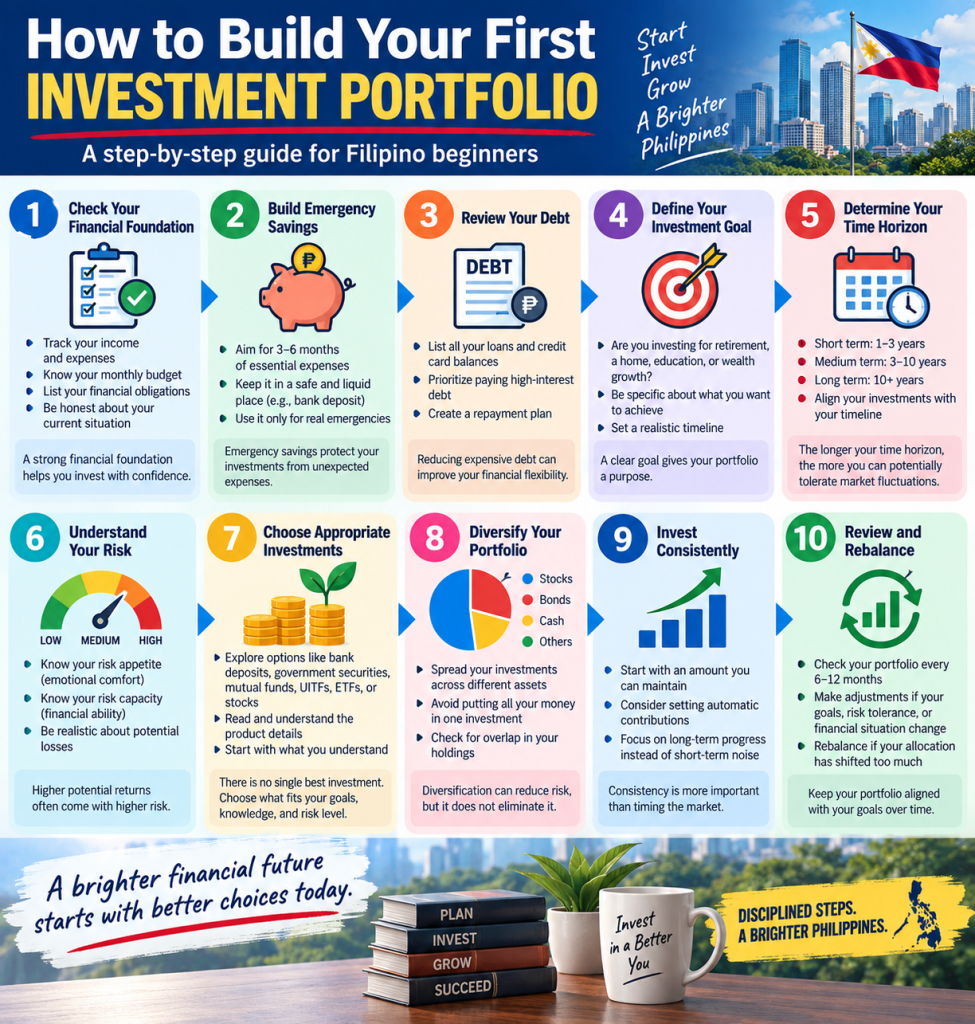
Investing should not come at the expense of basic financial stability.
Before putting substantial money into investments, examine your:
- Monthly income
- Essential expenses
- Emergency savings
- Existing debt
- Insurance needs
- Upcoming financial obligations
- Short-term and long-term goals
BSP’s financial education materials place saving, budgeting, debt management, investing, fraud prevention, and consumer protection within the broader framework of personal financial management.
This matters because money has different jobs.
Money needed next month should not necessarily be exposed to the same level of investment risk as money intended for retirement decades from now.
Keep Emergency Savings Separate
An emergency fund is designed to provide access to money when unexpected expenses occur.
Possible emergencies include:
- Loss of employment
- Medical expenses
- Major home repairs
- Emergency travel
- Unexpected family expenses
- Urgent bills
There is no universal emergency-fund amount that applies to every Filipino.
Someone with a stable salary, low debt, and few dependents may have different needs from a freelancer supporting a family.
The important principle is separation.
Emergency savings are for emergencies. Long-term investments are for long-term goals.
BSP’s investment education materials specifically advise investors to keep investment money separate from emergency funds and savings intended for specific financial goals.
This can also reduce the risk of being forced to sell investments during an unfavorable market period.
Review High-Interest Debt
Debt should also be considered before increasing investment contributions.
Suppose you have a credit-card balance accumulating significant interest while simultaneously investing new money.
Investment returns are uncertain, while the interest charged on debt is a contractual financial cost.
This does not mean everyone must eliminate every debt before investing. Mortgages, business loans, and other forms of borrowing can have very different characteristics.
Instead, look at your complete financial position.
If expensive debt is consuming a large portion of your income, addressing that problem may deserve priority before substantially increasing investment contributions.
Define Your Investment Goal
A portfolio should have a purpose.
Common investment goals include:
- Retirement
- Children’s education
- Home purchase
- Business capital
- Long-term wealth accumulation
- Financial independence
- A future major expense
Write down the goal and when you expect to need the money.
For example:
Goal: Retirement
Time horizon: 25 years
Starting contribution: ₱5,000 per month
Another investor might have:
Goal: House down payment
Time horizon: 4 years
Target: ₱500,000
These investors should not automatically use the same strategy.
The closer a financial goal becomes, the more important it can be to consider whether the portfolio’s volatility is appropriate for the remaining time horizon.
Understand Your Investment Time Horizon
Your investment time horizon is the period between investing the money and when you expect to use it.
A simple framework is:
Short term: Money needed relatively soon.
Medium term: Money intended for a goal several years away.
Long term: Money that can remain invested for many years.
Time horizon is important because investment prices can fluctuate.
Stocks can experience significant short-term declines. Bonds and bond funds can also fluctuate, particularly as interest rates change.
An investor with a long-term retirement objective may have more time to tolerate temporary declines than someone saving for a payment due next year.
A long time horizon does not eliminate risk. It simply gives the investor more time to potentially recover from market fluctuations.
Understand Risk Before Choosing an Investment
Risk is not limited to the possibility that an investment’s price will fall.
Investment risks can include:
- Market risk
- Interest-rate risk
- Credit or issuer risk
- Inflation risk
- Liquidity risk
- Currency risk
- Concentration risk
- Business risk
- Fraud and unauthorized-investment risk
BSP’s investing materials emphasize understanding the risk-return relationship and assessing your risk appetite before choosing investments.
A basic principle is that investments with greater potential returns can involve greater risk.
But this does not mean high risk guarantees high returns.
An investment can carry substantial risk and still produce poor results.
Risk Appetite and Risk Capacity Are Different
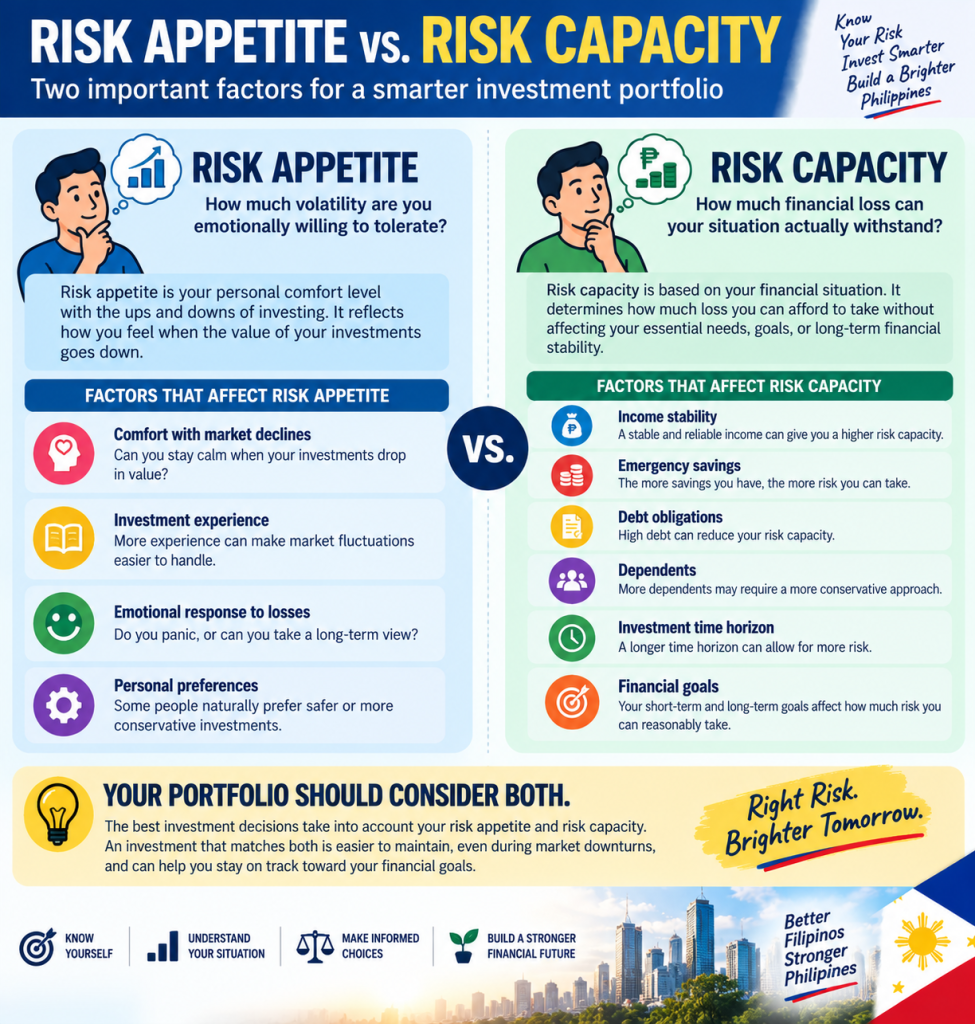
Risk appetite describes how much investment volatility you are willing to accept.
Risk capacity describes how much financial loss you can actually withstand.
These two things can be very different.
For example, a young investor might say they are comfortable with aggressive investments.
But if that investor has:
- No emergency savings
- Unstable income
- Large debts
- Several dependents
their financial capacity to absorb losses may be limited.
Conversely, an investor with substantial savings and stable income may have greater capacity to absorb temporary investment losses while still preferring a conservative portfolio.
A practical portfolio considers both your financial ability and your personal comfort with risk.
The Main Investment Options in the Philippines
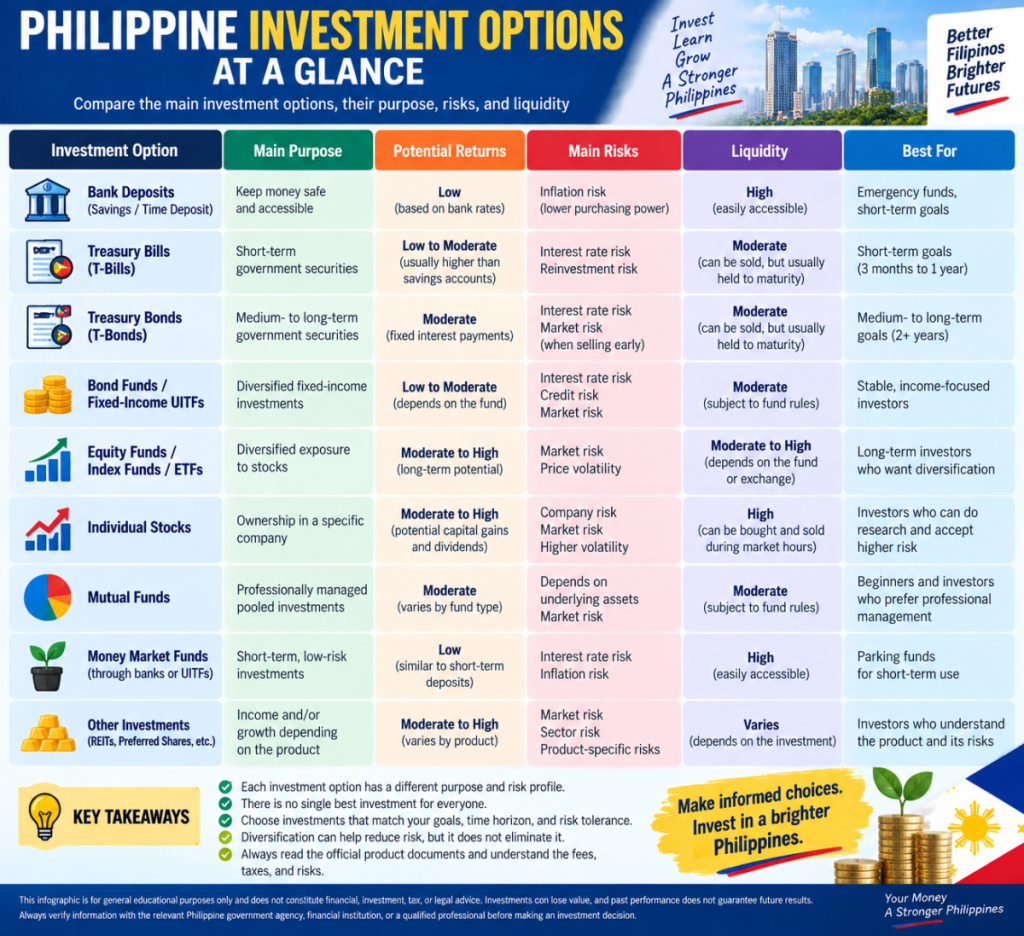
Filipino investors have access to several broad categories of financial products.
Each has a different purpose and risk profile.
Bank Deposits and Savings Products
Bank deposits are primarily designed for saving and liquidity rather than long-term investment growth.
They can be useful for:
- Emergency funds
- Short-term goals
- Cash reserves
- Money that should remain easily accessible
Eligible deposits in PDIC member banks are protected by deposit insurance subject to PDIC rules.
As of 2026, the maximum deposit insurance coverage is ₱1 million per depositor, per bank, effective March 15, 2025.
This protection is important, but it has a specific scope.
PDIC deposit insurance does not mean that stocks, mutual funds, ETFs, or other investment products are protected against investment losses.
Philippine Government Securities
The Philippine government issues securities including Treasury bills and Treasury bonds.
BSP’s financial education program includes government securities such as Treasury bills and Retail Treasury Bonds as part of its investing discussions.
The Bureau of the Treasury publishes schedules and public-offering information for Treasury bills and Treasury bonds. Its 2026 schedule includes regular government-security offerings, while its public-offering pages show current and recent issues.
Government securities are generally considered lower-risk investments compared with many equity investments, but “lower risk” does not mean “risk-free.”
The specific terms matter.
Before purchasing a government security, examine its:
- Maturity
- Interest or discount structure
- Minimum investment
- Purchase channel
- Tax treatment
- Liquidity
- Current offering terms
Do not rely on an old article for the current rate or terms of a Treasury offering. Check the latest Bureau of the Treasury notice.
Stocks
Stocks represent ownership in companies.
When you buy shares of a publicly listed company, you acquire an ownership interest in that company.
Potential sources of return include:
- Increase in share price
- Dividends, when declared
But stock prices can also fall significantly.
Individual-stock investing therefore requires research.
Before buying a company, a beginner should learn about:
- The business model
- Revenue and earnings
- Debt
- Cash flow
- Industry conditions
- Competition
- Corporate disclosures
- Valuation
- Dividend policy
- Major business risks
A familiar company is not automatically a good investment.
Knowing a brand because you see it every day is very different from understanding its financial position.
Mutual Funds
A mutual fund pools money from multiple investors and invests according to a defined strategy.
A fund may invest in:
- Stocks
- Bonds
- Money-market instruments
- Other securities
- A combination of assets
One benefit is that investors can gain exposure to multiple securities without personally selecting every holding.
However, mutual funds differ significantly.
Before investing, review the fund’s official documents and understand:
- Investment objective
- Underlying holdings
- Fees
- Risk level
- Minimum investment
- Redemption procedures
- Historical performance
Past performance does not guarantee future results.
Unit Investment Trust Funds
UITFs are pooled investment products managed by banks or trust institutions.
Like mutual funds, they provide exposure to a portfolio of investments.
But one UITF can be very different from another.
A fixed-income UITF should not be treated as equivalent to an equity UITF simply because both are called UITFs.
Read the product documents and understand what the fund owns, what risks it takes, how fees are charged, and how you can redeem your investment.
Exchange-Traded Funds
Exchange-traded funds, or ETFs, are funds that trade on an exchange.
An ETF can provide exposure to multiple securities through one investment.
However, not all ETFs are broadly diversified.
Some may concentrate on:
- A particular industry
- A particular country
- A particular sector
- A particular investment theme
- A narrow group of securities
Therefore, do not judge diversification by the number of funds in your account.
Look at what those funds actually own.
Investment Options at a Glance
| Investment type | Main role | Key risks | Liquidity considerations |
|---|---|---|---|
| Bank deposits | Emergency and short-term funds | Inflation/purchasing-power risk | Generally high |
| Treasury bills | Shorter-term government securities | Interest-rate and reinvestment considerations | Depends on the product and transaction |
| Treasury bonds | Medium- or longer-term fixed-income exposure | Interest-rate and market risk | Depends on holding period and market |
| Bond funds/UITFs | Diversified fixed-income exposure | Interest-rate and credit risk | Subject to fund rules |
| Equity funds/ETFs | Diversified long-term growth exposure | Market risk | Depends on the product |
| Individual stocks | Direct company ownership | Company and market risk | Generally tradable through the relevant market |
| Mutual funds | Professionally managed pooled investment | Depends on underlying assets | Subject to fund rules |
This table is a starting point, not a ranking.
The appropriate investment depends on the investor’s objective, time horizon, risk capacity, and other circumstances.
Build Your Portfolio Around Asset Allocation
Asset allocation means deciding how your money is distributed across different types of investments.
For example, a portfolio could contain some combination of:
- Growth-oriented assets
- Fixed-income assets
- Cash or cash-like assets
There is no universal percentage that every Filipino should follow.
An allocation suitable for someone investing for retirement over 25 years may not be appropriate for someone who needs the money in three years.
BSP encourages investors to understand their risk appetite, diversify investments, invest for the medium to long term, and develop a portfolio that lets them remain comfortable with the level of risk they are taking.
A Four-Layer Way to Think About Your Portfolio
Instead of immediately searching for a percentage allocation, beginners can think about their money in four layers.
Layer 1: Financial safety
Emergency savings and money needed for immediate obligations.
Layer 2: Stability
Investments that may be suitable for medium-term goals depending on the investor’s circumstances.
Layer 3: Long-term growth
Assets that can fluctuate substantially but may provide long-term growth potential.
Layer 4: Optional or specialized investments
Individual stocks or more specialized investments that you understand and can afford to research.
This is a framework for thinking, not a recommended portfolio allocation.
Its purpose is to prevent a common mistake: treating every peso you own as though it should be invested in exactly the same way.
How Much Money Do You Need to Start?
There is no universal minimum amount needed to begin learning about investing.
The minimum investment depends on the product and provider.
Some financial products may allow relatively small initial investments, while others require substantially more.
The more important question is whether the amount you invest is appropriate for your financial situation.
A person who can comfortably invest ₱1,000 per month may be better served by developing a consistent habit than by waiting years until they believe they have enough money to build a “serious” portfolio.
Example: Investing ₱1,000 a Month
Suppose a hypothetical investor contributes ₱1,000 every month.
The contributions would total:
| Period | Total contributions |
|---|---|
| 1 year | ₱12,000 |
| 5 years | ₱60,000 |
| 10 years | ₱120,000 |
These numbers do not include investment returns, losses, fees, or taxes.
The example demonstrates the importance of consistency rather than predicting what the portfolio will eventually be worth.
A beginner with ₱1,000 does not need to immediately buy several individual stocks.
The initial objective can simply be learning how the investment works and establishing a sustainable contribution habit.
Example: Investing ₱3,000 a Month
A ₱3,000 monthly contribution would result in:
| Period | Total contributions |
|---|---|
| 1 year | ₱36,000 |
| 5 years | ₱180,000 |
| 10 years | ₱360,000 |
Again, these are contributions only.
The investor’s actual account value could be higher or lower depending on investment performance and costs.
Example: Investing ₱5,000 a Month
At ₱5,000 per month:
| Period | Total contributions |
|---|---|
| 1 year | ₱60,000 |
| 5 years | ₱300,000 |
| 10 years | ₱600,000 |
This illustrates an important aspect of long-term investing: your savings rate is one of the factors you can control.
You cannot control the market’s return.
You can control how much you save, how consistently you invest, and how carefully you manage unnecessary costs.
Example: Investing ₱10,000 a Month
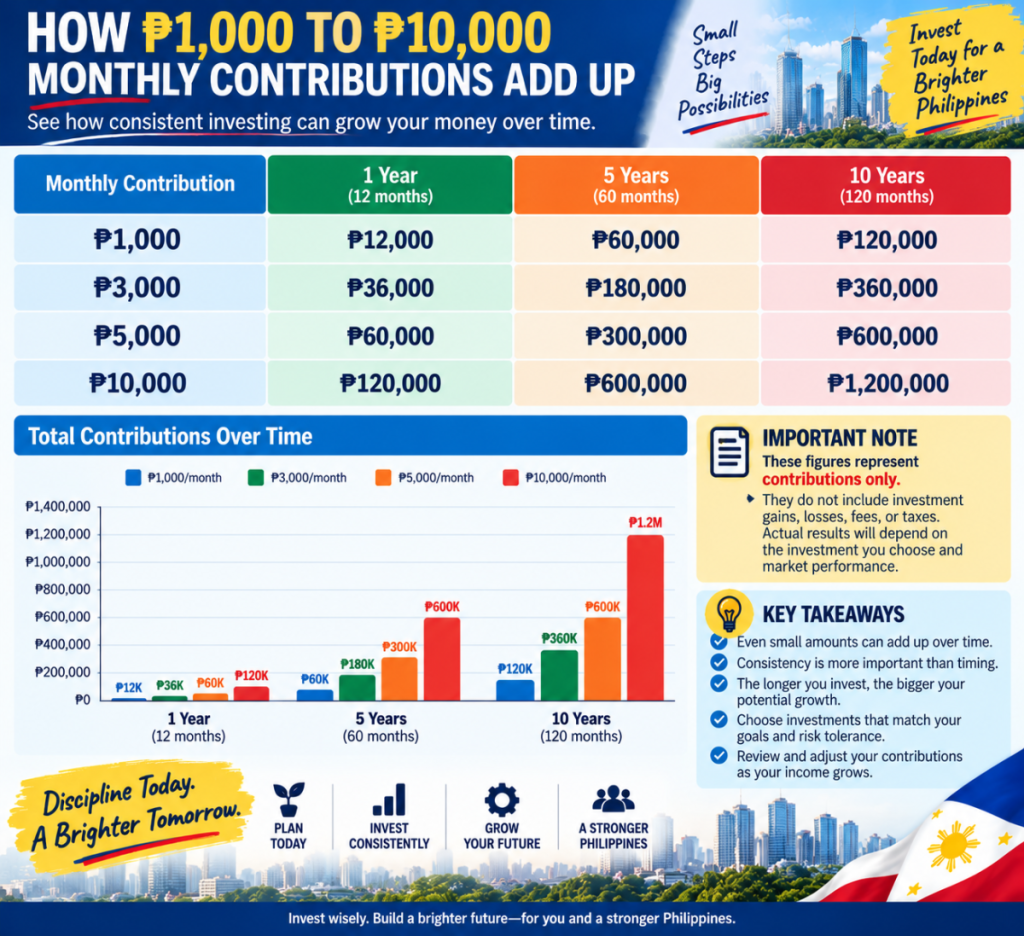
At ₱10,000 per month:
| Period | Total contributions |
|---|---|
| 1 year | ₱120,000 |
| 5 years | ₱600,000 |
| 10 years | ₱1.2 million |
The ₱1.2 million figure is not a prediction of portfolio value.
It is simply the total amount contributed over ten years.
Actual investment performance could cause the portfolio value to be higher or lower.
This distinction should always be made when discussing long-term investing.
Why Diversification Matters
Diversification means spreading investments across different assets, companies, sectors, markets, or other exposures rather than relying heavily on one investment.
BSP describes diversification as an important investing principle and recommends spreading investments across different instruments, companies, industries, and regions with varying risk profiles.
Imagine someone puts almost all of their money into one company.
If that company experiences serious financial problems, the investor’s portfolio can be severely affected.
A diversified portfolio can reduce the impact of one individual holding performing badly.
However, diversification does not eliminate investment risk.
A broad market decline can still affect many investments simultaneously.
Diversification is primarily a way to reduce unnecessary concentration.
Diversification Does Not Mean Owning Everything
Some investors respond to the idea of diversification by buying as many products as possible.
That can create another problem: overlap.
Suppose you own three different funds.
If all three funds hold many of the same companies, your actual exposure may be more concentrated than the number of fund names suggests.
Before adding another investment, ask:
What does this investment add that I do not already own?
If you cannot answer that question, research the underlying holdings before buying.
The Five-Question Portfolio Test
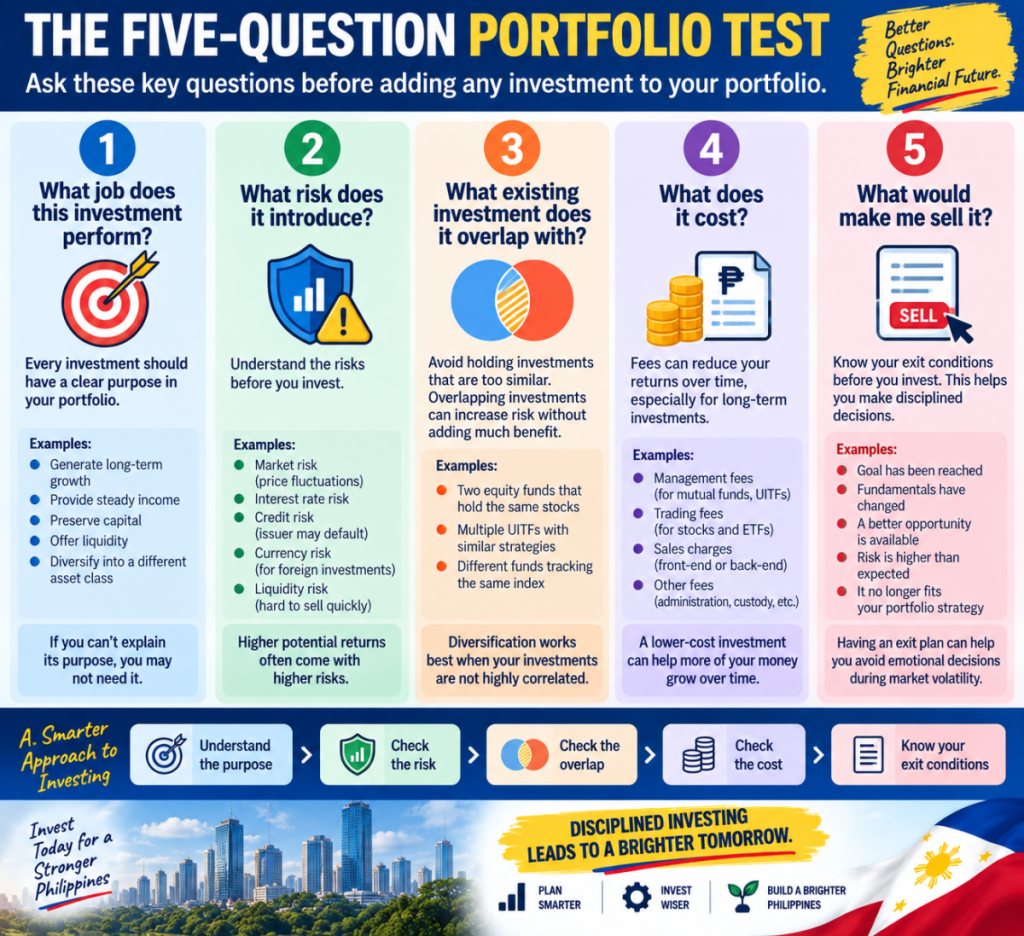
A useful original framework for beginners is to ask five questions before adding any investment to the portfolio.
1. What job does this investment perform?
Is it intended for long-term growth, income, stability, diversification, or liquidity?
2. What risk does it introduce?
Could the price fall? Could the issuer have problems? Is liquidity limited?
3. What existing investment does it overlap with?
Look at the underlying holdings rather than only the product name.
4. What does it cost?
Check management fees, transaction costs, spreads, taxes, and other charges.
5. What would make me sell it?
Decide whether you would sell because your financial goal changed, the investment thesis changed, or your portfolio became inappropriate—not simply because the price moved for a few days.
These five questions can help prevent impulsive additions to a portfolio.
Understand Investment Fees
Fees can reduce the amount of money that remains invested.
Depending on the product, you may encounter:
- Trading commissions
- Management fees
- Fund expenses
- Transaction charges
- Platform fees
- Bid-ask spreads
- Taxes
- Administrative charges
The exact costs vary by product and provider.
A beginner should read the official fee schedule rather than assuming that investing is free because an application or website does not charge an obvious account-opening fee.
When comparing two investments, consider the total cost rather than focusing only on the advertised return.
Understand Taxes Before Investing
Investment income can have tax consequences.
The applicable treatment can depend on the type of investment, transaction, investor, and other circumstances.
For example, interest income, dividends, and certain gains may be subject to different rules.
Tax regulations can also change.
For this reason, avoid relying on an old investment blog for current tax rates.
When the tax impact is material, verify the applicable rule with the Bureau of Internal Revenue, the financial institution, or a qualified tax professional.
How to Research an Investment Before Sending Money
Research should happen before you transfer money, not after.
Start with the official information.
Look for:
- The legal identity of the provider
- Relevant regulatory information
- Official product documents
- Investment objectives
- Risk disclosures
- Fees
- Withdrawal rules
- Contact information
- Financial statements or disclosures where applicable
The SEC maintains investor-education resources that include Investment 101 and an Investment Scam Checklist. Its current website also publishes public advisories concerning unauthorized investment solicitation and other investment-related activities.
A company being registered does not automatically mean that it is authorized to conduct every type of investment activity.
Verify the relevant authorization for the specific activity being offered.
Warning Signs of a Questionable Investment
Be especially careful when an opportunity involves:
- Guaranteed high returns
- Fixed daily profits
- “No-risk” claims
- Pressure to invest immediately
- Secret investment strategies
- Requests to recruit friends before earning
- Requests to send money to a personal account
- Unclear explanations of where the money goes
- No official documents
- Unverifiable company information
- Claims based primarily on screenshots of profits
A legitimate investment can still lose money.
That is why understanding the downside is just as important as understanding the potential return.
Be Careful With Social-Media Investment Advice
Social media can help people discover financial topics, but it is not automatically a reliable source of investment advice.
A screenshot showing a ₱50,000 profit does not tell you:
- How much money was invested
- Whether the gain was realized
- How long the investment was held
- What losses occurred
- What fees were paid
- What risks were taken
- Whether the result was typical
Treat social-media claims as information that needs verification.
Use official documents and credible financial sources for the facts that matter.
Do Not Invest Because You Feel Left Behind
Market enthusiasm can create pressure.
You may see friends posting gains, influencers discussing a stock, or online communities claiming that everyone is making money.
This can create a fear of missing out.
But an investment should be evaluated based on your own financial plan.
If you buy something simply because everyone else appears to be making money, you may have no clear plan for what happens when prices fall.
A written investment process can help reduce this type of emotional decision-making.
Create a Personal Investment Plan
Your plan does not need to be complicated.
For example:
Goal: Long-term retirement
Time horizon: 20+ years
Monthly contribution: ₱5,000
Investment approach: Diversified portfolio appropriate to risk profile
Review schedule: Every six or twelve months
Rule: Avoid changing the strategy solely because of short-term market news
The exact details should reflect your circumstances.
The important part is having a process before emotions influence your decisions.
Invest Consistently, But Understand What It Does Not Guarantee
Regular investing can help establish discipline.
For someone receiving a monthly salary, a predetermined investment contribution can be easier to maintain than repeatedly deciding whether “today” is the perfect time to invest.
But regular investing does not guarantee profit.
The market can decline after you make a contribution.
Its main benefit is that it creates a repeatable process and reduces the temptation to make every decision based on short-term price movements.
Increase Your Contributions as Your Income Grows
Portfolio growth does not depend entirely on investment returns.
Your savings rate also matters.
Suppose someone starts investing ₱2,000 per month.
After receiving a salary increase, they might increase their contribution to ₱3,000.
Later, it could become ₱5,000.
The actual amount depends on income, expenses, debt, and other goals.
This approach allows the investment plan to grow alongside the investor’s earning capacity.
Review Your Portfolio Periodically
Long-term investors generally do not need to make decisions every day.
Constantly checking prices can encourage emotional reactions.
Instead, establish a review schedule.
For example, review the portfolio every six or twelve months.
During the review, ask:
- Has my financial goal changed?
- Has my income changed?
- Has my emergency fund changed?
- Has my time horizon changed?
- Has my risk tolerance changed?
- Has the portfolio become too concentrated?
- Have fees changed?
- Does each investment still have a purpose?
The purpose of reviewing the portfolio is not to generate more transactions.
It is to make sure the portfolio continues to match your circumstances.
Understand Portfolio Rebalancing
Rebalancing means adjusting a portfolio when its asset allocation has moved significantly away from the investor’s intended structure.
Imagine a hypothetical portfolio containing growth-oriented investments and fixed-income investments.
If the growth portion performs strongly for several years, it could eventually represent a much larger percentage of the portfolio than originally intended.
The investor may then decide to rebalance.
Rebalancing can sometimes be accomplished through new contributions rather than selling investments.
For example, if one part of the portfolio has fallen below its intended allocation, future contributions could be directed toward that area.
The appropriate method depends on the investment product, transaction costs, taxes, and personal circumstances.
Common Beginner Investment Mistakes
Many investing mistakes are behavioral rather than mathematical.
Common examples include:
- Investing emergency money
- Borrowing money to speculate
- Putting too much money into one company
- Chasing investments after large price increases
- Selling everything during a market decline
- Following anonymous online tips
- Ignoring fees
- Ignoring taxes
- Buying products that are not understood
- Owning overlapping funds without realizing it
- Assuming past performance will continue
- Believing guaranteed-return claims
- Changing strategies constantly
- Sending money to unverified individuals
- Investing without understanding how the investment works
Avoiding these mistakes can be more valuable than learning a complicated trading strategy.
A Practical 12-Month Plan for Building Your First Portfolio
You do not have to build a complicated portfolio in one day.
A gradual process can help you learn before committing larger amounts.
Months 1–2: Organize your finances
Track income, expenses, debt, savings, and financial goals.
Determine how much you can realistically invest every month.
Months 3–4: Learn the fundamentals
Study stocks, bonds, funds, government securities, diversification, risk, fees, and taxes.
Prioritize primary sources and official product documents.
Months 5–6: Research providers
Compare available investment accounts and products.
Check fees, minimum amounts, withdrawal procedures, available investments, and relevant regulatory information.
Months 7–8: Start with a manageable amount
Begin with an amount that does not interfere with essential expenses or emergency savings.
Your first objective is to build experience and discipline.
Months 9–10: Examine diversification
Review the investments you own.
Look at underlying holdings and determine whether you have unnecessary concentration or overlap.
Months 11–12: Review your system
Evaluate your contribution rate, financial goals, risk tolerance, costs, and portfolio structure.
Make deliberate adjustments rather than reacting to short-term market movements.
A Simple First-Portfolio Checklist
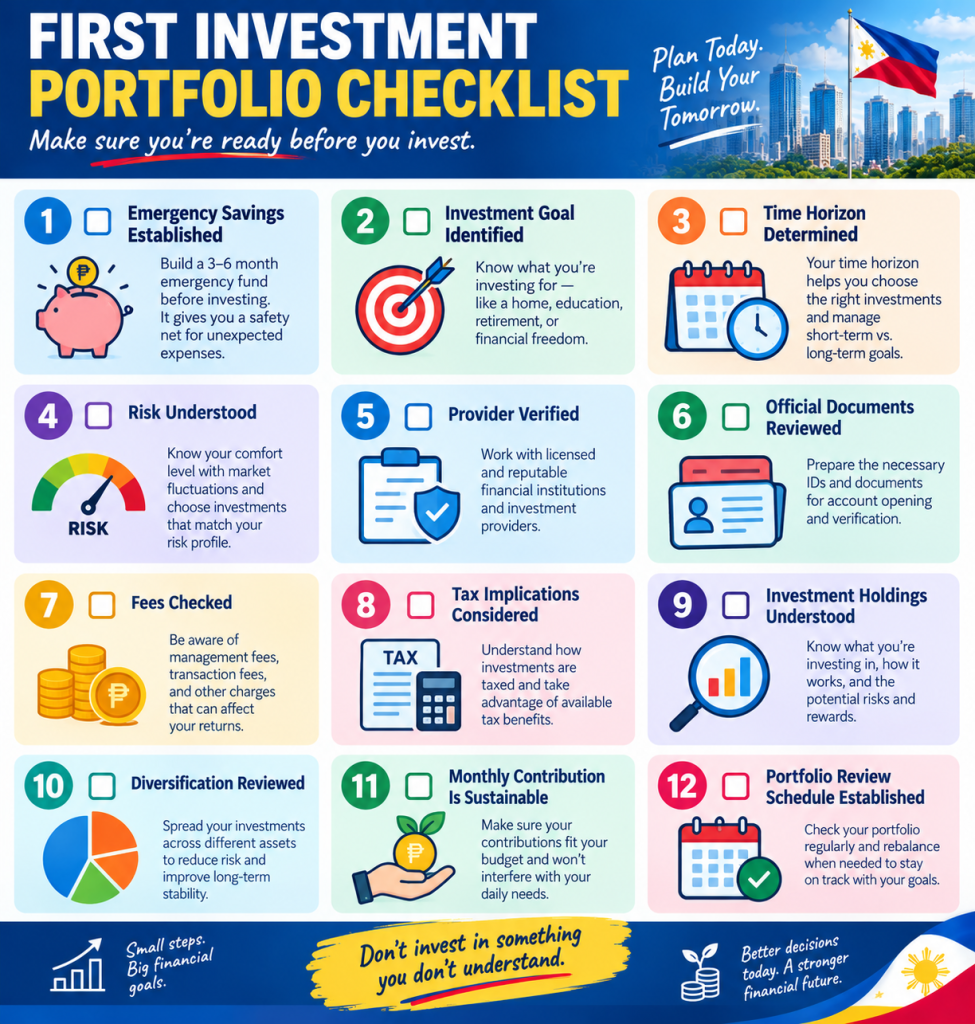
Before investing, ask yourself:
☐ Do I have emergency savings?
☐ Do I know what I am investing for?
☐ Do I know when I may need the money?
☐ Do I understand the investment’s major risks?
☐ Do I understand how it potentially generates returns?
☐ Have I checked the fees?
☐ Have I considered taxes?
☐ Have I verified the provider?
☐ Have I checked the official product documents?
☐ Do I understand what the investment actually owns?
☐ Can I tolerate a temporary decline in value?
☐ Am I investing money I can afford to leave invested?
If you cannot answer several of these questions, there is no need to rush.
More research may be the better next step.
How to Make a Portfolio More Sustainable
A portfolio should be something you can maintain.
That means considering your actual income and lifestyle rather than designing a portfolio based on an unrealistic savings target.
For example, promising yourself that you will invest ₱20,000 every month when your budget can realistically support only ₱5,000 may lead to repeated withdrawals or abandoned plans.
A smaller contribution that you can sustain may be more practical.
The same principle applies to risk.
If a portfolio is so aggressive that a normal market decline causes you to panic and sell, the portfolio may not be appropriate for you even if it looked attractive on paper.
BSP describes the concept of a “sleep-well” investment portfolio as one that allows investors to remain comfortable with the amount of risk they are taking while their other needs and financial goals are being addressed.
When Professional Financial Advice May Help
Some beginners can manage a straightforward portfolio after learning the basics.
Others may benefit from professional advice, particularly when their finances become more complicated.
Professional guidance may be useful when you have:
- Significant investment assets
- Multiple income sources
- Business interests
- Complex tax circumstances
- Estate-planning needs
- Several competing financial goals
- Retirement-planning concerns
- Difficulty determining appropriate risk levels
If you consult a financial professional, understand their qualifications and how they are compensated.
Ask whether they receive commissions or other compensation from products they recommend.
Understanding potential conflicts of interest is part of responsible financial decision-making.
The Five Questions to Ask Before Every New Investment
Before adding any investment to your portfolio, return to the five-question test:
What job does this investment perform?
If you cannot explain its purpose, reconsider whether you need it.
What risk does it introduce?
Understand what can cause the investment to lose value.
What does it overlap with?
Check whether you already have similar exposure elsewhere.
What does it cost?
Look at fees, spreads, taxes, and other charges.
What would make you sell?
Define the circumstances before you become emotionally attached to the investment.
This simple process can help turn a collection of financial products into an intentional portfolio.
What Your First Portfolio Does Not Need to Do
Your first portfolio does not need to:
- Beat the stock market every year
- Contain dozens of investments
- Generate immediate passive income
- Make you rich quickly
- Follow the latest investment trend
- Copy an influencer’s portfolio
- Predict the next market winner
Its primary purpose is to provide a structured way of investing toward your financial goals.
As your knowledge, income, and assets grow, the portfolio can evolve.
Final Thoughts on Building Your First Investment Portfolio
Building your first investment portfolio in the Philippines is not about finding one magical investment.
It is about creating a financial system that you understand and can maintain.
Start with your financial foundation.
Build appropriate emergency savings, understand expensive debt, define your financial goals, identify your time horizon, and determine how much investment risk you can realistically handle.
Then learn how different investments work.
Stocks can provide long-term growth potential but can experience significant price declines. Government securities can provide a different risk and income profile. Funds can provide diversification, but their holdings, fees, and risks still need to be understood. Bank deposits can provide liquidity, and qualifying deposits in PDIC member banks currently have deposit insurance coverage of up to ₱1 million per depositor per bank, subject to PDIC rules.
Diversification can reduce concentration risk, but it cannot eliminate investment losses.
Regular investing can help establish discipline, but it cannot guarantee returns.
And no legitimate investment strategy can remove uncertainty from financial markets.
For Filipino beginners, one of the most useful principles is therefore simple:
Understand your money before trying to grow it.
Do not invest because somebody on social media says an opportunity is guaranteed.
Do not invest money you need for an emergency.
Do not buy a financial product you cannot explain.
And do not assume that a company or investment offer is legitimate simply because it looks professional online.
Instead, research the investment, verify the provider, read the official documents, understand the risks and costs, and make sure the investment has a clear role in your financial plan.
Your first portfolio does not need to be perfect.
It needs to be understandable, appropriately diversified, financially sustainable, and aligned with your goals.
Over time, the most valuable result may not simply be the amount of money you accumulate. It may be the development of a disciplined financial habit that allows you to make better decisions as your income, responsibilities, and investment experience grow.
This article is for general educational purposes only and does not constitute personalized financial, investment, tax, or legal advice. Investments can lose value, and past performance does not guarantee future results. Financial products, fees, tax rules, regulations, and government-security offerings can change. Verify current information with the relevant Philippine government agency, regulator, financial institution, official product document, or qualified professional before making an investment decision.
Sources and Official References
Bangko Sentral ng Pilipinas — Financial Education Learning Modules: BSP’s financial education resources cover financial planning, saving and budgeting, debt management, investing, fraud and scam prevention, and consumer protection. Its investing module specifically discusses inflation, investment instruments, risk-return trade-offs, and assessing risk appetite. BSP Financial Education Learning Modules
Bangko Sentral ng Pilipinas — Investing and Financial Education: BSP’s investor-education materials discuss investigating investments before investing, understanding risk and returns, investing only what you can afford to lose, investing over the medium to long term, and diversification. BSP Investor Education Materials
Bureau of the Treasury — Government Securities: The Bureau of the Treasury publishes official schedules for Philippine Treasury bills and Treasury bonds. Its government-security schedule includes 2026 offerings and is useful for checking current issuance information rather than relying on outdated investment articles. Bureau of the Treasury — Government Securities Schedule
Bureau of the Treasury — Public Offerings: The BTr also publishes current public-offering announcements for Treasury bills and Treasury bonds, including September 2026 offerings. Readers should check the latest notice for current terms and offering details. Bureau of the Treasury — Public Offerings
Philippine Deposit Insurance Corporation — Deposit Insurance: PDIC currently provides maximum deposit insurance coverage of ₱1 million per depositor, per bank. The current coverage took effect on March 15, 2025, subject to applicable PDIC rules. PDIC — Deposit Insurance
Securities and Exchange Commission Philippines — Investment 101: The SEC’s investor-education materials advise investors to be cautious about quick-profit schemes, high-pressure investment offers, “hot tips,” and guaranteed-return claims. The SEC also advises investors to request and review appropriate offering and financial documents and verify whether an entity has the necessary authority for the activity it is conducting. SEC Philippines — Investment 101
Securities and Exchange Commission Philippines — Investor Education and Information: The SEC provides investor-education resources, including Investment 101, the Investment Scam Checklist, advisories, and other investor information. SEC Philippines — Investor Education and Information





 Facebook
 Twitter