

The cost of living in Davao City in 2026 depends largely on housing, food choices, transportation, household size and lifestyle. For a single person, a monthly take-home income of around ₱30,000 to ₱40,000 can support a reasonably comfortable lifestyle with controlled spending, while ₱40,000 to ₱50,000 or more provides greater room for better housing, leisure and savings. Families and households with larger financial commitments will naturally need a higher budget.
If you are planning to move to Davao City, start working there, or simply want to know whether your current salary is enough, a realistic monthly budget matters more than a single “cost of living” number.
In 2026, a single person can live reasonably well in Davao City with around ₱30,000 to ₱40,000 per month, provided housing and lifestyle choices are controlled. A more comfortable lifestyle, with better housing, regular dining out, transportation flexibility, savings, and room for unexpected expenses, is more realistically supported by ₱40,000 to ₱50,000 or more in monthly take-home income.
For couples, a combined household income of around ₱50,000 to ₱70,000 can provide a workable lifestyle, while families generally need more depending on rent, school expenses, healthcare, transportation, and the number of dependents.
These are not official “required income” figures. They are practical budget estimates based on typical household expense categories and current 2026 economic conditions. Davao’s prices also vary considerably depending on where you live, whether you rent or own, how often you eat outside, and how much you spend on transportation and leisure.
The timing is also important. The Philippine Statistics Authority has reported significant price increases in Davao and the wider Davao Region during 2026. In July 2026, Davao Region’s headline inflation reached 8.4%, while the inflation rate for bottom-30%-income households reached 11.6%. The July report showed particularly strong increases in food and housing-related costs.
That means older cost-of-living estimates should not automatically be treated as accurate for 2026.
For a single person living alone, a practical monthly budget can look like this:
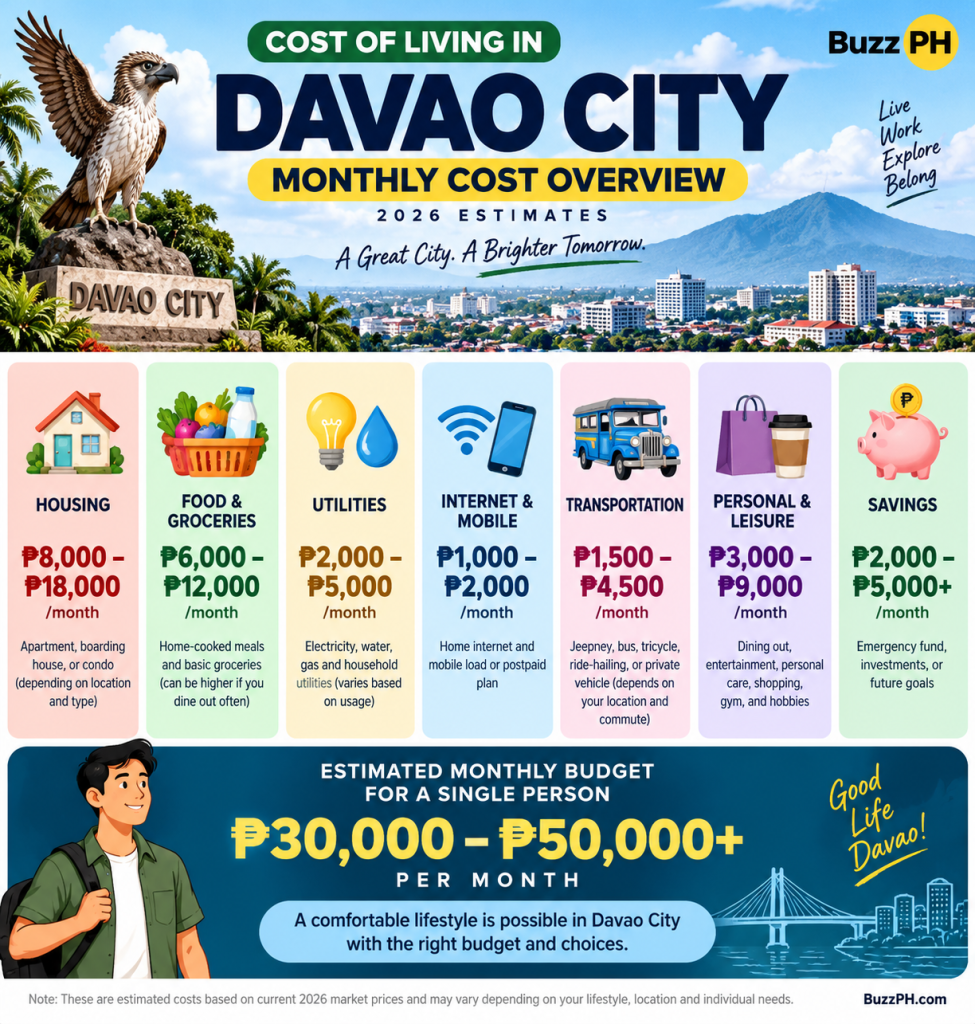
| Expense | Basic-Comfortable | More Comfortable |
|---|---|---|
| Rent | ₱8,000–₱12,000 | ₱12,000–₱18,000 |
| Food & groceries | ₱6,000–₱8,000 | ₱8,000–₱12,000 |
| Electricity & water | ₱2,000–₱3,500 | ₱3,000–₱5,000 |
| Internet & mobile | ₱1,000–₱1,500 | ₱1,200–₱2,000 |
| Transportation | ₱1,500–₱3,000 | ₱2,500–₱4,500 |
| Personal & household expenses | ₱1,500–₱2,500 | ₱2,500–₱4,000 |
| Leisure/dining out | ₱1,500–₱3,000 | ₱3,000–₱5,000 |
| Savings/emergency allowance | ₱2,000–₱4,000 | ₱5,000+ |
| Estimated total | ₱23,500–₱37,500 | ₱37,200–₱55,500+ |
The most important variable is housing. Someone who rents a modest room or apartment outside the most expensive areas can keep monthly expenses considerably lower than someone renting a newer condominium in a central location.
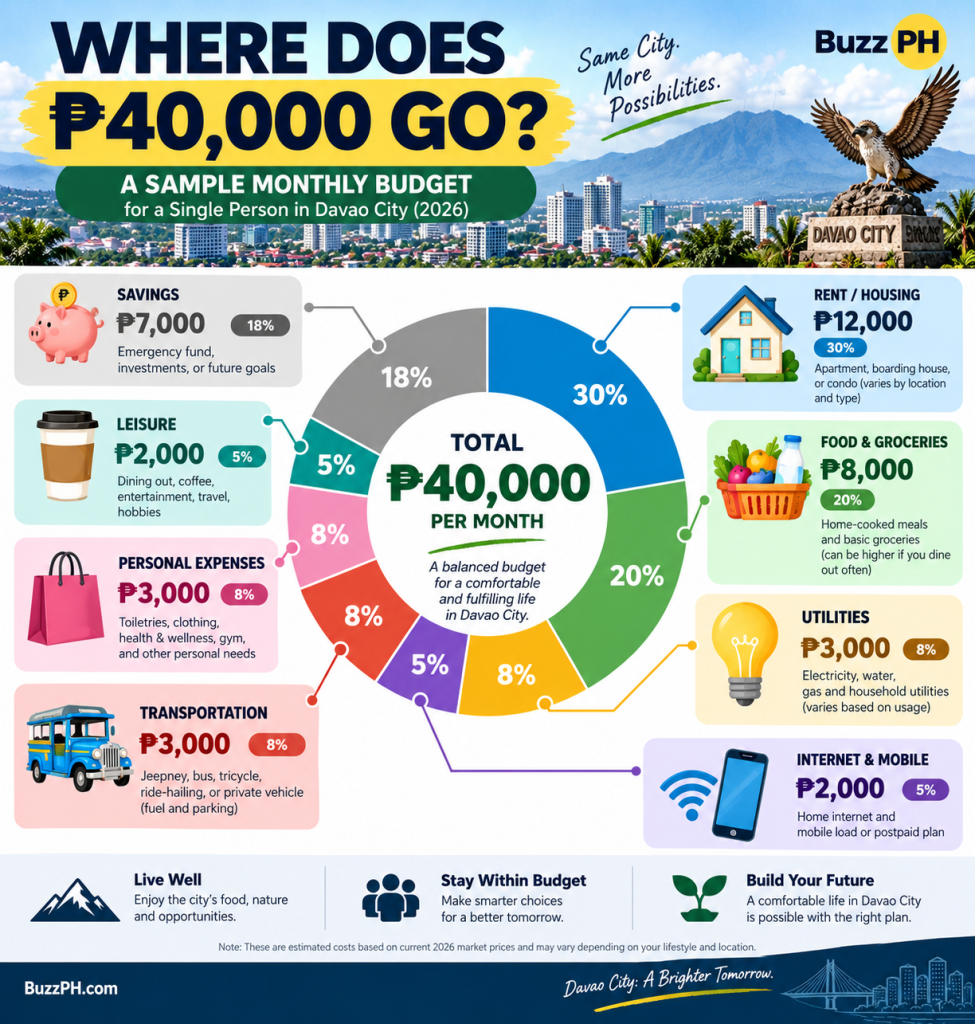
Housing should therefore be evaluated together with transportation. Saving ₱3,000 on rent is not necessarily a saving if the cheaper property requires expensive daily transportation or significantly increases travel time.
For a single professional, ₱30,000 a month can be enough to live in Davao City, but it does not provide unlimited flexibility. A person earning that amount may need to choose a reasonably priced rental, cook frequently, use public transportation, limit frequent restaurant meals, and maintain a controlled entertainment budget.
At ₱40,000 per month, the situation becomes noticeably more comfortable. There is more room for better accommodation, occasional ride-hailing, eating out, hobbies, subscriptions, and regular savings.
At ₱50,000 or more, a single person can generally create a much stronger financial buffer, assuming lifestyle inflation is kept under control. The extra income can go toward emergency savings, investments, insurance, travel, or other financial goals instead of simply increasing monthly consumption.
Food is another major variable. Davao is surrounded by agricultural and fishing areas, but that does not mean every household will automatically have a low grocery bill. Food prices have been moving significantly in 2026. The PSA reported that Davao Region’s bottom 30% income households experienced 13.1% food inflation in July 2026, while housing, water, electricity, gas and other fuels recorded 16.9% inflation for that group.
Your food budget therefore depends heavily on how you eat.
A single person who mostly cooks at home and buys groceries carefully may be able to work within roughly ₱6,000 to ₱8,000 per month. Someone who regularly orders food, eats at restaurants, buys coffee, or prefers premium groceries can easily spend ₱10,000 or more.
A useful strategy is to separate groceries from discretionary food spending. For example, a ₱7,000 grocery budget and a separate ₱2,000 dining-out budget makes spending easier to monitor than treating everything as one food category.
Utilities also deserve more attention than they usually receive in simple cost-of-living articles. Electricity consumption can change dramatically depending on air-conditioning, appliances, work-from-home equipment, and the size of the home.
A person who rarely uses air-conditioning may have a very different electricity bill from someone who runs an air-conditioner for several hours every day. A work-from-home household with multiple computers can also consume more electricity.
Water is another household cost that should be included, although its impact is generally smaller than rent or electricity for many households. Davao City Water District provides official water-rate and billing information through its website, making it a better reference point than relying on old social-media posts or outdated cost-of-living articles.
Transportation is where location can make a major difference.
Someone living close to work can potentially keep transportation expenses relatively low by using jeepneys, buses, walking, or occasional ride-hailing. Someone living farther away may spend considerably more each month, especially when using motorcycles, private vehicles, taxis, or ride-hailing services regularly.
This is why a “cheap rent” strategy should not be evaluated by rent alone. Consider the combined cost of rent + transportation + time.
For example, suppose Apartment A costs ₱9,000 per month and Apartment B costs ₱13,000. If Apartment B reduces daily transportation costs by ₱1,500 and saves significant commuting time, the ₱4,000 difference in rent may not represent the true financial difference.
The same principle applies to food. Living near a workplace, market, grocery store, or public transportation route can reduce several smaller expenses simultaneously.
Another useful benchmark is local wages. Under Wage Order No. RB XI-24, the Davao Region’s non-agricultural minimum wage increased to ₱525 per day upon the first tranche and is scheduled to reach ₱540 per day effective September 1, 2026. The NWPC estimates the corresponding monthly minimum wage at ₱14,085 upon full implementation.
That figure is important because it shows the difference between the legal minimum wage and the income required for a comfortable independent lifestyle.
A minimum-wage worker living alone and paying full market rent may find it difficult to cover housing, food, utilities, transportation and savings from wages alone. Sharing accommodation, living with family, receiving household support, or having another income source can significantly change the calculation.
This does not mean Davao City is unaffordable. It means that “living in Davao” and “living comfortably in Davao” are two different financial targets.
Here is a practical way to think about different monthly income levels for a single person:
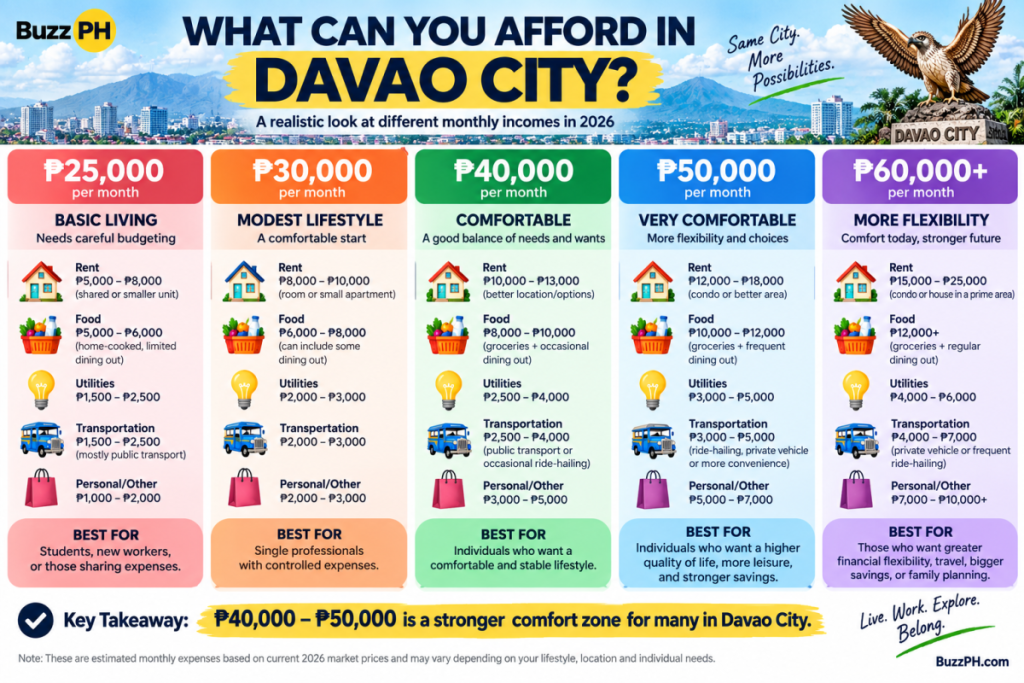
| Monthly Take-Home Income | What It Can Generally Support |
|---|---|
| ₱20,000–₱25,000 | Basic lifestyle; careful housing and spending required |
| ₱25,000–₱30,000 | Modest independent lifestyle with controlled expenses |
| ₱30,000–₱40,000 | Reasonably comfortable for a single person |
| ₱40,000–₱50,000 | Comfortable with better housing, leisure and savings |
| ₱50,000–₱60,000+ | Very comfortable for many singles if lifestyle remains controlled |
| ₱60,000+ | Greater flexibility for housing, travel, savings and lifestyle |
These ranges should not be interpreted as guarantees. Two people earning the same salary can have completely different financial situations.
Someone earning ₱35,000 and paying ₱8,000 in rent may have more disposable income than someone earning ₱45,000 while paying ₱18,000 in rent, financing a car, eating out frequently, and supporting family members.
For couples, the calculation changes because some expenses can be shared. Rent, internet, electricity and some household costs do not necessarily double when two people live together.
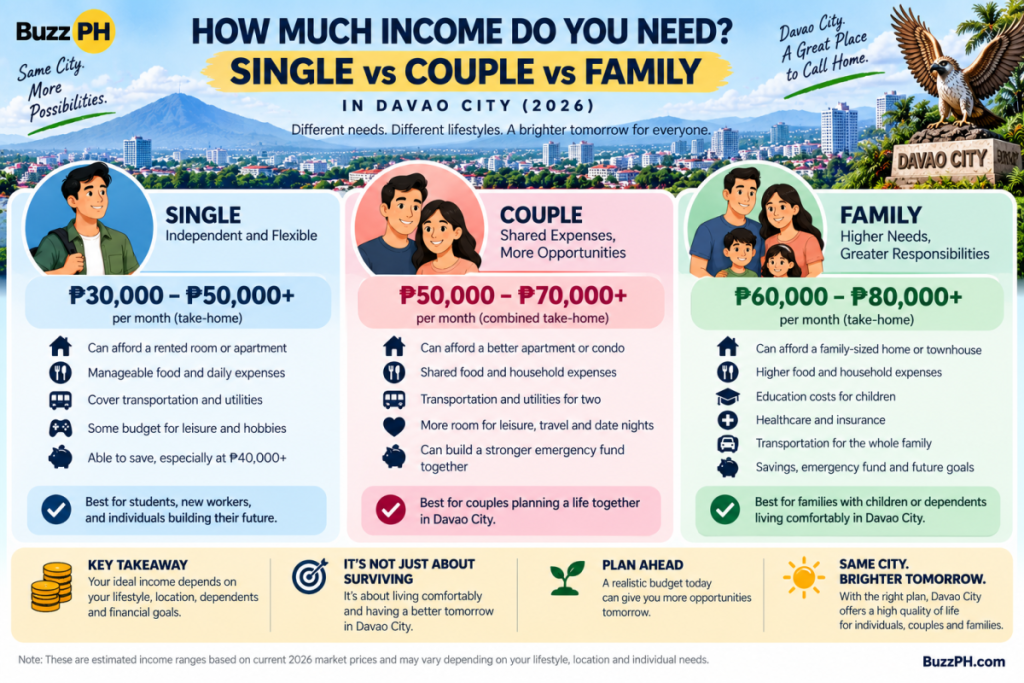
A couple with a combined income of ₱50,000 to ₱60,000 can potentially live comfortably if housing is reasonably priced and they do not have major debt or large dependent-related expenses. A combined income of ₱70,000 or more provides substantially more room for savings, dining out, travel and higher-quality housing.
Families require a different benchmark altogether.
A family with children may have expenses that do not appear in a single-person budget, including tuition, school supplies, childcare, healthcare, larger grocery purchases, transportation and family activities. Because of this, a household earning ₱60,000 may feel comfortable for one couple but considerably tighter for a family with several children.
A reasonable starting point for a small family might be ₱60,000 to ₱80,000 per month, while households with private-school tuition, vehicle expenses, higher rent, healthcare costs, or multiple dependents may require considerably more.
One of the biggest mistakes when estimating a “comfortable” salary is forgetting savings.
If your entire monthly income disappears into rent, food, utilities, transportation and entertainment, you may be surviving comfortably rather than living financially securely.
A stronger definition of comfortable living includes the ability to handle an unexpected medical bill, appliance replacement, temporary loss of income, travel requirement, or other emergency without immediately borrowing money.
For this reason, someone earning ₱40,000 but saving ₱5,000 to ₱8,000 every month may be in a healthier position than someone earning ₱50,000 and spending the entire amount.
For a person planning to move to Davao City, a useful target is to build an emergency fund equivalent to several months of essential expenses before increasing discretionary spending.
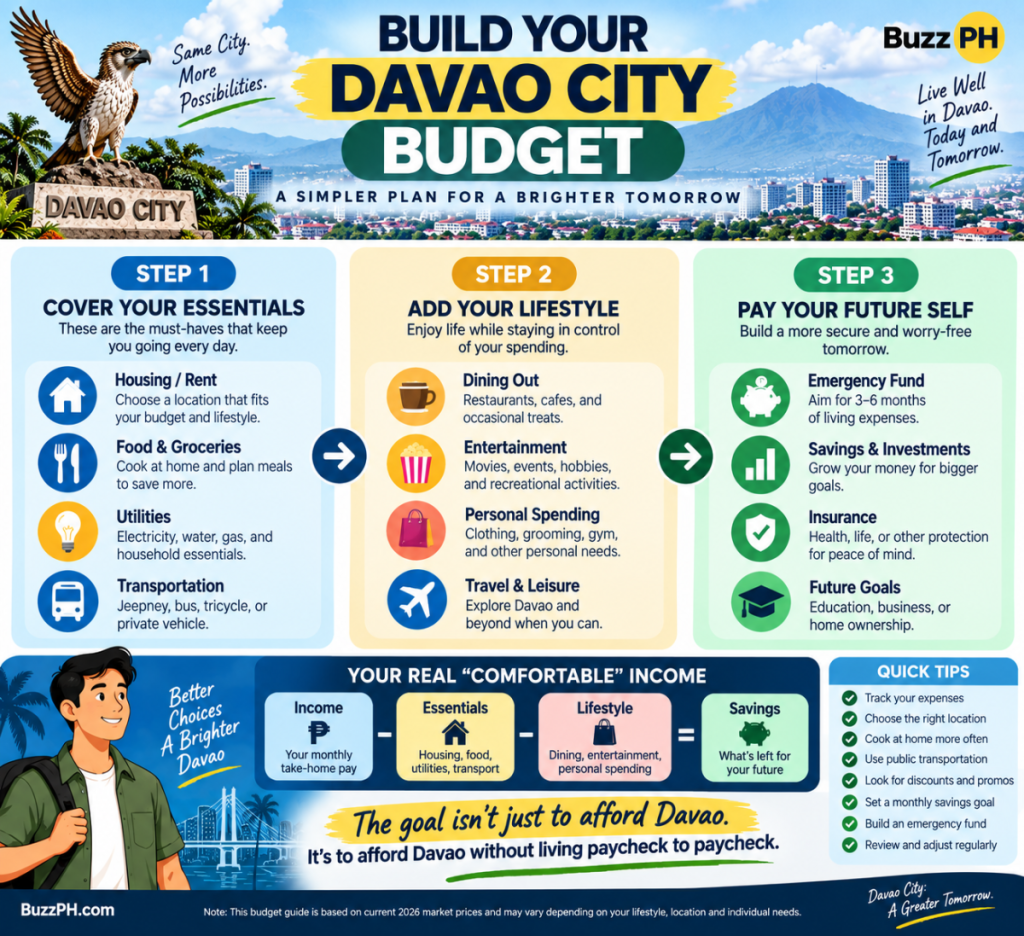
The city also offers an important advantage: you do not necessarily need a luxury lifestyle to enjoy a good quality of life. People can choose between different neighborhoods, housing types, food options and transportation arrangements. The right combination can make a significant difference to monthly expenses.
The best approach is therefore not to ask, “How much does it cost to live in Davao?”
A better question is, “What kind of life do I want to live in Davao, and how much will that lifestyle cost?”
For a single person, ₱30,000 to ₱40,000 in monthly take-home income is a reasonable practical target for a comfortable but controlled lifestyle in 2026. If you want better housing, frequent dining out, more transportation flexibility and stronger savings, ₱40,000 to ₱50,000 or more is a safer target.
For couples, a combined income of around ₱50,000 to ₱70,000 can provide a comfortable foundation, while families should generally budget higher based on the number of dependents and education-related costs.
The most important point is that these numbers are starting points, not fixed rules. Davao City’s inflation and household costs continue to change, and individual spending patterns can produce very different results. PSA data shows that 2026 has brought meaningful price pressure in food, transportation and housing-related categories, so anyone planning a move should review current prices rather than relying entirely on older online estimates.
If you are considering moving to Davao City, the safest approach is to calculate your own budget using your expected rent, food habits, transportation needs, debt payments, family obligations and savings target. Once those numbers are clear, you can determine whether ₱30,000, ₱40,000, ₱50,000 or a higher income actually fits the lifestyle you want.
In 2026, Davao City remains capable of supporting a comfortable lifestyle at a wide range of income levels—but “comfortable” becomes much easier when your housing costs are controlled and your budget includes savings from the beginning.
Sources and research basis: Philippine Statistics Authority (PSA) Davao Region inflation and consumer-price reports; National Wages and Productivity Commission/Regional Tripartite Wages and Productivity Board XI wage information; Davao City Water District official rate and billing resources. Third-party cost-of-living figures were treated only as supplementary reference material, while the sample budgets and income thresholds above are editorial calculations rather than official government estimates.








 Facebook
 Twitter