
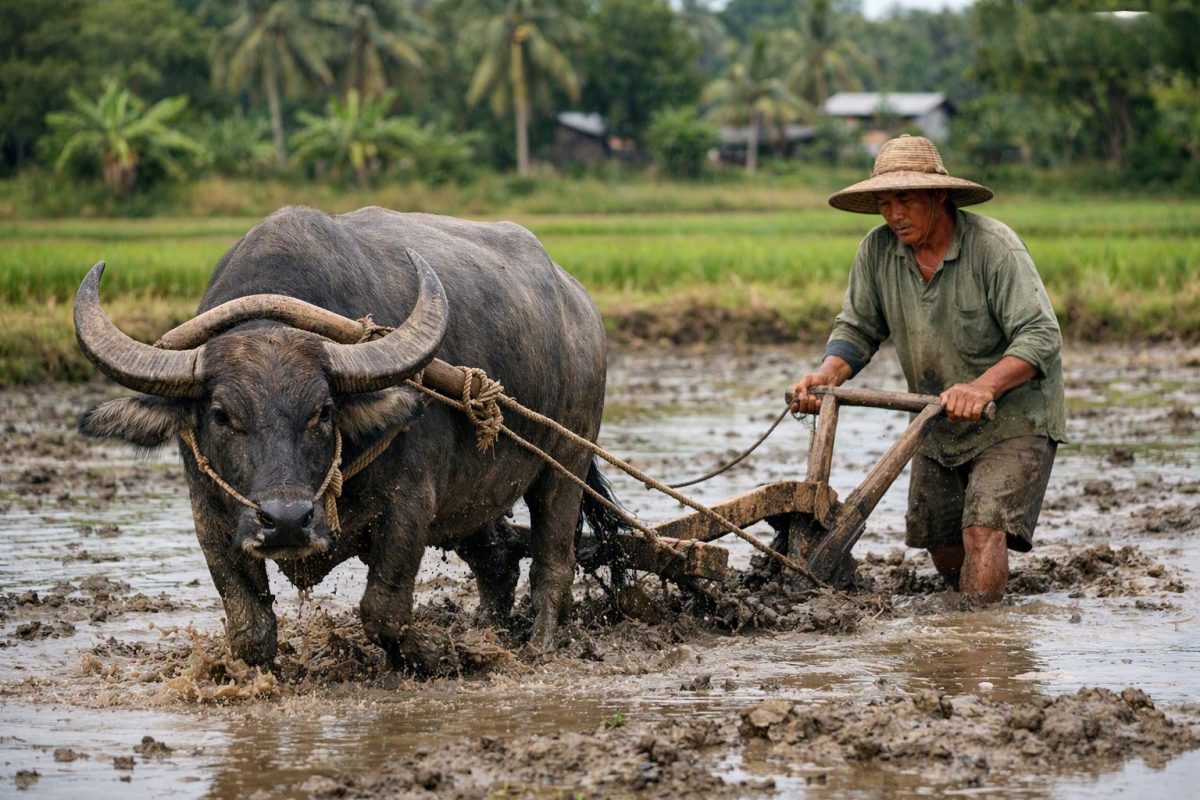
Carabao in the Philippines has long symbolized the country’s rich agricultural heritage and the resilience of Filipino farmers. For generations, the hardworking animal has helped cultivate rice fields, transport harvests, and support rural communities, making it one of the nation’s most recognizable icons of farming and perseverance.
If you ask a Filipino to describe what a farmer looks like, don’t be surprised if carabao is also being mentioned. The two, after all, are partners when it comes to farming. The carabao is the farmer’s beast of burden, pulling the plow and harrow and hauling farm produce when market time comes.
In Northern Samar, the traditional payatak farming technique remains the preferred method among local farmers. Initially, the soil in the rice paddies is softened using rainwater or redirected watersheds. Subsequently, farmers lead a team of carabaos to trample the planting area until it becomes sufficiently saturated to accommodate the rice seedlings.
While there is currently no legislation designating the carabao as a national symbol, it is widely regarded by many Filipinos as the country’s animal icon. In the late 1980s, a contemporary carabao puppet character, known as Kardong Kalabaw, gained popularity. This cherished figure has come to represent the industriousness and resilience of the Filipino people.
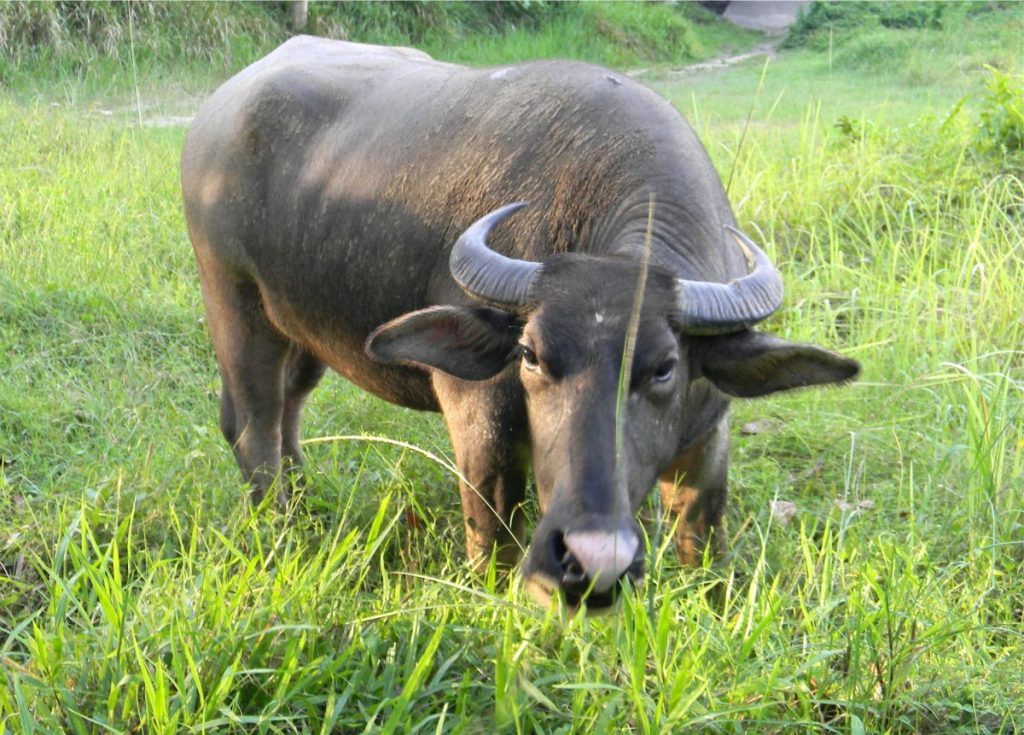
Additionally, a festival is celebrated in honor of this animal. During the Carabao Festival, the creatures are bathed and adorned with ribbons and flowers. Following the carabao races, the animals are paraded in front of the local church, where they are made to kneel for a blessing.
In the recent week-long celebration of Bansaulog Festival in Bansalan, Davao del Sur, one of the most anticipated events was Farmers Day, which highlighted the town’s flourishing agricultural sector. A vibrant parade featuring nine adorned carabaos, which traversed around the town’s busy streets.
But despite all these, carabao has been forced out from the farm by mechanized farming. The Philippine Statistics Authority reported the total carabao inventory was estimated at 2.74 million heads, as of September 30, 2023. This indicates a decline of 1.8 percent from the previous year’s same period count of 2.79 million heads.
“Unless we do something now, we might wake up one day to an agricultural country without a carabao to speak of,” a farming expert warned.
These are several kinds of large-hoofed mammals with an imposing pair of horns atop their heads. But the true buffalo has only three species, according to the International Fund for Animal Welfare (IFAW). These are the African buffalo, the water buffalo, and the anoa. Although they somewhat look like bison – American bison are commonly referred to as buffalo – they’re not the same animals.
If you want to differentiate buffalo from that of a bison, just find where they come from and their horns. Buffaloes can only be found in Africa and Asia and they have much larger horns than bison.
The country’s domesticated buffaloes (scientific name: Bubalus bubalis) have historically been categorized into two subspecies: swamp buffaloes and riverine buffaloes.
But a recent study done by researchers from University of the Philippines–Diliman College of Science’s Institute of Biology and Philippine Carabao Center presents evidence indicating that these two groups are not subspecies, but rather are fundamentally different from one another.
Swamp buffaloes (Bubalus bubalis carabanensis) serve a crucial role in agricultural practices by aiding farmers in land tilling, transporting equipment, and providing resources such as meat, milk, hide, and manure, which is utilized as organic fertilizer.
Riverine buffaloes (Bubalus bubalis bubalis), on the other hand, are predominantly utilized for milk production. In the Philippines, extensive crossbreeding and backcrossing of these two breeds aim to develop animals with enhanced capabilities for both milk and meat production, despite their inherent differences.
The researchers undertook a study to find out the taxonomic classification of swamp and riverine buffaloes. Their findings revealed that the DNA sequences of genes from both types of buffaloes are distinguishable, and they possess differing chromosome numbers. This evidence confirms that they represent two separate species rather than mere subspecies of the country’s native carabao.
The team asserts that the Philippine native carabao, presently designated as Bubalus bubalis carabanensis, ought to be reclassified as Bubalus kerabau.
“The reclassification of the Bubalus bubalis carabanensis to Bubalus kerabau supports earlier assumptions that riverine and swamp buffaloes are distinct,” said UP’s Dr. Ian Kendrich C. Fontanilla. “Confusions on the classifications of the two buffaloes have implications on the breeding program of these species.”
Although carabao is the beast of burden in the country, it didn’t receive any attention from the government in the past.
It wasn’t until the Philippine Carabao Center (PCC) in Nueva Ecija came into existence. It was created when then President Corazon C. Aquino signed Republic Act 7307 (authored by then senator Joseph Estrada) in 1992.
An attached agency of the Department of Agriculture, PCC is mandated to conserve, propagate and promote the carabao as a source of milk, meat, draft power, and hide to benefit the rural farmers.
The PCC started its operation in 1993 and now has 12 centers strategically situated in Luzon, Visayas, and Mindanao.
The PCC’s program has three components: genetic conservation and utilization, social and enterprise development, and research and development. “We genetically improve the productivity of our native animals,” said Dr. Libertado C. Cruz, former PCC executive director. “This is aimed at improving the breed of the native animals to produce crossbreeds that have better potential for milk production.”
Carabao’s milk is considered the “most complete food” because it contains protein, fat, lactose, vitamins and minerals, and water. Carabao’s milk is richer and creamier than cow’s or goat’s milk due to its high percentage of milk fat which is also a good source of energy. “The water buffalo milk is considered the finest among dairy animal milk,” said Dr. Cruz.
The milk production from native carabaos is relatively low, and milking activities are conducted only in specific communities, mainly for domestic consumption and for the creation of local carabao milk products.
According to the PCC, the rise in the population of crossbred carabaos – resulting from the interbreeding of dairy buffalo and native carabaos – has afforded farmers new opportunities to enhance milk output, as these crossbreds typically yield an average of 4.5 liters per day.
“It is clear that the quantity of milk obtained from the crossbred can meet household requirements and also provide extra volume for sale,” the PCC reported on its website. “In many communities in Regions II, III and IV, there are emerging buffalo-based dairy enterprises which are largely using crossbred carabaos. Many farmers in these areas have organized groups (cooperatives) that facilitate collecting and marketing of their milk.”
Carabao’s milk can be processed into chocolate-flavored milk, pastilles de leche (milk candy), kesong puti (white cheese), milk-o-jel, condensed milk, cheese spread, ice cream, mozzarella, or rennet (coagulated milk).
Aside from milk, carabao also offers big opportunities for the meat industry. In South American countries like Argentina, Brazil, Colombia and Venezuela, the demand for “carabeef” (carabao meat) is growing. This current demand for carabeef is due to recent studies which show that buffaloes are a better source of quality meat than cattle.
Based on data released by the United States Department of Agriculture, carabeef has 41% less cholesterol, 92% less fat and 56% fewer calories than beef. Recent studies regarding the chemical composition of carabeef show that fresh carabeef obtained higher crude protein than pork and beef.
“Ground carabeef has an exquisite flavor and texture,” said a fact sheet disseminated by the PCC. “Buffalo meat is tender. It has little or no marbling or outside fat, so only a small amount of juice is lost when it is cooked.”
Another good thing about carabeef: the meat is produced with fewer hormones or antibiotics. “Carabaos are not raised in mass and are not fed in feedlot such as that done in cattle. Carabaos are raised mainly out of nature’s fodder and grain,” the PCC explains.
Carabao is equally important for its hide. Filipinos consume a lot of chicharon made of carabao hide, kare-kare, which is partly skin of the animal, and a favorite pulutan, softened thin slices of hide spiced heavily with ginger, onion and red pepper.
Carabao manure is also of economic importance. It’s a good organic fertilizer, containing 18.5 % nitrogen, 43.7 % phosphoric acid, and 9.6 % potash. It’s also a good source of fuel either as dried dung, or in generating biogas or methane. When mixed with clay, the dung serves as building material or as plaster on the ground where palay is threshed.
The role of carabao as a source of draft power remains very important, particularly in the rain-fed or upland areas.
“However, with the advent of mechanization, there is a significant displacement of carabao by hand tractors, particularly in irrigated, rice-producing areas in the country, ranging from 16% in Leyte to 60% in Pangasinan,” the PCC reported.
In the upland regions, the utilization of carabao tends to rise alongside the expansion of farm size, with the exception of Luzon, where numerous larger farms prefer hand tractors for land preparation.
Beyond their draft power, carabaos can help generate income and create jobs, the PCC said, adding that most of the country’s carabaos are used mainly for draft purposes in sugarcane plantations and rice and corn farms, and for hauling.
“The milk, meat, hide and horn businesses from carabaos are still not yet fully developed,” said Dr. Cruz.
The Philippine carabao is just one of the many breeds of the water buffalo. Actually, there are two types of water buffaloes: the river and the swamp types. The river type is exemplified by the Indian and sub-continent breeds. It is considered under the dairy category because it possesses high genetic capacity for milk production.
In the Philippines, the carabao is put to continuous work from the age of four years up to 15 years or beyond. Some studies have shown that three females can perform the work of two male carabaos. As a draft animal, the carabao is most remarkable. It pulls plows, harrows, and carts with loads of several tons, forging through mud up to its belly.
Carabaos are here to stay. As the PCC fact sheet explains: “The carabao and Philippine agriculture will remain synonymous for many years to come. This is because a large portion of our agriculture continues to be unirrigated. Moreover, land ownership of one hectare and below has significantly increased. This could be due to decreasing land area against the increasing number of farming families in the rural areas.
“Unless the industrial sector absorbs this available labor, they will remain dependent on the produce of their decreasing size of land. Hence, the integration of crops and livestock is the best way to survive. Carabao is therefore indispensable in this scenario.”



 Facebook
 Twitter